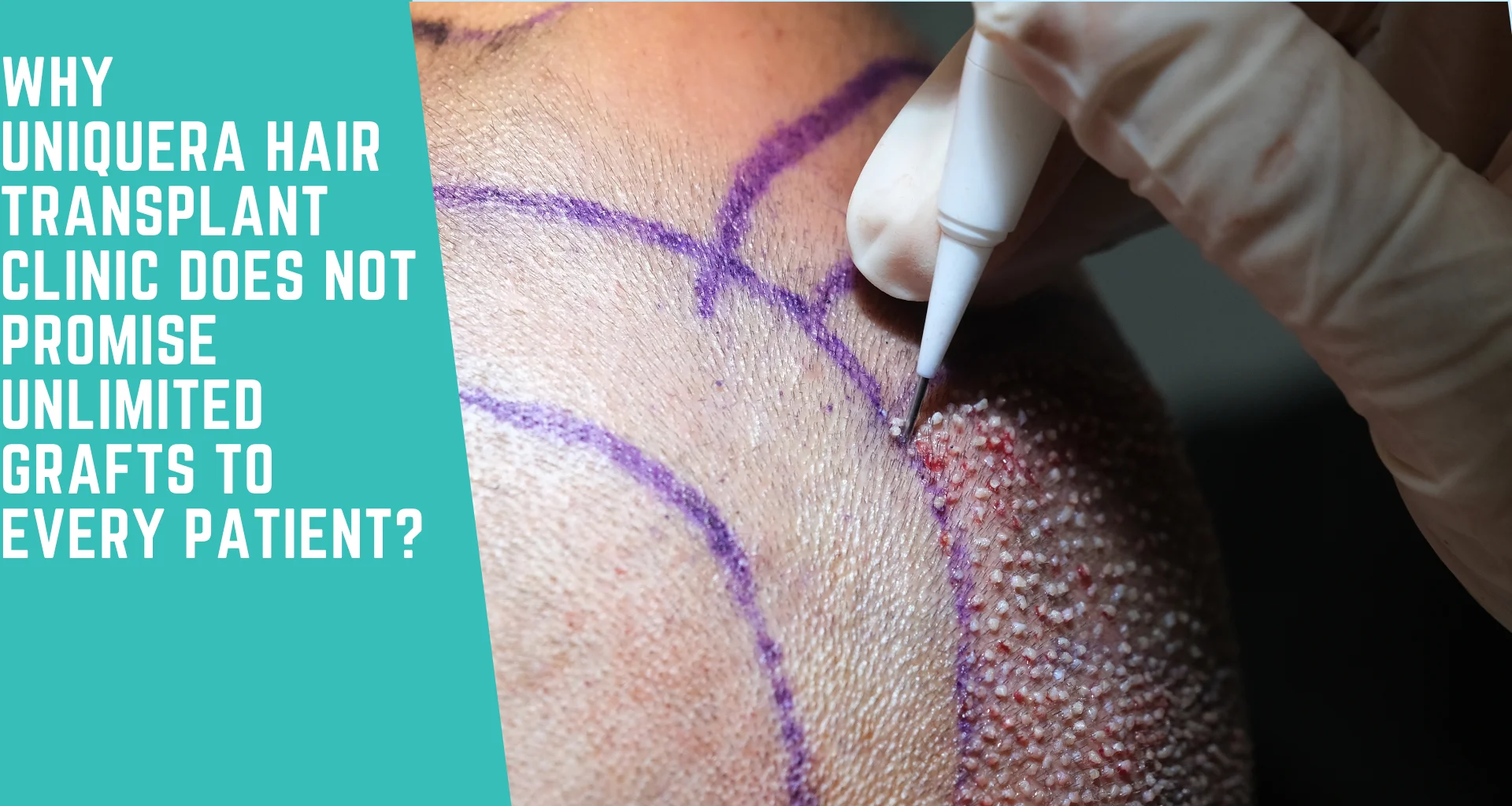

One clinic may advertise 4,000 grafts. Another may offer 5,000. Another may promise “unlimited grafts.”
Those numbers can make comparison seem simple: more grafts must mean more hair.
But there is no unlimited donor supply.
At UniquEra, the graft number depends on what the individual donor area can support, the areas being restored, existing hair, previous procedures and possible future hair loss. The aim is to recommend the number your treatment plan needs, not automatically the largest number that can be advertised.
Because every patient’s donor area has a different limit.
Follicles extracted from the donor area are permanently moved to the recipient area. The same donor supply may also be needed if another part of the scalp thins later.
| Question | UniquEra approach |
| Is there an unlimited donor supply? | No. |
| Is the highest possible graft number always used? | No. |
| Is the online graft estimate final? | No. |
| Can the graft number be reduced in Istanbul? | Yes. |
| Is future hair loss considered? | Yes. |
| Can donor hair be preserved for later treatment? | Yes, where the individual case allows. |
An unlimited graft hair transplant promise therefore does not reflect how donor capacity actually works.
The size of the bald area matters, but it does not determine the graft number on its own.
The treatment plan also considers:
Two patients with similar-looking baldness can therefore receive different graft recommendations.
For a deeper explanation, read How UniquEra Designs a Personalized Hair Transplant Plan.
Yes. If fewer grafts are more appropriate after physical assessment, the original estimate can be reduced.
The number discussed during an online consultation is based on photographs and the information available remotely.
After the patient arrives in Istanbul, the donor and recipient areas are examined physically before the final plan is confirmed.
If the original number is unnecessary or could compromise the donor area, the plan can change before surgery.
This is one reason a hair transplant graft estimate should not be treated as a guaranteed maximum.
Read What Happens During a Hair Transplant Consultation at UniquEra Clinic? for the full assessment sequence.
No. A technique does not create more donor hair.
DHI and Sapphire FUE affect how the treatment is performed. The graft requirement comes from the scalp and the treatment plan.
| Determines graft requirement | Does not determine it by itself |
| Treatment area. | DHI label. |
| Planned density. | Sapphire FUE label. |
| Existing hair. | Package name. |
| Donor capacity. | Advertised maximum graft number. |
| Future hair-loss planning. | Competitor graft offers. |
The technique follows the case. It should not be used to justify an arbitrary graft number.
Because donor hair may also be needed for future hair loss.
Someone restoring the frontal area today may later develop more thinning through the mid-scalp or crown.
Using donor follicles unnecessarily during the first procedure can reduce those future options.
Depending on the individual case, the plan may instead:
Patients comparing graft numbers should know what number is actually being quoted.
| Term | Meaning |
| Planned grafts | The number included in the treatment plan. |
| Extracted grafts | Follicular units removed from the donor area. |
| Implanted grafts | Grafts ultimately placed into the recipient area. |
A large advertised figure tells you little if the clinic cannot explain how the number for your scalp was calculated.
The more useful question is:
“Why do I need this number of grafts?”
not:
“What is the maximum number you can give me?”
The plan may be reduced, changed, postponed or rejected.
This can happen when:
A clinic agreeing to every requested graft number would not be performing a meaningful candidacy assessment.
For more on when UniquEra may advise against surgery, read Why We Sometimes Reject Hair Transplant Patients.
Before choosing a procedure, you should understand:
The highest graft offer is not automatically the strongest treatment plan.
Want to know how many grafts your own scalp actually needs? Book a UniquEra consultation for a case-specific assessment based on your hair loss, donor area and treatment goals rather than an unlimited-graft promise.
No. Every graft recommendation is limited by the patient’s donor capacity, hair characteristics, treatment requirements and future needs.
No. More grafts can be unnecessary and may reduce donor options for future treatment.
Yes. The initial estimate can be reduced if physical examination shows that fewer grafts are more appropriate.
Yes. Grafts can be allocated between the hairline, mid-scalp and crown according to the individual treatment plan.
Yes. Surgery can be postponed or declined when donor supply or stability does not support the requested treatment.