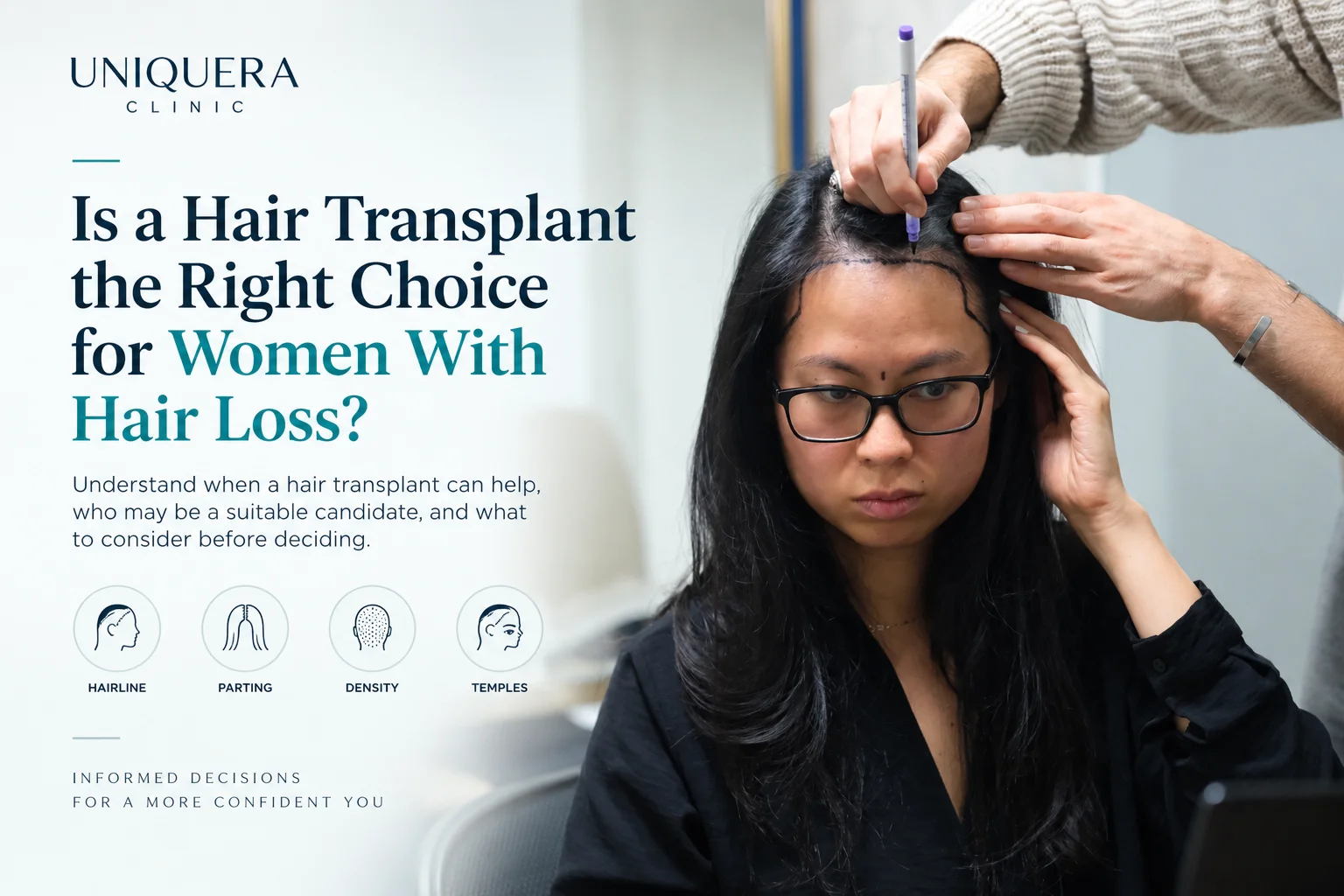

A hair transplant for women can be a good option when the cause of hair loss is understood, the donor area is strong, and the thinning pattern is suitable for surgery.
Female hair loss often behaves differently from male pattern baldness. Men may develop a clearly receding hairline or bald crown, while women are more likely to notice a widening part, reduced density across the top, thinning around the temples, or more generalised shedding.
A transplant moves existing hair from one area of the scalp to another. It can help rebuild a receding hairline or add density in selected areas, but it does not stop the reason your natural hair is thinning.
That is why the first question should not be “How many grafts do I need?” It should be “Is my type of hair loss suitable for a transplant?”
If you are unsure, send UniquEra Clinic clear photos of your hairline, parting, crown, sides, and donor area. We can first review whether your pattern looks suitable for transplantation, so you know whether it makes sense to keep exploring surgery before comparing graft packages or planning a trip to Istanbul. |
The biggest difference is often the pattern. Men commonly develop clearly defined areas of loss, such as temple recession, a receding frontal hairline, crown thinning, or more advanced baldness.
Women can lose hair very differently. You may notice:
● Your centre part becoming wider
● More scalp showing through the top
● Reduced density without a completely bald area
● Thinning around the temples
● A naturally high hairline
● Hairline recession
● Permanent loss from repeated tight hairstyles
● Localised hair loss after injury or scarring
Female hair loss can also have several causes, including genetics, hormonal changes, iron deficiency, thyroid conditions, medications, traction, and temporary shedding such as telogen effluvium. That is why medical evaluation matters before deciding that surgery is the answer.
There is no single female hair-loss pattern that automatically qualifies someone for surgery. The strongest candidates usually have several things in common.
A transplant requires healthy follicles from another part of your scalp, normally the back and sides. If this hair is dense and relatively stable, there may be enough donor supply to restore another area. If the donor area is also becoming progressively thinner, transplantation becomes much more difficult.
Transplantation is often easier to plan when there is a specific area that needs improvement. Examples include:
● Receding temples
● A high frontal hairline
● Localised frontal thinning
● Permanent traction alopecia
● Selected areas of stable patterned thinning
● Hair loss around a scar
These cases give the medical team a clearer recipient zone while preserving the surrounding native hair.
If your hair is currently shedding rapidly, moving grafts into the scalp does not solve the reason for that shedding. The cause needs to be investigated first. A transplant makes more sense when the pattern has been properly assessed and the team can reasonably plan around future hair loss.
A transplant redistributes your available donor hair. It cannot restore the density you had as a teenager if your donor supply cannot support it. The aim is usually to improve visible coverage, strengthen the hairline, reduce scalp visibility, or add density where it will make the greatest cosmetic difference.
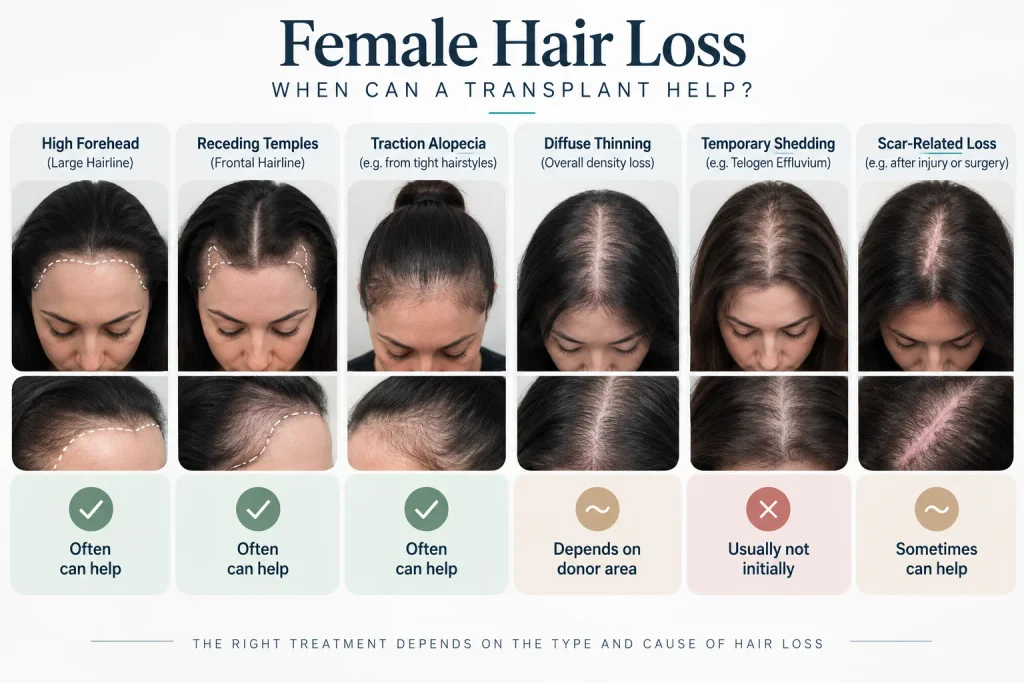
Different patterns require different decisions.
| Hair-loss pattern | Can a transplant help? | Main consideration |
| High or naturally large forehead | Often | Hairline design and donor supply |
| Receding temples or frontal hairline | Often | Natural female hairline shape |
| Stable traction alopecia | Often | Loss should be permanent rather than temporarily weakened |
| Localised scar-related loss | Sometimes | Cause and stability of the scar |
| Female pattern hair loss | Sometimes | Donor density and extent of diffuse thinning |
| Diffuse thinning | Depends heavily on donor area | Donor hair may also be affected |
| Temporary telogen effluvium | Usually not initially | Underlying trigger should be addressed first |
| Active inflammatory or scarring condition | Usually not while active | Medical treatment and diagnosis come first |
In practice, a decision for something like traction alopecia usually comes down to how long-standing and permanent the loss is, and whether the donor area can safely supply enough grafts.
Sometimes.
A hair transplant for thinning hair is very different from filling a completely bald area.
When native hair remains in the treatment zone, new grafts need to be positioned between existing follicles. The team also has to consider whether those existing hairs are likely to remain.
If surrounding native hair continues thinning after surgery, the transplanted grafts may remain while the original hair becomes progressively weaker. That can gradually change how the result looks.
This is why visible scalp alone does not tell us whether transplantation is the right answer. The donor area and expected future hair loss matter just as much.
Diffuse thinning does not automatically prevent surgery, but it requires much more careful donor assessment. The key distinction is where the thinning occurs.
If density has fallen mainly across the top while the back and sides remain dependable, selected patients may still be candidates for a diffuse thinning hair transplant.
If thinning also affects the donor region, the available follicles may not be stable enough to move.
This is one reason diffuse unpatterned alopecia, or DUPA, needs to be distinguished from patterns where the donor region remains usable.
Women with stable, localised loss and dependable donor density tend to be better candidates than women with widespread thinning across the whole scalp.
For more detail on this pattern, see UniquEra Clinic’s guide to diffuse thinning hair transplants, which explains how donor stability and the distribution of thinning affect candidacy.
This is one of the clearer applications of transplantation in women. Some women naturally have a high forehead. Others lose hair around the temples or frontal edge, changing the frame of the face.
A receding hairline transplant can move donor follicles into these areas to rebuild or lower the frontal border.
The main challenge is design. A female hairline should not simply copy a standard male transplant pattern. The curvature, temple transitions, direction of growth, density, and placement of single-hair follicular units all influence whether the result looks natural.
For someone researching hairline restoration Turkey options, it is worth looking closely at actual female hairline cases rather than judging a clinic only by its male before-and-after gallery.
A transplant can be one treatment for receding hairline problems when the loss is permanent and donor supply is suitable.
UniquEra Clinic also has separate guidance on receding hairline transplants, including how facial proportions, age, hair type, donor supply, and future loss influence hairline planning.
The donor area matters because a transplant does not create new follicles. It only moves them.
The success of hair implants for women therefore depends heavily on what is available at the back and sides of the scalp.
Imagine two women who both have visible thinning across the top. The first has strong, dense donor hair at the back. The second also has noticeable miniaturisation throughout the donor region. Their recipient areas might look similar in photographs, but their transplant options could be completely different.
A proper assessment should consider:
● Donor density
● Hair calibre
● Miniaturisation
● Size of the usable donor region
● Existing recipient-area density
● Pattern of future hair loss
● How much donor hair needs to remain after extraction
This is why large graft promises based on a few frontal photographs can be misleading. The number that matters is not the highest number a clinic says it can extract. It is the number your donor area can safely support.
If you already have a graft quote from another clinic, you can send UniquEra Clinic that estimate together with clear photos of your thinning area and the back and sides of your scalp. We can review whether the proposed graft number appears realistic for your donor supply before you commit to surgery or arrange travel to Istanbul. |
Not always. This is understandably one of the biggest concerns women have before considering surgery.
Depending on the technique, graft requirement, donor area, recipient zone, and existing hair length, it may be possible to shave only a concealed area of the donor region. The surrounding longer hair can sometimes cover this area during recovery. The recipient area may also be treated without fully shaving it in selected cases.
Partial-shave or unshaven approaches may therefore be possible for some women, particularly when limited frontal work or placement between existing hairs is required.
Whether this is practical should be decided after examining the actual case rather than promising a no-shave procedure in advance.
Neither method is automatically better simply because the patient is female. The technique should fit the case.
With FUE, individual follicular units are extracted from the donor region. With DHI, implantation is performed using a Choi implanter pen.
At UniquEra Clinic, DHI may be considered for precise hairline work and selected procedures where grafts need to be positioned between existing hairs. Sapphire FUE may be considered when larger areas need to be covered. Technique selection follows assessment of the hair-loss pattern, donor area, recipient area, and long-term goals.
For women, the more useful questions are:
● Can enough stable grafts be safely extracted?
● How will those grafts be distributed?
● Can existing hair be protected during placement?
● What density is realistically possible?
● How should the hairline or parting be designed?
● What happens if native hair continues thinning?
Technique comes after those questions.
Then a transplant may be unnecessary. Women can experience temporary or reversible shedding after:
● Pregnancy
● Major physical or emotional stress
● Illness
● Significant weight loss
● Iron deficiency
● Thyroid problems
● Medication changes
● Other hormonal changes
Telogen effluvium, for example, can improve once the trigger is addressed.
Transplanting into a temporarily thinned scalp before understanding the cause may expose the patient to surgery without addressing the real issue.
This is why a female hair loss clinic should first help determine what type of hair loss you have rather than automatically treating visible thinning as a surgical problem.
Sometimes, yes. It depends on the diagnosis.
For female pattern hair loss, a dermatologist may discuss treatments such as topical minoxidil or other prescription options depending on age, medical history, pregnancy plans, and the cause of hair loss. Medical treatments often require several months before their effect can be properly assessed.
Medical treatment and transplantation also solve different problems. Treatment may help preserve or support hair that still exists. A transplant redistributes follicles into an area where additional permanent coverage is needed.
Some patients may ultimately use both approaches under medical guidance.
A female transplant follows the same basic principle as any hair transplant, but planning changes according to the pattern of loss.
The first step is understanding why the hair is thinning and whether surgery is appropriate.
The back and sides are examined to determine the quantity and quality of available follicles.
The team decides which area should receive grafts and where additional density will create the strongest visual improvement.
For frontal cases, the hairline is planned around the woman’s facial proportions and natural growth pattern. For thinning areas, grafts need to integrate with the hair that remains.
Individual follicular units are removed from the planned donor area.
Grafts are positioned according to the required direction, angle, distribution, and density.
New growth takes time, and existing native hair also needs to be monitored.
At UniquEra Clinic, international patients can begin with an online consultation. After arriving in Istanbul, the donor area is physically assessed before the final graft count, technique, hairline, and treatment plan are confirmed. Procedures are overseen by senior Medical Directors with more than a decade of hands-on hair transplant experience.
It can, provided the case is suitable and the planning reflects female hair characteristics. Naturalness is affected by:
● Hairline shape
● Hair direction
● Graft angle
● Use of finer follicular units along the frontal edge
● Distribution of density
● Existing hair pattern
● Donor hair characteristics
The aim should not be to create the lowest or sharpest possible hairline. It should be to create one that fits the patient’s face and still looks believable if native hair changes over time.
Transplanted follicles are selected from areas expected to remain relatively resistant to pattern hair loss.
That does not mean all of your hair becomes permanent after surgery. Your native, non-transplanted hair can continue thinning. This is especially important for women with progressive patterned loss.
A long-term plan therefore needs to consider both transplanted grafts and the hair surrounding them.
There is no single female hair transplant cost that applies to every woman.
Pricing may depend on:
● Technique used
● Number and size of treatment areas
● Amount of surgical work required
● Whether treatment takes one or more days
● Clinic and medical team
● Accommodation or travel package
● Aftercare included
At UniquEra Clinic, female transplant pricing is based on the treatment method and overall plan rather than simply charging a flat amount per graft.
That matters because two women needing similar graft numbers may still require very different procedures. Someone receiving frontal hairline restoration is not necessarily undergoing the same treatment as someone receiving grafts throughout a wider thinning area.
Price should therefore come after candidacy and treatment planning.
Istanbul has a large hair-restoration sector and clinics experienced in treating international patients, which is why many women compare Turkey when considering surgery.
Someone searching female hair restoration Turkey may be comparing specialist experience, patient cases, travel arrangements, and cost.
A search for female hair transplant Turkey may bring up a very wide range of clinics and packages.
People searching women hair transplant Turkey may see very different treatment promises and graft numbers depending on the clinic.
The same applies to hair transplant in Turkey for women as a broader search, results vary widely, and the range itself says nothing about which clinic is right for your case.
Those searches are useful for comparing options, but location should not decide candidacy. A lower price does not make an unsuitable patient suitable.
The first question should still be: will moving donor hair actually improve my type of hair loss? Once that has been answered, you can compare technique, team experience, female cases, communication, aftercare, travel arrangements, and price.
If you are comparing a women hair loss clinic, ask questions that show how the clinic actually makes treatment decisions.
The same applies if you are comparing a hair transplant clinic in Istanbul more generally.
Ask:
A clinic should be able to explain why transplantation makes sense for you. It should also be prepared to tell you when it does not.
A hair transplant can be a very good option for selected women, but suitability depends much more on the type of hair loss and donor area than on gender alone.
| You may be a stronger candidate if you have | A transplant may need to wait, or may not be appropriate, if you have |
| Stable donor hair | Rapid active shedding |
| Permanent rather than temporary loss | A reversible medical cause |
| A clearly identifiable area needing restoration | Temporary postpartum hair loss |
| A high or receding hairline | An untreated scalp condition |
| Stable traction alopecia | Widespread thinning involving the donor area |
| Selected patterned thinning | Insufficient donor density |
| Realistic expectations about density and coverage | Unclear or unstable hair-loss progression |
The question is therefore not simply, “Can women have hair transplants?” They can.
The better question is: “Will transplantation solve my particular type of hair loss?”
If you are ready to find out what surgery could realistically change in your case, send UniquEra Clinic clear photographs of your hairline, parting, top, crown, sides, and donor area. We can review your current pattern, explain what may or may not be possible, and help you decide whether an in-person assessment in Istanbul should be your next step. Book your consultation with UniquEra Clinic today. |
The procedure is performed under local anaesthesia, so pain during the transplant itself is limited. Some tenderness or tightness in the first few days afterward is normal and manageable with standard aftercare.
The main downsides are a slow growth timeline and temporary shedding during recovery. Less common risks include infection, uneven growth, or continued thinning of the native hair around the graft.
There’s no fixed best age. What matters more is whether your hair loss has stabilised and your donor area is healthy enough to support a transplant.
Most sessions run between four and eight hours, depending on the number of grafts and technique used. Larger cases may need a second day.
FUE removes follicles individually, so it leaves no linear scar. Tiny extraction marks can remain but are usually hidden once the surrounding hair grows back.
Postpartum shedding is usually temporary, so a transplant shouldn’t be planned while hair is still actively shedding. It’s better to wait until the pattern has stabilised and any hormonal factors have been checked.
Options include medical treatment, PRP, scalp micropigmentation, or styling and coverage products, depending on the cause. Which one fits should follow a proper diagnosis, not just how the thinning looks.
Transplanted hair from a stable donor area is intended to keep growing long-term. Native hair that wasn’t transplanted can still thin over the years, which is why donor preservation matters early on.