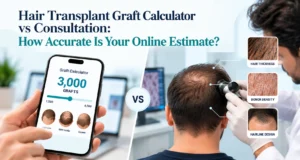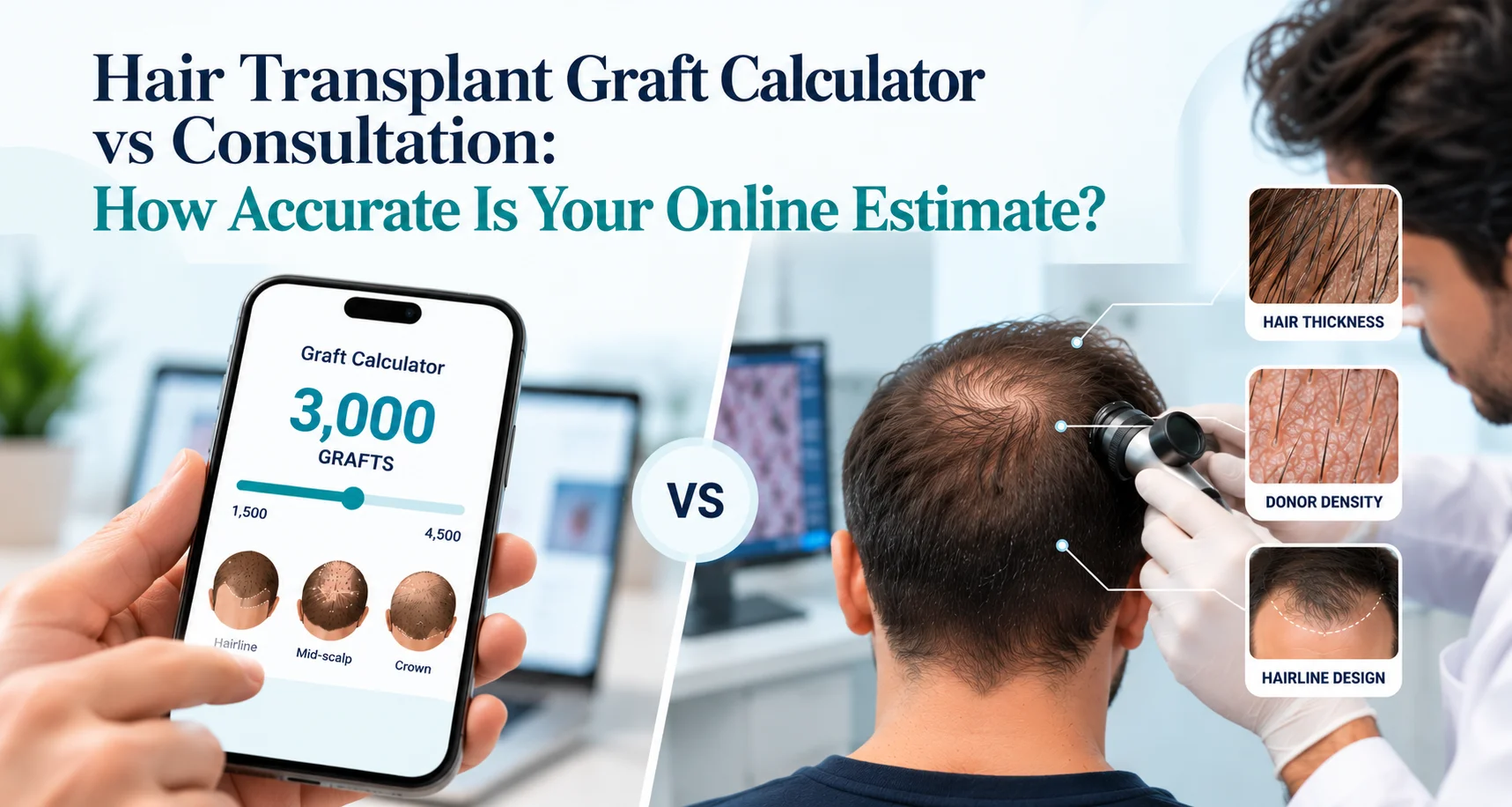

Hair transplant graft calculator results are a rough estimate, not a final graft count. A calculator can estimate how much hair you may need, but it can’t confirm how many grafts your scalp can safely provide.
You might get 2,200 grafts from one calculator and 3,000 from another. Then a clinic reviews your photos and suggests a different number.
So which one is right? It depends on your hair loss, donor area, hair thickness and goals.
There are three ways to estimate grafts:
1. An online calculator gives a general estimate based on your answers.
2. A photo or video consultation reviews your hair loss and gives a preliminary range.
3. An in-person consultation examines your scalp and confirms the plan.
Each step adds information the one before it couldn’t check.
Already have a graft estimate?
Send it to us on WhatsApp with clear photos of your hairline, top, crown and the back of your head. We’ll review your case and explain what the number means for you before you travel to Istanbul.
Send your photos on WhatsApp →
A calculator can give a reasonable starting range, but it can’t give an exact number.
It works best for simple cases, like early hairline recession. Estimates become less certain when hair loss is widespread or the donor area is weak.
| Hair loss pattern | What to expect |
| Early hairline recession | Estimate may be fairly close |
| Front and mid-scalp thinning | Count may vary with the planned density |
| Crown and extensive hair loss | Donor capacity matters more |
| Diffuse thinning or a previous transplant | Estimate may differ a lot |
These are general examples, not measured accuracy rates.
No. No study has proven a figure for graft calculator accuracy.
Some websites say calculators are 40 to 60% accurate and in-person consultations are 90 to 95% accurate. Others suggest allowing a 20 to 30% difference.
These figures aren’t proven medical accuracy rates. A calculator may be close for one patient and far off for another. It depends on what the calculator can’t assess.
Most calculators estimate the thinning area you want to cover. They don’t measure your available donor hair.
They usually ask for:
• your age.
• your stage on the Norwood scale.
• the areas affected by hair loss.
• sometimes photos or a preferred technique.
The calculator uses these answers to suggest a graft range. But two patients with the same Norwood stage may need different counts. One may have thick, dense hair. The other may have fine hair and a smaller donor area.
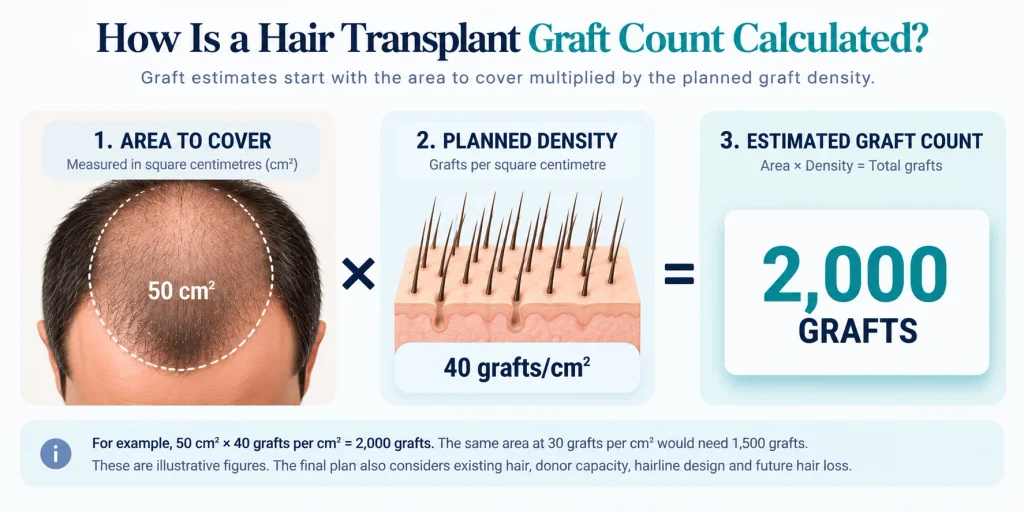
Graft estimates start with the area to cover multiplied by the planned density.
For example, 50 cm² × 40 grafts per cm² = 2,000 grafts. The same area at 30 grafts per cm² needs 1,500. These are illustrative figures.
The final plan also considers existing hair, donor capacity, hairline design and future hair loss. Learn more in our guide on how clinics calculate hair transplant grafts.
No. One graft can contain one to four hairs.
A graft is a natural group of hair follicles. Many grafts hold around two hairs, though this varies. So 2,000 grafts might contain roughly 4,000 hairs. Always check whether an estimate counts grafts or hairs.
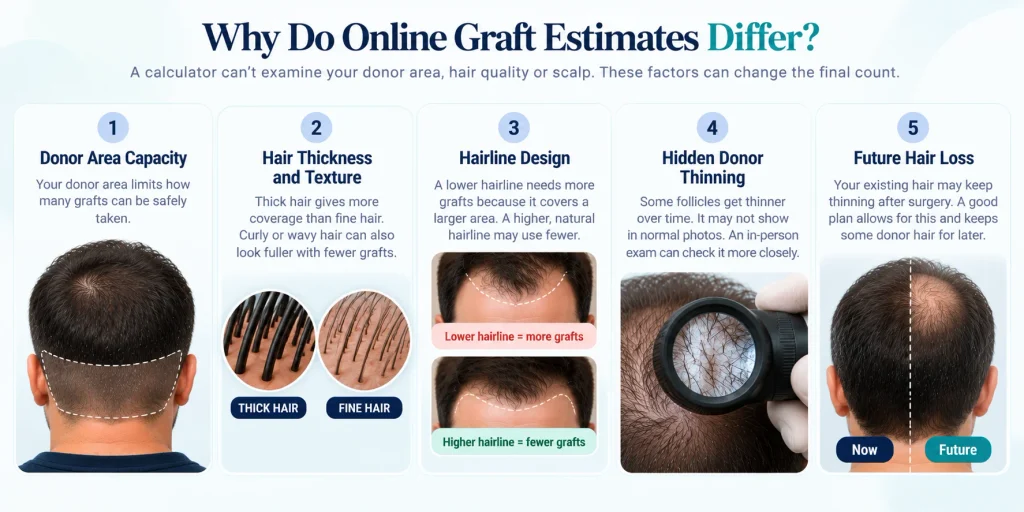
Because a calculator can’t examine your donor area, hair quality or scalp. These factors can change the final count.
Your donor area limits how many grafts can safely be taken. A calculator might suggest 3,500 grafts, but your donor area may only support 2,500. Then the plan has to change.
Thick hair gives more coverage than fine hair. Curly or wavy hair can also look fuller with fewer grafts. Calculators rarely consider this.
A lower hairline needs more grafts because it covers a larger area. A slightly higher, natural hairline may use fewer. This matters most for a receding hairline transplant.
Some follicles get thinner over time. This is called miniaturization. It may not show in normal photos. An in-person exam can check it more closely, sometimes with magnification.
Your existing hair may keep thinning after surgery. A good plan allows for this and keeps some donor hair for later.
The difference is simple: a calculator estimates what you want to cover. A consultation checks what your donor area can support.
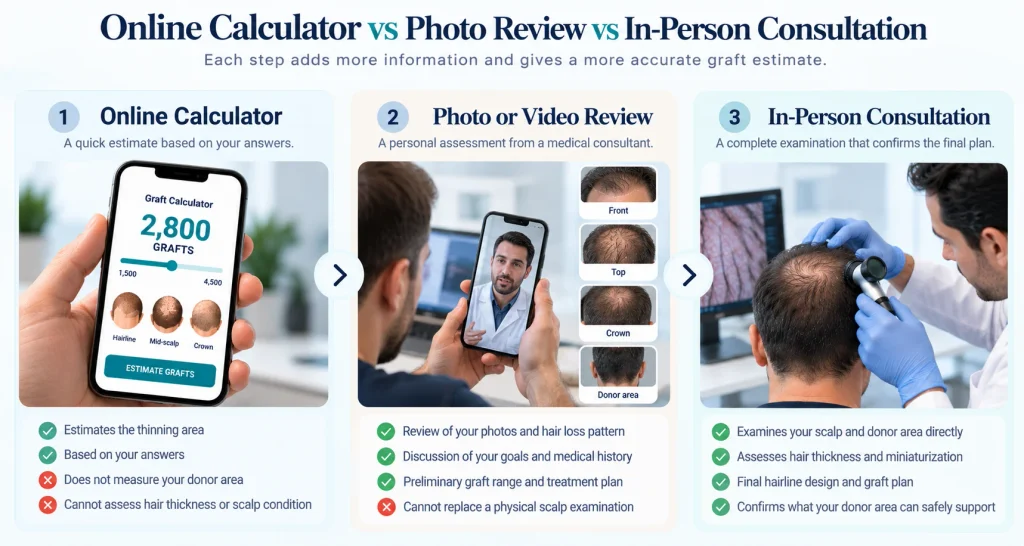
A calculator gives a general number. A personal photo review gives a preliminary plan. An in-person exam confirms the final plan.
| What is checked | Online calculator | Photo or video review | In-person consultation |
| Hair loss pattern | General estimate | Reviewed visually | Examined directly |
| Donor area | Assumed | Visual check | Assessed directly |
| Hair thickness | Not measured | Rough impression | Examined |
| Miniaturization | Not assessed | Sometimes suspected | Checked more closely |
| Hairline design | Generic | Discussed | Drawn and agreed |
| Graft count | Rough estimate | Preliminary range | Confirmed plan |
A personal photo consultation is much more useful than an automated calculator. A medical consultant reviews your hair loss, asks about your history and discusses your goals. This helps you understand your options before traveling. But photos can’t replace a physical scalp exam.
Got different graft estimates from different clinics?
Speak with our team. We’ll help you understand what each estimate covers and what needs to be confirmed before surgery.
Because they may be planning different coverage or density.
One clinic may recommend 2,500 grafts for the front of your scalp. Another may suggest 3,500 because its plan includes the crown. Both numbers can make sense for what they cover.
If you’re looking for the best clinic for hair transplant in Turkey, ask each one:
1. Which areas will get the grafts?
2. What density is planned?
3. Has my donor area been assessed?
4. How much donor hair will be left?
5. Can the number change after the exam?
The highest graft count isn’t always the best choice. Many people search for an expert hair transplant Turkey clinic. A real expert explains why you need a number, rather than simply offering more grafts.
UniquEra Clinic starts with a personal online consultation and confirms the final graft plan after examining your scalp in Istanbul.
You share photos and speak with our medical consultant. We review your hair loss, medical history and goals. This shows whether a transplant looks suitable and gives you an initial estimate.
You receive a written PDF report with a diagnosis and a proposed treatment plan.
If you decide to go ahead, you choose your dates and pay a deposit. After you arrive, we run the required checks, including blood tests.
The medical team examines your scalp and donor area. Your hairline is drawn, the treatment areas are reviewed, and the final graft plan is agreed with you before the procedure.
Every case is supervised by Medical Directors with over a decade of hands-on hair transplant experience. They check the plan against your donor supply.
The online assessment helps you plan your treatment and travel. The in-person exam confirms the final medical details.
Because an in-person exam can show details that weren’t clear in your photos.
For example, your online consultation might suggest around 3,200 grafts. After examining your donor area, the medical team may recommend 2,700 instead, because some donor follicles are thinner or weaker than expected.
A different final number doesn’t necessarily mean the first assessment was wrong. It means the medical team now has more information.
The number could also go up if your donor area is stronger than expected and the treatment area can safely be widened.
At UniquEra, the final treatment areas and graft plan are discussed and agreed with you before the procedure. Any change is explained clearly, including what it means for your expected coverage.
Your donor area has a limited supply of follicles. Once a graft is removed, it doesn’t grow back in that spot.
That’s why taking the maximum number of grafts isn’t always a good idea. Removing too many can leave the donor area visibly thin. It can also limit your options if you need another procedure later.
Second procedures aren’t rare. In the ISHRS 2025 Practice Census (2024 data), patients needed 1.5 procedures on average to reach the result they wanted. Read more about how UniquEra protects donor hair for future hair loss.
No. Neither technique increases the number of grafts in your donor area.
A manual FUE hair transplant extracts follicles with a hand-operated punch.
A DHI hair transplant places grafts with an implanter pen.
These techniques change how grafts are removed or placed, not how much donor hair you have. At UniquEra, the medical team recommends a technique based on your hair loss, donor condition and goals.
Use it as a starting point for a hair transplant consultation, not as a fixed surgical target.
Save your estimate and the answers you entered. When you speak with a clinic, ask whether the proposed count covers your hairline, mid-scalp, crown or all three.
If you’re comparing clinics, compare the treatment plans before the prices. A lower hair transplant Turkey price may look attractive, but price alone doesn’t tell you if the graft count suits you.
Send clear photos of your hairline, top, crown, sides and donor area.
For a useful remote review, include:
1. Front, with your hair pushed back to show the hairline.
2. Top, taken from directly above.
3. Crown, taken from above and slightly behind.
4. Both sides.
5. Back, with a clear view of the donor area.
Take photos in even daylight. Keep your hair clean and dry, with no styling products, fibers or filters. Also share your age, hair loss history, medications and any past transplants.
Better photos help us give a more informed estimate. They still can’t replace an in-person exam.
When your hair loss is unusual, changing fast or affecting the donor area.
A medical assessment is especially important if you have:
• diffuse thinning across the scalp.
• sudden or patchy hair loss.
• thinning at the back or sides.
• scalp pain, redness or scaling.
• a previous hair transplant.
• very different graft estimates from clinics.
Some types of hair loss need medical treatment rather than surgery. A doctor or dermatologist should check unexplained hair loss before a transplant is planned.
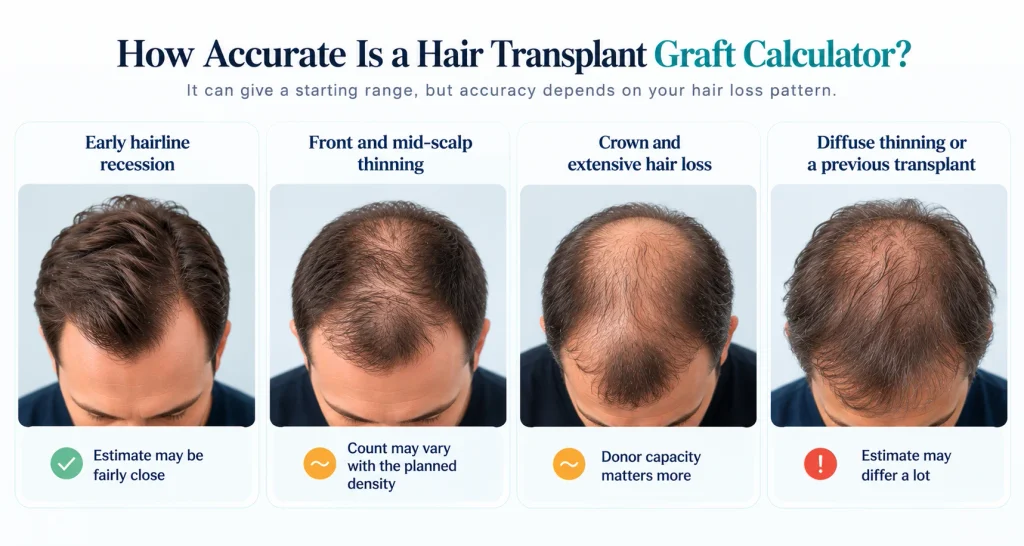
No. An online graft estimate is a useful first step, but the final plan needs a proper medical assessment.
A calculator gives you a general number. A personal online consultation helps you understand your options before traveling. An in-person exam confirms what your donor area can safely provide.
At UniquEra Clinic, the goal is a graft count that suits your hair loss, protects your donor area and allows for future changes.
Ready to find out what may suit your hair loss?
We’ll review your case, explain your options and help you plan the next step. Book your consultation with UniquEra Clinic today.
It gives a rough estimate. It may be close for simple hair loss but can differ a lot when donor density, hair thickness or past surgery affects the plan.
Yes. It may change after the medical team examines your scalp and draws your hairline, and any change should be explained and agreed with you first.
Usually, yes. A medical consultant reviews your photos, history and goals, but the estimate still needs to be confirmed in person.
They may be planning different areas, densities or hairline positions. Ask each clinic where the grafts will go.
No. The count has to suit your treatment area and your available donor hair.
No. Suitability depends on the cause of your hair loss, your donor area and your medical history, which need a medical assessment.
Yes. UniquEra offers online consultations and photo reviews before travel. You pay a deposit when you book, and the final plan is confirmed in person.
Yes. Your donor area, hairline and treatment zones are reviewed in person, and the final plan is agreed before the procedure.
Sources
International Society of Hair Restoration Surgery. 2025 Practice Census Results (2024 data).