
Hair transplant cost is one of the most confusing numbers in medicine. One clinic quotes $2,000. Another quotes $18,000. Same head.
Nobody explains the gap. So patients assume the expensive clinic is overcharging, or the cheap one is cutting corners. Sometimes true. Often not — we break this down fully in are expensive clinics worth the hair transplant cost.
The real answer sits in four things:
• Who does the work?
• How grafts are counted?
• Which technique is used?
• What the quote includes?
This guide breaks down each one, plus the hidden costs most patients only discover after paying.
Comparing five clinics and getting five different prices?
That usually means each clinic is quoting a different plan, not the same procedure. Before the price matters, you need to know how many grafts your donor area can safely support and which technique fits your case.
Book your free assessment with UniquEra and get your real treatment plan before comparing prices.
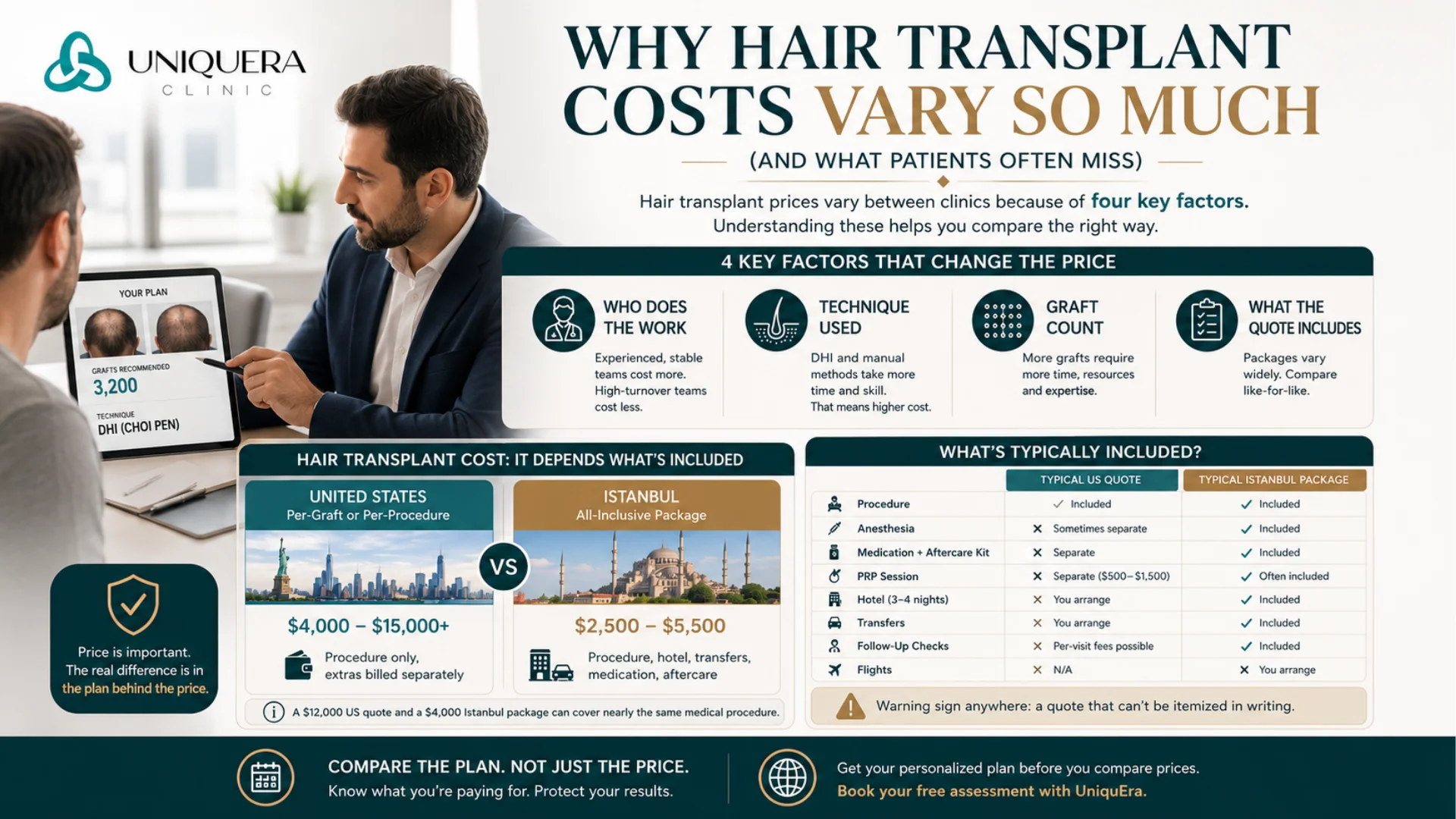
A hair transplant costs $4,000 to $15,000 in the US, while all-inclusive Istanbul packages run $2,500 to $5,500. Both numbers are honest. They describe different billing systems.
| Billing model | Typical range | What’s inside |
| US per-graft or per-procedure | $4,000–$15,000+ | Procedure only, extras billed separately. |
| Istanbul all-inclusive package | $2,500–$5,500 | Procedure, hotel, transfers, medication, aftercare |
So when someone asks how much does a hair transplant cost, the honest answer is: it depends what the number includes. A $12,000 US quote and a $4,000 Istanbul package can cover nearly the same medical procedure.
Hair transplant costs vary because clinics differ in four things: who performs the procedure, the technique used, graft count, and location. Each one moves the price.
The team is the biggest hidden variable in hair transplant pricing.
• Some clinics: a stable, experienced medical team handles every case
• Others: the famous name on the website never touches your scalp, and rotating technicians do the work
Experienced teams cost more to keep. High-turnover staff costs less, so the clinic charges less.
Ask any clinic: who exactly will extract and implant my grafts, and how long have they worked together? A vague answer explains a low price.
Technique changes labor time, and labor time changes price.
| Technique | How it works | Price impact |
| FUE | Motorized punch extraction | Baseline |
| Sapphire FUE | Sapphire blade opens channels, cleaner healing | Slightly higher |
| DHI | Choi pen implants directly, high precision | Higher |
| Manual FUE | Doctor extracts every graft by hand | Highest |
A fue hair transplant turkey package may look similar across clinics, but the real difference is who performs the extraction, how grafts are handled, and whether the donor area is protected.
Manual FUE shows the labor math clearly. Extracting just 1,000 grafts by hand takes over four hours of nonstop work. A manual hair transplant turkey option exists at select clinics, but only for small, high-precision cases. No honest clinic offers it as the default. The economics don’t allow it.
Graft count drives a large share of the final price. It’s also where patients get misled most.
| Grafts | Approximate coverage |
| 2,000 | ~30% of a bald area |
| 3,500 | ~50% |
| 5,000 | Rare, needs an unusually rich donor area |
A clinic promising 5,000+ grafts to everyone is quoting a sales number, not a medical one. Your donor area is finite. It has to last your whole life.
Location changes a clinic’s cost of doing business, not the medicine. Rent in Manhattan is not rent in Istanbul. Wages, insurance, and currency all differ.
This is the part of the turkey hair transplant cost story that US marketing skips. Lower prices in Istanbul mostly reflect lower operating costs and higher case volume. More on that below.
Per-graft pricing means you pay a fixed rate for every graft, usually $4 to $10 in the US. It sounds transparent. It carries a built-in conflict of interest.
The more grafts a clinic quotes, the more it earns. And nobody independently counts the grafts placed in your scalp. A clinic can quote 4,000, place 3,200, and you’d never know.
This is why three clinics give three different graft counts for the same head.
One question fixes it: is my graft count set by my donor capacity and coverage needs, or by the invoice?
A complete quote lists everything you’ll pay, start to finish. Most don’t. Compare line by line:
| Cost item | Typical US quote | Typical hair transplant turkey package |
| Procedure | Included | Included |
| Anesthesia | Sometimes separate | Included |
| Medication | Separate | Included |
| PRP session | Separate ($500–$1,500) | Often included |
| Hotel (3–4 nights) | You arrange | Included |
| Transfers | You arrange | Included |
| Follow-up checks | Per-visit fees possible | Included |
| Flights | N/A | You arrange |
Neither model is wrong. Comparing a bare procedure fee against an all-in package is wrong.
Warning sign in any country: a quote that can’t be itemized in writing.
Not all quotes include the same treatment.
A lower number can miss aftercare, PRP, medication, follow-up, or even the right level of medical planning.
Book your free assessment with UniquEra and compare the full treatment cost before you commit.
The turkey hair transplant cost is lower because operating costs are lower and case volume is higher, not because the medicine is worse.
Three reasons:
• Facilities and staffing cost less in Istanbul than in New York or London.
• Specialized teams perform procedures daily, not weekly. A team doing sapphire fue hair transplant turkey procedures every day builds more hands-on experience per year than a general practice doing a few cases a month.
• The same volume logic applies to dhi hair transplant turkey work, where Choi pen precision improves with repetition.
A sapphire fue hair transplant turkey procedure can offer strong value when the clinic has enough experience to use the technique correctly for larger coverage cases.
A DHIi hair transplant turkey plan usually costs more than basic FUE because placement is slower and needs more precision around existing hair.
Does Istanbul have bad clinics? Yes. Every country does. The variable that predicts your result is the clinic, not the flag on the building. Picking the right hair transplant clinic in Istanbul takes the same due diligence you’d apply at home.
The safest choice is not the cheapest clinic, but the one that explains your donor limits, technique choice, and long-term plan before giving a final price. For a full checklist, see how to compare hair transplant clinics in Turkey — what actually matters.
Patients most often miss three costs: the consultation quality, aftercare expenses, and repair costs if the first procedure goes wrong.
The hair transplant consultation cost is usually free at reputable clinics, while some US practices charge $100 to $300. Free isn’t the issue. Content is.
A real consultation includes:
• Donor density examination.
• Hair loss pattern mapping and future projection.
• A written diagnosis and treatment plan.
• The option of “not yet” if your hair loss hasn’t stabilized.
If the free consultation is a five-minute price pitch with a salesperson, it’s the most expensive thing in the funnel.
Aftercare adds $500 to $2,000 in itemized systems. Medication, specialized shampoo, PRP sessions, and follow-up visits each carry fees.
Package models fold most of this in. Confirm the follow-up schedule in writing. Structured check-ins at 1, 3, 6, and 12 months are the standard worth insisting on.
Fixing a botched hair transplant costs $8,000 to $25,000, more than the original procedure. Corrective work is harder than doing it right the first time.
• Wrong angles and unnatural hairlines take more skill to fix than to avoid.
• An overharvested donor area cannot be restored. Those grafts are gone.
• Repair specialists work with whatever donor hair the first clinic left behind.
This is the math behind cheap quotes. Saving $3,000 on the procedure and spending $15,000 on a botched hair transplant repair is a bad trade.
Ten years after a well-planned hair transplant, the transplanted hair is still growing. Those follicles come from zones resistant to hair loss.
The catch: your non-transplanted hair keeps thinning. A result planned only for today can look odd at 45, an island of transplanted hair sitting in front of ongoing recession.
Good planning:
• Accounts for future hair loss.
• Keeps graft use conservative.
• Leaves donor reserve for later.
Price is what you pay on surgery day. Cost is everything that follows the decision.
At UniquEra Clinic, pricing follows assessment, never the reverse. Every patient receives a written PDF diagnosis and treatment plan before any payment.
What that means in practice:
• Graft counts set by what your donor area can safely support, not by a sales target.
• Medical Directors with over a decade of hands-on hair transplant experience, supervising each case personally.
• A core team that has worked together for years.
• One itemized package: procedure, hotel, transfers, medication, aftercare kit, and follow-up at 1, 3, 6, and 12 months.
And if the honest answer for your case is “not yet,” we tell you that too.
Compare costs, not prices. A quote is thirty seconds of information. The result is on your head for decades.
You can now read the price gap: labor model, technique, graft count, geography, and what’s inside the quote. The patients who regret their choice rarely regret the price. They regret the plan behind it.
Don’t compare the price of a hair transplant. Compare the lifetime cost of living with the result.
The cheapest option is the one you only pay for once.
A proper plan protects your donor area, avoids unnecessary repair work, and gives you a result built to last. Find out what your case really needs before choosing a clinic.
Book your consultation with UniquEra today.
Around $12,000 to $24,000 at US per-graft rates of $4 to $10. The same session in Istanbul usually costs $3,000 to $5,500 as a package.
Yes, it’s a large session for significant hair loss. It provides roughly 40 to 50% coverage of a bald area.
Lower operating costs and higher procedure volume. Rent, wages, and currency reduce prices without reducing standards at reputable clinics.
No. Price reflects cost structure and location as much as quality. Team experience and planning predict results better than the invoice.
The procedure, hotel, transfers, medication, aftercare kit, and follow-up checks in one price. Flights are typically the only major extra.
At reputable clinics, yes. It should produce a written diagnosis and graft plan, not just a price pitch.
Most reputable clinics charge $2,500 to $5,500 all-inclusive. Final pricing depends on graft count and technique after assessment.
The real cost includes the procedure, possible repair surgery, lost donor grafts, travel, aftercare, and time spent correcting poor results.
Prices vary because of team experience, graft count, technique, clinic location, and what is included in the quote.
Sometimes, if enough donor hair remains. Severe overharvesting or donor damage can only be partially improved.