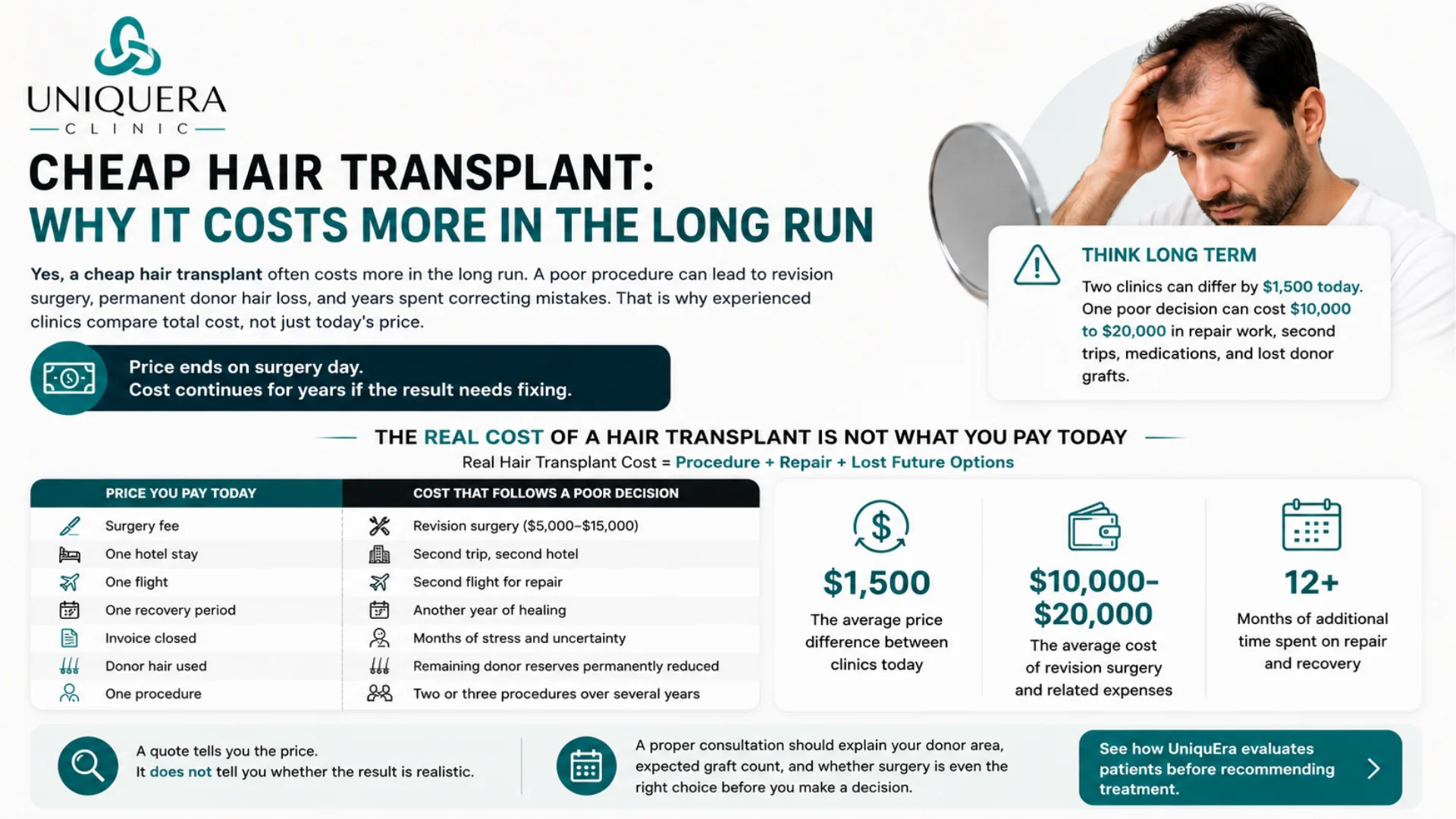

Yes, a cheap hair transplant often costs more in the long run. A poor procedure can lead to revision surgery, permanent donor hair loss, and years spent correcting mistakes. That is why experienced clinics compare total cost, not just today’s price.
Most people comparing clinics look at one number: the price on the invoice. That is the wrong number to compare. Good hair transplant pricing reflects the experience of the medical team, graft handling standards, and long-term patient outcomes rather than simply the lowest advertised fee.
Patients who choose the cheapest option often pay for the procedure twice. Once at the low-cost clinic. Once to fix what went wrong. Add revision surgery, lost donor hair, and the time spent waiting before repair is even possible, and the affordable option becomes the most expensive decision they made.
| Still comparing clinics?A quote tells you the price. It does not tell you whether the result is realistic. A proper consultation should explain your donor area, expected graft count, and whether surgery is even the right choice before you make a decision. See how UniquEra evaluates patients before recommending treatment. |
Here is a framework that experienced clinics use but rarely explain plainly.
Real Hair Transplant Cost = Procedure + Repair + Lost Future Options
Most patients only budget for the procedure. The other two costs only appear if the first procedure goes wrong. And when they do, they are usually larger than the original quote.
| Price you pay today | Cost that follows a poor decision |
| Surgery fee | Revision surgery ($5,000-$15,000) |
| One hotel stay | Second trip, second hotel |
| One flight | Second flight for repair |
| One recovery period | Another year of healing |
| Invoice closed | Months of stress and uncertainty |
| Donor hair used | Remaining donor reserves permanently reduced |
| One procedure | Two or three procedures over several years |
Two clinics can differ by $1,500 today. One poor decision can cost $10,000 to $20,000 in repair work, second trips, medications, and lost donor grafts.
These two terms are often used interchangeably. They describe completely different things.
| Cheap hair restoration | Affordable hair restoration |
| Lower clinical standards to hit a price point | Lower operating costs in a high-volume, experienced clinic. |
| Corners cut on assessment, handling, and follow-up | Same medical standards as premium markets. |
| Higher risk of poor graft survival and donor damage | Better long-term outcomes at a competitive price. |
| Low price that often grows into a much higher total cost | Better value because you rarely need a second procedure. |
Istanbul’s best clinics offer affordable hair restoration. The lowest-priced packages in the market offer cheap hair restoration. The result, and the long-term cost, are completely different.
Graft survival rate is the percentage of transplanted follicles that actually take root and grow. It is the most important metric in any hair transplant, and it almost never appears in a price quote.
Quality clinics with careful handling achieve graft survival above 95%. Volume-focused, budget clinics often drop to 60-70%. Here is what that difference looks like in practice.
| You paid for | Quality clinic result | Budget clinic result |
| 3,000 grafts | 2,700+ grafts growing | 1,800-2,100 grafts growing. |
| What you see at 12 months | Full, natural density | Thin, patchy, may need revision. |
| Donor hair spent | Managed, reserves protected | Often overspent, less for future use. |
If you paid for 3,000 grafts and only 1,800 survive, you did not get what you paid for. The invoice said 3,000. The result shows 1,800. And the donor hair used to extract the lost grafts is gone permanently.
Grafts are living tissue. They are fragile outside the body and sensitive to how they are handled. Survival drops when:
• Grafts spend too long between extraction and implantation
• Roots are damaged during rushed extraction by less experienced hands.
• Storage conditions between steps are not controlled.
• Implantation is hurried, placing grafts at wrong angles or depths.
• The team lacks the case volume to read follicle depth accurately.
This is why cost per surviving graft is the real metric, not cost per graft. A clinic charging $3 per graft with 90% survival delivers more value than one charging $1 per graft with 60% survival.
Think of your donor area like a savings account. Every graft you remove is a withdrawal. You never get to deposit those follicles back.
Overharvesting happens when a clinic extracts more grafts from the donor zone than it can safely supply.
The result is visible thinning or bald patches at the back and sides of the scalp, in an area the patient assumed was untouched.
Research published in the Hair Transplant Forum International found that extracting more than 50% of the original terminal hair from the donor zone causes it to look noticeably thin. In severe cases, the back of the scalp ends up looking worse than the area the patient originally wanted to fix.
No, not fully. Overharvesting donor area tissue reduces the number of healthy grafts available for any future procedure and cannot be fully reversed. Extracted follicles do not regenerate. Partial visual improvement is possible using beard or body hair grafts, or scalp micropigmentation to create the illusion of density. But the original follicles are gone.
Most patients with progressive hair loss need more than one procedure over time. If the donor area is overharvested in a first procedure, options for any future work are permanently narrowed. The cheap decision today closes doors that cannot be reopened.
| Hidden cost | Why it happens |
| Revision surgery ($5,000-$15,000) | Poor graft survival or unnatural hairline requires corrective work. |
| Second trip to a clinic | Repair procedures require travelling again, new hotel, more time off work. |
| Scalp micropigmentation (SMP) | Used to camouflage an overharvested donor area when surgery is no longer possible. |
| 18+ months of waiting | Repair cannot begin until the scalp heals fully from the first procedure. |
| Reduced future options | Donor area already spent limits what any future procedure can achieve. |
| Post-operative medications | Budget packages often exclude medications and aftercare kits. |
A failed transplant can extend the treatment timeline by two to three years. That is two to three years of living with a result you did not want before repair is even possible.
Sometimes yes, sometimes partially, and sometimes not at all. The answer depends on what went wrong and how much donor hair remains. Many patients seek repair because of unnatural hair transplant results, including poor density, incorrect hairline design, or visible donor scarring.
Repair procedures are always more complex than a first-time procedure. Scar tissue makes extraction harder. The rate of graft damage during extraction tends to be higher. And if the donor area was overharvested, there may not be enough follicles left to work with.
| Problem from a bad hair transplant | Can it be corrected? |
| Unnatural or poorly placed hairline | Usually yes, with careful graft redesign. |
| Low density or patchy growth | Partially, if donor supply allows. |
| Visible donor area scarring | Partially, with targeted grafting or SMP. |
| Overharvested donor zone | Limited. Follicles cannot be restored, only camouflaged. |
| Completely depleted donor area | Very limited. Beard or body hair only, with lower predictability. |
The ISHRS (International Society of Hair Restoration Surgery) has documented cases where patients needed two or three repair procedures after a single low-cost transplant, spending far more in total than a quality first procedure would have cost.
| Already had a hair transplant? If your growth looks patchy, your hairline feels unnatural, or If you’re concerned about donor area damage, an independent assessment can help determine what treatment options are still available. Learn how UniquEra approaches hair transplant repair cases. Book your consultation with UniquEra today. |
Comparing quotes by price misses the point. Here is what the comparison looks like when outcomes are included.
| Cheap package | Quality clinic | |
| Upfront price | $1,500-$2,500 | $3,500-$6,000. |
| Graft survival rate | 60-70% | 95%+. |
| Result at 12 months | Often thin, patchy, unnatural | Full density, natural. |
| Revision surgery needed? | Frequently | Rarely. |
| Donor area status | Often compromised | Preserved for future use. |
| Total cost over 3 years | $10,000-$20,000+ | $3,500-$6,000. |
Clinic A looks cheaper on day one. Clinic B is cheaper over a lifetime.
| Experienced clinics protect donor hair like a limited resource because every graft removed today affects your options years from now. |
When comparing clinics, stop comparing price. Compare these instead.
| What to compare | What a good answer looks like |
| Donor area assessment | Graft count confirmed after seeing your scalp, not before. |
| Graft survival rate | Clinic can state their average and explain how grafts are protected. |
| Who performs the procedure | Experienced medical professional, not a technician. |
| Technique selection | Recommended based on your case, not the clinic’s default method. |
| Follow-up and revision policy | Structured check-ins included, clear process if results fall short. |
| Aftercare inclusion | Post-operative medications and follow-up consultations in the package. |
1. Who performs my procedure, and are they a trained medical professional?
2. How will you assess my donor area before recommending a graft count?
3. What technique do you recommend for my case, and why this one specifically?
4. What is your average graft survival rate, and how do you protect grafts between extraction and implantation?
5. What is included in the package, and what happens if I am not satisfied at twelve months?
A clinic that answers all five directly, without deflecting, is worth shortlisting. One that deflects on question one or two is telling you something important.
Istanbul is the global centre of hair restoration. Experienced clinics there perform this procedure daily, at a volume that most Western clinics cannot match. That repetition builds a level of technical precision that is hard to replicate in markets where hair transplant surgery is one of many services a practice offers.
The all-in package model also changes the cost picture. A quality hair transplant package should clearly explain what is included before you commit to treatment. A quality Istanbul clinic typically includes the procedure, hotel, airport transfers, aftercare kit, medications, and structured follow-up at one fee. When you compare the total cost of a US or UK procedure against the total cost of a quality Istanbul package including flights, the gap is significant even at the higher end of the market.
But Istanbul also has a large number of budget operations without proper medical oversight. The country is not the risk. The clinic is. Choosing a quality hair transplant clinic in Istanbul is a value decision.
One difference experienced clinics share is that surgery is not recommended for everyone. If donor density is too low, or hair loss is still progressing rapidly, delaying treatment may produce a better long-term result than operating immediately.
That is the approach used at UniquEra Clinic. Patients considering hair transplant repair Turkey services first undergo a detailed donor assessment to understand what can realistically be improved. The Medical Directors, with over a decade of hands-on hair transplant experience supervising each case personally, assess the donor area first.Then they decide whether a Sapphire FUE hair transplant Turkey, DHI hair transplant in Turkey, or manual hair transplant Turkey approach best suits the patient’s donor area, hair loss pattern, and long-term goals.
The goal is to protect donor hair and achieve a result that still looks natural years later. Sometimes that means telling a patient the timing is not right yet. That conversation is part of what a proper consultation includes.
The cheapest hair transplant is the one you only pay for once
The most expensive hair transplant is not the one with the highest price tag. It is the one you have to do twice.
Price is what you pay today. Cost is what you continue paying if the result goes wrong. That is the only comparison that matters when you are making a visible, long-term decision about your hair.
The right question is not which clinic charges less. It is which clinic gives me a result that holds up, the first time, with an honest plan for everything that comes after.
Cheap decisions become expensive decisions. The cheapest hair transplant is the one you only pay for once.
| Still deciding between clinics?The right choice is rarely the cheapest quote. It is the clinic that protects your donor area, plans for the long term, and gives you realistic expectations from the beginning.See how UniquEra plans treatment before recommending a procedure. |
1. Is a cheap hair transplant worth it?
Usually not. A low upfront price can lead to poor growth, revision surgery, and permanent donor hair loss, making it more expensive in the long run.
2. What causes graft survival to drop at budget clinics?
Poor graft handling, longer time outside the body, rushed implantation, and inexperienced teams can reduce graft survival and affect the final result.
3. Can a botched hair transplant be fixed?
Some problems can be repaired if enough donor hair remains. Severe donor damage or overharvesting cannot be fully reversed.
4. How much does hair transplant revision surgery cost?
Revision surgery often costs between $5,000 and $15,000, with total repair costs reaching $10,000 to $20,000 when travel and recovery are included.
5. Does hair transplant financing make a quality clinic more affordable?
Yes. Monthly payment plans can make a quality procedure easier to afford and may cost less overall than paying twice for a poor result.
6. What is the regret rate for hair transplants?
Regret is uncommon when surgery is well planned and performed by an experienced team. Most dissatisfaction occurs after poorly planned or low-quality procedures.
7. How do I know if a hair transplant package is missing something?
Ask whether medications, follow-up care, aftercare, and support for poor results are included. If details are unclear, the package may cost more than it appears.
8. Is the cheapest hair transplant ever the best value?
No. The best value comes from a procedure that delivers a lasting result and avoids the need for revision surgery.
9. Will hair transplants get cheaper over time?
Prices may change, but experienced planning, donor management, and graft handling will always remain major parts of the cost.
10. What is the difference between a failed and a botched hair transplant?
A failed hair transplant has poor hair growth. A botched hair transplant also includes problems such as an unnatural hairline, scarring, or donor area damage.