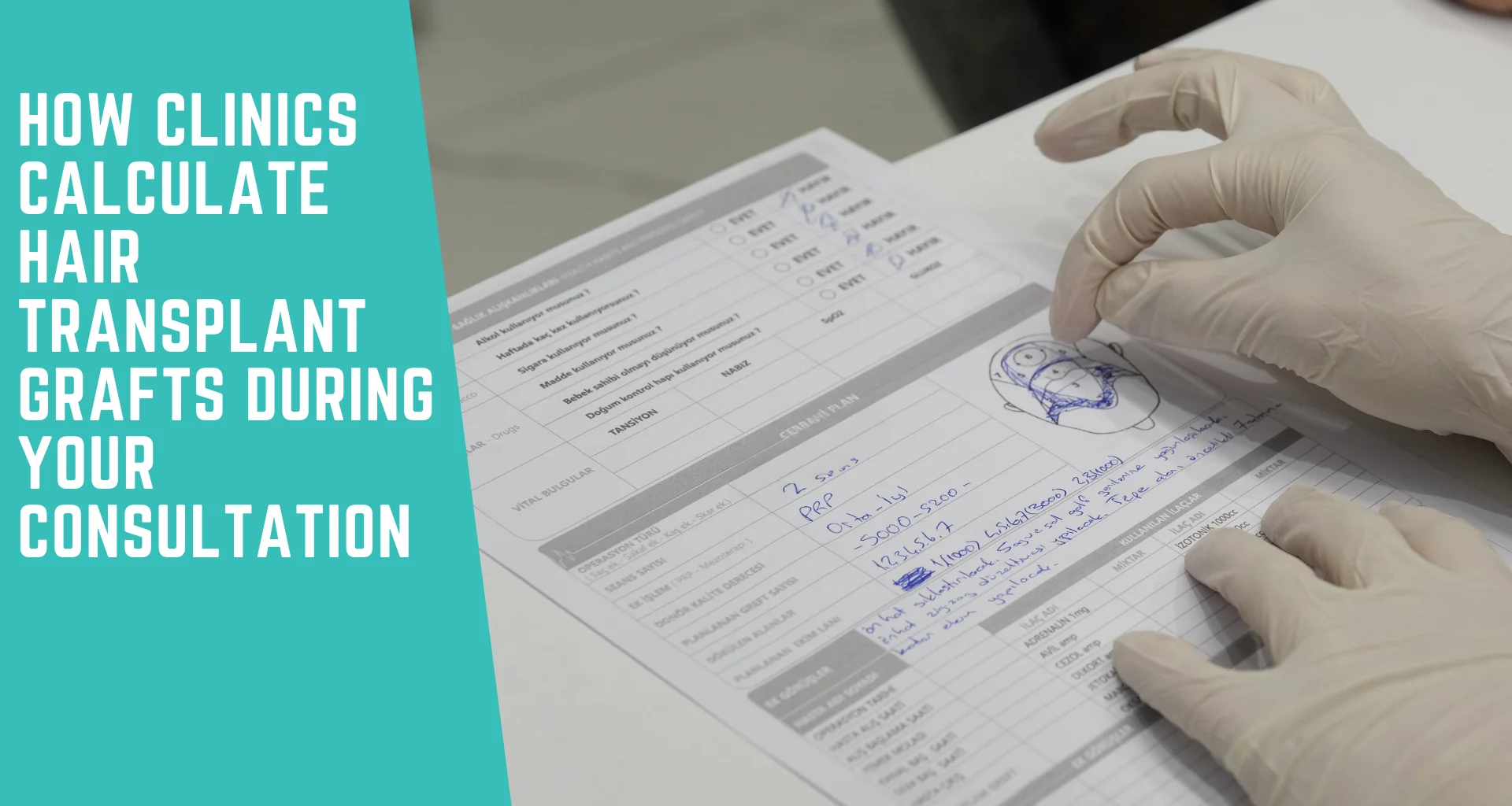

Hair transplant grafts are calculated from four things: the size of your bald area, the density planned for each zone, your donor supply, and your hair type. Change any one of them, and the number changes.
This is why two men with similar hairlines get quoted 2,800 and 4,000 grafts. They may be using different inputs. The only way to know is to ask each clinic how it calculated the number.
This article shows you the calculation step by step. By the end, you will know how any graft quote was built, and how to spot one that was not built at all.
| Comparing quotes that don’t match?If three clinics gave you three different graft numbers, the difference may come from how each clinic measured the area, planned the density, or assessed your donor supply. We are happy to walk you through how a graft estimate is built for your specific case. Talk to UniquEra’s team and get a graft plan you can actually read. |
Hair transplant procedures may involve roughly 1,000 to 5,000 grafts. Your exact number depends on the area treated, the density planned, and what your donor area can safely provide.
As a general orientation, a treatment plan might involve:
• Receding hairline: 1,000 to 1,500 grafts.
• Hairline plus frontal zone: 2,000 to 3,000 grafts.
• Front, mid-scalp, and crown: 4,000 or more.
No one can give you an accurate figure without assessing your scalp. That is what the consultation is for.
One graft contains one to four hairs, not one hair. A graft is a follicular unit, a small natural group of follicles that grows together.
The average is about two hairs per graft. So a 3,000-graft procedure moves roughly 6,000 hairs.
This matters when comparing quotes:
| Term | What it means |
| Graft | A follicular unit with 1 to 4 hairs. |
| Hair count | Individual hairs, roughly 2x the graft count. |
Confirm whether the clinic is quoting follicular units or individual hairs, because the two numbers are not interchangeable.
Step 1 of 4
The clinic measures your thinning area in square centimeters. The graft calculation starts with surface area.
The core formula is simple:
Area (cm²) × planned density (grafts per cm²) = graft count
Illustrative zone sizes:
| Zone | Approximate size |
| Receding hairline | 20 to 30 cm² |
| Front half of scalp | About 100 cm² |
| Crown | 60 to 100 cm² |
The crown can cover a larger surface area than it appears to in photographs. Each zone is measured separately, because each zone gets its own density plan.
Step 2 of 4
Density is planned zone by zone. Different parts of the scalp need different coverage to look natural.
The front gets the most visual attention, so it usually gets the highest density. The crown requires careful distribution because of its size and spiral growth pattern.
These are general planning ranges used for explanation. They are not fixed targets for every patient.
| Scalp zone | Typical planning range | Why |
| Hairline and frontal zone | 35 to 45 grafts per cm² | Most visible, frames the face. |
| Mid-scalp | 30 to 40 grafts per cm² | Connects front to crown. |
| Crown | 25 to 35 grafts per cm² | Large area and whorl direction need careful distribution. |
Final density may be planned lower in diffuse thinning, limited donor cases, or areas with existing hair. Natural density is much higher than these figures. Transplants look full at lower densities because of placement angle and graft layering.
Step 3 of 4
Your donor area decides the maximum grafts available, no matter what the bald area needs. It is a fixed supply. It does not regrow what is taken.
The safe donor zone is an individually defined area at the back and sides of the scalp. Its follicles are generally more resistant to pattern hair loss.
During a donor area hair transplant assessment, the medical team:
• Measures follicular density, often with trichoscopy, a magnified examination of the hair and scalp.
• Checks for miniaturized hairs, follicles that are shrinking and may not be suitable for long-term donor use.
• Plans extraction spacing so the donor area never looks thinned.
The safe number differs by patient. It cannot be reduced to one fixed percentage. Overharvesting can cause permanent visible thinning in the donor area, which is why a responsible clinic sets the limit during consultation, not after extraction begins. We cover this in depth in our donor area guide.
Step 4 of 4
Your hair type can change the graft number even when two people have identical bald areas. This is the input online calculators cannot see.
| Factor | Possible effect on visual coverage |
| Thick hair shafts | May cover more scalp per graft. |
| Fine hair | May require more grafts for similar visual coverage. |
| Wavy or curly hair | May create more volume and hide more scalp. |
| Straight hair | May reveal more scalp because it lies flatter. |
| Dark hair on pale skin | Higher contrast can make thinning more visible. |
| Lower hair-to-scalp contrast | Can make reduced density less noticeable. |
| Many multi-hair units | May provide more hairs from the same graft count. |
Two patients, same Norwood stage, same surface area. Their graft numbers can differ substantially. Either plan may be appropriate if it is based on a proper donor and recipient assessment.
The Norwood Hamilton scale is orientation, not a calculator. It describes the pattern of hair loss, from Stage 1 (minimal) to Stage 7 (severe).
| Norwood stage | Common orientation range |
| 2 to 3 | 1,000 to 2,000 grafts |
| 3 to 4 | 2,000 to 3,000 grafts |
| 4 to 5 | 2,500 to 4,000 grafts |
| 6 and above | 4,000+, often staged |
These ranges are broad orientation figures rather than clinical recommendations for every patient.
The stage does not measure surface area, density needs, or donor supply. If a clinic quotes a firm number from your Norwood stage alone, that is a guess wearing a uniform.
Larger graft counts extend coverage further back across the scalp. But the same number produces different results on different heads.
| Graft count | Possible treatment scope | Donor demand | Possible staging |
| 3,000 | Hairline plus frontal zone, or front plus partial crown. | Moderate | Usually one session |
| 4,000 | Front and mid-scalp, or broad coverage with crown work. | High | Sometimes split |
| 5,000 | Extensive restoration across multiple zones. | Very high, rare donor quality | Often two days or two sessions |
A 3,000-graft hair transplant is commonly discussed for moderate coverage goals. A 4,000-graft hair transplant is a large procedure that demands a strong donor area. At UniquEra, 5,000-graft plans are uncommon and require a particularly strong donor supply.
Internal UniquEra planning discussions have used 2,000 and 3,500 grafts as examples of how coverage can increase with graft count. These are not universal formulas. Surface area, density target, hair thickness, curl, and contrast decide what those grafts achieve in each case. When a case genuinely supports 5,000 grafts, the work may be divided across two days when the Medical Directors consider that structure appropriate for the case.
| Tempted by the biggest quote?Grafts your donor area cannot spare are grafts you lose twice, once from the back and once from the result. Before committing to any number, it is worth checking what your donor area can actually support.Get an honest graft assessment from UniquEra’s medical team. |
A diffuse thinning hair transplant is harder to calculate because the recipient area still contains living hair. That changes every step of the math.
Diffuse thinning means hair is losing density across a wide area, rather than receding in a clean pattern. Four extra problems appear:
• The area is not empty. New grafts must fit between existing follicles without damaging them.
• Miniaturized hair inflates the picture. Shrinking follicles make a zone look denser than it really is. Trichoscopy separates healthy hair from hair on its way out.
• Future loss must be planned for. Transplanting around hair that will disappear in three years leaves holes later.
• The donor needs checking too. In some diffuse patterns, thinning reaches the donor zone and reduces the safe supply.
Sometimes the honest answer for a diffuse thinner is not yet. Stabilizing the loss first, or using a lower-density plan, protects the existing hair and the donor reserve. A clinic that says this is protecting your result, not losing a sale.
Photos support an initial estimate. The final number requires hands on the scalp.
A remote consultation can measure the visible area and read your loss pattern. It cannot test donor density under magnification or spot miniaturization.
A serious hair transplant clinic in Istanbul treats the remote estimate as a working plan. The clinic should be willing to revise it if the physical examination reveals something photos could not show.
Three different numbers exist in every procedure:
| Term | Meaning |
| Planned grafts | The consultation estimate used in the treatment plan. |
| Extracted grafts | Follicular units removed from the donor area. |
| Implanted grafts | Suitable grafts ultimately placed. |
Extracted and implanted counts may not match. Some grafts get damaged or judged unsuitable during sorting. Clinics should state which number appears in the treatment plan, the invoice, and the final procedure record. Our consultation guide covers what to confirm before you travel.
No. DHI or Sapphire FUE does not decide how many grafts your scalp needs. The treatment area, planned density, existing hair, and donor supply set the number. The technique affects how the grafts are placed.
With a DHI hair transplant in Turkey, extraction happens first as a separate stage. Then a Choi pen creates the opening and places each graft in the same movement, which can be useful when implanting between existing hairs.
With a Sapphire FUE hair transplant in Turkey, channels are opened first with a sapphire blade, then grafts are placed. Both can deliver excellent results. Neither changes the size of the problem being solved.
Neither model is automatically better. But you need to know which one you are looking at before comparing quotes for hair transplant surgery in Turkey.
| Pricing model | How it works | Watch out for |
| Per graft | Rate × your graft count | The total rises with the quoted count, so ask how that count was calculated. |
| Package | One price regardless of count | Confirm that the package includes a case-specific graft plan rather than a default maximum. |
The hair transplant cost per graft on the invoice is what you pay on surgery day. A low quote can become expensive if poor planning or donor damage later requires corrective work.
One question cuts through both models: which number am I paying for, planned, extracted, or implanted? Our full cost guide breaks down what package quotes should include.
How does UniquEra calculate your graft plan?
UniquEra Clinic builds your graft number in two stages, with everything in writing before the procedure. The process at our hair transplant clinic in Istanbul:
1. Remote video consultation with photos. We measure the visible loss and discuss your goals.
2. Initial written treatment plan. You get a graft estimate with the reasoning behind it, not just a figure.
3. In-person assessment. Our Medical Directors examine the donor and recipient areas, confirm the graft plan, and review every case before the procedure.
4. Hairline and zone planning. The design is mapped on your scalp and agreed with you.
5. Final graft allocation. Singles at the frontal edge, two-hair units behind the hairline, larger units through the mid-scalp and crown.
6. Written confirmation. The final plan is confirmed with you before anything begins.
Patients searching for the best hair transplant clinic in Turkey should ask how the clinic calculated the graft number, not which clinic offered the highest count. The calculation is the product. The grafts are just how it gets delivered.
Five questions separate a calculated quote from a sales figure:
1. How did you measure the area you plan to cover?
2. What density are you planning for each zone, and why?
3. Has anyone assessed my donor density, or is this based on photos alone?
4. Will the number be revised after an in-person examination?
5. Am I paying for planned, extracted, or implanted grafts?
A credible clinic should be able to explain the basis of its answers clearly.
The graft number matters less than how it was produced. Two people with the same Norwood stage can get very different estimates, and both can be correct.
The calculation runs on surface area, zone density, donor supply, and hair characteristics unique to each scalp. A quote built from that process is a plan. A quote built from a photo and a price list is a hope.
| Get clarity before choosing a graft numberA consultation can show what your donor area can support now, what should be preserved for the future, and whether the timing is right. You can then compare clinic quotes using your actual scalp assessment rather than the largest number offered.Book your consultation with UniquEra today. |
Roughly 1,000 to 5,000 grafts depending on your case. The exact hair transplant grafts needed depend on area size, planned density, donor supply, and hair type.
It can be. A 3,000-graft procedure may cover the hairline and frontal zone in one patient, or a smaller area at higher density in another.
Yes. It is generally considered a large session and requires careful donor assessment before deciding whether to complete it at once or in stages.
Only in selected patients with a strong donor supply. At UniquEra, 5,000-graft plans are uncommon, confirmed only after direct donor assessment, and sometimes split across two days.
More conservatively, with extra diagnostics. The team maps existing follicles, identifies miniaturized hair, plans for future loss, and checks the donor area itself.
No. One graft holds one to four hairs, averaging about two. A 3,000-graft procedure moves roughly 6,000 hairs.
Photos give an initial estimate, not a final number. Donor density and miniaturization can only be confirmed in person.
Not always, so ask. Get in writing whether your invoice reflects planned, extracted, or implanted grafts.