
Red flags when choosing a hair transplant clinic Turkey is one of the most searched Only after understanding that picture do questions by patients who are serious about getting this right. Turkey is one of the most established destinations in the world for hair restoration, and the vast majority of patients who go there have a good experience.
Patients travel from the US, UK, Europe, and the Middle East for experienced medical teams, internationally accredited facilities, and procedures that cost a fraction of what the same quality would at home.
The question most people ask is: is Turkey good for a hair transplant?
The honest answer is yes, when you choose the right clinic.
The harder question is the one this guide actually answers: how do you tell a good clinic from one that looks identical online but works very differently?
Every clinic shows before-after photos, hotel packages, graft numbers, and promises of natural results. From the outside, they all look the same. This guide helps you look past that.
Still deciding which clinic feels right? Book a free consultation at UniquEra Clinic and get a clear picture of your hair loss and what is realistically possible for your case.
Turkey for hair transplants is not a trend. It is a well-established medical system built over more than two decades.
Turkey welcomed around 1.5 million international health tourists in 2024, according to Turkish health tourism reporting. Hair restoration is one of the most common reasons patients travel, and Istanbul concentrates the majority of that activity.
Istanbul clinics routinely handle patients from dozens of countries. That volume builds clinical judgment across different hair types, donor areas, ethnicities, and hair loss stages.
A procedure costing $15,000 to $25,000 in the US or $8,000 to $12,000 in the UK can be done in Turkey for significantly less. The savings come from lower operational costs and currency differences, not from reduced medical standards.
Strong clinics offer online consultation, travel and accommodation coordination, surgery, post-operative care, and structured follow-up at one, three, six, and twelve months.
International patients are not an afterthought at good clinics. They are the primary focus.
Because every clinic markets itself the same way.
Open ten clinic websites and you will see the same things: dramatic before-after photos, graft counts, hotel packages, and claims of being the best hair transplant clinic in Turkey. None of that tells you what actually matters.
| What most patients compare | What actually matters |
| Price | Quality of diagnosis |
| Graft count | Safe donor area planning |
| Hotel package | Full patient support before and after |
| Before-after photos | Cases similar to your hair type and stage |
| Social media presence | Real consultation process |
| Best clinic claims | Long-term result planning |
The difference between a good outcome and a disappointing one rarely comes down to price. It comes down to how carefully the clinic assessed your case before surgery.
Start by comparing the clinic’s process, not its package.
If you are researching how to choose a hair transplant clinic in Turkey, the first question to ask is: is this clinic diagnosing my case or selling me a number?
A serious clinic asks for photos of your hairline, crown, and donor area. They ask about your age, family history of hair loss, how long the loss has been progressing, and what result you are hoping for.
Only after understanding that picture do they suggest a graft range, technique, or hairline design for patients experiencing receding hairline hair loss.
A clinic that offers you a fixed graft package on the first contact, before knowing anything about your case, is not planning your result. It is filling a slot.
These are not reasons to avoid Turkey. Turkey has excellent clinics with experienced teams and strong infrastructure. These questions help you find them.
A good sign: the clinic asks for photos, hair loss history, family history, and donor area condition before making any recommendation.
A caution sign: they offer a graft package on first contact without knowing your case.
Every patient has a different donor area and hair loss pattern. A realistic plan starts with understanding those factors first.
A good sign: they explain the reasoning behind the graft range and acknowledge the limits of your donor area.
A caution sign: the focus is always on maximum grafts with no discussion of what your donor can safely provide.
Clinical hair restoration literature consistently notes that most patients have a maximum of around 6,000 harvestable grafts across their lifetime. A clinic that plans conservatively now protects your options for the future.
A good sign: they show cases with similar hair type, loss stage, donor area quality, and age range to yours.
A caution sign: they only show dramatic transformations with no case details, no timeline, and no context.
A great result for one patient does not predict your result. Similar cases give you a realistic picture of what is achievable for someone starting where you are.
A good sign: they explain why the hairline fits your face shape, age, donor capacity, and future hair loss pattern.
A caution sign: they agree to any hairline request without discussion, particularly very low hairlines for younger patients.
A hairline that looks great at 28 can look out of place at 45 if the hair behind it continues to thin, especially in progressive cases of receding hairline hair loss. A good clinic has that conversation even if it means saying no to what you initially asked for.
A good sign: they explain swelling, scabbing, washing, shock loss, early growth, and the full timeline to final results.
A caution sign: the conversation focuses entirely on the procedure itself and goes quiet on what happens after.
Hair transplant results take up to twelve months to fully develop. Knowing what is normal at each stage is part of a well-managed experience.
A good sign: they provide written post-operative instructions and scheduled photo check-ins at one, three, six, and twelve months.
A caution sign: support is vague, WhatsApp-only with no structure, or stops when the patient leaves.
For international patients, aftercare is not a bonus. It is part of the medical process.
A good sign: they discuss your likely hair loss progression and explain how the transplant plan accounts for it.
A caution sign: the focus is entirely on filling visible areas today with no mention of what happens over the next ten years.
This matters most for younger patients experiencing progressive receding hairline hair loss. Transplanted hair placed without this planning can become isolated as surrounding native hair continues to thin.
Yes, when you choose a properly credentialed clinic.
Turkey has developed a strong medical infrastructure for international patients. Here is what the main credentials mean in plain language.
| Credential | What it means | How to verify |
| Turkish Ministry of Health licence | Legal requirement for all legitimate clinics | Ask the clinic. Request the document. |
| JCI accreditation | Meets international healthcare quality standards across 1,300 criteria | Search jointcommissioninternational.org |
| ISHRS membership | Physician engaged with international hair restoration standards | Search ishrs.org member directory |
Turkey has dozens of JCI-accredited healthcare facilities listed in the official Joint Commission International directory. JCI accreditation is renewed every three years through an independent audit.
A clinic that is transparent about all three credentials and can provide documentation without hesitation is operating at a serious medical level.
Yes, meaningfully.
Graft survival is directly affected by how the clinic handles the procedure. Clinical and peer-reviewed literature on follicular graft survival consistently identifies four key variables.
Grafts that are extracted and left sitting for long periods before implantation have lower survival. Experienced teams work efficiently to minimize this time.
Grafts kept in appropriate solutions at controlled temperatures maintain viability longer. This is a clinical detail most patients never think to ask about.
Grafts are living tissue. How carefully they are extracted, sorted, and placed affects how many survive and grow. A well-coordinated team matters.
A patient with high donor density and strong hair calibre will naturally achieve better coverage. This is why honest donor assessment before surgery matters so much.
Research published in peer-reviewed journals on hair restoration shows that in reputable, medically supervised clinics using modern FUE and DHI techniques, graft survival rates are significantly higher than in high-volume, poorly supervised operations.
A 2024 study found that patients receiving PRP therapy alongside FUE achieved substantially better graft survival outcomes compared to those receiving FUE alone.
Ask any clinic you are considering: how does your team manage graft time outside the body, and what storage protocol do you use? A clinic that cannot answer that question clearly is showing you something important.
Most clinic websites describe the surgery day. A properly structured journey covers everything before and after it.
At UniquEra Clinic, every patient goes through the same structured process, whether they are travelling from the UK, US, Europe, or the Middle East.
• Online consultation with photos of your hairline, crown, and donor area
• Written diagnosis and treatment plan sent before you book anything
• Pre-arrival support including hotel and transfer coordination
• Blood test and in-clinic consultation on arrival day
• Procedure performed under Medical Director supervision
• Post-operative wash and aftercare instructions on day two
• Structured check-ins with photo review at 1, 3, 6, and 12 months
• WhatsApp support throughout the recovery and growth period
• Clear guidance on what is normal at every stage
This is what a complete patient journey looks like. If a clinic you are comparing cannot describe their process at this level of detail, ask them to.
Want to see what a properly structured consultation looks like? UniquEra Clinic walks every patient through diagnosis, donor assessment, and a realistic plan before anything else.
A trustworthy clinic explains the plan, not just the price.
| What they should explain | Why it matters |
| Receding hairline hair loss type and pattern | Different types need different approaches. |
| Your donor area condition. | Determines what is safely achievable. |
| Your realistic graft range. | Sets honest expectations. |
| Hairline design and reasoning. | Affects how natural the result looks now and later. |
| Crown planning. | Crown often needs staged or careful density planning. |
| Full recovery timeline. | Helps patients follow aftercare and stay calm |
| Post-operative support and contact. | Essential for international patients. |
| Future hair loss considerations. | Protects the long-term result. |
The best hair transplant clinic in Turkey for your case is not always the most well-known one online. It is the one that gives you a plan you understand, based on an honest assessment.
Most failed hair transplant results are not about Turkey as a destination.
They happen when a clinic is chosen without enough information about how they actually work.
| Cause of disappointment | How informed patients avoid it |
| No proper diagnosis | Ask what type of hair loss you have before any plan is suggested |
| Unrealistic graft promises | Ask what range is safe for your specific donor area |
| Poor donor area management | Ask how extraction protects your future options |
| Unsuitable hairline design | Ask why the hairline suits your age and future loss pattern |
| No similar cases shown | Ask for results from patients with your hair type and stage |
| No structured aftercare | Ask exactly what happens after you return home |
| No long-term planning | Ask how future hair loss is factored into the plan |
Many patients who experience disappointing results report choosing their clinic based on price, graft count, or marketing without asking about diagnosis or aftercare.
The information was available. The questions were not asked.
What do hair transplant risks and complications actually look like?
Knowing what is normal removes most of the anxiety around recovery.
A 2023 to 2025 systematic review of peer-reviewed hair transplant literature found that infection is relatively uncommon and typically superficial when it does occur. Shock loss in surrounding native hair usually resolves. The most common complications in poorly managed cases relate to handling, hygiene, and aftercare gaps.
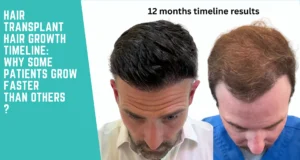
| Timeframe | What to expect |
| Days 1 to 3 | Swelling around forehead and eyes. Peaks day two, resolves within days. |
| Days 4 to 10 | Scabs loosen and fall with gentle washing. Follow the clinic’s protocol exactly. |
| Weeks 2 to 6 | Shock loss begins. Transplanted hairs fall out. This is normal. Follicles stay. |
| Months 3 to 5 | Early growth begins. Hairs are thin and fine at first. |
| Months 6 to 9 | Growth becomes more visible. Density improves. |
| Month 12 | Result approaches final appearance. Some continue improving to 18 months. |
A good clinic tells you all of this before surgery. If the clinic’s pre-operative education skips these stages, ask why.
No. A clinic can have a large social media presence and thousands of before-after photos and still not be the right clinic for your case.
The best hair transplant clinic in Turkey for you depends on:
• Your age and how far your hair loss is likely to progress
• Your hair type and calibre
• Your donor area density and condition
• Your Norwood stage and pattern
• Whether your crown is involved
• Whether you have had a previous transplant
A smaller clinic with an experienced Medical Director who personally supervises your procedure may deliver a more considered result than a high-volume operation where the doctor is only present for part of the process.
The right question is not which clinic is most famous. It is which clinic gave you the clearest and most honest assessment of your case.
These twelve questions help you assess whether a clinic is planning your result or selling a package.
A clinic that answers all twelve clearly is worth a second conversation. A clinic that deflects or brings every answer back to the package price is showing you something important.
Most clinic websites show before-after photos. Not all of those photos tell you what you need to know.
| Weak proof | Strong proof |
| One perfect photo with no context | Full timeline at 3, 6, and 12 months |
| Different lighting before and after | Consistent lighting and angles throughout |
| No case details | Hair type, graft count, and loss stage noted |
| Only front view | Front, crown, and ideally donor area shown |
| Only dramatic transformations | Cases similar to your own starting point |
| No dates or timeline | Clear timeline from surgery to final result |
When reviewing results, look for cases where the patient started with a similar Norwood stage, hair type, and goal to yours.
A result from a patient with thick coarse hair and high donor density will not predict your result if your hair is finer and your donor is more limited.
Ask the clinic directly: can you show me a case similar to mine?
An honest clinic does not just tell you what you want to hear. It tells you what is true about your case.
Here are things an honest clinic will say:
• Your donor area has a limit. Here is what we can safely achieve for your current pattern of receding hairline hair loss.
• A very low hairline may not suit your age and future hair loss risk.
• Your crown may need a staged approach rather than full coverage in one session.
• You may benefit from medical treatment to stabilise your hair loss before surgery.
• “A transplant can significantly improve density in cases of receding hairline hair loss, but it will not recreate the hair you had at twenty.
• Your final result will take twelve months to develop fully.
• Here are cases from patients with similar hair so you can set realistic expectations.
None of those statements are negative. They are honest.
A clinic willing to tell them is thinking about your actual result, not just your booking confirmation.
A clinic that agrees to everything and never mentions limits is not being positive. It is being vague in a way that protects them, not you.
| Confirm this before booking | Why it matters |
| My hair loss type has been explained | I understand what I have and what drives it |
| My donor area has been assessed | My safe graft range is based on real evaluation |
| My graft range is realistic | I am not being promised more than my donor can provide |
| The hairline plan has been explained | I understand why it suits my age and future loss |
| I have seen cases similar to mine | My expectations are based on comparable results |
| The full recovery timeline is explained | I know what is normal at every stage |
| Aftercare is structured and included | I have support after I return home |
| Future hair loss has been discussed | My long-term result is planned, not just today |
| Clinic credentials can be provided | I can verify them independently |
| I did not feel rushed to decide | The consultation was informational |
Turkey is a genuinely strong destination for hair restoration.
The medical infrastructure is serious, the clinical experience is deep, and many patients who travel there get results they could not have achieved at home for the same cost.
The difference between a good experience and a poor one is almost always the clinic selection process.
Patients who take time to understand their diagnosis, ask about donor planning, check similar cases, and evaluate aftercare before booking consistently report better outcomes.
When you know what to check, the decision becomes much clearer. The right clinic gives you clarity before it asks for commitment.
UniquEra Clinic is a hair transplant clinic in Turkey where every patient gets a clear diagnosis and an honest plan before committing to anything.
“Book Free Hair Transplant Consultation Today“
| Factor | Turkey (Istanbul) | Mexico |
| Global procedure volume | Among the highest in the world | Significant but lower |
| JCI-accredited facilities | Dozens listed in JCI directory | Available but fewer |
| Cost range for 3,000 to 4,000 grafts | Approx. $1,800 to $4,000 | Approx. $3,000 to $6,000 |
| Travel for European patients | Very accessible | Much longer journey |
| Travel for US/Canada patients | Longer flight | More practical |
| Technique availability | FUE, DHI, Sapphire FUE widely available | FUE primarily |
| Aftercare for international patients | Highly developed infrastructure | Developing |
For European and Middle Eastern patients, Turkey is generally the more experienced and practical choice. For patients in the US or Canada, Mexico offers shorter travel but typically at higher cost and with less concentrated procedure volume.
Regardless of destination, the same principles apply. Diagnosis quality, donor management, and aftercare matter more than geography.
No. Age alone does not determine whether someone is a good candidate.
The ISHRS 2025 Practice Census found that 95% of first-time hair restoration patients in 2024 were between 20 and 35. That reflects when most people first seek surgery, not when surgery stops being appropriate.
Patients in their 40s and 50s can be excellent candidates. In many cases they are easier to plan for because the hair loss pattern is fully declared and more predictable.
What actually determines suitability at any age:
• Donor area density and condition.
• Stability of current hair loss.
• Realistic expectations for coverage.
• Overall health.
• Whether the pattern is still actively progressing.
A graft is not the same as a single hair. Each follicular unit graft contains between one and four hairs. The average is approximately 2 to 2.5 hairs per graft.
| Graft count | Approximate hair count | Typical coverage area |
| 1,500 grafts | 3,000 to 3,750 hairs | Hairline and mild temples |
| 2,000 grafts | 4,000 to 5,000 hairs | Hairline and moderate temple recession |
| 3,000 grafts | 6,000 to 7,500 hairs | Hairline, temples, and early crown |
| 4,000 grafts | 8,000 to 10,000 hairs | Broader coverage including crown |
| 5,000 grafts | 10,000 to 12,500 hairs | Significant coverage across top and crown |
The ISHRS 2025 Practice Census reported that first-time procedures in 2024 required an average of 2,347 grafts to achieve the patient’s desired result. That reflects realistic planning rather than maximum graft counts.
8,000 grafts in a single session is beyond what most experienced hair restoration physicians consider safe.
Clinical hair restoration literature consistently notes that most patients have a maximum of around 6,000 harvestable grafts from the scalp donor area across their lifetime. Harvesting 8,000 in one session risks permanent thinning of the donor zone and takes from areas that may not produce permanent hair.
5,000 grafts in one session is possible for patients with a very rich and dense donor area. Some experienced clinics split high-graft procedures across two consecutive days to protect graft survival throughout.
If a clinic offers 6,000 or more grafts in a single session without a thorough donor area assessment, that warrants a serious question.
Transplanted hair is permanent in patients where the donor area is stable.
The follicles taken from the safe donor zone at the back and sides are genetically resistant to DHT, the hormone responsible for male pattern baldness. When transplanted, they retain that resistance and continue to grow for life.
What can affect the long-term appearance:
• Continued thinning of native non-transplanted hair around the transplanted area.
• Whether the donor area was properly preserved during surgery.
• Whether ongoing medical treatment was used to protect existing hair.
Patients who combine their transplant with ongoing medical treatment to protect surrounding native hair consistently achieve better long-term results than those who treat the transplant as a standalone solution.
At a reputable hair transplant clinic in Turkey, 5,000 grafts typically costs between $2,500 and $4,500, depending on technique, clinic, and what is included in the package.
Important context:
-Always request a written breakdown of exactly what is and is not included before committing.
–FUE Sapphire and DHI are both available at this graft range in Istanbul
-Most reputable clinics offer packages covering procedure, accommodation, transfers, and aftercare.
-At 5,000 grafts, donor management and surgical quality matter enormously. Price alone is not the right filter at this volume.
Ask about their diagnostic process first. A reputable clinic assesses your hair loss type, donor area, and realistic graft range before suggesting anything. Check for Ministry of Health licensing and ask about ISHRS membership.
Yes, when you choose a clinic with verifiable credentials and a clear process. Turkey has internationally accredited facilities and experienced teams. The key is knowing what to check before booking.
Neither is universally better. FUE Sapphire suits larger coverage areas and higher graft counts. DHI is preferred for precision work and two-day procedures. The right technique for receding hairline hair loss follows your diagnosis, not a marketing preference.
FUE Sapphire uses a sapphire blade to open channels before implantation with forceps. DHI uses a Choi pen to extract and implant in one step with less skin trauma. DHI suits precision cases and enables two-day procedures for higher graft volumes.
It is a moderate to large session. For Norwood stages 4 to 5, it is a realistic planning range when based on proper donor assessment. What matters is whether the count is based on your actual case, not a fixed package.
Fixed graft packages before diagnosis, no similar cases shown, pressure to book quickly, no structured aftercare plan, and inability to provide accreditation documentation.
Istanbul has the highest concentration of experienced clinics and international patient infrastructure in Turkey. But the clinic process matters more than the city. A strong clinic in Ankara or Antalya can deliver better results than a poor clinic in Istanbul.