
Hair loss can look simple from the outside. You see more scalp. Your hair feels thinner. The crown looks lighter in photos.
But for a hair transplant expert, the first question is never just how much hair you have lost. It is what type of hair loss is happening.
That question changes everything. It changes the diagnosis, the treatment, and whether a hair transplant for thinning hair makes sense at all, or whether medical treatment should come first.
The difference between diffuse thinning vs male pattern baldness is not always obvious. Male pattern baldness follows a predictable path, especially when mapped through the Norwood scale used by hair restoration specialists. Diffuse thinning spreads differently and can have completely different causes. Treating one like the other leads to the wrong plan.
This article explains how hair transplant experts tell them apart, what tools they use, and what your options are depending on what they find.
If your hair has been changing and you still do not have a clear answer, book a free consultation at UniquEra Clinic and find out exactly where you stand. Get your hair solutions for thinning hair mapped out clearly from day one. Book a free consultation
Diffuse thinning is when hair loses density across the whole scalp rather than in one or two specific areas. The hairline often stays in place, unlike the progressive recession seen in receding hairline hair loss. There is no obvious bald patch. But the hair gets thinner over time until the scalp becomes visible through it.
Common signs include:
• Hair looks flat even after styling.
• The scalp becomes visible under bright light.
• The parting line looks wider than before.
• Hair feels weaker and less full across the top.
• Shedding feels higher than usual.
• Density drops without a clear bald area forming.
Diffuse thinning can be caused by stress, illness, nutritional deficiencies, thyroid problems, medications, or early androgenetic alopecia. According to the American Academy of Dermatology, sudden or rapid shedding often points to a temporary trigger rather than permanent genetic loss. This is why identifying the cause matters before choosing any treatment.
Male pattern baldness is the most common form of hair loss in men. It is also called androgenetic alopecia. It develops slowly, driven by genetic sensitivity to DHT (dihydrotestosterone), a hormone that causes hair follicles to shrink over time.
According to the American Academy of Dermatology, male pattern baldness affects approximately 50 million men in the United States alone, with around 50% of men over 50 experiencing some degree of it.
Common signs include:
Male pattern baldness is progressive without treatment. The AAD notes that treatment works best when started early, before significant follicle miniaturization has occurred.
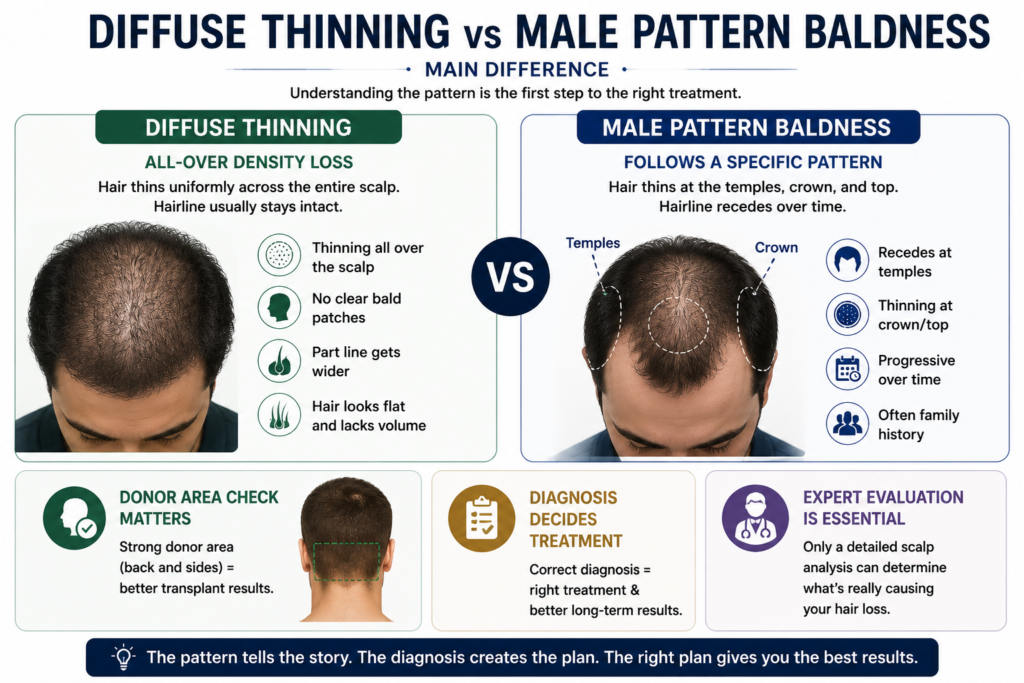
The main difference is the pattern. Diffuse thinning spreads across the scalp. Male pattern baldness follows a more predictable shape.
| Factor | Diffuse Thinning | Male Pattern Baldness |
| Where hair thins | All over the scalp | Temples, crown, top of head |
| Hairline | Usually stays intact | Recedes progressively |
| Donor area (back/sides) | May also be affected | Usually remains strong |
| Primary cause | Stress, hormones, nutrition, genetics | DHT sensitivity, genetics |
| Follows a pattern? | No clear pattern (or broad pattern) | Yes, follows Norwood stages |
| Main diagnostic tool | Trichoscopy, blood tests, density mapping | Norwood scale, trichoscopy |
| Hair transplant suitability | Depends heavily on donor strength | Often suitable from Stage 3 onward |
This distinction is not just academic. It changes whether a hair transplant is appropriate, which technique is used, and how many grafts are needed.
Catching hair loss early gives you more options. Both conditions can start quietly, which is why many people miss the window.
• The hairline at the temples starts to pull back slightly
• An M-shaped recession becomes visible from the front
• A small thinning spot appears at the crown (vertex)
• Hair in the affected zones feels finer and shorter over time
• More hair on the pillow or in the shower drain, mostly from the top of the head
These are the classic early signs of male pattern baldness that align with Norwood stages 2 and 3 on the Norwood scale used by hair restoration specialists.
• Overall volume loss across the whole scalp, not just the top.
• The ponytail or bunch of hair feels noticeably thinner.
• Hair feels limp, flat, or less full even when freshly washed.
• Shedding increases but is spread across the whole scalp.
• No single area stands out as the main problem zone.
• The scalp may become slightly visible under bright light, all over.
One key difference is the rate of loss. Diffuse thinning often presents with rapid, high-volume shedding, sometimes more than 100 hairs per day. Male pattern baldness tends to be slower and more gradual, with hair miniaturizing quietly over years before the loss becomes obvious.
If the shedding started suddenly after a period of illness, intense stress, or a major diet change, the cause may be telogen effluvium. That is a temporary condition where a large number of follicles enter the resting phase at the same time. It can look identical to diffuse thinning but often resolves on its own once the trigger is removed.
This is exactly why a proper scalp analysis matters before any treatment decision is made.
Miniaturization is when hair follicles shrink over time, producing progressively thinner, shorter, and weaker strands before eventually stopping growth altogether.
A study published in the Journal of the American Academy of Dermatology confirmed that follicular miniaturization is the hallmark diagnostic marker of androgenetic alopecia in both men and women. The ratio of miniaturized to healthy hairs in a given zone directly guides treatment planning.
Where miniaturization appears tells the expert which condition they are dealing with:
• In male pattern baldness: concentrated at temples and crown, donor area stays healthy.
• In diffuse patterned alopecia (DPA): spreads across the top of the scalp, the donor area stays strong.
• In diffuse unpatterned alopecia (DUPA): present across the entire scalp including the donor area.
You cannot see miniaturization with the naked eye. Under trichoscopic magnification, the expert measures the ratio of miniaturized to healthy hairs in each zone. A high ratio in the donor area changes the entire transplant plan.
Diffuse thinning often comes on fast. Male pattern baldness is usually slow and gradual.
With diffuse thinning, patients often report sudden heavy shedding, sometimes exceeding 100 hairs per day across the whole scalp. A temporary condition called telogen effluvium, where a large number of follicles enter the resting phase simultaneously, is a common trigger. According to Cleveland Clinic, telogen effluvium typically peaks around 3 months after the trigger event and can last 6 months or more before resolving.
Male pattern baldness moves differently. The follicles miniaturize slowly, sometimes over decades. Many men only notice real change when a photograph angle makes it obvious. By that point, the process has usually been running for years.
Rate of loss also affects treatment timing. Fast, active diffuse shedding is not a good point to plan a hair transplant. The pattern has not declared itself and the donor area may still be changing. Slow, stable, patterned loss is much easier to work around surgically.
Male pattern baldness has one primary cause. Diffuse thinning can have many.
Male pattern baldness causes:
• Genetic sensitivity to DHT.
• DHT binds to hair follicles, shortening the growth cycle and shrinking the follicle over time.
• Can be inherited from either parent’s side.
Diffuse thinning causes:
• Telogen effluvium triggered by stress, illness, surgery, or crash dieting.
• Iron deficiency or low ferritin levels.
• Thyroid dysfunction, both overactive and underactive.
• Vitamin D deficiency.
• Hormonal changes.
• Certain medications including blood thinners, antidepressants, and retinoids.
• Androgenetic alopecia presenting in a diffuse rather than patterned form.
A paper published in the International Journal of Trichology noted that nutritional deficiencies, particularly iron and vitamin D, are among the most frequently overlooked contributors to diffuse hair loss in men under 40. Blood tests are a standard part of any thorough diagnosis for this reason.
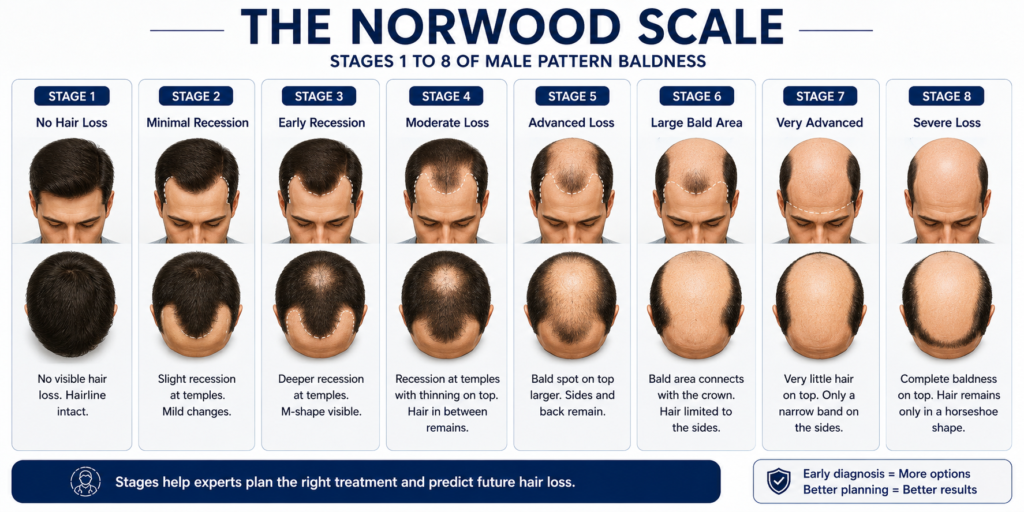
The Norwood scale is the most widely used system for classifying male pattern baldness. It was developed in the 1950s by Dr. James Hamilton and refined by Dr. O’Tar Norwood in 1975. It gives doctors and patients a shared language for describing how far hair loss has progressed.
| Norwood Stage | What It Looks Like | Typical Action |
| Stage 1 | No visible loss. Full hairline. | Monitoring, preventive care |
| Stage 2 | Slight temple recession. Early M-shape forming. | Medication may begin |
| Stage 3 | Deeper temple recession. Crown may start thinning. | Medication, possible early transplant |
| Stage 3 Vertex | Crown thinning is the dominant feature. | Medication, transplant consideration |
| Stage 4 | Significant crown and temple loss. | Transplant often recommended |
| Stage 5 | Crown and front merge. Wide bald area on top. | Transplant, larger graft count needed |
| Stage 6 | Only a band of hair remains at sides and back. | Transplant planning more complex |
| Stage 7 | Narrowest band of hair remaining. | Limited surgical options |
Doctors do not diagnose from the Norwood scale alone. Two people at the same Norwood stage can need very different plans depending on their hair density, donor area strength, and age. The scale is a starting point, not a complete diagnosis.
The Norwood scale maps specific patterns of recession and baldness. Diffuse thinning does not follow those patterns. That is why the scale alone cannot diagnose it.
There are actually two types of diffuse hair loss experts distinguish between:
Diffuse Patterned Alopecia (DPA):
Hair thins across the top of the scalp in a broad zone, similar to a Norwood 5 or 6 spread. But the back and sides of the head stay relatively strong. This matters because the donor area remains viable for a hair transplant.
Diffuse Unpatterned Alopecia (DUPA):
Hair miniaturization spreads across the entire scalp, including the back and sides. This is the more difficult case. Because the donor zone is also thinning, harvesting grafts from it carries a higher risk. Hair taken from a weakened donor area may continue to miniaturize after transplant.
This is why the first question in any diffuse thinning hair transplant assessment is not how many grafts do you need, but: is your donor area stable?
Yes, sometimes. This is one of the most misunderstood areas in hair loss diagnosis.
Some men do not follow the classic Norwood pattern in the early stages. Instead of clear temple recession, they may see general thinning across the top of the scalp. This can still be androgenetic alopecia, presenting in a diffuse form rather than a patterned one.
But diffuse thinning can also come from entirely different causes, including temporary conditions. That is why experts check whether the donor area is stable, whether miniaturization is present, and whether the loss is temporary or progressive before labelling it as anything.
Getting this wrong in either direction leads to the wrong treatment plan.
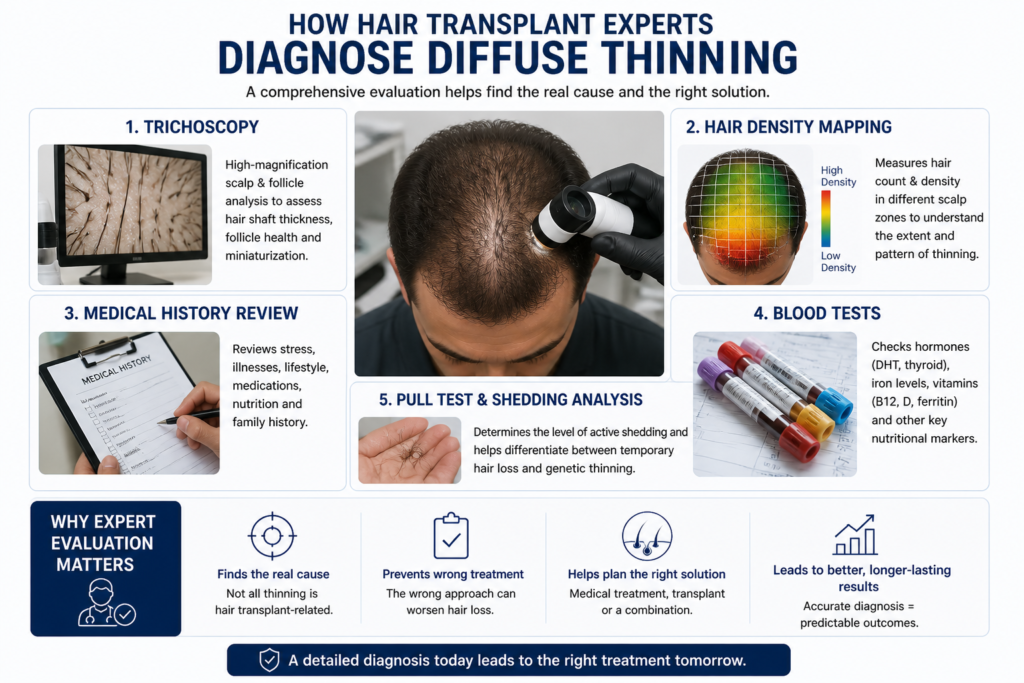
Scalp analysis for hair loss is not a single test. It is a series of observations that build a complete picture of what is happening at follicle level. Here is what a thorough assessment covers.
Trichoscopy is a magnification technique that lets a specialist examine the scalp up close without any incision. Think of it as a high-powered camera for your follicles. The expert looks for:
• Hair diameter variability, where some hairs are much thinner than others in the same area.
• Miniaturized hairs, which are shorter, finer versions of normal hair.
• Hair follicle density per square centimetre.
• Empty follicle units where hair has already stopped growing.
• Differences in follicle health between the donor area and the thinning areas.
In diffuse thinning, miniaturization often appears across the whole scalp. In male pattern baldness, it is concentrated in the Norwood-pattern zones while the donor area stays healthy.
This measures how many hairs grow per square centimetre in different zones of the scalp. A normal density is roughly 80 to 100 hairs per square centimetre. Areas below 50 are considered thinning. Comparing density across zones tells the expert whether the loss is patterned or diffuse.
This is the assessment most people do not expect. The back and sides of the head are examined just as carefully as the thinning zones. If the donor area shows miniaturization or low density, the transplant plan changes significantly. In some cases, surgery may not be the right first step.
Blood work checks for underlying causes of diffuse thinning that have nothing to do with genetics. These include iron deficiency, thyroid function, vitamin D levels, and hormonal imbalances. If a reversible cause is found, addressing it may slow or stop the shedding without surgery.
Clinical consultation and history
When did the shedding start? Was there a sudden increase? What medications are being taken? Is there a family history? These questions help separate genetic diffuse thinning from telogen effluvium, which is temporary, and from androgenetic alopecia, which is progressive.
All of this together gives the expert a diagnosis they can actually build a treatment plan from.
Most people wait too long. By the time the pattern is obvious, options have already narrowed. If something has changed in the last 6 to 12 months, a scalp analysis for hair loss at UniquEra Clinic now gives you more to work with.Book your scalp analysis.
Photos are useful but they are not a diagnosis.
Lighting changes everything. Wet hair looks thinner. A bright overhead light makes the scalp show more. A bad angle can make the crown appear worse than it really is. A styled photo can hide real thinning.
For a proper assessment, experts typically ask for:
• Front, side, and crown photos.
• A wet hair photo showing natural density.
• A donor area photo from the back.
• Close-up scalp photos under good lighting.
• Old photos for comparison over time.
For international patients considering a hair transplant clinic in Turkey, an online consultation is often a practical first step. But the final treatment plan should always be confirmed after in-person scalp analysis and trichoscopy.
Treatment for thinning hair depends entirely on the cause and the stage. There is no single answer that fits every case. Here is a clear breakdown of what is typically available.
| Situation | Typical Treatment Direction |
| Early male pattern baldness | Medical treatment, monitoring, lifestyle support |
| Diffuse thinning from stress or illness | Treat the trigger first |
| Nutritional deficiency causing shedding | Correct the deficiency |
| Stable male pattern baldness with bald areas | Hair transplant may be considered |
| Weak or thinning donor area | Avoid rushing into surgery |
| Active heavy shedding | Stabilise before any transplant planning |
Minoxidil is a topical or oral treatment that increases blood flow to follicles and prolongs the growth phase of the hair cycle. It is used for both male pattern baldness and diffuse thinning. Results are gradual and maintenance is ongoing.
Finasteride works by reducing DHT levels. Because DHT is the main driver of male pattern baldness, it is most effective for that condition. It may also help in diffuse thinning cases where DHT is a contributing factor.
Both medications require a prescription in most countries and should be discussed with a qualified medical professional.
PRP (platelet-rich plasma) therapy uses growth factors from the patient’s own blood to support follicle activity. It does not replace lost hair but can slow shedding and support existing follicles. It is commonly used alongside medical treatment or as preparation before a hair transplant.
A hair transplant for thinning hair is possible in the right candidate, particularly when the donor area remains stable and healthy. The key conditions are:
• The donor area is stable and shows healthy, dense follicles.
• The thinning follows a patterned form (DPA rather than DUPA).
• Medical treatment has been tried first and hair loss is no longer accelerating.
• The patient understands that transplanted hair adds density, not a completely different scalp.
For diffuse thinning hair transplant cases, the approach is different from standard male pattern baldness surgery. Grafts are placed across a wider area to improve overall density rather than rebuilding a single hairline. The technique is usually FUE (Follicular Unit Extraction) or DHI, which allows individual follicles to be placed with precision without disturbing the existing thin hair around them.
If the scalp analysis shows active rapid shedding that has not stabilised, a DUPA pattern with miniaturization in the donor zone, or an underlying medical cause that has not yet been treated, the medical team will typically recommend addressing those issues first. Surgery on an unstable scalp can lead to continued thinning around the transplanted area, which affects the long-term result.
This is not a reason to avoid the conversation. It is a reason to have it early, with a clinic that gives you an honest answer.
This is one of the most searched questions from diffuse thinning patients, and the honest answer is: it depends.
If the donor area is only mildly affected, a careful extraction plan can still work. The specialist maps which follicles are strongest, extracts conservatively, and avoids over-harvesting.
If the donor area shows significant miniaturization through trichoscopy, transplanting those follicles carries a real risk. Miniaturized hairs may continue to thin after transplant because they were already in the process of weakening. The result can look patchy over time.
In these cases, clinics with experience in diffuse thinning will often:
• Recommend medical treatment first to stabilise the donor zone.
• Monitor the scalp at 3 to 6 month intervals before making a surgical decision.
• Consider combining PRP or supportive therapy to improve follicle quality before surgery.
• Set honest expectations about how many grafts can safely be taken.
Younger patients with rapid diffuse thinning are often advised to delay surgery. The pattern of loss needs time to declare itself fully before a permanent plan can be made. A transplant placed too early, before the pattern is clear, may need revision as surrounding hair continues to thin.
A specialist who tells you all of this upfront, including the limitations, is one worth trusting.
Get checked if any of these apply:
• Your hair has noticeably changed in the last 6 to 12 months.
• Your crown looks thinner in photographs than it did a year ago.
• Your hairline has visibly moved back.
• You are shedding more than usual for more than 2 to 3 months
• Your scalp is suddenly more visible under normal lighting
• Family members have pattern hair loss.
• You are considering a hair transplant and want to know if you are a candidate.
• You are unsure whether what you have is diffuse thinning or male pattern baldness
Waiting too long can reduce your options. But rushing into surgery before the pattern is stable can compromise the long-term result. Diagnosis first, then treatment planning.
| What You Notice | More Likely | Action |
| Receding temples | Male pattern baldness | Norwood staging, medication |
| Crown thinning patch | Male pattern baldness | Norwood staging, transplant assessment |
| Whole scalp looks and feels thin | Diffuse thinning | Trichoscopy, blood tests |
| Sudden heavy shedding recently | Possible telogen effluvium | Blood tests, monitoring |
| Slow thinning over several years | Male pattern baldness | Norwood scale, plan treatment |
| Donor area also looks thin | DUPA possible | Full scalp analysis essential |
| Hairline stable, volume lower overall | Diffuse thinning or early genetic | Trichoscopy, density mapping |
| Family history of baldness | Male pattern baldness likely | Early assessment and treatment |
This checklist is not a diagnosis. It only helps you understand what an expert will look for.
Diffuse thinning vs male pattern baldness is not just a naming difference. It changes the entire diagnostic and treatment approach.
The Norwood scale is the right tool for tracking male pattern baldness stages. It does not capture diffuse thinning on its own. Scalp analysis for hair loss, trichoscopy, density mapping, and donor zone assessment together give the complete picture.
If you are seeing overall volume loss, wider parting, or hair that just feels thinner everywhere, the right move is a proper clinical assessment before anything else.
Some cases clear up with medical treatment. Some are good hair transplants for thinning hair candidates with the right planning, especially when modern DHI hair transplant techniques are used for precision density placement.
What none of them benefit from is guessing.
If you are still unsure whether you need a diffuse thinning hair transplant or medical treatment first, one consultation at UniquEra Clinic gives you a clear diagnosis and a plan built around your specific hair loss. As a leading hair transplant clinic in Turkey, UniquEra provides full support from first consultation through your 12-month follow-up. Start with a free consultation.
Diffuse thinning is when hair density reduces across the whole scalp with no defined pattern. The hairline usually stays intact but all areas become thinner and the scalp gradually becomes more visible.
Male pattern baldness follows the Norwood pattern starting at temples and crown. Diffuse thinning spreads evenly with no defined zone and often has different underlying causes including stress, nutrition, or thyroid issues.
Yes, if the donor area is healthy and stable. If the back and sides are also thinning (DUPA pattern), surgery may need to wait until the condition is stabilised with medical treatment first.
Genetics, high stress, poor nutrition, and low iron or vitamin D can trigger rapid hair loss in younger men. Fast diffuse shedding in the 20s is often telogen effluvium layered on top of a genetic predisposition.
The scale runs from Stage 1 (no visible loss) to Stage 7 (only a side band remaining). Stage 3 is where most men first seek treatment. Stages 5 to 7 typically require larger graft counts for surgical restoration.
Trichoscopy, density mapping, donor zone evaluation, hairline and crown assessment, medical history, and sometimes blood tests. Together these identify the type and cause of hair loss and whether a transplant is appropriate.
It depends on the cause. Minoxidil and finasteride are usually the first step for genetic loss. Nutritional or hormonal causes need different treatment. A hair transplant for thinning hair is considered once loss is stable and the donor area is confirmed healthy.
Temple recession, an M-shaped hairline, or a thinning patch at the crown. Hair in those zones also starts feeling finer and shorter over time.
Not always. If caused by stress, nutritional deficiency, or a hormonal shift, it can improve once the trigger is treated. Genetic diffuse thinning is progressive and needs ongoing management.
Yes, when the clinic has experienced Medical Directors, a transparent diagnostic process, and structured long-term aftercare. Quality of assessment matters more than location or price.
Yes. If the cause is stress, illness, nutrition, or hormones, medical treatment may be all that is needed. Surgery is not always the first or right answer.
Look for temple recession, a forming M-shape, or crown thinning. Comparing current photos to photos from 2 to 3 years ago can make early changes more obvious. A scalp analysis confirms it clinically.
Yes, sometimes. If the thinning is caused by stress, illness, nutrition, hormones, or early genetic loss, treatment may focus on the cause first. Surgery is not always the first answer.
Male pattern baldness usually progresses without treatment. Treatment can slow further loss and may help some men regrow some hair, especially when started early.
Possibly, but only after checking donor strength and hair loss stability. If the donor area is also thinning, surgery may not be safe.
Look for temple recession, crown thinning, an M-shaped hairline, and slow changes over time. Comparing old photos with current photos can help. A clinic can confirm it through scalp analysis and the Norwood Scale.