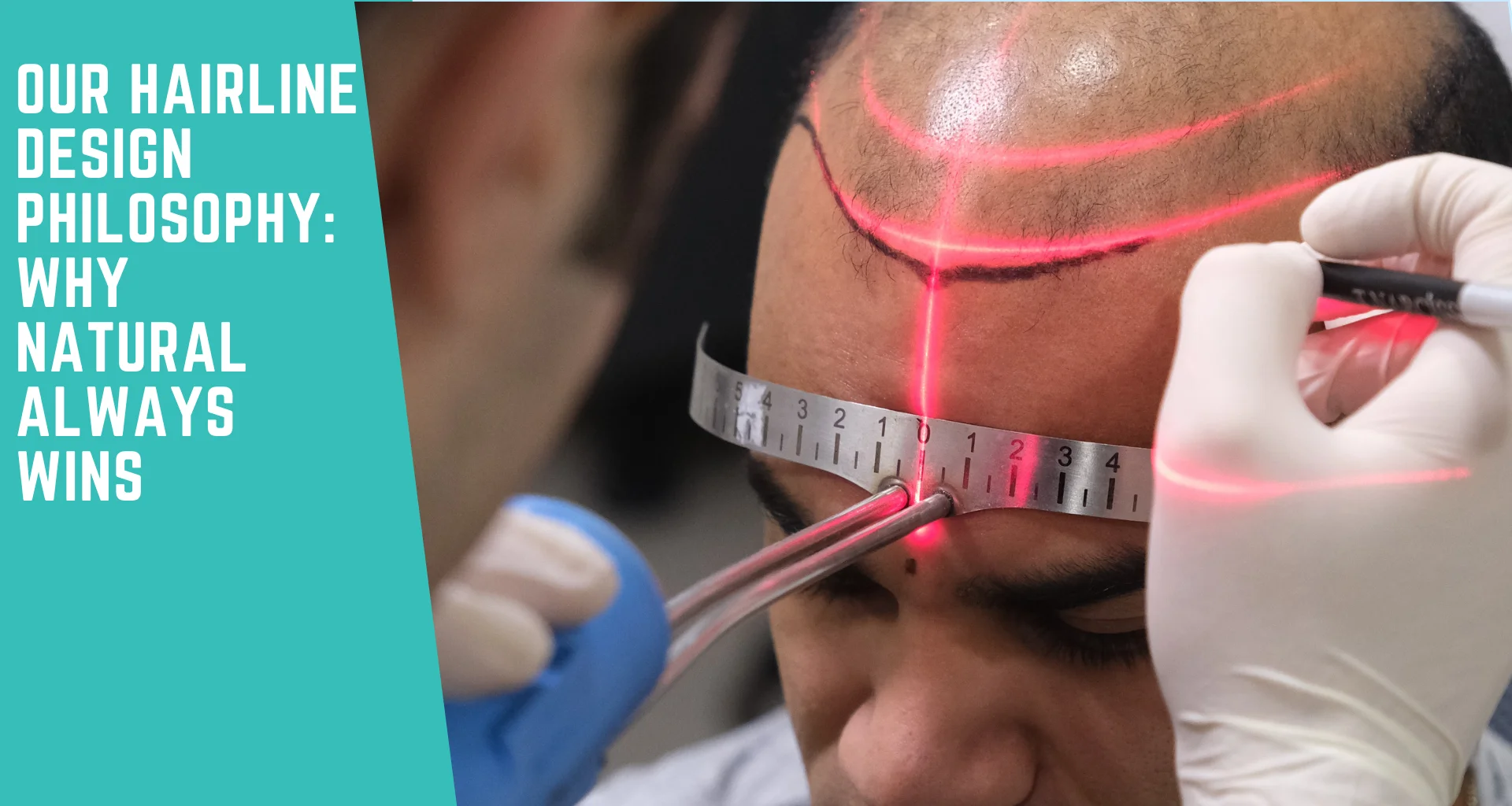

Can you ask for a lower hairline during a hair transplant? Yes, but the lowest possible hairline is not always the best long-term design.
At UniquEra clinic, the final hairline is planned around facial proportions, age, existing hair, donor capacity, natural growth direction and expected future hair loss. Patient preference matters, but it has to fit what the scalp can realistically support.
The result should look natural today without creating a problem several years later.
There is no single measurement that determines the correct hairline for every patient.
The final position depends on several factors:
| Factor | How it affects the design |
| Facial proportions | Helps determine the height and overall contour. |
| Age | Affects how conservative the position should be. |
| Existing hairline | Provides clues about the patient’s natural pattern. |
| Donor capacity | Limits how much area can realistically be restored. |
| Hair characteristics | Affect visual density and transition. |
| Growth direction | Guides the angle and flow of transplanted hair. |
| Future hair loss | Helps avoid a design that becomes difficult to maintain later. |
This is why hair transplant hairline design is part of the wider treatment plan rather than a separate cosmetic decision.
See How UniquEra clinic Designs a Personalized Hair Transplant Plan for how hairline, graft count, donor supply and technique are planned together.
Face shape affects the height, width and contour of a transplanted hairline. Two patients with similar recession may therefore need different designs.
A hair transplant plan based on face shape considers the relationship between:
The purpose of facial proportion analysis in a hair transplant is not to create mathematical perfection. It is to position the line so it looks consistent with the patient’s own face.
Yes. The patient’s preferred height and shape are discussed before the final design is approved.
However, requesting a particular line does not automatically make it medically appropriate.
If the requested design fits the patient’s anatomy, donor supply and long-term hair-loss pattern, it can be incorporated into the plan.
If not, a different position may be recommended.
A lower hairline increases the area that must be covered and can require considerably more donor grafts.
Using those grafts at the front may leave fewer available if native hair later thins through the mid-scalp or crown.
A very low line can therefore affect:
This is why an age-appropriate hairline transplant and donor preservation are connected.
Read How UniquEra clinic Preserves Your Donor Area for Future Hair Loss for more on why the maximum possible graft count is not always used.
Natural hairlines usually contain small variations rather than one rigid row of equally thick hairs.
The frontal edge requires particular attention to graft selection and placement.
| Frontal planning | Purpose |
| Single-hair follicular units near the edge. | Creates a softer transition. |
| Higher-hair-count units farther behind. | Adds visual density. |
| Small variations in the frontal outline. | Avoids a rigid appearance. |
| Planned angle and direction. | Helps grafts follow the intended natural flow. |
This is why single-hair grafts in the hairline, irregularity, angle and direction can matter as much as the shape drawn on the forehead.
For the technical side of this topic, read Why Hairline Design Depends on More Than Technique Alone.
Yes. The final design considers the possibility that native hair behind the transplant may continue thinning.
Future hair loss can influence:
A natural-looking hairline should not be planned only around the scalp seen on surgery day.
No. Online photographs can support the initial treatment plan, but the final hairline is confirmed after physical assessment in Istanbul.
The process is:
Online assessment → physical scalp and donor assessment → final graft and treatment-zone review → hairline design → patient discussion and agreement → documented treatment plan.
The doctor responsible for the medical plan confirms the final hairline before the procedure begins.
For the full consultation sequence, read What Happens During a Hair Transplant Consultation at UniquEra Clinic?.
The requested design is discussed rather than automatically accepted or rejected.
If it can be supported by the donor area and long-term plan, the design can be adjusted.
If a lower or denser hairline would require unnecessary grafts or create problems as hair loss progresses, the medical team can explain why a different design is recommended.
| Patient request alone | What also needs to be considered |
| “I want it this low.” | Donor capacity and future loss. |
| A celebrity hairline photo. | The patient’s own facial proportions. |
| Maximum frontal density. | Donor preservation and natural transition. |
| A perfectly straight line. | Natural variation, graft type and direction. |
| DHI or Sapphire FUE | The actual placement plan. |
Before agreeing to the design, you should know:
Not sure how low your hairline can realistically be? Send UniquEra clinic your photos for an initial assessment of your facial proportions, hair-loss pattern and donor area.
The final design is medically confirmed after physical assessment and discussed with the patient before treatment.
Yes. The request can be accepted if the donor supply, facial proportions and long-term plan support it.
Yes. Age and likely future hair loss can influence how conservative the final position should be.
They help create a softer transition instead of a dense, artificial-looking frontal edge.
Yes. Physical examination can change the working design before the final hairline is agreed.