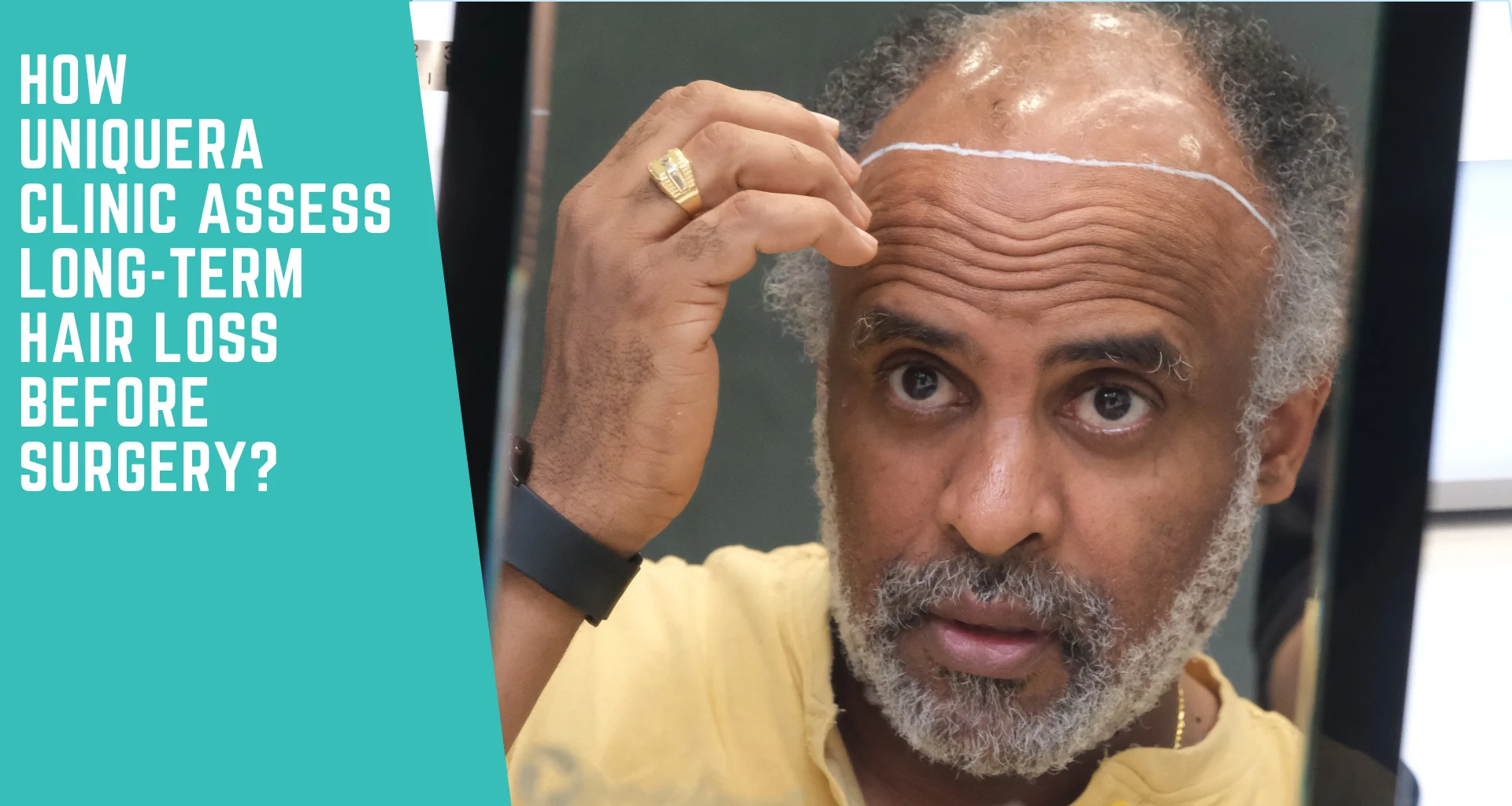

A hair transplant can restore areas where hair has already been lost. It does not stop the rest of your native hair from continuing to thin.
That is why UniquEra Clinic does not plan surgery around the bald area alone.
Before deciding the hairline, graft number or areas to treat, the assessment considers your current hair-loss pattern, age, existing native hair, donor capacity, previous procedures and likely future progression.
The question is not only:
“Where have you already lost hair?”
It is also:
“What might your scalp need if this pattern continues?”
Long-term hair loss assessment looks at both the hair already lost and the native hair that may still be at risk.
| What is assessed | Why it matters |
| Current hair-loss pattern. | Shows which areas are already affected. |
| Hair-loss history. | Helps establish how the pattern has changed over time. |
| Age. | Gives context to how early or advanced the current pattern is. |
| Existing native hair. | Shows which areas may continue thinning. |
| Donor condition. | Determines what supply may be available now and later. |
| Previous transplants. | Shows how much donor hair has already been used. |
| Likely future progression. | Influences hairline position, graft distribution and coverage. |
No single factor decides the treatment plan on its own.
Because transplanted hair and your remaining native hair do not necessarily follow the same future pattern.
Native hair behind or around the transplanted area may continue thinning.
For example, rebuilding a low frontal hairline without considering future recession behind it could leave a strong transplanted line with thinning native hair farther back.
Long-term planning therefore affects where grafts are used today and what needs to remain possible later.
Age matters, but UniquEra Clinic does not use age alone to decide whether someone should have surgery.
The Hair Transplant Surgeon considers age together with the current pattern, rate of progression, existing hair and donor capacity.
For a younger patient with active loss, the plan may need to be more conservative.
That can affect:
This is also why hairlines are planned around future progression rather than simply being placed as low as possible.
Read Our Hairline Design Philosophy: Why Natural Always Wins for how long-term loss affects hairline design.
Expected progression can change the hairline, graft count, density and areas selected for treatment.
| If future planning suggests… | The treatment plan may… |
| Further recession behind the hairline. | Use a more sustainable frontal design. |
| Future mid-scalp thinning. | Avoid using unnecessary grafts at the front. |
| Crown progression | Preserve donor supply for later treatment. |
| Large multi-zone loss. | Prioritize one area rather than treating everything equally. |
| Limited donor capacity. | Reduce graft numbers or coverage expectations. |
The aim is not to predict exactly how the scalp will look many years from now.
It is to make today’s treatment plan with likely progression in mind.
UniquEra Clinic may recommend waiting rather than proceeding immediately.
If hair loss is changing quickly, operating too early can make long-term planning more difficult.
Waiting may also be recommended when:
Being advised to wait does not automatically mean the patient will never qualify.
Read Why We Sometimes Reject Hair Transplant Patients for more on how candidacy decisions are made.
The donor area may need to support more than one stage of hair restoration during a patient’s lifetime.
That is why UniquEra Clinic considers:
Using more grafts than necessary in the first procedure can reduce the options available if native hair continues thinning.
See How UniquEra Clinic Preserves Your Donor Area for Future Hair Loss for how donor reserves are considered from the first treatment plan.
Yes, but the remote assessment is preliminary. The final treatment plan is confirmed after physical assessment in Istanbul.
The process starts with photographs, medical history, hair-loss history, previous treatment information and the patient’s expectations.
The case is reviewed medically before travel.
After arrival in Istanbul, the Hair Transplant Surgeon physically reassesses:
The final hairline, graft number, technique and restoration strategy are then confirmed before the procedure.
For the complete process, read What Happens During a Hair Transplant Consultation at UniquEra Clinic?
Before proceeding, you should know:
A treatment plan should explain what happens if your hair loss continues, not only what will be transplanted today.
Not sure whether your current hair-loss pattern is ready for surgery? Send UniquEra Clinic your photos and hair-loss history for an initial assessment before making your treatment decision.
Yes. Current pattern, age, existing native hair, donor capacity and likely future progression are considered before the final treatment plan.
Yes. A hair transplant does not stop future thinning of non-transplanted native hair.
Yes. UniquEra Clinic may recommend waiting when hair loss is progressing too rapidly for a reliable long-term plan.
Yes. Graft allocation may be adjusted to preserve donor supply and future treatment options.
No. The initial remote assessment is preliminary. The final plan is confirmed after physical examination in Istanbul.