
Most people walk into a hair transplant consultation with no idea what to expect. They do not know what a good one looks like, what questions actually matter, or how to tell a real clinical assessment from a quick pitch with a price at the end.
That gap is a problem. A consultation shapes everything. It is where your technique gets decided, where your graft count gets estimated, and where your expectations either get set properly or left vague.
This guide covers both halves of that question. What actually happens during a hair transplant consultation, step by step. And what you should ask to know whether you are in good hands.
| Not sure if you are ready for a consultation? Book your Hair Transplant consultation today with one of Turkey’s best hair transplant clinics. |
A hair transplant consultation is a structured medical assessment. It is not a sales call. Its job is to evaluate whether you are a suitable candidate, understand your hair loss pattern, estimate what is achievable, and build a plan specific to your case.
The International Society of Hair Restoration Surgery (ISHRS) describes the consultation as the most important conversation you will have before any hair restoration procedure. It covers your goals, expectations, candidacy, and treatment options.
Most consultations run between 30 and 60 minutes. Online consultations are usually shorter but should still result in a written plan. In-person consultations at the clinic include a physical scalp examination and take longer.
Both can be legitimate starting points. They serve different purposes at different stages.
An online consultation happens before you travel. You submit photos of your scalp from multiple angles, share information about your hair loss history, and join a video call with a medical consultant.
During the call, the consultant reviews your photos, asks about your timeline and goals, and gives you an initial assessment. You should leave with a clear sense of whether you are a candidate, which technique is likely suitable, an estimated graft count, and realistic expectations for coverage.
A proper online consultation ends with a written report sent to you by email. If a clinic only gives you a WhatsApp message with a price, that is not a consultation.
The in-person consultation happens on the day you arrive at the clinic, before surgery begins. This is where the medical expert physically examines your scalp, assesses your donor area under direct observation, draws the hairline on your scalp, and confirms everything agreed during the remote phase.
It also includes a blood test. This is standard safety protocol. Results are reviewed before anything proceeds.
Nothing agreed remotely is assumed to be final. The in-person review is a second check. If anything has changed, it is addressed before you enter the operating room.
Start with an online consultation. It lets you assess the clinic without committing to travel. If the clinic cannot give you a clear, written plan from photos alone, that tells you something important before you book a flight.
Whether online or in-person, every proper consultation follows a clear sequence. Here is what each step involves.
Before the call, you send clear photos of your scalp. Front, top, sides, and the back (donor area). The clinic uses these to begin the assessment before you speak.
You will also be asked how long you have been losing hair, whether hair loss runs in your family, what medications you take, and whether you have had any previous hair procedures. These questions are not formalities. They determine candidacy and technique.
The donor area is the back and sides of your scalp. This is where hair follicles are taken from. Its quality determines how much can be done.
The consultant assesses donor density, meaning how many follicles are available per square centimetre. They also look at hair calibre (thickness), miniaturisation (how many existing hairs are already weakening), and the safe harvest zone.
Poor donor density does not always mean surgery is impossible. It means the plan needs to be adjusted. A responsible clinic tells you this clearly, rather than promising coverage that the donor area cannot support.
Hair loss follows predictable patterns. In men, the Norwood Hamilton Scale is used, running from stage 1 (minimal loss) to stage 7 (advanced baldness). In women, the Ludwig Scale is used.
Your current stage and likely future progression both matter. A consultation that only looks at where you are now, without considering where your hair loss is going, produces a plan that may look good for two years and wrong for ten.
A graft is a small unit of follicles. Each graft contains one to four hairs. Your graft count is estimated based on the area to be covered and the density target.
Here is a simple reference for what graft counts typically mean in terms of coverage:
| Graft Count | Coverage Area | Approximate Result |
| 1,000 – 1,500 grafts | Hairline only or temples. | Subtle, targeted improvement. |
| 2,000 – 2,500 grafts | Frontal area and hairline. | Approx. 30% overall coverage. |
| 3,000 – 3,500 grafts | Frontal + mid-scalp. | Approx. 40-50% overall coverage. |
| 4,000 – 5,000 grafts | Full scalp including crown. | Extensive coverage, requires rich donor area. |
Note: Coverage estimates vary depending on your hair type, calibre, and donor density. These are general guides, not guarantees.
FUE and DHI are the two main techniques. Most clinics treat this as a patient preference. It is not. The right technique is a clinical recommendation based on your graft count, donor area quality, and how much skin trauma is appropriate for your case.
This decision is made at the consultation. You will understand more about how that works in the next section.
Hairline design is not a cosmetic preference. It is a clinical act. The hairline is drawn with specific rules governing where it sits relative to your facial proportions, where it will look natural as you age, and what the donor area can actually support.
A patient who asks for a very low hairline may get one that looks fine at 35 and wrong at 55. An experienced medical team explains this. They do not just draw what you ask for.
This is often skipped. It should not be. Before you leave the consultation or before you receive a booking confirmation, you should have a written document.
A proper treatment plan includes your diagnosis, the recommended technique, estimated graft count, target coverage areas, hairline design notes, timeline for results, and aftercare outline. This is not a quote. It is a treatment plan.
Your hairline is the first thing people notice. It is also the hardest thing to fix if it is wrong.
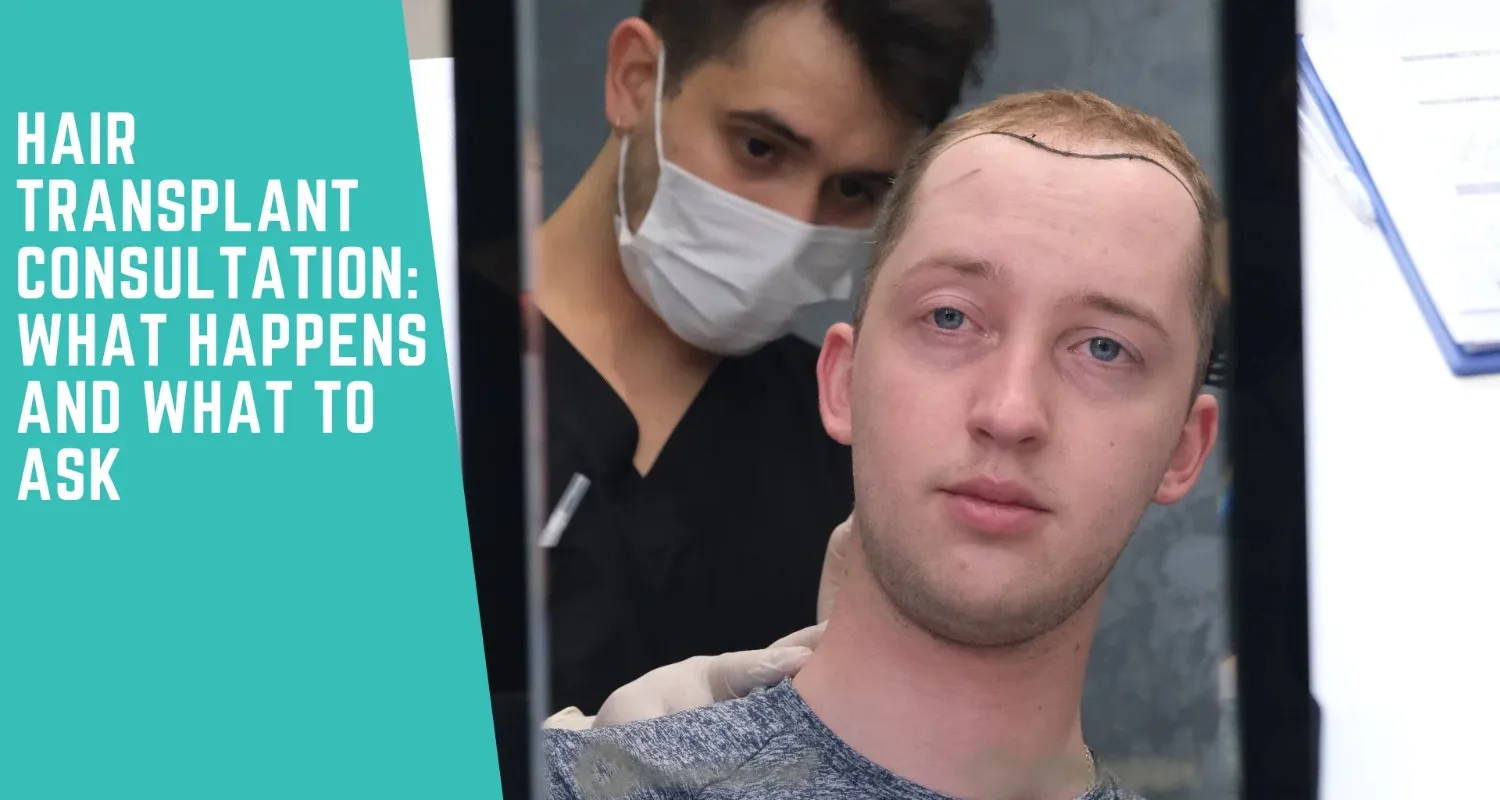
During the consultation, the medical expert draws the proposed hairline on your forehead with a marker. This is done with your face proportions in mind, not just your preference. The standard reference is the golden ratio between your facial thirds. The hairline should sit at the junction of your upper and middle facial third.
Age matters too. A hairline designed for a 30-year-old can look out of place on a 50-year-old if the surrounding natural hair has continued to thin. A responsible consultation accounts for your likely future hair loss pattern and designs a hairline that stays appropriate over time.
The hairline design is finalised and photographed before surgery. Nothing proceeds until you have agreed to it in writing.
This is one of the most common questions at consultation. The honest answer is that you do not decide. The clinic does, based on your case.
| FUE (Sapphire) | DHI (Choi Pen) |
| Best for larger graft counts (2,000+). | Best for precision and smaller areas. |
| Extraction, channel opening, then implantation. | Extraction and implantation in one step. |
| Single-day sessions standard. | Two-day procedures possible due to less skin trauma. |
| High-volume coverage across broad areas. | High density and precision placement. |
FUE hair transplant is the standard choice for larger graft counts, typically 2,000 and above, where broader coverage is needed. The technique involves extraction, opening microchannels with a sapphire blade, and then implanting grafts with forceps. It allows high volume in a single session.
DHI hair transplant involves extracting and implanting in one step using a Choi pen. There is no channel-opening stage, which means less skin trauma. This makes it suitable for precision work on smaller areas and allows two-day procedures when graft counts are high, because the donor area recovers faster between sessions.
If your donor area is very strong and your hair loss is extensive, the clinic may recommend a two-day DHI procedure rather than a single large FUE session. This is a clinical decision. It is made at the consultation after examining your scalp.
Most guides focus on what you should ask the clinic. This one goes further. A proper medical assessment runs both ways. If a clinic only talks about what they offer and never asks about your case in depth, that is a signal.
Here is what a quality clinic should ask you before recommending anything:
• How long have you been losing hair, and is it still progressing?
• Has anyone in your family experienced advanced hair loss?
• What medications are you currently taking?
• Have you tried any hair loss treatments such as finasteride or minoxidil?
• Have you had any previous hair procedures?
• What is your primary goal: hairline, crown, or full coverage?
• How realistic are your expectations about density and timeline?
• Are you willing to continue hair loss treatment after the transplant to protect existing hair?
If a clinic skips most of these and moves straight to pricing, that is a warning sign.
This is the document most clinics do not give you. It is also the clearest sign that a clinic is treating you as a patient and not a booking.
A proper written treatment plan should include the following:
• Your diagnosis and current hair loss stage (Norwood or Ludwig).
• Recommended technique (FUE or DHI) with the reason for that recommendation.
• Estimated graft count and target density.
• Coverage areas to be treated.
• Hairline design notes.
• Expected timeline for growth (initial shedding, early growth, full result).
• Aftercare outline.
• Any honest limitations based on your donor area.
If what the clinic sends after a call is a price and a booking link, ask for the plan first. If they cannot provide one, keep looking.
These questions are not just formalities. Each one gives you information that changes your decision. For every question below, we explain why it matters.
This is the most important question you can ask. The ISHRS has issued consumer alerts specifically about this issue. Donor harvesting, hairline design, channel creation, and graft placement should be performed or directly supervised by a qualified medical professional, not delegated entirely to unlicensed technicians.
Ask clearly: will the person I met in the consultation be the one overseeing my procedure? Ask who else will be in the room and what their role is. The American Society of Plastic Surgeons recommends asking specifically whether the facility is accredited and whether the person performing your procedure holds relevant credentials.
A graft count without an honest coverage estimate is not useful. Ask what percentage of coverage you can expect from the recommended number of grafts, given your specific donor area.
A clinic that gives you a number without explaining what it delivers in practice is leaving the most important part out.
Ask this even if the clinic has already mentioned a technique. You want to hear the clinical reasoning, not just the name. If the consultant cannot explain why FUE fits your case better than DHI, or vice versa, the recommendation may not be based on your scalp at all.
Not everyone is a good candidate at every stage of hair loss. Peer-reviewed research published in PMC/NCBI notes that poor candidates include those with unstable hair loss, insufficient donor supply, or unrealistic expectations. A good clinic will tell you if now is not the right time.
Ask the consultant to describe your donor area specifically. How dense is it? Is there any miniaturisation? How many grafts can safely be extracted without depleting it? This is the raw material for your entire procedure. You should understand its condition before agreeing to anything.
Transplanted hair is permanent because it comes from the safe donor zone. But your existing natural hair can continue to thin. If this is not planned for in the hairline design and coverage plan, you may need a second procedure sooner than expected.
Ask what your projected hair loss progression looks like and whether the plan accounts for it.
Ask for an itemised breakdown. Some clinics quote a per-graft price that does not include anaesthesia, aftercare, medications, or follow-up visits. Others offer all-inclusive packages. Make sure you know what you are comparing when you look at different clinics.
The consultation is one appointment. The recovery is twelve months. Ask what happens after you go home. How often will the clinic check in? Is there a written aftercare protocol? Can you reach someone if you have concerns at month two or month six?
A good consultation has a clear structure and leaves you with documented information. A poor one leaves you with a sense of urgency and a quote. Knowing the red flags when choosing a hair transplant clinic in Turkey will help you tell the difference before you commit.
Watch for these warning signs:
• The price is given in the first five minutes, before your scalp has been reviewed.
• No one asks about your medical history, current medications, or hair loss timeline.
• The technique is described as your choice, not a clinical recommendation.
• Results are guaranteed. No hair transplant result can be guaranteed.
• The future progression of your hair loss is never mentioned.
• You receive no written plan after the consultation.
• The person you speak to in the consultation is different from anyone involved in your procedure.
The ISHRS Fight the Fight campaign advises patients to always ask whether a licensed physician will be performing their procedure, and warns specifically about high-pressure sales environments where clinical evaluation takes a back seat to closing a booking.
| If you have been through a consultation that felt more like a sales call than a medical assessment, you are not alone. We are happy to review your case and give you an honest second opinion, in writing, before you decide anything. |
If you are considering a hair transplant in Turkey, the consultation process starts well before you book a flight. Most reputable hair transplant clinics in Turkey run a structured remote consultation phase first. This protects both you and the clinic.
Here is how it typically works at a quality hair transplant clinic in Turkey:
When you arrive at the clinic, the remote consultation is reviewed in person. Your scalp is examined physically, the hairline is drawn, blood tests are completed, and the surgical plan is confirmed in writing before anything begins.
This is the standard a good hair transplant Turkey clinic should hold. If a clinic skips the remote assessment and only reviews your case on the day you arrive, that is a structural problem. You should not be making decisions about a surgical plan hours before it happens.
There are hundreds of hair transplant clinics in Turkey. Most describe their consultation in terms of their team credentials or technology. We are going to describe ours differently. Here is exactly what happens from your first message to the moment you sit down in the clinic.
We do not have call centre agents. The person you speak to is a trained medical consultant. Their job is to understand your case, not close a deal.
Before the call, we ask you to fill in a short intake form. It covers how long you have been dealing with hair loss, what you have tried, what your main goal is, and how soon you are thinking about moving forward. We also ask for photos. Five angles: front, top, left side, right side, and the back of your head.
This means by the time we speak, we have already reviewed your case. The call is not a discovery session for us. It is a real assessment for you.
After the video call, we prepare a PDF report. It includes your diagnosis, the technique we recommend and why, an estimated graft count, expected coverage by area, and a realistic timeline for results.
This is not a quote. It is a treatment plan. You have something in writing before you commit to anything.
Most clinics send a WhatsApp message with a price. We send a document you can read, question, and keep.
We do not show you a generic gallery. When you are on the call, we pull before and after cases that match your specific situation. Same hair texture, same loss stage, same age range where possible.
This is the only honest way to set expectations. Showing someone with thick, dark hair the result of a patient with fine, light hair does nothing useful. The photo only builds trust if it is actually relevant to your case.
If your donor area has limitations, we say so. If your hair loss is still progressing and the timing may not be right, we say that too. If a certain level of coverage is not achievable given your donor supply, we explain why before you book a flight.
Honest admissions during a consultation are not weakness. They are the reason our patients come back and refer others. What we promise in the consultation is exactly what gets delivered at the clinic. That is what separates the best hair transplant clinics in Turkey from the ones that look good on a price list and disappoint in person.
On arrival in Istanbul, you go through a blood test first. This checks for HIV and hepatitis. It is a non-negotiable safety step that happens before you enter the consultation room.
After clearance, you meet the medical expert in person. They examine your scalp directly, assess your donor area physically, and draw the hairline on your scalp with a marker. Everything agreed during the remote consultation is reviewed again, in person, and confirmed in writing before you go into the operating room.
If anything looks different from the photos, it is addressed before the procedure begins.
A hair transplant consultation is where your entire procedure gets planned. The technique, the graft count, the hairline, the timeline. If the consultation is thorough, the rest of the process has a clear foundation. If it is thin, you carry that uncertainty all the way to the operating room.
This matters especially if you are considering a hair transplant in Turkey. The distance between your home and the clinic means the remote consultation does more work than it would locally. It has to establish trust, set expectations, and produce a written plan before you book anything. A good hair transplant Turkey clinic handles this seriously. A poor one sends you a price and a booking link.
You now know what a proper consultation includes, what to ask, and how to read whether the clinic in front of you is doing it properly. Use that knowledge before you commit to anything.
Ready to understand your options properly? Book your Hair Transplant consultation today or call now.
Ask who performs the procedure, how many grafts you need, which technique fits your case, and what your donor area can realistically support.
Expect scalp assessment, donor analysis, hair loss classification, graft estimation, technique recommendation, and a written treatment plan.
Usually the frontal area and mid-scalp with moderate density. Coverage depends on hair thickness, donor quality, and scalp size.
Yes. Clear photos and a structured video consultation are usually enough to create an initial treatment plan before in-person confirmation.
Online consultations usually take 20-40 minutes. In-person consultations take longer because they include scalp examination and hairline design.
Yes. A proper consultation helps determine whether now is the right time or whether your hair loss should stabilize first.
Most reputable clinics offer free online consultations before any travel or booking commitment.
The Norwood scale classifies male pattern baldness from stage 1 to 7 and helps estimate graft needs and long-term planning.
The Ludwig scale classifies female hair loss patterns and helps guide treatment planning in women.
No. Hair shaving is not required during consultation. Existing hair actually helps evaluate your current loss pattern.
A clinic may recommend waiting or stabilizing hair loss first to avoid future imbalance as native hair continues thinning.