
No, finasteride is not required after a hair transplant.
The transplanted hair comes from your donor area, which is naturally resistant to the hormone that causes pattern baldness. That resistance stays with the follicle after it is moved. Finasteride cannot change that, and it does not make your grafts work better.
What finasteride does is slow down future thinning in the hair you already had before surgery. That is a different job entirely. And whether you need it for that purpose depends entirely on your hair loss pattern, your age, and how far your loss is likely to progress.
Hair loss already makes men question enough. After deciding on surgery, the last thing anyone wants is a daily pill hanging over the result. So let us be clear about what finasteride actually does and does not do, so you can make this decision without fear driving it.
At UniquEra Clinic, finasteride is not a standard post-operative requirement. Every patient’s case is different, and medication decisions are discussed carefully, not pushed automatically.
| Thinking about hair transplant surgery but unsure about post-operative medication? Our medical consultants review each case personally and send a written plan before you commit to anything. |
What is finasteride and how does it work?
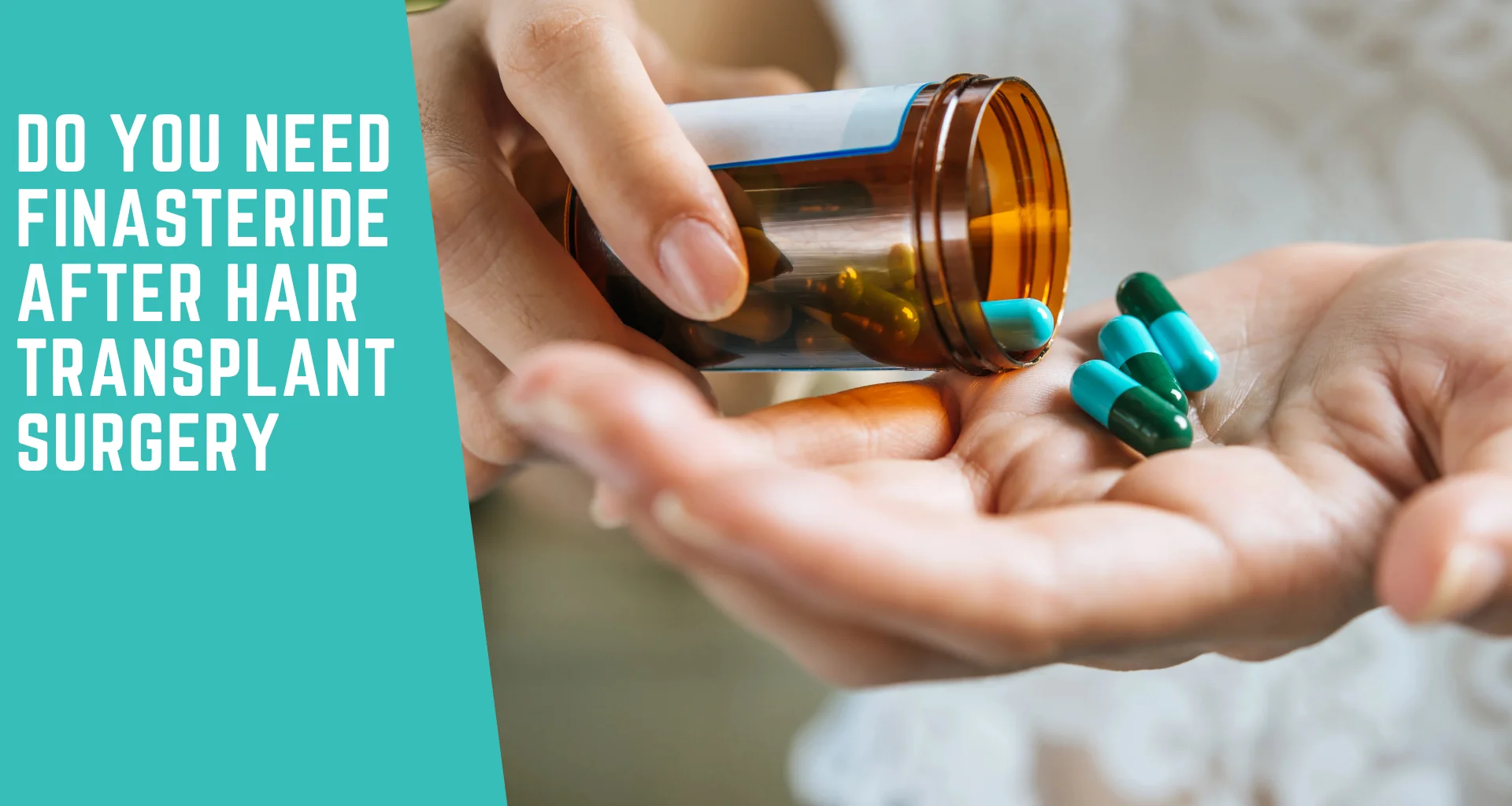
Finasteride is a prescription medication used for male pattern hair loss. It works by reducing DHT, a hormone linked to hair follicle miniaturisation in men with androgenetic alopecia.
DHT is a byproduct of testosterone. In men who are genetically sensitive to it, DHT gradually shrinks hair follicles over time until they stop producing hair. Finasteride blocks the enzyme that converts testosterone into DHT, which can slow this process for some men.
But finasteride is not a vitamin. It is not a basic aftercare product. It is a medication with a documented mechanism, a documented benefit for some patients, and documented risks for others – which is why understanding what DHT is and how it causes hair loss helps you evaluate whether finasteride is relevant to your case. This is why it should never be treated as something every hair transplant patient must take without a proper individual discussion.
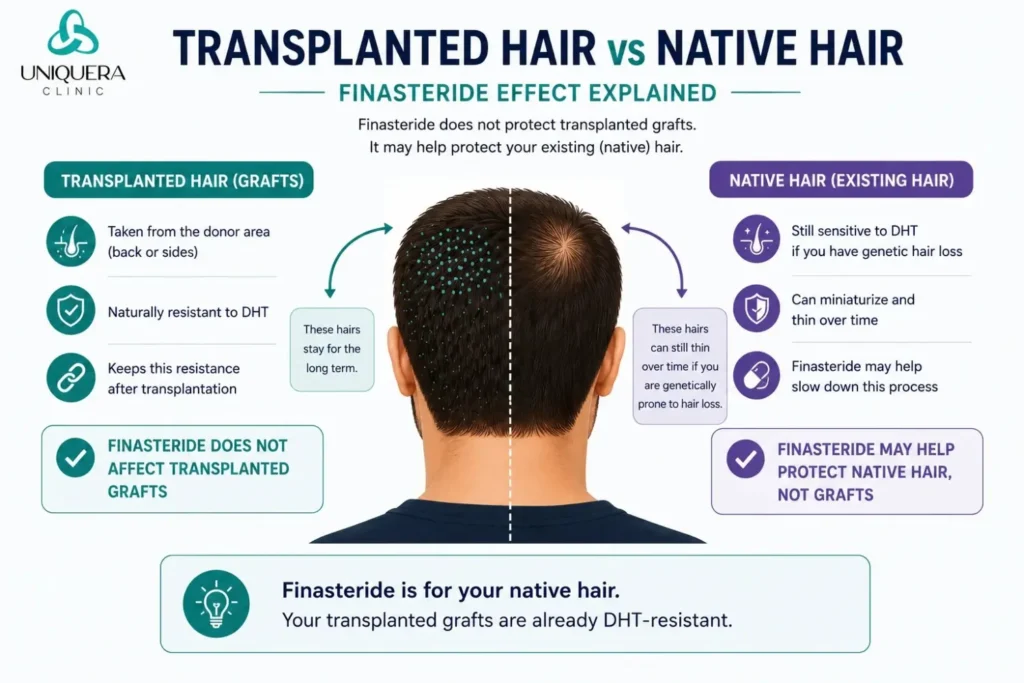
No. This is the most misunderstood point about finasteride after hair transplant surgery.
Transplanted hair grafts are taken from the donor area at the back and sides of your scalp. This area is naturally more resistant to DHT. That resistance is why donor hair is used. Once transplanted, those follicles carry that same resistance with them into the new location.
Finasteride does not make the grafts more resistant, or less resistant. The transplanted hair behaves like donor-area hair regardless of whether you take finasteride.
What finasteride may help with is your remaining native hair. The hair you had before surgery, behind the hairline, in the mid-scalp, or around the crown, is still susceptible to DHT if you are genetically prone to hair loss. Finasteride’s role is to protect that hair, not the grafts.
No, finasteride is not necessary for every patient.
A hair transplant moves stronger follicles from the donor area to the thinning or bald area. Those grafts are expected to behave like donor-area hair. Once they heal and grow, they are generally there for the long term.
The real question is not whether finasteride is necessary for the grafts to work. The better question is whether your original hair is still likely to thin after the transplant.
If your hair loss is still active, you may lose more native hair over time. The grafts will remain, but the hair around them may thin. This can change how your result looks. If your hair loss has already slowed or stabilised, the picture is different.
That assessment should happen during your consultation, not after your surgery.
Yes. Many patients have successful hair transplant surgery without finasteride, provided the surgical plan is built with their future hair loss pattern in mind from the start.
This is more likely to work well when:
• Your hair loss pattern is already stable.
• You are older and your future hair loss is easier to predict.
• Your donor area is strong and healthy.
• Your hairline design is conservative, not overly low or dense.
• You understand that existing native hair may still thin later.
• You do not want long-term medication.
• You have had side effects from finasteride before.
This does not mean every patient should avoid finasteride. It means finasteride should not be a forced condition for surgery. A patient should be able to ask honest questions and receive honest answers before anyone discusses medication.
Questions like: will my transplant still grow without it? What happens if I lose more native hair later? Can my hairline be designed safely without medication? Will I need another session in the future?
These are normal questions. A serious clinic answers them clearly before booking anything.
Male pattern baldness can continue after surgery. A hair transplant fills areas that are already thin or bald. It does not stop the biological process that caused hair loss in the first place – which is why understanding DHT vs testosterone and the real cause of male pattern baldness is useful before deciding on any post-operative medication. The 2025 ISHRS Practice Census found that 72.3% of surveyed surgeons frequently prescribe finasteride before or after a hair transplant. This reflects how common the recommendation is in the industry.
So if a young patient restores the hairline but continues losing hair in the mid-scalp or crown, the final look may change over time. Finasteride may help slow that thinning in native hair. For some men, this can support fuller-looking long-term hair transplant results.
But there is a difference between ‘this may help your existing hair’ and ‘you must take this forever or your transplant will fail.’ The second statement is too extreme, and a good clinic should never say it.
Your transplanted hair can still grow. The main concern is the hair you already had before surgery.
If you restore the front hairline but continue losing hair behind it, you may later notice a gap between the transplanted grafts and the thinning native hair around them. This is why some men say they experienced hair loss after hair transplant surgery. In many cases the grafts are not the problem. The original hair around them kept thinning. If you suspect a poor result, it is worth reading about the top reasons hair transplants fail before drawing any conclusions. A clinical study published on PubMed found that patients taking finasteride from 4 weeks before until 48 weeks after hair transplant showed improved density in surrounding hair compared to a placebo group. The transplanted grafts were not the focus. The surrounding native hair was.
This is why planning matters more than medication.
If you do not want finasteride, your hair transplant plan should account for that from day one. The clinic should avoid wasting grafts on an overly low or dense hairline if your future hair loss risk is high. A safe plan may include a mature hairline, careful density planning, donor area protection, crown risk assessment, and future session planning.
The goal is not just to make the result look good in 12 months. The goal is to make sure it still makes sense years later.
This section matters. Finasteride is widely used, but it is not without risk for some patients. The regulatory picture has become more detailed in recent years, and patients deserve to know what is currently documented.
In April 2024, the UK’s Medicines and Healthcare products Regulatory Agency (MHRA) issued a formal drug safety update on finasteride. In May 2026, the MHRA strengthened those warnings further, updating product information for all finasteride-containing medicines after reviewing evidence including the outcome of a European regulatory review.
The documented side effects now include:
• Sexual dysfunction, including decreased libido, erectile dysfunction, and reduced semen volume. In some reported cases, these persisted after stopping the medication.
• Mood alterations including depressed mood and depression.
• Suicidal ideation. This is rare but documented. The MHRA has received reports and has acted on them.
The MHRA’s 2024 drug safety update noted that these side effects were not well known among prescribers or patients at that time. Patient alert cards were introduced into finasteride packaging to raise awareness. In June 2022, the FDA also updated the patient labelling for finasteride to include warnings about suicidal ideation, sexual dysfunction, and psychoneurocognitive adverse events.
Most patients tolerate finasteride well. The reported side effect rate for sexual dysfunction is approximately 2% in clinical data. But the operative word is ‘most.’ Some patients are not in that group, and they deserve to know that before starting treatment.
This is not a reason to dismiss finasteride. It is a reason to have a proper informed discussion before anyone takes it.
For patients who use finasteride and respond well to it, it is typically a long-term treatment. If someone stops taking it, the benefit gradually reduces. DHT levels return to normal, and hair thinning can resume.
This commitment is part of what patients should think through before starting. The question is not only ‘does it work?’ The question is also ‘am I comfortable taking medication indefinitely, given its known risks, for a benefit to my native hair?’
For some men the answer is clearly yes. For others it is clearly no. Both are valid. What matters is that the answer is the patient’s own, not a default assumption made by the clinic.
There is no universal timing that applies to every patient. Some men start finasteride before surgery to see whether they tolerate it. Some continue it if they were already using it before the transplant. Some never take it at all.
If you are considering it, the safest approach is to discuss it with a qualified medical professional before the procedure. The conversation should cover your age, your hair loss pattern, your family history, your current health, your concerns about side effects, and whether your hair loss is still active.
Starting finasteride is not something to do casually based on a clinic’s general recommendation. It is a decision that should be specific to your case.
If finasteride is not right for you, there are other approaches. None of them replace the specific mechanism finasteride uses. But some can support scalp health and native hair in different ways.
| Option | What it does | Limitation | Best for |
| Topical Minoxidil | Widens hair follicles, stimulates growth. | Does not reduce DHT. Must be used daily. | Most patients. |
| Oral Minoxidil (low dose) | Can be more effective than topical. | Blood pressure, fluid retention possible. | Under medical supervision. |
| PRP (Platelet-Rich Plasma) | Supports scalp health and graft recovery. | Not a DHT blocker. Results vary. | Post-op recovery support. |
| Low-Level Laser Therapy | Stimulates follicle activity. | Limited evidence for ongoing DHT protection. | Mild to moderate thinning. |
| Dutasteride | Stronger DHT reduction than finasteride. | Similar or greater side effect risk. | Discussed case by case. |
| Natural scalp care routine | Supports scalp health and hygiene. | Does not block DHT. | All patients post-op. |
No aftercare product should be sold as a direct replacement for finasteride. Aftercare supports healing, scalp comfort, and recovery. Finasteride works internally by reducing DHT. These are different things and should be discussed separately.
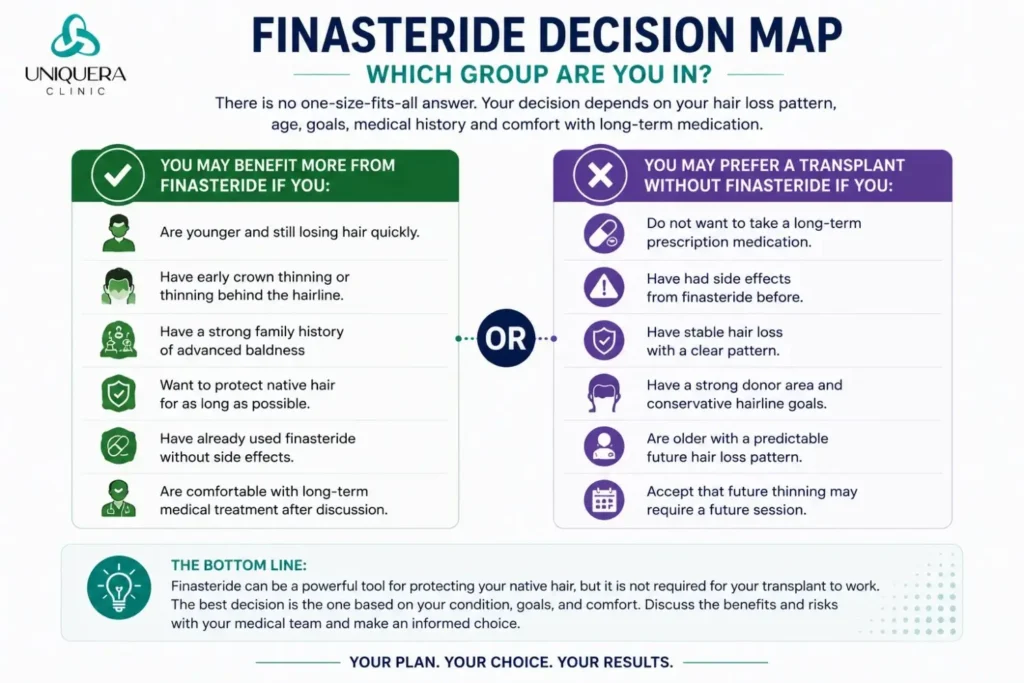
Finasteride may be more useful for patients who:
• Are you younger and still losing hair quickly?
• Have early crown hair loss or thinning behind the hairline?
• Have a strong family history of advanced baldness?
• Want to protect native hair for as long as possible?
• Have you already used finasteride without side effects?
• Are comfortable with long-term medical treatment after proper discussion?
Even for these patients, the decision should be personal. They should know both the possible benefit and the possible risk before agreeing to anything.
A hair transplant without finasteride may suit patients who:
• Do not want to take a long-term prescription medication?
• Have had side effects from finasteride before?
• Have stable hair loss with a clear pattern?
• Have a strong donor area and conservative hairline goals?
• Are older with a predictable future hair loss pattern?
• Want a surgical plan that does not depend on medication?
• Accept that future thinning may require a future session.
This is not a weaker approach. It is simply a different one. But it needs better planning upfront. A patient who avoids finasteride but still wants an aggressive low hairline, very high density, and full crown coverage in one session may not be setting themselves up for a result that holds long term.
The safest result is usually the one that respects your future hair loss, not just your current wish.
If you are not planning to take finasteride, your hairline design becomes more important, not less.
A low hairline may look exciting at first. But if you keep losing hair behind it, it can become difficult to maintain naturally. The grafts stay. The native hair behind them thins. Over time the result can look less even than it did at 12 months.
A mature, face-appropriate hairline is usually safer. Not because it is less impressive, but because it holds up better over a longer period, with or without medication. The art behind this is explained in detail in our guide on hairline design and why technique alone is not enough.
A good consultation should factor in your age, donor strength, forehead shape, current hair loss stage, crown condition, family history, future hair loss risk, and your willingness to take medication. All of these belong in the conversation before surgery. Not one or two of them.
Finasteride may improve the overall appearance for some patients by protecting the native hair around and behind the transplanted area. The PubMed clinical study referenced above found visible improvements in surrounding scalp hair in 94% of finasteride users compared to 67% in the placebo group after transplantation. The effect was on native hair, not on the transplanted grafts themselves.
But finasteride does not guarantee perfect results. It does not replace good surgery. A poor hairline design, weak donor planning, wrong graft placement, or poor aftercare cannot be fixed by taking finasteride.
The foundation of a good hair transplant is correct diagnosis, strong donor assessment, natural hairline design, proper graft handling, correct angle and direction, good aftercare, and honest long-term planning. Finasteride may support some results. It is not the foundation of any of them.
Before agreeing to anything, these questions are worth raising:
• Can my hair transplant be planned without finasteride?
• What areas of my scalp are still at risk of thinning?
• Is my donor area strong enough for future needs?
• Will this hairline still look natural as I age without medication?
• Am I likely to need a second session later?
• How will you protect my donor area long term?
• What aftercare support will I receive after surgery?
• Will you still guide me if I choose not to take medication?
These questions are more useful than simply asking for the maximum number of grafts. More grafts do not always mean a better result. A better plan means a better result.
At UniquEra Clinic, finasteride is not recommended as a standard post-operative step. It is not part of a default aftercare protocol. If a patient is thinking about it, that conversation belongs in the consultation, where their specific case, health history, and preferences can be properly reviewed.
The reason is simple. The goal of our consultation is not to create a patient who is dependent on long-term medication to maintain their results. It is to create a surgical plan that is honest enough to hold up on its own.
This means the hairline is designed with the patient’s future hair loss in mind, not just their current wish. The graft count is planned around what the donor area can realistically support, including the possibility of future sessions. The coverage decisions account for what happens in 5 to 10 years, not just 12 months.
For patients who have used finasteride before and want to continue, that is their decision to make with proper medical guidance. For patients who have had side effects, or who simply do not want long-term medication, that preference is respected from the first consultation and built into the surgical plan.
When you arrive at the clinic in Istanbul, the medical expert examines your scalp in person, draws the hairline physically on your scalp, and reviews everything agreed remotely before surgery begins. That includes any conversation about post-operative medication. Nothing is assumed. What was agreed is confirmed in writing.
Follow-up check-ins at 1, 3, 6, and 12 months are included. WhatsApp support runs throughout. If a patient has questions about their native hair thinning after surgery, that conversation is part of the ongoing relationship, not a separate paid consultation.
| Considering hair transplant surgery in Turkey but have questions about medication, planning, or what to expect? Send us your photos. We review every case personally. Book a call now. |
No, you do not always need finasteride after hair transplant surgery.
Finasteride may help some men protect their existing native hair, especially if hair loss is still active. But it is not mandatory. It should not be forced on every patient. And it comes with documented risks that every patient deserves to understand before deciding.
A hair transplant can be planned to work without finasteride. The key is honesty. If you do not want to take it, your clinic should know that before surgery. Your hairline, graft count, donor use, and long-term plan should all be designed with that in mind.
If you are comparing hair transplant Turkey options and want a plan that does not depend on pressure or default assumptions about medication, the starting point is a consultation that takes your actual preferences seriously. It also helps to know how to compare hair transplant clinics in Turkey before you book.
| Ready to understand what is realistic for your hair loss stage, donor area, and long-term goals? Book your Hair Transplant consultation today or call now. |
It depends on how active your hair loss is. If you are still thinning, finasteride may protect native hair around the grafts. If your loss is stable, the benefit may not outweigh the side effect risk for you.
It is ideal to keep taking Finasteride throughout your life (or for as long as you want to maintain your native hair density), it is generally a long-term treatment. Stopping allows DHT to return to normal and thinning to resume in most cases.
You can still have a successful transplant. The surgical plan should be built around that preference from day one, with a conservative hairline and careful donor planning.
Yes. Propecia is a brand name for finasteride 1mg, the dose used for male pattern hair loss. Proscar is finasteride 5mg, prescribed for prostate conditions.
No. Finasteride is not recommended for women and must not be taken during pregnancy. Female patients typically use minoxidil or other alternatives instead.
No. Transplanted grafts grow independently of finasteride. It only helps native surrounding hair, not the grafts themselves.
No. Transplanted grafts are DHT-resistant and are not affected by stopping finasteride. Your native surrounding hair may thin again, but the grafts remain.
Topical finasteride may reduce systemic absorption and lower side effect risk while providing similar hair protection. It suits patients who are concerned about the documented risks of the oral form.
It may reduce shock loss in native hair around the transplant site. It does not affect the transplanted grafts, which shed and regrow as a normal part of recovery. For a full explanation of this phase, read our guide on what shock loss is, its causes, timeline, and prevention.
No. Graft survival depends on surgical technique and handling. Finasteride plays no role in whether grafts take after surgery.
Yes. Clinical data shows finasteride is particularly effective at slowing hair loss in the vertex or crown. This is why it is often discussed more urgently for younger patients with active crown thinning.
Dutasteride blocks more DHT and may be more effective for some patients. It carries similar or greater side effect risks and requires proper medical guidance before use.
Some clinics recommend stopping briefly before surgery to reduce shedding risks during recovery. Others recommend continuing. This is a clinical decision for your medical team, not a universal rule.
Finasteride typically takes three to six months to show a measurable effect. Changes to surrounding native hair are usually visible after six to twelve months of consistent use.
Yes. Minoxidil works differently, improving blood flow to follicles rather than blocking DHT. It is a common alternative for patients who choose not to take finasteride.
Weight gain is not a documented side effect of finasteride. If weight changes occur while taking it, other factors are more likely responsible.
This needs careful medical review before starting. The MHRA has documented links between finasteride and depression and suicidal ideation. Patients with existing mental health conditions should discuss this specific risk with their doctor.
No. PRP supports scalp health and recovery but does not block DHT. It works differently and cannot replace finasteride’s mechanism for slowing native hair loss.
No. It slows hair loss while being taken. Stopping the medication allows thinning to resume in most patients.
Native hair around the grafts may thin if hair loss continues progressing. Conservative hairline planning and careful donor management reduce this risk without requiring lifelong medication.
Occasional alcohol is generally not contraindicated. Regular heavy drinking may increase mood-related side effect risk. Any concerns should be discussed with the prescribing doctor.
At 25 hair loss may still be progressing rapidly. Finasteride is sometimes more relevant in these cases, but the decision is still individual and should be made with proper medical guidance.
It may slow follicle miniaturisation, allowing existing hair to stay thicker for longer. This is a protective effect, not a growth stimulus.
Turkey hair transplant packages are typically all-inclusive covering surgery, accommodation, transfers, and aftercare. Exact cost depends on graft count and technique. A personal consultation is the only accurate way to get a figure for your case.
No. Finasteride is not a standard post-transplant step at UniquEra. If a patient wants to discuss it, the conversation happens during consultation based on their case and preference. The surgical plan is built to work without assuming medication will fill any gaps.
Yes. A properly planned hair transplant in Turkey does not need post-operative finasteride to succeed. What matters is that the clinic accounts for your future hair loss pattern in the surgical design from the start.