
No. Retrograde alopecia does not automatically disqualify you from a hair transplant. But it can reduce the amount of stable donor hair available, so the donor area needs to be assessed carefully before surgery is planned.
For most hair transplants, grafts are taken from the back and sides of the scalp because these areas usually remain more resistant to pattern hair loss.
Retrograde alopecia changes that assumption.
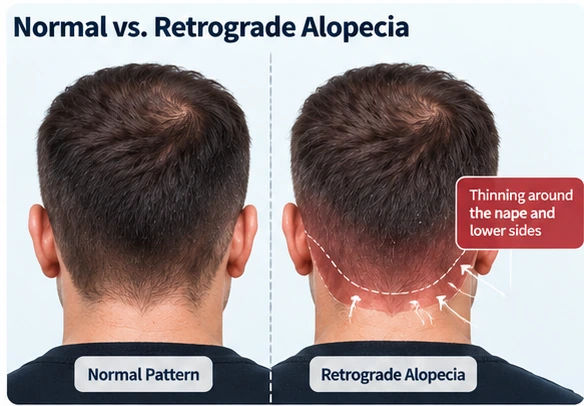
Instead of thinning being limited mainly to the hairline, top, or crown, hair can also become thinner around the nape and lower sides of the scalp. This can reduce the area from which dependable grafts can safely be extracted.
That does not always mean surgery is off the table. It means the question changes from:
“How many grafts do I need?”
to:
“How many stable grafts does my donor area actually have?”
If you have noticed thinning around your nape or sides and are unsure whether you can still have a transplant, send UniquEra Clinic clear photos of your front, top, crown, sides, and donor area. We can review whether your donor area appears suitable before you start comparing techniques or graft packages.
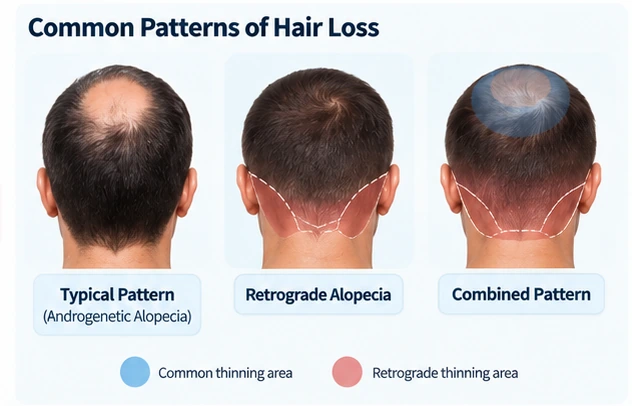
Retrograde alopecia is a pattern of thinning that affects the lower part of the scalp, particularly the nape and the areas around or above the ears.
In a typical case of androgenetic hair loss, recession is usually noticed at the temples, frontal hairline, top, or crown.
With retrograde alopecia, thinning can move upward from the lower boundary of the scalp.
This matters for hair transplantation because part of this lower region may normally appear to be usable donor hair.
If follicles in that area are already becoming finer or miniaturized, they may not be dependable grafts for transplantation.
The exact retrograde alopecia cause can vary, and thinning around the nape should not automatically be assumed to be retrograde alopecia.
In many patients, it can appear alongside androgenetic hair loss. Genetics and sensitivity of certain follicles to androgens may play a role.
However, thinning around the back or sides of the scalp can also occur for other reasons.
These may include:
A photograph may show that an area looks thin. It does not always explain why it is thinning.
That difference matters before graft extraction is planned.
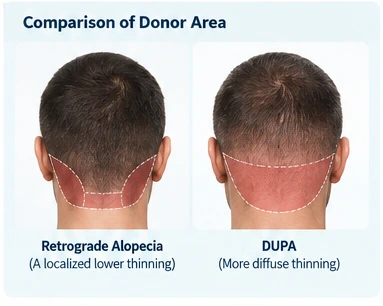
No.Retrograde alopecia and diffuse unpatterned alopecia, usually called DUPA, can both affect areas that are normally considered for donor harvesting, but their patterns are different.
| Factor | Retrograde Alopecia | DUPA |
| Typical pattern | Thinning around the lower nape and sides | More diffuse thinning throughout the donor region |
| Effect on donor area | May reduce the lower and side boundaries | May affect the donor region much more widely |
| Stable donor hair | A usable central donor zone may still remain | A dependable donor zone may be difficult to identify |
| Hair transplant | May still be possible in selected cases | Can be considerably more limited |
| Main concern | Reduced donor supply | Stability of the donor area itself |
This distinction is important because hair transplantation depends on taking follicles from an area expected to remain stable over time.
With retrograde alopecia, a stable donor region may still remain above the affected area.
With widespread diffuse thinning, that dependable region may be much harder to identify.
No. The deciding factor is how much stable donor hair remains.
Two people can both have retrograde alopecia and receive completely different recommendations.
One patient may have mild thinning around the lower nape while still having strong density through the central donor area.
Another may have thinning extending much higher, together with miniaturization around the sides and continued hair loss progression.
Their donor supplies are very different.
A hair transplant may still be considered when:
Surgery may need to be reduced, delayed, or avoided if the dependable donor zone is too small or shows significant ongoing thinning.
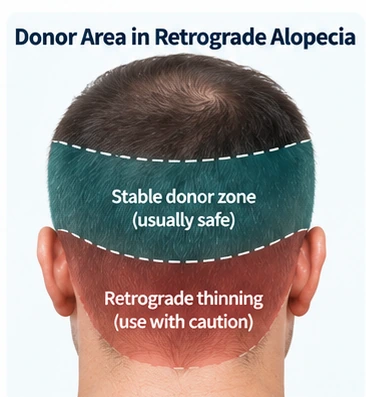
Hair transplant surgery redistributes existing follicles. It does not create new ones.
Every graft removed from the donor area represents a follicular unit that cannot simply be replaced later.
This becomes especially important when retrograde alopecia has already reduced the area available for extraction.
Imagine two patients who both want 3,500 grafts placed in the front and mid-scalp.
One has a wide, dense, and stable donor zone.
The other has significant retrograde thinning and a much smaller dependable donor zone.
Giving both patients the same graft recommendation simply because their bald areas look similar would ignore a major part of transplant planning.
The recipient area tells us what the patient wants restored.
The donor area tells us what can realistically be supplied.
A proper retrograde alopecia hair transplant assessment should look beyond whether there appears to be “enough hair” at the back.
Several factors need to be considered.
The lower boundary of the dependable donor area needs to be identified.
If retrograde loss has moved upward from the nape, the extraction zone may need to begin higher than it would in someone without this pattern.
The same applies around the sides of the scalp.
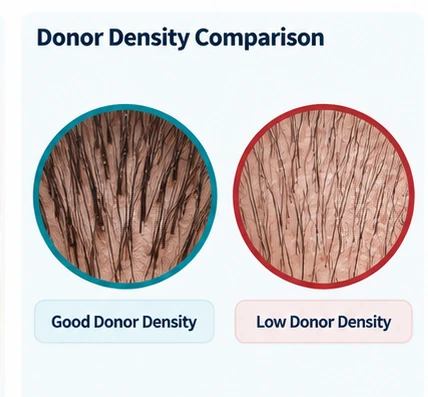
Donor density refers to how many follicular units or hairs are present within a measured area.
A donor area can look reasonably full when the hair is longer while still having lower density than expected.
Density therefore needs to be considered across the donor region rather than judged from one photograph or one small area.
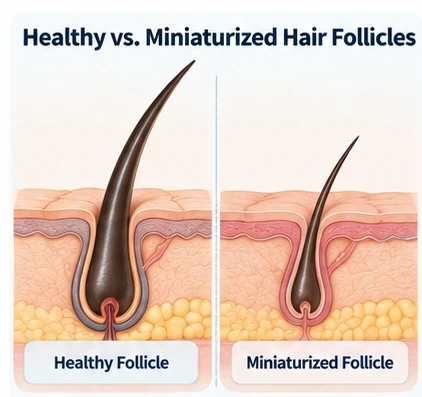
This is an important distinction.
Miniaturized follicles gradually produce finer and shorter hairs.
A region containing many miniaturizing follicles may not be a dependable source of long-term grafts, even when visible hair is still present.
This is one reason why visible hair does not automatically mean usable donor hair.
A transplant needs to account for the future, not simply how the scalp looks today.
Age, current pattern, family history, and the rate of hair loss progression all provide useful context.
This is particularly important in younger patients because the eventual extent of hair loss may not yet be clear.
The largest number that can technically be extracted is not automatically the correct number to use.
Safe graft availability depends on:
There is no universal graft number for someone with retrograde alopecia.
Already been quoted 3,500, 4,000, or 5,000 grafts from photographs? Before committing, send your donor-area photos to UniquEra Clinic. We can review whether that graft number appears realistic for your donor supply and what may need to be preserved for future hair loss.
Possibly.
People researching an FUE hair transplant in Turkey sometimes assume FUE solves donor limitations because grafts are removed individually.
It does not.
FUE describes the extraction method. It does not turn an unstable follicle into a stable one.
If follicles are taken from an area already affected by progressive miniaturization, the fact that they were removed with FUE does not change their biological characteristics.
The more useful question is therefore not:
“Can these hairs be extracted?”
It is:
“Should these hairs be used as donor grafts?”
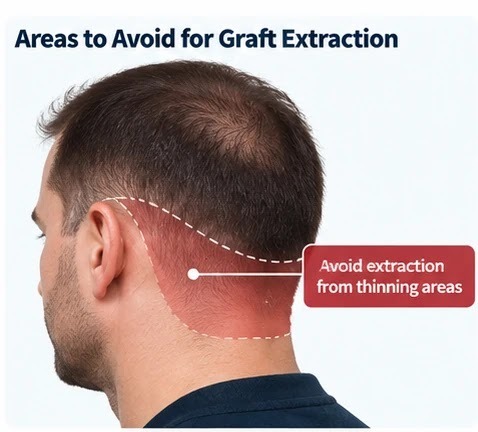
With retrograde alopecia, the lower nape and affected side areas may fall outside the dependable donor zone.
Extracting heavily from these regions can create two problems.
First, follicles from unstable areas may be less dependable over the long term.
Second, removing grafts from an already thin area can make the donor region look even weaker.
This is why graft extraction needs to be planned around the stable donor zone, rather than simply spreading extraction across the entire back of the scalp.
It can.
Retrograde alopecia may narrow the donor zone from below and around the sides.
That leaves a smaller surface area from which grafts can be safely distributed.
This can become especially important in someone who also has extensive frontal, mid-scalp, and crown hair loss.
There may simply be more area requiring restoration than the donor can reasonably supply.
This is where realistic expectations matter.
Rather than trying to spread limited grafts across every area, the plan may need to prioritise the regions that provide the strongest visual improvement.
For one patient, that might mean rebuilding a receding hairline and the frontal third while remaining conservative with the crown.
For another, it may mean using fewer grafts during the first procedure so that donor supply remains available if hair loss continues.
Aggressive extraction from a restricted donor area can create problems that may not be obvious immediately after surgery.
The donor area may later appear:
It can also leave fewer grafts available if another transplant becomes necessary in the future.
The front of the scalp should therefore never be planned in isolation.
A good transplant result includes the donor area too.
People searching for retrograde alopecia before and after photos often focus mainly on whether the hairline looks fuller.
Look at the donor area too.
Useful case documentation should help you understand:
Be careful comparing yourself with someone whose donor characteristics are completely different.
A patient with thick hair, good density, and mild retrograde loss may be able to support a very different procedure from someone with fine hair and a narrow stable donor zone.
Before-and-after photos can show what happened in another patient.
They cannot tell you your own graft capacity.
Yes.
A hair transplant does not automatically stop the biological process affecting your existing hair.
Your native hair may continue thinning after surgery.
Retrograde thinning around the lower donor boundary may also continue to change over time.
That is why long-term planning matters.
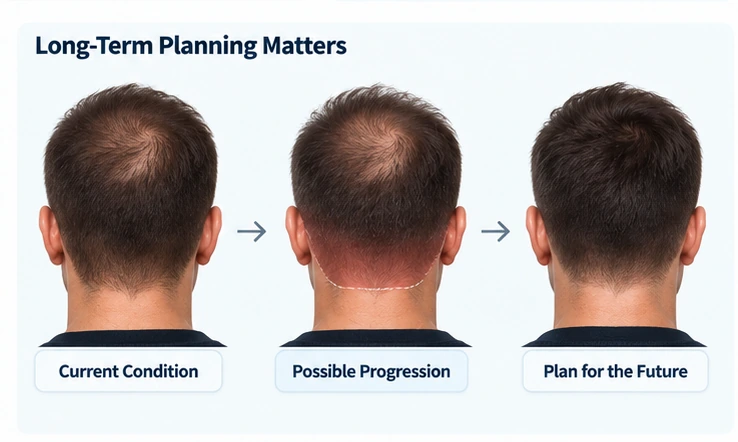
The goal is not simply to use as many grafts as possible during the first operation.
The plan should consider what your hair may look like several years later and whether donor supply may be needed again.
Sometimes, yes.
But density needs to be considered from two sides.
There is the density you want in the recipient area.
Then there is the donor density available to produce it.
Trying to create very high frontal density without considering a restricted donor supply may use grafts that could be needed later.
The right density is therefore not automatically the maximum density possible.
It is the density that provides a natural result while respecting the available donor supply.
At UniquEra Clinic, the transplant plan begins with an assessment rather than a fixed graft promise.
International patients can first complete a remote consultation and provide photographs of their hair loss and donor area.
This provides an initial view of the case.
After arriving in Istanbul, the donor area is physically assessed before the final procedure plan is confirmed. The graft number, technique, hairline, and expected coverage are reviewed before the procedure begins.
The clinic’s internal process also treats graft extraction as an area where experience and donor management matter. Follicles need to be removed and handled carefully because damaged grafts reduce the number that remain usable for implantation.
This becomes particularly relevant with retrograde alopecia because the donor area that looks available in photographs may be larger than the area that should actually be used.
If you are comparing options for a hair transplant clinic in Istanbul, ask more than how many grafts the clinic can provide.
Ask:
A responsible answer to these questions is more useful than a large graft number on its own.
Possibly. Retrograde alopecia does not automatically mean you cannot have a hair transplant.
The main question is whether enough dense and stable donor hair remains outside the affected area.
You may still be a suitable candidate when a dependable donor zone can be identified and enough follicular units remain to meet your goals without exhausting the donor supply.
Your options may be more limited if retrograde thinning extends higher, donor density is low, miniaturization is widespread, or future hair loss is expected to require many more grafts.
In some cases, surgery may not be the right option.
The aim should not be to extract the largest possible number of grafts today.
It should be to create a result that continues to make sense as your hair changes over time.
If you want to know what your donor area can realistically support, send UniquEra Clinic clear photos of your front, top, crown, sides, and back. We can review your current pattern, discuss how retrograde alopecia may affect your graft options, and explain whether the next step should be a hair transplant consultation in Istanbul.
Yes, some patients can. The decision depends mainly on whether enough stable donor hair remains outside the areas affected by retrograde thinning.
It does not automatically rule out transplantation. However, it can reduce the dependable donor zone and place limits on how many grafts should be extracted.
The main concern is the origin of the donor grafts. Follicles showing miniaturization or coming from an unstable area may be less suitable for transplantation.
It can reduce usable donor density and shrink the area available for safe extraction.
FUE can relocate individual follicular units, but it does not stop retrograde hair loss. A stable donor area still needs to be identified before extraction.
The assessment should consider donor density, miniaturization, hair calibre, the size of the stable donor zone, current hair loss, age, family history, and expected future progression.
It can progress in some people. This is why future hair loss should be considered before donor grafts are used.
No. Retrograde alopecia usually affects the lower boundaries of the donor region, while DUPA can cause more widespread thinning throughout areas normally considered for donor harvesting.
There is no fixed number. It depends on the size and density of your remaining stable donor zone and how much donor supply should be kept for the future.
An initial assessment can be made from photographs and an online consultation. The final graft plan is confirmed after the donor area is physically assessed in Istanbul.