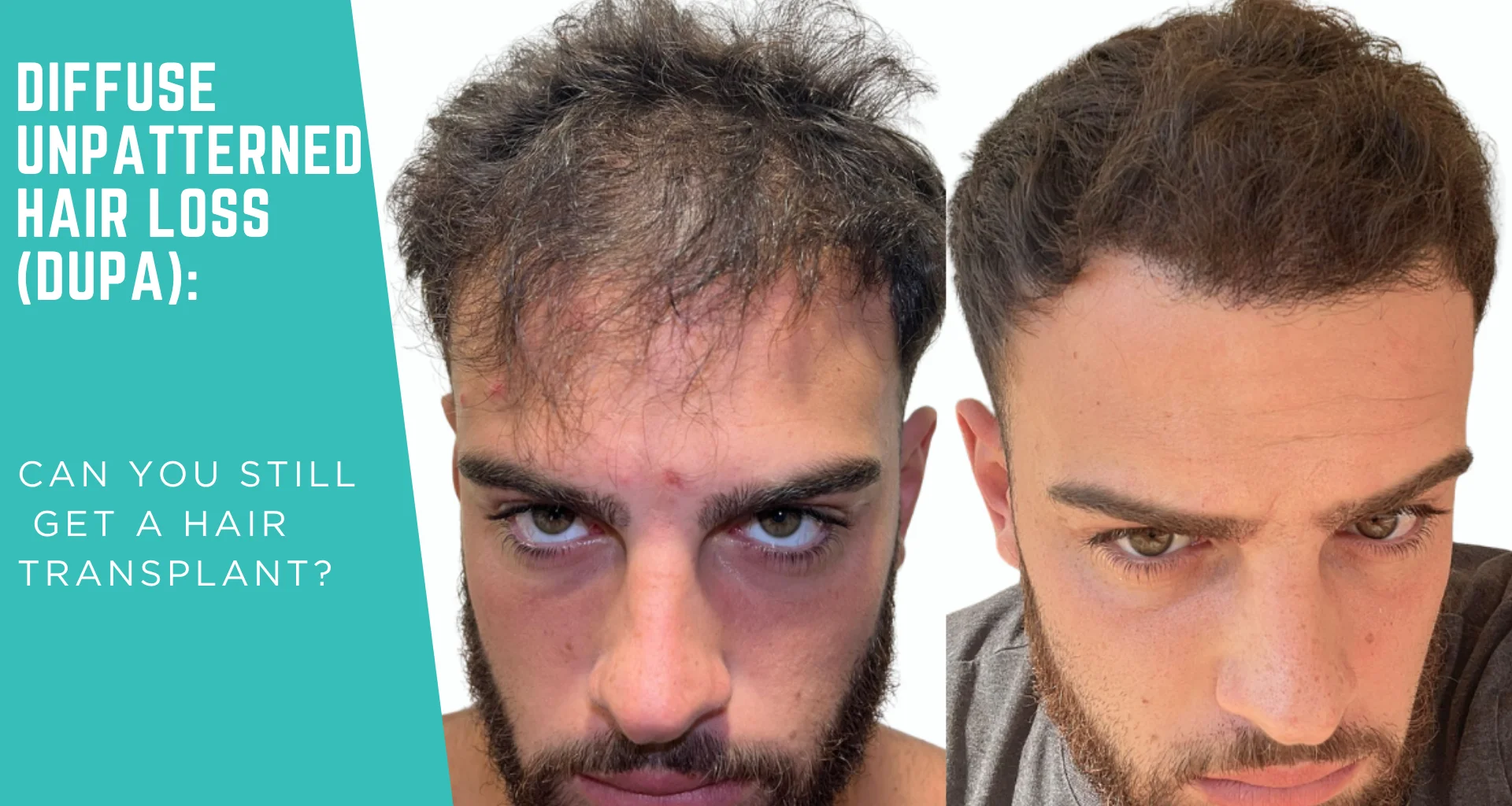

Yes, some people with diffuse unpatterned hair loss can have a hair transplant. But only if the donor area is stable enough to support long-term results. For many DUPA patients, surgery is not the right first step.
If your hair is thinning across your whole scalp, not just the top, you may have been told you have DUPA. That diagnosis matters because DUPA affects the back and sides of the scalp too. Those are the areas surgeons rely on for donor grafts.
This guide explains what DUPA means, why it blocks most hair transplants, how it is properly diagnosed, and what your real options are.
If you are still trying to work out whether surgery is even on the table for you, a donor area assessment is the right starting point.
| At UniquEra Clinic, we assess both the recipient area and the donor zone before giving any recommendation. Some patients leave with a surgery plan. Others leave with a medical plan. Both are the right answer for the right person. Book your free consultation with UniquEra Clinic today. |
DUPA is a type of androgenetic alopecia where hair thinning spreads across the entire scalp, including the back and sides. In most hair loss conditions, those zones stay strong. In DUPA, they thin too.
That single difference is what makes DUPA one of the most difficult hair loss types to treat with surgery.
In standard diffuse thinning, the donor area remains stable. Only the top of the scalp loses density. In DUPA, both the thinning areas and the donor area are affected, making surgical planning significantly more difficult.
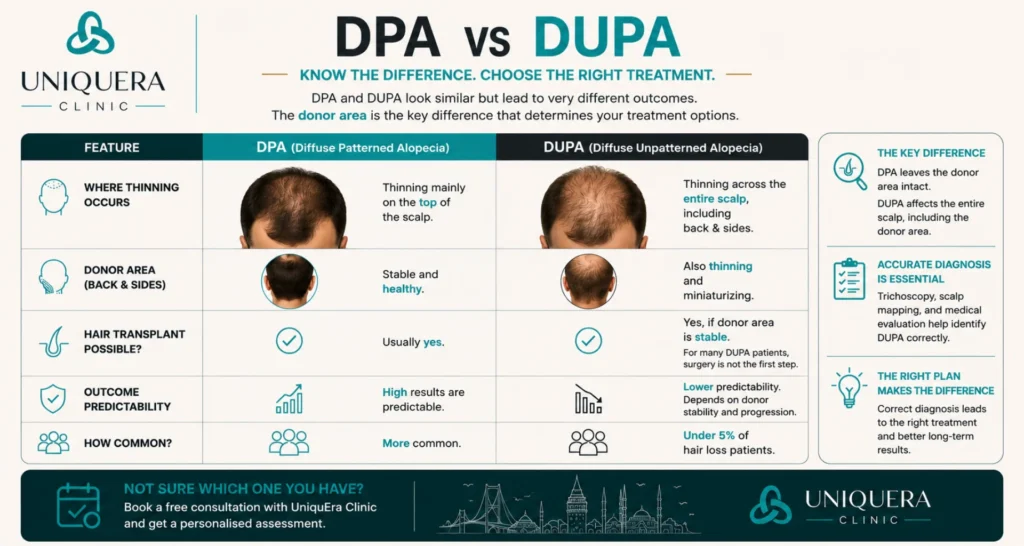
DPA is diffuse patterned alopecia. DUPA is diffuse unpatterned alopecia. They sound similar but lead to very different surgical outcomes. The donor area is the deciding factor.
| DPA | DUPA | |
| Where thinning occurs | Top of scalp only. | Entire scalp including back and sides. |
| Donor area | Stable and healthy. | Also thinning. |
| Hair transplant possible? | Usually yes. | Usually no. |
| How common? | More common. | Under 5% of hair loss patients. |
DPA leaves the donor area intact. DUPA does not. That is the line between surgical candidacy and a different treatment path.
A diffuse alopecia hair transplant only works when the donor area remains stable enough to provide healthy grafts. In DUPA, that stability is missing.
Hair transplants work because donor hair from the back and sides is genetically resistant to DHT, the hormone that causes follicle miniaturization. When that hair is moved to a thinning area, it keeps its resistance and grows permanently.
In DUPA, that resistance is absent in the donor zone. The back and sides are already miniaturizing. Grafts taken from there carry that weakness with them. They may grow at first. Then they thin. Then they fall.
This is why DUPA hair transplant results are less predictable than results in patients with a healthy donor area.
The donor area is also left depleted after extraction. Those follicles cannot be returned. The patient ends up with temporary improvement, continued loss, and fewer options than before surgery.
Under trichoscopy magnification, a healthy donor zone has thick hairs growing in groups of two to four. In a DUPA patient, the doctor sees finer hairs, more single strands where groups should be, and scalp visible through what should be the densest area of the head.
This is why photos are not enough. The damage is at the follicle level and only visible under magnification.
DUPA is frequently missed because it looks like ordinary diffuse thinning in early stages. A proper diagnosis covers three things.
The doctor examines follicles at the back and sides under magnification, not just the thinning areas on top. They measure the ratio of thick terminal hairs to fine vellus hairs. A high vellus ratio in the donor zone confirms the area is compromised.
The doctor checks the top, sides, and back separately. DUPA shows miniaturization in all three zones. Standard diffuse thinning shows it only on top. That distinction separates the two diagnoses.
Telogen effluvium, low iron, thyroid imbalance, and chronic shedding can all look nearly identical to DUPA. The difference is that those conditions do not miniaturize follicles. Blood tests and trichoscopy together make the distinction clear. Sometimes a scalp biopsy is needed.
Getting this right before any treatment decision is the most important step in managing diffuse unpatterned hair loss.
The hair may grow in the first few months. The patient sees early coverage and assumes it worked.
Then between month six and eighteen, the transplanted hair starts thinning. It gets finer and shorter. Most of it disappears. The harvested follicles were already miniaturizing before they were moved. Relocation did not change that.
The donor area is now depleted. There is no healthy reserve left. The patient has spent money, lost donor supply, and has fewer options than they had before surgery.
This outcome is preventable. It requires the right diagnosis before surgery is considered.
A hair transplant for diffuse thinning should only be considered after confirming long-term donor stability. For some DUPA patients, that stability is eventually achievable.
If a DUPA patient commits to medical treatment and the donor zone stabilizes meaningfully over time, a re-assessment may show enough terminal hairs to support a limited procedure. Not full restoration. A targeted, conservative session using only the most stable follicles available.
Even then, results carry more risk than a standard transplant in a healthy candidate. The underlying condition has not been cured. Ongoing management is required after surgery.
If you have been managing your hair loss for a while and want to know whether your donor zone is now stable enough, that is exactly what a re-assessment looks at.
| We regularly see patients who were told surgery was not possible and then became candidates after stabilization. The only way to know where you stand is to check the donor area properly. Book a donor assessment with UniquEra Clinic and understand your options before making any decision. |
If surgery is not possible right now, there are still things worth doing.
The goal is to slow or stop further miniaturization across the scalp, including the donor zone. What is appropriate depends entirely on the individual. This requires a specialist assessment, not self-directed research.
SMP adds the visual appearance of density using pigment. It does not grow hair, but it significantly reduces how visible the thinning looks. For many DUPA patients it is the most practical cosmetic option while medical management is ongoing.
These injectable treatments support existing follicles that are weakened but still active. They are not a cure, but they can slow decline and improve hair quality as part of a long-term plan. UniquEra offers these as part of a comprehensive approach to advanced hair loss treatment.
DUPA needs to be re-assessed periodically. Tracking the donor zone over time is the only way to know whether a future surgical window might open.
Not every consultation at UniquEra Clinic ends with a procedure recommendation. For patients with diffuse unpatterned hair loss, the assessment covers both the recipient area and the donor zone before any direction is given.
Every diffuse thinning hair transplant must be planned around donor stability, not just visible coverage. Our Medical Directors, with over a decade of hands-on experience supervising each case personally, use trichoscopy across all scalp zones to confirm this before anything else.
If the donor area is compromised, the patient is told clearly. They leave with an honest picture of their condition and a realistic management plan.
Choosing the right hair transplant clinic Turkey option matters most when donor stability is uncertain. At UniquEra, if the donor zone turns out to be stronger than expected, or the pattern is DPA rather than DUPA, the conversation moves to what surgical options make sense. Whether that is sapphire FUE hair transplant Turkey, DHI hair transplant Turkey, or manual FUE hair transplant is decided after the assessment, not before it.
DUPA is not the same as ordinary diffuse thinning. The difference is in the donor zone. And the donor zone determines everything.
Not every case of diffuse thinning hair loss is DUPA — see our guide on diffuse thinning vs male pattern baldness for how experts tell the two apart, which is why proper diagnosis matters before choosing any treatment. Most DUPA patients are not ready for surgery today. Some will become candidates after stabilization. Some will manage the condition long-term without surgery.
The biggest risk is not the diagnosis. It is going ahead with surgery before anyone has properly assessed the donor area.
If you have been sitting on this question, the donor area assessment is the one thing that actually moves you forward.
| The earlier you understand your donor area, the more options you keep. Whether surgery is right for you now or later, that answer starts with an honest assessment, not a guess.Book your consultation with UniquEra Clinic, an expert hair transplant Turkey provider, and receive a personalised treatment plan from our Medical Directors. |
DUPA is hair thinning that spreads across the entire scalp, including the back and sides. Unlike typical androgenetic alopecia, it affects the donor area too, which limits surgical options.
You cannot tell from the mirror. It requires trichoscopy of the donor zone. A specialist assessment is the only reliable way to confirm it.
Yes. Both cause diffuse thinning across the scalp, but telogen effluvium does not miniaturize follicles. Trichoscopy and blood tests can distinguish temporary shedding from diffuse unpatterned alopecia.
Usually not while the donor zone is actively compromised. Grafts taken from a miniaturizing area will continue thinning after being moved. In some cases, after meaningful stabilization, a limited procedure may become possible.
It may grow initially, then thin and fall because the harvested follicles were already compromised. The donor area is also depleted, leaving fewer future options.
No. Diffuse alopecia is a broad term covering many causes of widespread thinning, including reversible ones. DUPA is a specific genetic subtype where the entire scalp miniaturizes, including the donor zone.
It affects under 5% of hair loss patients. It is frequently misdiagnosed without a detailed donor zone assessment using trichoscopy.
No. It causes progressive thinning across the scalp but does not typically lead to complete baldness. Hair becomes finer and the scalp more visible over time.
The genetic sensitivity behind DUPA cannot be reversed. Medical treatment can slow the rate of miniaturization and in some cases improve hair quality, but it does not cure the underlying condition.
10. What is the best treatment for diffuse thinning caused by DUPA?
It depends on the individual. Medical management to slow miniaturization is usually the starting point. Growth factor or stem cell therapies can support remaining follicles. SMP helps with cosmetic appearance. A specialist consultation builds the right plan.
Not while the donor zone is compromised. DHI hair transplant Turkey requires stable donor follicles for lasting results. If the donor zone stabilizes, a limited DHI procedure may become possible after reassessment.
Yes. DUPA is more common in women relative to other androgenetic alopecia types. Female DUPA presents as diffuse thinning across the whole scalp, making detailed trichoscopy across all zones especially important for an accurate diagnosis.
A skilled specialist can identify it in one consultation using trichoscopy. Distinguishing it from reversible causes may require blood tests and sometimes a scalp biopsy, typically resolved within a week or two.