
Two patients can have similar-looking hair loss and still need completely different procedures.
One may have enough donor hair to restore both the hairline and crown. Another may need to prioritize the front and preserve grafts for future loss. One may benefit from DHI because substantial hair remains in the recipient area. Another may need Sapphire FUE for a larger open zone.
This is why UniquEra clinic does not begin planning with a standard graft number or a fixed technique.
A personalized hair transplant plan is built around the patient’s hair-loss pattern, donor capacity, facial proportions, existing hair, future loss and restoration priorities. The final graft number and technique come after those factors have been assessed.
The main factors in hair transplant planning are considered together rather than independently.
| Planning factor | What it changes |
| Hair-loss pattern | Which areas require treatment. |
| Donor density | How many grafts can safely be used. |
| Hair thickness and curl | How much visual coverage grafts may create. |
| Facial proportions | Hairline height and contour. |
| Existing hair | Where grafts need to be placed carefully. |
| Age and hair loss trajectory | How conservative the long-term plan should be. |
| Frontal, mid-scalp and crown loss | How grafts are divided between zones. |
| Patient priorities | Which areas receive greater focus. |
| Technique | How the agreed graft plan is carried out. |
| Future loss | How much donor supply should remain in reserve. |
This forms the basis of the UniquEra clinic treatment plan process and explains how hair transplant clinics customize treatment plan decisions around an individual patient rather than starting with a generic package.
The graft number is an outcome of the assessment, not the starting point.
UniquEra clinic develops the plan in two stages.
The UniquEra clinic personalized consultation begins before the patient travels to Istanbul.
The consultant collects:
The first hair loss pattern assessment for transplant looks at where hair has already been lost, whether thinning is still progressing and what areas are most important to the patient.
The case is medically reviewed and an initial written recommendation is prepared.
Photos can support an initial estimate, but the final plan is confirmed after examining the scalp directly.
The donor and recipient areas are assessed again. The team can then confirm or adjust:
This is why the hair transplant treatment plan process remains flexible until the physical assessment has been completed.
Your recipient area shows how much restoration you would like. Your donor area determines how much restoration is realistically available.
That is the basis of donor density treatment planning.
The donor assessment considers:
Donor density mapping helps answer three different questions:
Scalp laxity may also be observed during the physical scalp examination, although donor density and follicular stability are more directly relevant to FUE and DHI graft planning.
A larger bald area does not automatically mean more grafts should be extracted.
Sometimes the correct plan is to prioritize.
A hairline changes the proportions of the entire face, so it should not come from a standard template.
A hair transplant plan based on face shape can consider:
This facial proportion analysis helps determine the height and contour of the new hairline.
During a custom hairline design consultation, the patient’s preferences are also discussed.
If someone wants a lower or differently shaped hairline, that request can be considered. But the final design still has to make sense for the patient’s anatomy, donor supply and likely future loss.
Yes, but ethnicity should not become a preset hairline template.
What is sometimes described as ethnicity-based hairline shaping should mean taking the patient’s actual natural characteristics into account.
These may include:
For example, curly or Afro-textured hair can create different visual coverage compared with straight hair. Curved follicles can also affect extraction planning.
The objective is to reproduce the patient’s natural characteristics rather than apply the same design to everyone.
Yes. Planning only around the bald areas visible today can create problems later.
Native hair surrounding transplanted follicles may continue thinning. The team therefore considers the patient’s hair loss trajectory, particularly when loss is still progressive.
Future planning may affect the treatment in several ways:
| Patient situation | Possible planning response |
| Younger patient with continuing loss | More conservative hairline. |
| Limited donor supply | Prioritize frontal coverage. |
| Large frontal and crown loss | Divide grafts according to visual priority. |
| Likely future thinning | Preserve donor reserve. |
| Multiple large treatment zones | Consider staged treatment. |
This is where multi-stage hair transplant planning becomes important.
Trying to cover every area immediately is not always the strongest long-term decision.
Dan Caverly’s case shows what personalization can look like in practice.
His hair loss affected the frontal hairline, temples and crown. But those areas were not treated as one generic full-scalp procedure.
| Stage | Treatment priority |
| First procedure | Frontal hairline and temples. |
| Later assessment | Reassess remaining restoration needs. |
| Second procedure | Crown. |
| Second-session grafts | 3,500 |
| Technique | DHI |
| Planning reason | Existing transplanted hair was already present. |
His first procedure focused on rebuilding the frontal hairline and temples.
When he later returned, the situation had changed. The frontal area had already been restored, so the next priority was the crown.
For the second procedure, 3,500 grafts were placed across the crown using DHI hair transplant.
Because transplanted hair from the earlier procedure was already present in the recipient area, the new graft placement strategy needed to work around that existing hair.
The important part of the case is not simply the graft number.
The planning sequence was:
Front and temples first → reassess → crown second → select the technique for the new situation.
That is what an individualized hair restoration plan looks like.
Grafts are not simply spread evenly across every area of hair loss.
The graft placement strategy considers visual importance, available donor supply and follicular-unit type.
Single-hair follicular units are generally favored toward the frontal edge to create a softer transition. Higher-hair-count units can be used farther back where more visual coverage is required.
This creates density zoning (frontal vs. crown).
A patient with limited donor supply may benefit more from stronger frontal coverage than from spreading the same number of grafts thinly across the entire scalp.
Another patient, like Dan, may already have a restored frontal area and therefore use a later procedure primarily for the crown.
Hair transplant technique selection FUE and DHI happens after the patient’s scalp and treatment goals are understood.
| Factor | DHI | Sapphire FUE |
| Implantation | Choi implanter pen | Channels created before graft placement.. |
| Extraction | Separate extraction stage | Separate FUE extraction stage. |
| Existing hair | Can be useful when implanting among existing hairs | Often suited to more open recipient areas. |
| Placement | Direct control during implantation | Direction planned through channel creation. |
| Selection | Based on the individual case | Based on the individual case. |
The technique selection (FUE/DHI) should support the treatment plan.
The technique itself should not determine how many grafts a patient receives. Donor capacity, treatment zones, remaining hair and planned density establish the requirement first.
A patient should receive more than a verbal graft estimate and package price.
After the remote consultation, UniquEra clinic provides a written report containing the initial assessment and recommendation.
Following the physical consultation in Istanbul, the final plan covers:
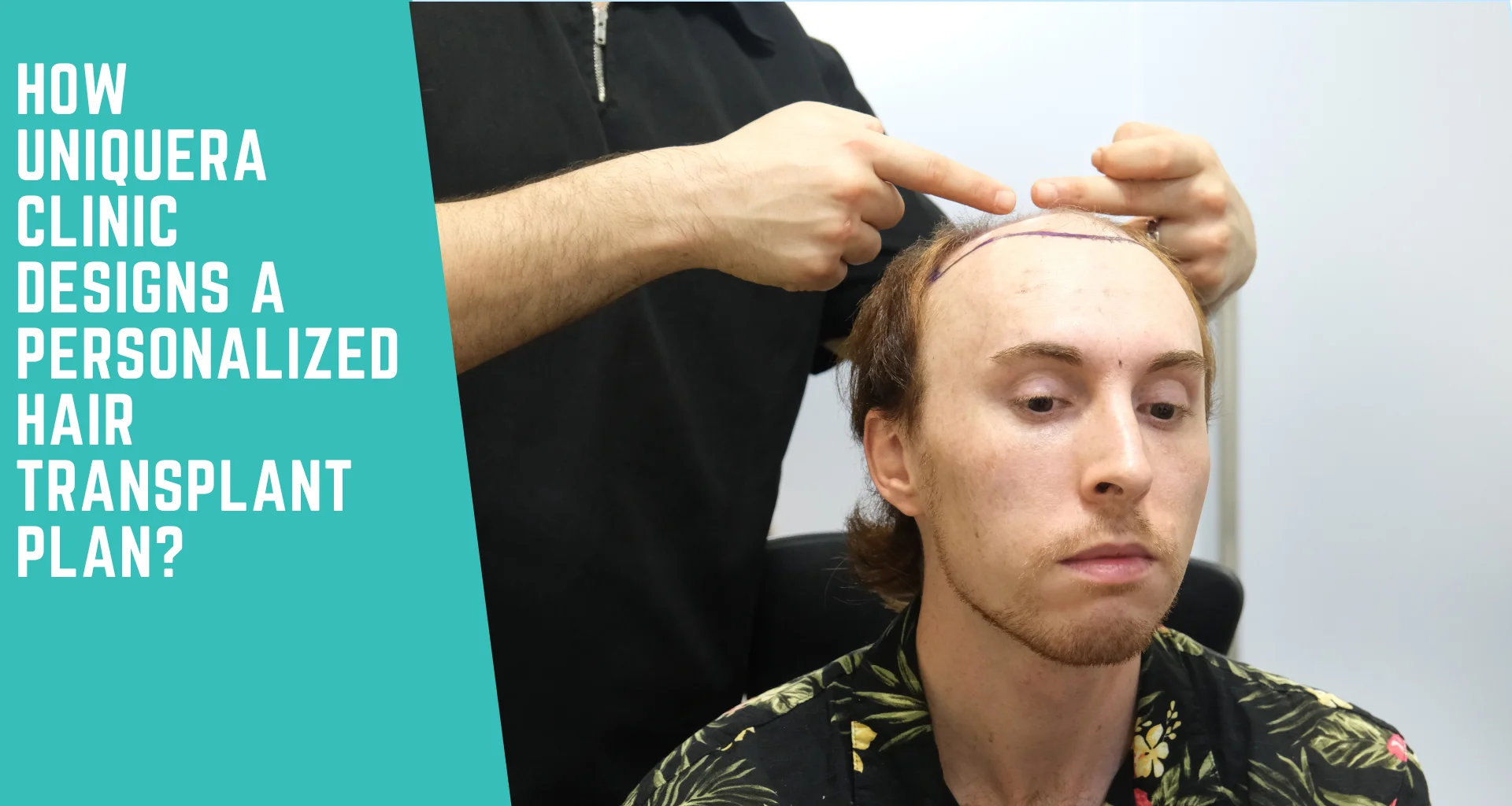
The proposed hairline is physically mapped on the scalp and reviewed before treatment begins.
This planning record should also be distinguished from informed consent documentation.
The treatment plan explains what is proposed for the individual case. Informed consent documents the patient’s agreement to the procedure after the relevant medical information and risks have been discussed.
A package describes what you purchase. A treatment plan explains what should actually happen to your hair.
| Generic hair transplant package | Personalized treatment plan |
| Lists included services | Defines what the scalp needs |
| May include hotel and transfers | Defines treatment zones |
| May advertise a graft allowance | Calculates case-specific graft needs |
| May advertise DHI or FUE | Selects technique after assessment |
| Can be similar for many patients | Changes according to the individual |
| Focuses on the commercial offer | Focuses on the procedure itself |
A package may include accommodation, transportation, the procedure and aftercare.
It should not determine your medical plan.
The patient’s scalp should determine the graft number, hairline, treatment zones and technique.
A useful hair transplant consultation should leave you understanding the reasoning behind the plan, not simply the price and graft number.
You should know:
If your consultation only gives you a price, package and graft number, important planning questions are still unanswered.
Book your consultation with UniquEra clinic and receive a case-specific assessment before choosing your procedure.
Hair-loss pattern, donor density, face shape, existing hair, future loss, treatment priorities and technique are assessed together.
Face shape helps determine hairline height, contour and proportions so the new line fits the patient’s facial structure.
Yes. Future loss can change hairline design, graft allocation, donor preservation and whether treatment should be divided into stages.
Patients receive an initial written recommendation followed by final confirmation of the hairline, graft number, treatment zones and technique after physical assessment.
A package lists services and logistics. A personalized plan decides what should actually be done to the donor and recipient areas.
Patients searching for UniquEra clinic hairline simulation should know the documented process uses physical hairline mapping on the scalp rather than a standard digital simulation.
Yes. Physical examination can reveal donor density, miniaturization or recipient-area details that photographs cannot fully show.
Yes. Multi-stage hair transplant planning may be appropriate when several areas require treatment or donor preservation is important.
When comparing the best hair transplant clinic in Istanbul for your case, ask how the clinic assessed your donor supply, future loss, hairline, graft distribution and technique, not just the package price.