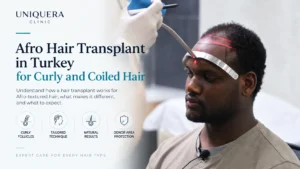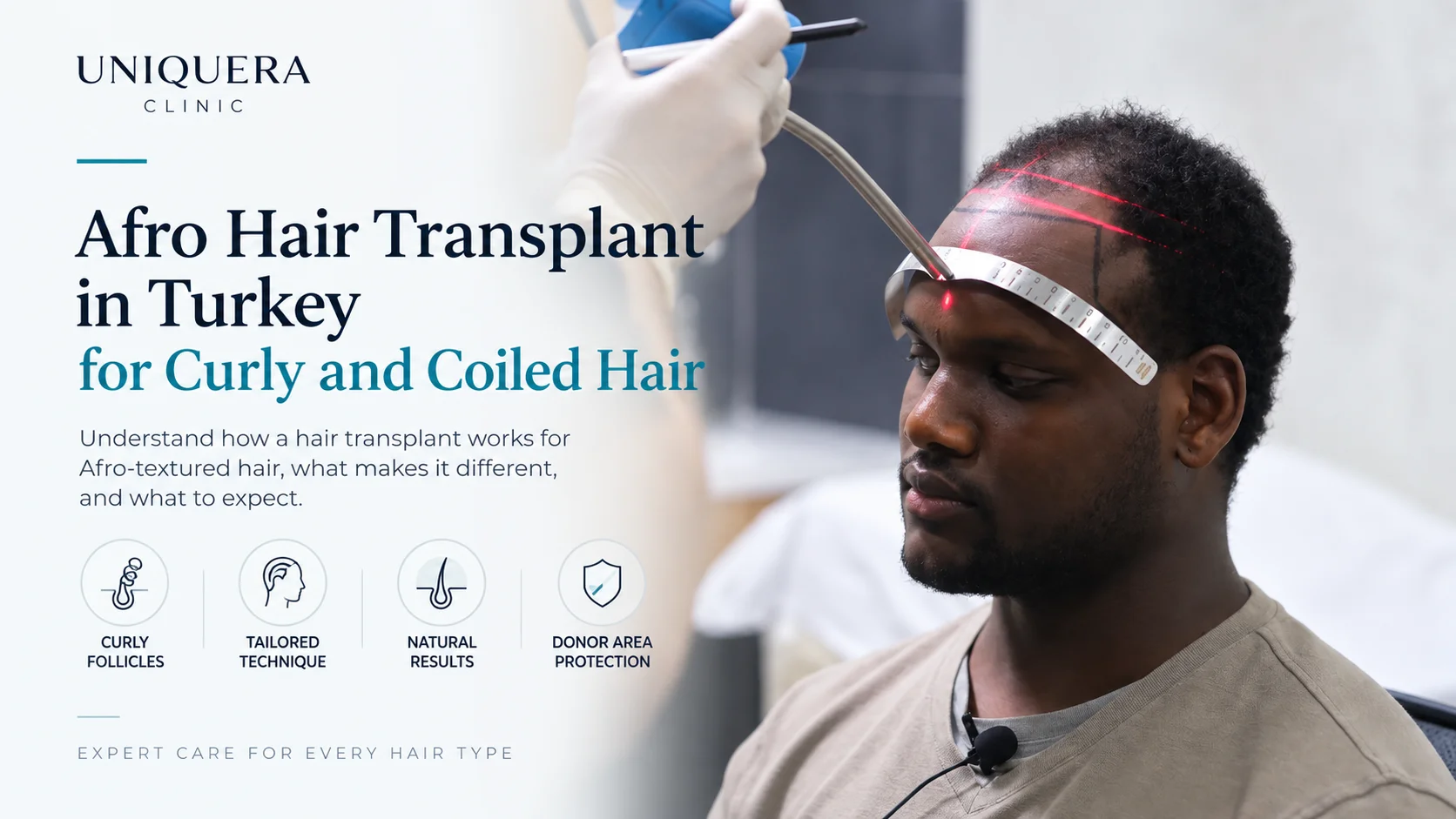

An Afro hair transplant in Turkey moves healthy follicular units from the donor area into areas affected by permanent hair loss. The main difference with curly and coiled hair is that the follicle can continue curving beneath the scalp.
That hidden curve can make extraction harder because the visible hair does not always show the complete path of the root. At the same time, curly hair can create strong visual coverage because the strands naturally bend and overlap.
So a curly hair transplant should not be planned around the biggest graft number. The goal is to obtain healthy grafts while protecting the donor area and keeping the patient’s natural curl pattern.
If you have tightly curled or coiled hair, send UniquEra Clinic clear photos of your hairline, top, crown, sides, and donor area. We’ll review your hair-loss pattern and donor strength first, before you compare graft numbers or techniques.
It can be, because the follicle may curve beneath the skin in a way the visible hair does not show.
During FUE, this raises the risk of transection, where part of the follicle is accidentally cut during extraction.
| Straight or mildly wavy hair | Tightly curly or coiled hair |
| Follicular path is usually easier to predict | Follicle may curve beneath the scalp |
| Extraction angle is more predictable | Angle may need adjusting during extraction |
| Lower technical difficulty in many cases | Needs closer attention to follicular path |
| Standard punch settings often work | Punch size, depth, or movement may need adjustment |
This is why a curly hair transplant should be planned around the individual’s follicular behaviour rather than treated exactly like straight hair.
A damaged graft may not be usable, so how many follicles survive extraction intact matters just as much as how many are attempted.
If too many follicles are cut, the team may need to work through more of the donor area to reach the number of healthy grafts needed.
That can mean:
For an Afro-textured hair transplant, the quality of extraction matters as much as the final graft count.
The extraction method may need to change depending on how the patient’s follicles behave beneath the scalp.
Adjustments can include:
The first extractions can also tell the medical team more about the patient’s follicular paths before working across a larger area.
That is why an Afro textured hair transplant should be planned around the way that patient’s follicles actually behave rather than using one extraction setting for everyone.
Yes. FUE can be suitable for a hair transplant for Afro hair, although the extraction stage may need to be adjusted for curved follicles.
FUE removes follicular units individually from the donor area.
With curly follicles, the main extraction difficulty is following the root closely enough to free it without cutting it.
At UniquEra Clinic, curl pattern, donor density, follicular direction, and the number of grafts required are considered before the extraction plan is confirmed.
For a hair transplant for curly hair, Manual FUE can be useful in selected cases like Diffuse thinning,
Manual extraction gives the extraction specialist direct control over each punch movement.
It may be considered when:
Larger procedures may call for a different approach.
The decision should follow the donor assessment, not simply the patient’s hair texture.
DHI for Afro hair can be useful during implantation, especially where detailed control over graft direction and placement matters. At UniquEra we encourage DHI CHOI pen for Afro hairin selective cases.
But DHI does not solve the extraction difficulty created by curved follicles.
That is because:
A patient may therefore have adapted FUE extraction followed by DHI for the implantation stage.
DHI can be useful for:
The technique should still be chosen around the actual case. Any FUE/DHI adaptations should follow what the donor and recipient areas require rather than using the same method for every patient with curly hair.
Not automatically.
Curly and coiled strands can create stronger visual coverage than straighter hair in some patients because they bend and overlap more of the visible scalp.
This is one reason a curly and coiled hair transplant may create strong visual coverage without simply copying the graft numbers used for straighter hair.
The graft number still depends on:
| Factor | Why it matters |
| Size of the bald or thinning area | Larger areas need more coverage. |
| Donor density | Determines how much hair is available. |
| Hair calibre | Thicker strands can give stronger visual coverage. |
| Curl pattern | Tighter curls can increase the appearance of fullness. |
| Hairs per follicular unit | Multi-hair grafts add more coverage. |
| Future hair loss | Some grafts may need to be preserved. |
A graft number should come after assessment.
It should not be chosen just because another patient with curly hair received the same number.
Donor hair is limited, and extraction difficulty can make careful donor planning even more important.
If more follicles are damaged during extraction, the team may need to remove additional grafts to reach the usable target.
That is why donor preservation should be part of the plan from the beginning.
A good transplant should improve the recipient area without leaving the back or sides visibly depleted.
Already received a quote for 3,000, 4,000, or more grafts? Send UniquEra Clinic the estimate along with your donor-area photos. We’ll review whether the graft number looks reasonable for your curl pattern, donor density, and expected future hair loss before you commit to the procedure.
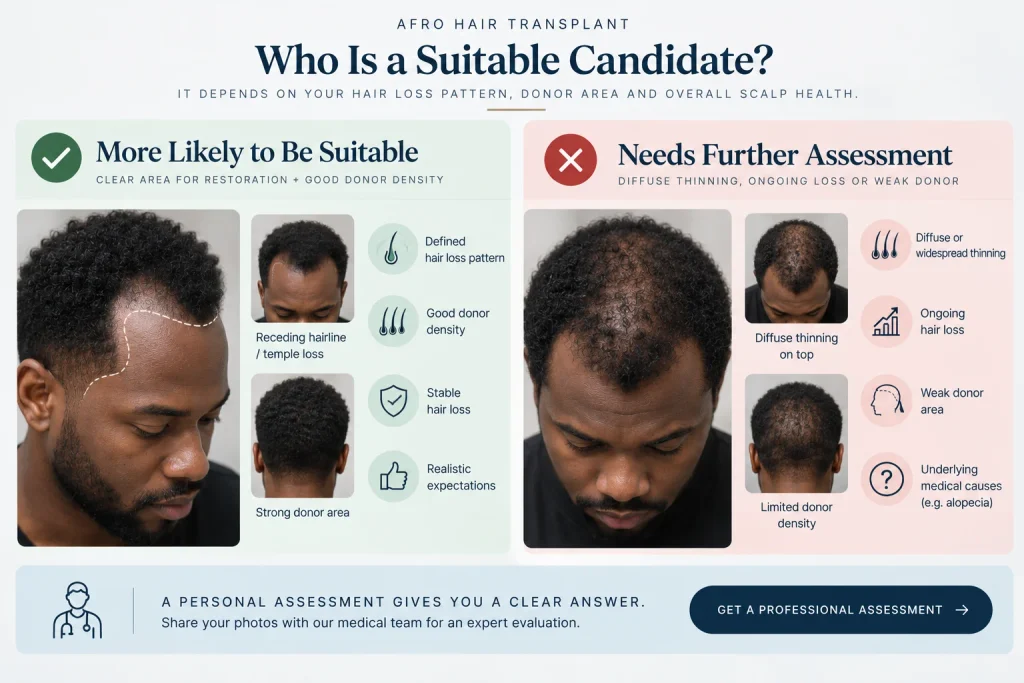
A good candidate usually has permanent hair loss, a strong donor area, and enough healthy follicles to restore the target area without overusing the donor supply.
Hair texture alone does not decide whether someone can have an Afro hair transplant. The medical team also needs to look at the cause of hair loss, donor density, scalp health, and whether the loss is stable enough to plan around.
| More favourable for transplantation | May need treatment or further assessment first |
| Strong, stable donor area | Diffuse thinning in the donor area |
| Permanent pattern hair loss | Rapid or unexplained shedding |
| Stable frontal or temple recession | Active scalp inflammation |
| Permanent traction alopecia | Ongoing traction from tight hairstyles |
| Healthy recipient scalp | Active or uncontrolled CCCA |
| Realistic expectations about density | Very limited donor supply |
| Clear area to restore | Unclear cause of hair loss |
A hair transplant for Afro hair may work well when the donor follicles are healthy and the area being restored is suitable for surgery. If the hair loss is still active or the donor area is also thinning, the first step may be further assessment rather than transplantation.
Sometimes, once the source of repeated pulling has stopped and the hair loss has become permanent.
Traction alopecia develops from repeated tension on the same follicles.
Commonly affected areas include:
If the follicles can still recover, surgery may not be necessary.
If the loss is permanent and stable, transplantation may become an option.
Active CCCA usually needs to be medically assessed and controlled before transplantation is considered.
CCCA, or central centrifugal cicatricial alopecia, is a scarring form of hair loss that commonly affects the central scalp and crown, particularly in Black women.
Warning signs can include:
Not every thinning crown is ordinary pattern hair loss.
Diagnosis comes first, sometimes through examination, trichoscopy, or a scalp biopsy.
Yes, when the donor area is suitable.
Good hairline design needs to consider more than where the new frontal border begins.
It should account for:
The implanted follicles should grow in a direction that works naturally with the patient’s existing curls.
More than a thick final hairstyle.
When looking at afro hair transplant before and after cases, check:
Good afro hair transplant results should look natural from both the recipient and donor side.
A patient with loose curls and minor temple recession is not a useful comparison for someone with tightly coiled hair and advanced frontal loss.
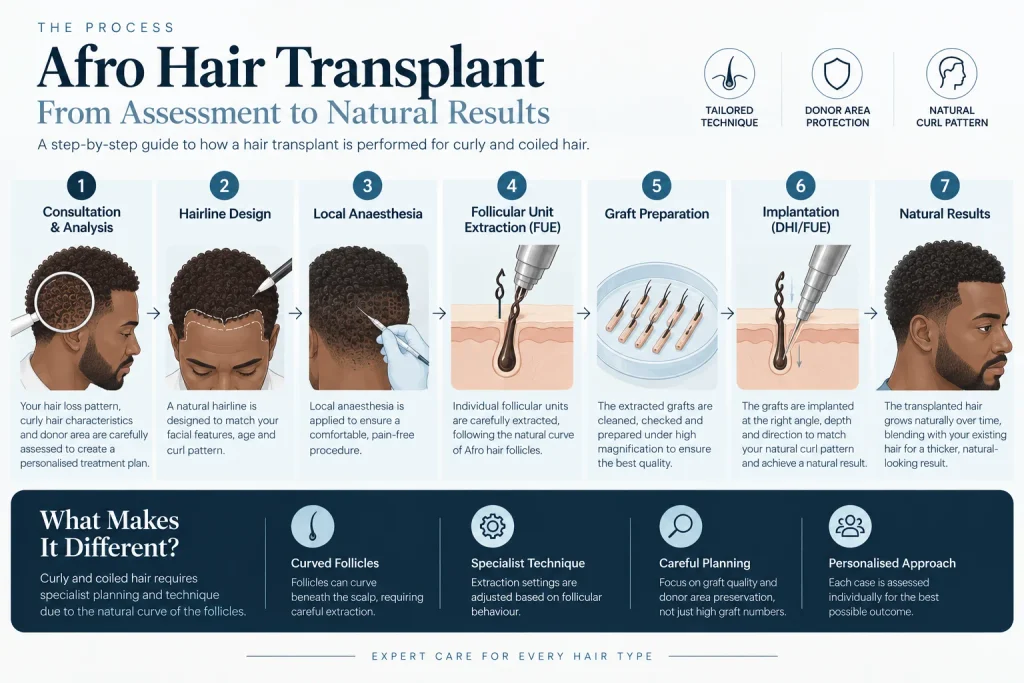
The process can be broken into five stages.
| Stage | What’s assessed or done |
| 1. Hair-loss assessment | Identify the pattern and likely cause. |
| 2. Donor assessment | Check density, curl pattern, calibre, and usable area. |
| 3. Extraction planning | Choose the punch and extraction approach. |
| 4. Hairline and implantation planning | Decide direction, distribution, and density. |
| 5. Follow-up | Monitor healing, shedding, and new growth. |
At UniquEra Clinic, international patients can start with photographs and an online consultation.
The plan is then confirmed again once the donor area is physically assessed in Istanbul.
This second assessment matters because follicular direction, donor density, and scalp characteristics cannot always be judged fully from photographs.
Ask questions that show how the clinic plans to work with your hair specifically:
A clinic saying it “treats Afro hair” is not enough.
What matters is how that changes the plan for curly and coiled follicles.
There is no single price that applies to every patient.
Cost can vary according to:
The graft plan should come before the price comparison.
A cheaper 4,000-graft package is not automatically better than a more conservative plan that protects the donor area.
It can be, for patients with suitable donor hair, permanent hair loss, and a team experienced with tightly curled follicles.
The same curl that makes extraction harder can also help create strong visual coverage once the transplanted hair grows.
The main questions are:
If those four questions are answered properly, technique, graft count, and price become much easier to discuss.
For anyone comparing a hair transplant in Turkey, those medical questions should come before the hotel package, graft promise, or advertised price.
If you want to know what your own donor area can realistically support, send UniquEra Clinic clear photos of your hairline, temples, top, crown, sides, and back. We’ll review your curl pattern, hair loss, and donor area before you decide whether travelling to Istanbul makes sense for your case. Book your consultation with UniquEra Clinic today.
Yes. Curly and Afro-textured hair can be transplanted when the donor area is suitable and the cause of hair loss can be treated surgically.
Generally, yes. Transplanted follicles retain the characteristics of the donor hair, including its curl pattern.
There is no standard price. Cost varies by clinic, technique, procedure complexity, and what is included in the package.
Transplanted follicles are intended to keep growing, while surrounding native hair may continue thinning. Long-term planning helps keep the result balanced.
Grafts taken from a stable donor area are intended to grow long term. Native hair that was not transplanted can still thin with age.
Like any medical procedure, it carries risks. These can include infection, scarring, poor growth, overharvesting, and graft damage. Curved follicles can also make extraction more demanding.
Transplanted hair may remain while the patient’s original hair continues changing with age and further hair loss. The long-term appearance depends heavily on the original treatment plan.
Follow your clinic’s aftercare instructions because healing timelines vary. Avoid rubbing, scratching, or picking at the recipient area while it is still healing.