
Who performs hair transplant surgery is the first question most patients should ask, and the honest answer is: not one person. At UniquEra, a hair transplant moves through separate stages, consultation, planning, extraction, graft preparation, implantation, anesthesia, and monitoring, and different people are responsible for each one. Medical Team Directors hold decision-making responsibility for the treatment plan, while trained specialists carry out each stage according to their qualifications and assigned roles. Here’s how that works, from your first consultation through implantation.
One of UniquEra’s two Medical Team Directors, Çagri Çelik or Atakan Akay, makes the final call on suitability, not a sales consultation. Before you travel to Istanbul, a medical consultant collects your medical history, hair loss history, previous treatments, expectations, and scalp and donor-area photographs. A director reviews that file and makes an initial assessment: whether transplantation is appropriate, which areas can be treated, what limitations apply, and whether your case fits DHI hair transplant or Sapphire FUE hair transplant, based mainly on how extensive the balding is and how strong your donor area looks. This is where the hair transplant surgeon vs technician distinction matters: a consultant can gather information and explain the process, but that assessment itself isn’t made on a sales call.
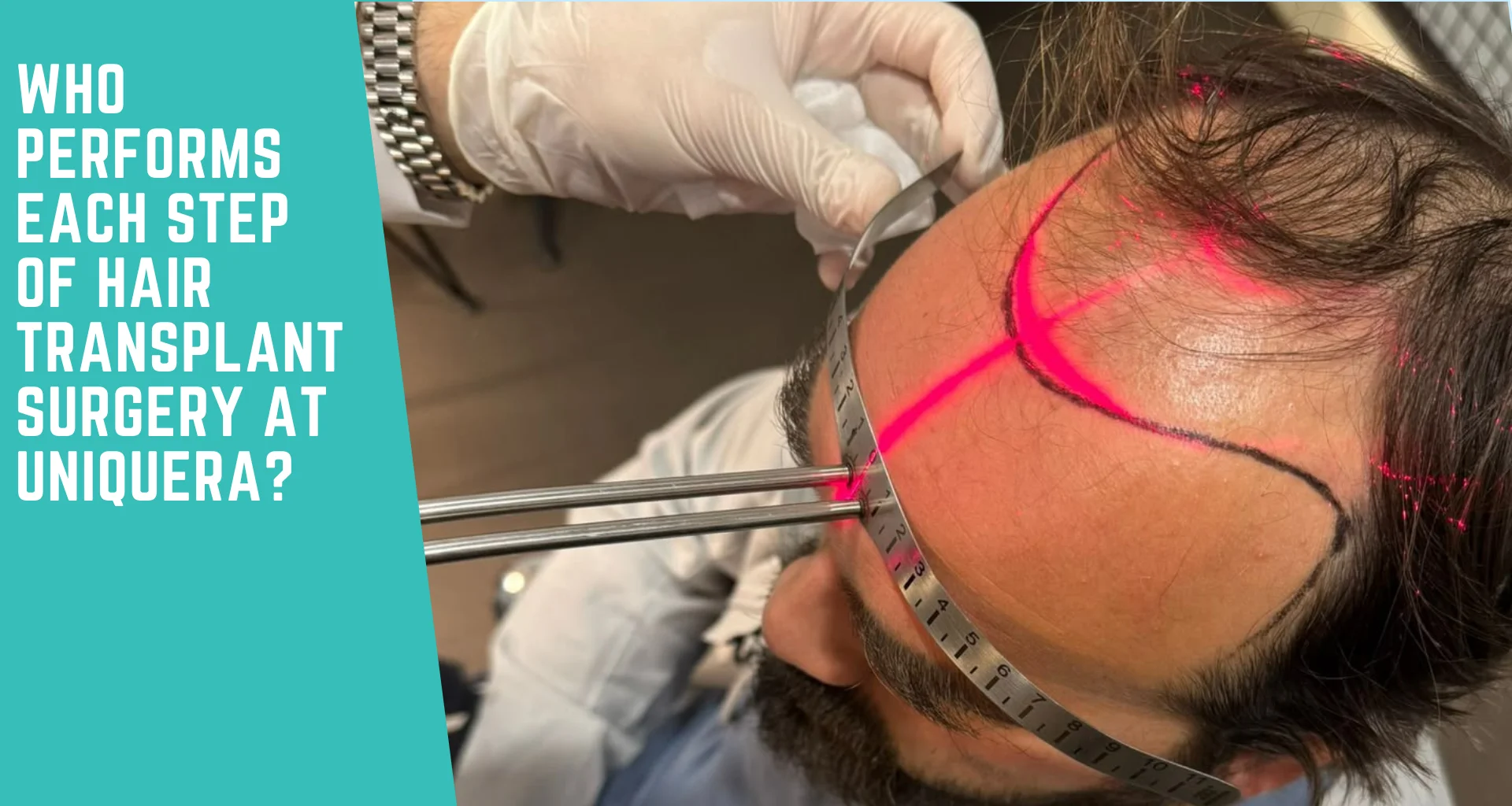
A Medical Director designs the hairline, based on facial proportions, age, your existing hair pattern, natural hair direction, donor capacity, and how your hair loss might progress. The goal isn’t a standard hairline placed on every patient, it’s built from your own original pattern. If you request changes, a lower hairline, for example, that request still gets reviewed medically, and can be changed or declined if it would look unnatural or use donor grafts in a way that hurts long-term results.
Once your technique is set, the same director maps out the hairline design, estimated graft requirement, treatment zones, and density plan. That plan isn’t final until you arrive in Istanbul. During the face-to-face consultation, your donor area, hair loss progression, expectations, and any surgical limitations get reviewed again before the treatment plan is confirmed.
Anesthesia is handled by a qualified medical professional on the team, UniquEra’s anesthesiologist, Yagmur Dalioğlu, for standard cases. Blood testing and medical clearance happen before surgery, and if testing identifies something that needs a closer look, that case follows a separate medical evaluation process before treatment continues.
At UniquEra, graft extraction is performed by medical professionals trained in hair restoration techniques.
During FUE-based procedures, follicular units are extracted individually from the donor area. The extraction stage commonly takes approximately three to four hours, although the duration varies according to graft requirements and donor characteristics.
Extraction requires control because a follicular unit can be damaged if it is handled incorrectly.
This is why the hair transplant technician role should not be reduced to simply “removing hairs.” Extraction affects how many usable grafts remain available for implantation and how the donor area looks after healing.
After extraction, two trained nurses count and classify the follicular units.
The grafts are separated according to their characteristics and preserved in a controlled medical solution while waiting for implantation.
This sorting matters because different follicular units are used differently.
Placing thicker multi-hair units directly along the frontal edge can make a transplanted hairline appear unnatural.
A Medical Director controls the major decisions in implantation: angle, direction, depth, and density distribution. The exact workflow depends on which technique you’re having.
The director personally creates the implantation channels using a sapphire blade, their angle and direction are what determine how the transplanted hair will grow. Once a channel is open, specialists place grafts according to the plan and the graft classification already done.
The director keeps direct control using a Choi implant pen rather than opening every channel in advance. Whoever is placing a graft has to know the planned direction, angle, and location for that specific graft, and whether it’s a single, double, or multi-hair unit, which is why DHI stays hands-dependent even with the device involved.
DHI Choi Pen can be suitable for diffuse thinning hair transplant cases because it allows grafts to be placed between existing hair with careful control over angle, depth, and direction.
No. A modern hair transplant is normally a team procedure rather than one person performing every task.
The more useful question is not simply, “Is my hair transplant done by a doctor or technician?” It is:
Who makes the medical decisions, who performs each technical stage, and how are those stages checked?
At UniquEra, responsibility is divided across the medical team. Doctors make the treatment decisions, trained medical professionals perform assigned clinical stages, nurses assist with graft counting and preparation, and senior medical professionals oversee the procedure according to the patient’s treatment plan.
This team structure is also reflected in UniquEra’s internal training standards, where medical team members are expected to complete medical education, supervised professional training, artificial-scalp practice and substantial hands-on hair restoration experience before independently taking responsibility for clinical stages.
“Supervised” should mean more than having a doctor’s name associated with a clinic.
For a patient, the practical questions are:
Who reviewed my case? Who approved my graft plan? Who designed my hairline? Who will extract the grafts? Who controls implantation direction and depth? Who will check the work during surgery?
These questions give patients a much clearer picture of the hair transplant surgical team roles than a clinic simply saying that its procedures are “doctor-led.”
At UniquEra Clinic, the process begins with individual medical assessment and continues through defined responsibilities for planning, extraction, graft handling and implantation. For patients comparing who does hair transplant surgery in Turkey, understanding those responsibilities can be just as important as comparing DHI, Sapphire FUE or graft numbers.
If you are considering a best hair transplant clinic in Istanbul, your consultation with UniquEra can provide a case-specific treatment plan explaining the recommended technique, treatment areas, estimated graft requirements and how your procedure would be carried out.
Both, split by stage. Extraction and graft placement fall to a specialist, while hairline design and channel-opening stay with a Medical Director.
No single person does. Extraction alone runs three to four hours and is specialist-led, then a director takes over personally for channel-opening, the step that shapes the result.
A trained specialist performs extraction, using a motorized or manual FUE method. Two nurses count and classify grafts as they’re removed.
A Medical Director designs and approves the hairline based on face shape, age, and donor supply, before extraction begins. The same director opens the implantation channels along that design themselves.
It varies by clinic, Turkey doesn’t regulate one fixed structure across every provider. At UniquEra, that split is specialist-led extraction and director-led channel-opening.
At UniquEra this role belongs to a specialist. It covers graft extraction and placing grafts into already-opened channels, not hairline design or channel-opening, those stay with a director.
For part of it, not the whole thing. A director is present to approve the hairline and personally open the channels, but steps back during the extraction stage, which a specialist handles alone.