
Most people are not afraid of hair loss itself. They are afraid of looking like they had a hair transplant.
Hairline design hair transplant planning is the single decision that determines whether your result looks natural or looks operated on.
That fear is valid. Bad hairline design is permanent. A hairline that sits too low, runs too straight, or packs too much density at the front does not look like natural hair. It looks like a procedure. And no amount of graft count or technique can fix a design that was wrong from the start.
The truth is that the most important decision in a hair transplant happens before a single graft is extracted. It happens at the design stage. Where the hairline sits, how it curves, what angle each hair enters the scalp, how density builds from front to back. These decisions determine whether the result looks like your hair or like someone else’s idea of your hair.
This article breaks down what hairline design actually involves, what makes a result look natural, and how to tell the difference between a clinic that gets this right and one that does not.
If you want to understand what a well-planned hairline would look like for your face, a design consultation at UniquEra starts with your facial structure, not a standard template.
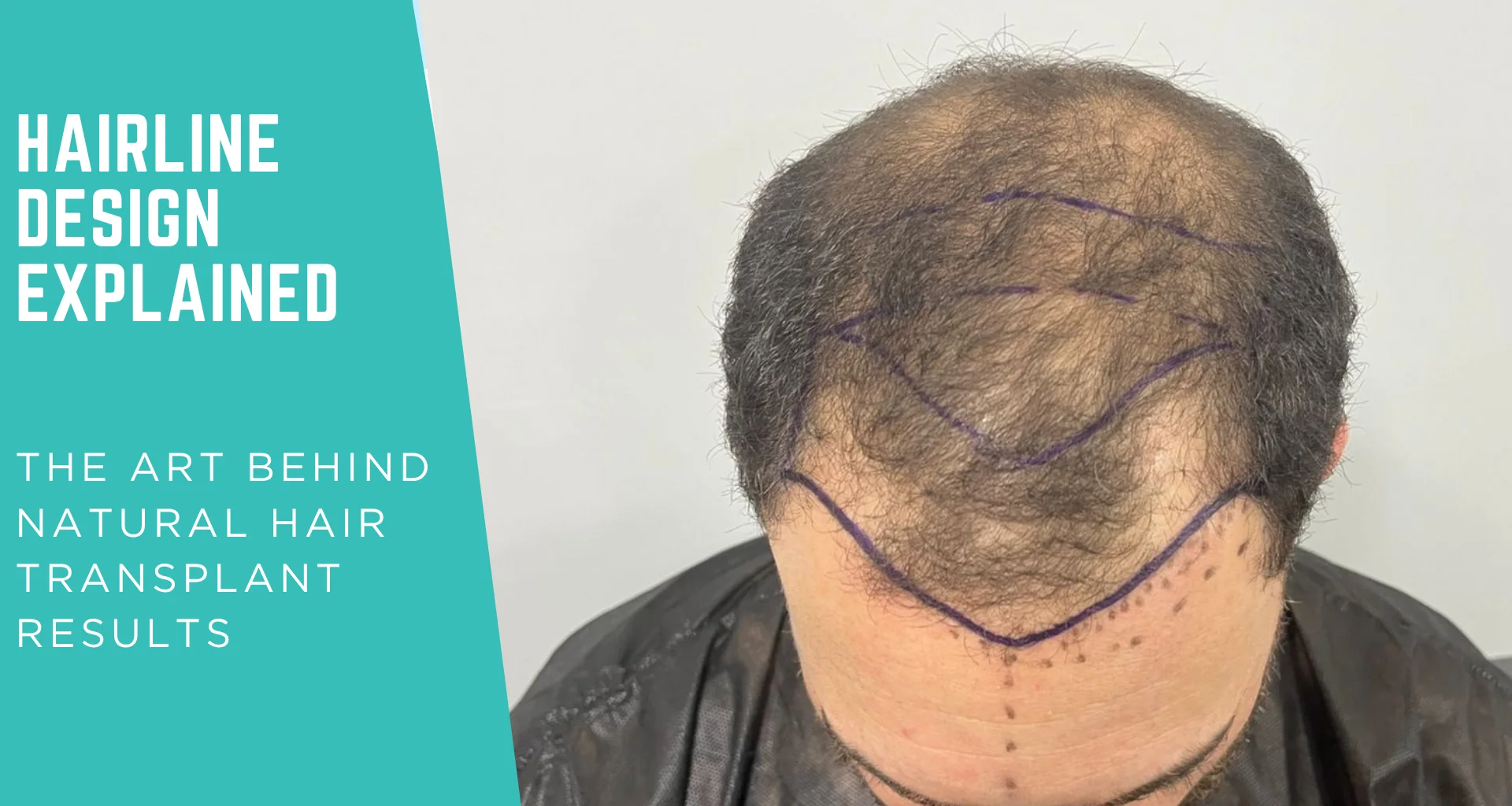
Hairline design is the process of planning where the frontal hairline begins, how it curves across the forehead, what shape it takes at the temples, and how transplanted hair transitions from sparse to dense. It is a visual and anatomical plan that guides the entire procedure.
A good hairline design hair transplant plan covers height, shape, angle, and density before any graft is placed.
It is not just about drawing a line on the scalp. It determines how the result looks immediately after growth and whether it continues to look appropriate five, ten, and twenty years from now.
Most patients focus on graft numbers when researching hair transplant surgery. More grafts, better results. That assumption is wrong. Understanding which hair transplant technique gives the most natural results is a better starting point.
A well-designed hairline with 1,500 grafts can look more natural than a poorly designed one with 3,500. The design determines the outcome. The grafts execute it.
The hairline is the first thing anyone sees. The human eye goes to it immediately. Small design mistakes in that zone have a disproportionate effect on overall appearance. This is why experienced teams spend as much time on planning as they do on extraction and implantation.
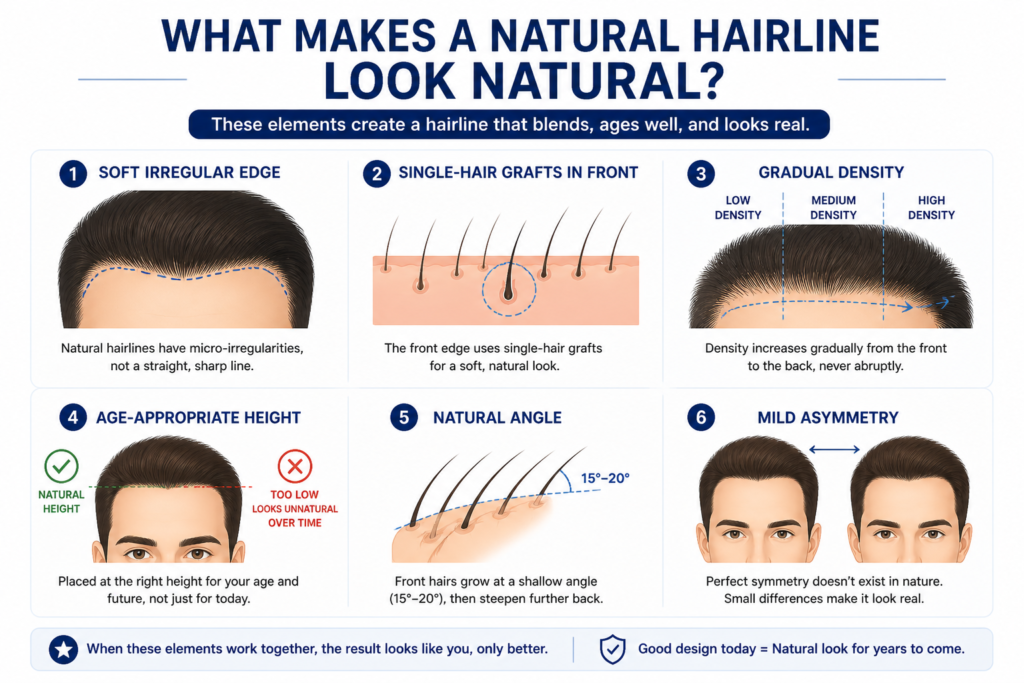
A natural hairline has specific characteristics that every good hairline design hair transplant attempts to replicate. Understanding these helps you assess any result, including one you are considering.
1. It is never a straight line. Natural hairlines have micro-irregularities along the edge. Small variations where individual hairs emerge at slightly different points. A ruler-straight hairline signals surgery immediately, even to untrained eyes.
2. The very front is built with single-hair grafts. At the leading edge, nature uses individual hairs to create a soft, feathered look. A transplant that uses two or three-hair grafts at the very front produces a dense, hard border that looks pluggy. Single-hair grafts at the edge are non-negotiable for a natural result.
3. Density builds gradually from front to back. The transition from forehead to full hair density is never abrupt. It increases progressively, starting very soft at the hairline edge and building toward full density a centimetre or two back. Abrupt density at the front is one of the most common reasons a transplant looks artificial.
4. The height is age-appropriate, not aspirational. A very low hairline looks appealing at 30. At 50, with the surrounding hair continuing to thin, it looks wrong. Surgeons place the hairline slightly higher than a patient might request because it needs to work for the next twenty years, not just the next two.
5. Controlled asymmetry is built in deliberately. Perfect symmetry does not exist in nature. A hairline that is identically mirrored on both sides reads as artificial. Small intentional differences between the left and right temple, tiny variations in the leading edge, these are features of a well-designed result, not flaws.
6. Hair angle matches natural growth direction. At the front of the hairline, hair grows at a shallow angle of roughly 15 to 20 degrees from the scalp. Further back it steepens. Placing grafts at the wrong angle causes hair to grow away from the face rather than across it, which creates an unnatural look that no styling can fix.
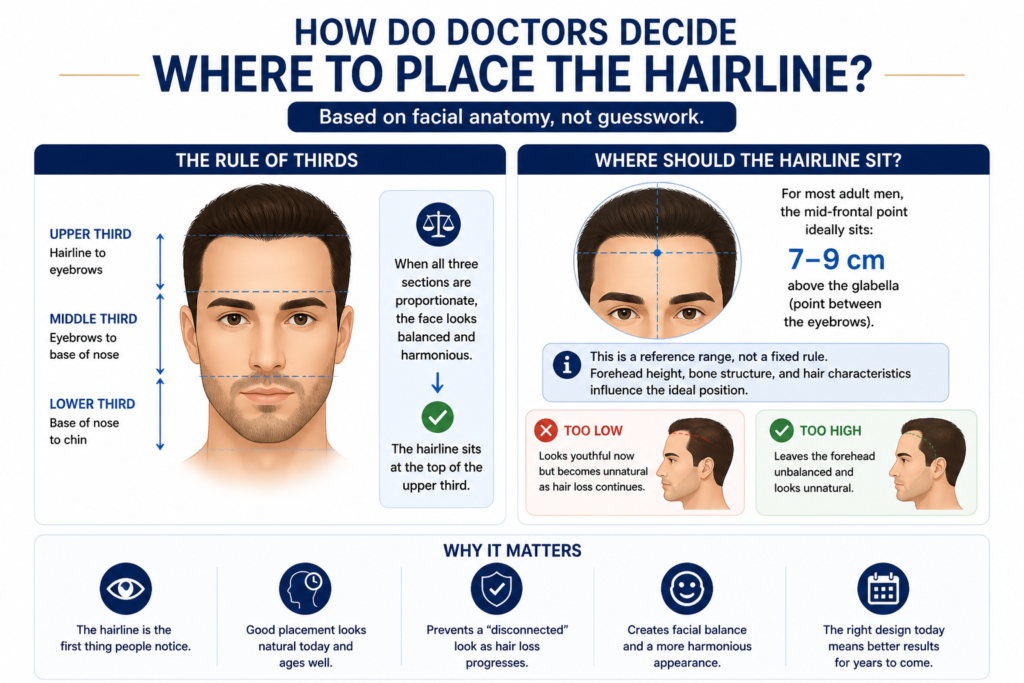
Hairline placement is not guesswork and it is not based on what the patient wants or what they used to have. It is based on facial anatomy.
The most widely used reference principle is the rule of thirds, drawn from Leonardo da Vinci’s facial proportion studies. The face is divided vertically into three roughly equal sections:
• Lower third: base of nose to chin.
• Middle third: eyebrows to base of nose.
• Upper third: hairline to eyebrows.
When these three sections are proportionally balanced, the face reads as harmonious. The hairline sits at the top of that upper third.
In practice, for most adult men the mid-frontal point of the hairline sits 7 to 9 centimetres above the glabella, which is the point between the eyebrows. This is a reference range, not a fixed rule. Forehead height, bone structure, and hair characteristics all influence where exactly within that range the hairline should sit.
Placing the hairline too low creates a youthful but unsustainable result. If hair loss continues behind a low hairline, the area looks increasingly disconnected from the rest of the scalp over time. Placing it too high leaves the forehead visually unbalanced.
The skill is finding the position that looks natural today and continues to make sense as the face ages and, in most cases, as hair loss progresses.
The ideal hairline for men is one that suits that specific face, fits the patient’s age, and holds up as hair loss continues. There is no single shape that works for everyone. But there are clear principles for what works on male faces.
There is no single ideal shape. But there are clear principles for what works on male faces.
Temple recession is natural, not a flaw. Most adult men have some natural recession at the temples. A hairline that fills the temples completely flat tends to look feminized and artificial on a male face. Recreating a slight M-shaped recession at the temples, even if mild, is one of the most important factors in a natural male hairline result.
The M-shape is the most natural pattern for men. A central forelock with gentle recession at the temples mimics how male hair actually grows and matures. It is not a sign of hair loss. It is a sign of how male hairlines look in adulthood.
The design must account for where the hair loss is going. A 28-year-old and a 48-year-old with similar current hair loss should not receive the same hairline design. The younger patient’s loss will likely continue. The hairline needs to be planned around that future, not just today’s picture.
Hairline shapes used in hair transplant design:
| Hairline Shape | Key Characteristics | Works Best When | Risk |
| Straight | Minimal recession, flat frontal line | Rarely used. Select female cases only | Looks artificial on most male faces |
| Rounded | Soft curve across the forehead | Patient wants a softer appearance | Can look too low or too young if overdone |
| M-shaped | Natural temple recession with central forelock | Most adult men. Most natural pattern | Requires precise symmetry control at temples |
| Irregular | Small variations built along the edge | Almost all natural hairline designs | Needs high surgical precision to execute well |
A hairline before and after comparison tells you more than the result alone.Any hairline before and after photo should show you the leading edge, temple shape, and density gradient, not just fullness. Look at whether the shape respects these principles. A result that looks impressive in a photo but places the hairline too low or eliminates natural temple recession will not age well.
Male and female hairlines follow different anatomical norms. The ideal hairline for men follows an M-shape with natural temple recession. Women need a softer, more rounded design. Using the wrong framework for the wrong patient is one of the clearest signs of inexperienced planning.
| Factor | Men | Women |
| Typical shape | M-shaped with mild temple recession | Rounded, softer, sometimes with a gentle widow’s peak |
| Hairline height | Slightly higher, age-adjusted | Generally lower, more youthful positioning |
| Temple corners | Natural recession preserved | Corners lowered or maintained flat |
| Density at front | Feathered, gradual | More even density distribution |
| Key priority | Long-term masculinity and aging appropriateness | Maintaining a soft, feminine frame around the face |
| Common mistake | Filling temples too full, creating a feminized look | Placing hairline too high, making forehead appear large |
Female hair transplant patients with diffuse thinning or a naturally high hairline often seek hairline restoration through a transplant. The design in female cases prioritizes a soft rounded frontal line, preservation of any natural widow’s peak, and an even density that does not draw attention to the hairline itself.
The hairline does not exist in isolation. It frames the face. A shape that works on one face structure can look wrong on another. Experienced hairline design always considers the face as a whole.
| Face Shape | Recommended Hairline Approach | Why It Works |
| Round | Slight height with soft irregular peaks | Adds the appearance of length to the face |
| Square | Rounded or mildly peaked hairline | Softens the strong angular jawline visually |
| Long | Lower, straighter frontal line | Reduces the apparent length of the face |
| Oval | Most designs work. Balanced proportions | Natural harmony with most hairline shapes |
| Heart-shaped | Soft curve, avoid strong widow’s peak | Prevents top-heaviness in the facial silhouette |
Beyond face shape, ethnic background plays a role. East Asian hairlines tend to be flatter and straighter across the forehead. Mediterranean patients often have more defined central forelock patterns. African and Afro-Caribbean patients have tighter curl patterns that affect how grafts are placed and how density reads at the hairline. A good hairline design respects these norms rather than applying a one-size approach.
The transition zone is the few millimetres at the very front of the hairline where the scalp becomes hair. It is the most technically demanding part of the entire procedure and the part that most determines whether a result looks natural or artificial.
In nature, this zone is made entirely of single, fine hairs that emerge softly from the scalp. There is no sharp border. The hairline fades in gradually.
In a hair transplant, the transition zone is recreated using exclusively single-hair grafts placed at a shallow angle. These hairs create what is called a feathered edge. Soft, slightly irregular, transparent when light hits it at certain angles. Exactly how a natural hairline looks.
Behind the transition zone, density builds. Two-hair grafts come next, then three-hair grafts further back. This layered approach is how the illusion of full density is created without a harsh visible border.
What happens when the transition zone is done wrong:
• Multi-hair grafts placed at the very front create a thick, dense border that looks pluggy.
• The hairline appears as a hard line rather than a soft fade.
• Under direct lighting or close inspection, the artificial edge is immediately visible.
• This is what older transplants looked like. Modern technique avoids it entirely when done correctly.
The transition zone is where the artistry of hairline design meets the technical precision of graft placement. Getting it right requires both.
Most unnatural hair transplant results are not caused by poor graft survival. They come from avoidable mistakes in hairline design hair transplant planning. They are caused by avoidable design mistakes made during planning. Some look acceptable immediately after surgery but become increasingly obvious as swelling resolves, hair grows, and aging continues.
| Mistake | Why It Happens | What It Looks Like |
| Hairline placed too low | Patient pressure or clinic willingness to please | Youthful at first, disconnected and artificial as surrounding hair thins |
| Hairline too straight | Lack of surgical artistry or planning | Immediately signals surgery. Hard border across the forehead |
| Multi-hair grafts at the leading edge | Rushing the process or poor graft selection | Pluggy, dense front edge with no soft transition |
| Eliminating temple recession in men | Overly filling to impress. Patient requested it | Feminized, flat appearance that does not suit adult male faces |
| Overpacking the frontal zone | More grafts equals better result misconception | Wall effect. No natural density gradient. Obvious transplant |
| Designing for trends not longevity | Following what looks good now rather than planning ahead | Hairline looks outdated or mismatched as the patient ages |
| Ignoring future hair loss | Short-term planning only | Transplanted island of hair surrounded by thinning areas later |
The ideal hairline for men is never the lowest possible position. It is the most natural and sustainable one. The most important thing to understand about these mistakes: most of them feel like good ideas at the time. A lower hairline looks more dramatic in a before and after photo. A perfectly symmetrical design looks precise. A dense front looks full. The problem is that natural hair does not work this way, and the result only reveals itself months or years later.
Hairline design is where patient expectations and surgical reality diverge most often. Patients arrive with reference photos, memories of their teenage hairline, or celebrity examples. A surgeon’s role is to translate those expectations into a design that is realistic, safe, and natural for that specific patient’s anatomy and long-term hair loss pattern.
| Patient Expectation | Surgical Reality | How It Is Addressed |
| I want my old hairline back | Past hairlines may not suit current age or facial structure | Design adjusted to be age-appropriate and proportionally balanced |
| Lower means better | Very low hairlines often look unnatural as surrounding hair thins | Hairline placed conservatively to age naturally |
| It should look dense immediately | Natural hairlines have gradual density transitions | Density built progressively from the leading edge backward |
| This photo is exactly what I want | Photos do not account for donor limits or hair characteristics | Reference images used as guidance, not templates |
| More grafts at the front is best | Overpacking causes the wall effect and looks artificial | Grafts distributed strategically for realism and longevity |
| Perfect symmetry looks natural | Perfect symmetry rarely exists in nature | Controlled irregularity introduced intentionally at the design stage |
The consultation is where these gaps are addressed. A clinic that agrees with everything a patient wants without clinical pushback is not a clinic that is thinking about what the result will look like in ten years.
Hairline design hair transplant planning does not begin on surgery day. It is a structured process that happens during consultation and is agreed upon before a single graft is extracted. It is a structured planning process that happens in the consultation stage and is agreed upon before a single graft is extracted.
1. Facial proportion and landmark analysis. The hairline is positioned using stable anatomical reference points: forehead height, brow position, and facial thirds. The goal is balance across the upper, middle, and lower face, not an arbitrary measurement or a past hairline.
2. Age-appropriate placement. The hairline is designed for where the patient is now and where they are going. Younger patients typically receive slightly higher and softer designs to allow natural aging. Older patients may have more conservative designs to avoid disconnection from thinning hair around the transplanted area.
3. Hair characteristics assessment. Hair thickness, curl pattern, colour contrast with skin, and natural growth direction all affect how the hairline is drawn. Coarser or curlier hair provides more visual coverage per graft. Fine, straight hair requires more precise placement for the same visual effect.
4. Donor area evaluation. The donor area is assessed before any hairline position is finalised. How many grafts can be safely allocated to the hairline without compromising future needs for the crown or mid-scalp? Hairline ambition is always balanced against donor preservation.
5. Irregularity mapping. Natural hairlines are never perfectly straight. The planning stage intentionally introduces micro and macro irregularities, slight peaks and troughs along the leading edge, to mimic how hair grows naturally.
6. Patient review before surgery. The proposed hairline is drawn on the scalp with the patient standing and awake. The patient sees it in a mirror. Adjustments are discussed and made before any incision. Nothing is finalized without agreement.
Every hairline design decision is ultimately limited by the donor area. A hairline can only be executed safely if there are enough healthy grafts available. This is why responsible hairline planning always starts with donor assessment, not frontal aesthetics.
The donor area contains a finite number of follicles that do not regenerate once extracted. Using too many grafts on a low or dense hairline today limits what is possible for the crown and mid-scalp in future sessions.
How donor area supply directly shapes hairline design:
• Total donor density determines how low and dense the hairline can safely be.
• Hair thickness and curl affect how much visual coverage each graft provides.
• Overuse of grafts at the front reduces options for mid-scalp or crown restoration later.
• Aggressive low hairlines increase the risk of depleting the donor zone.
• Conservative front-line planning protects grafts for future procedures as hair loss continues.
A clinic that designs a low, dense hairline without a full donor assessment is making a decision that looks impressive today and creates problems in five years. The best hairline design is one that allocates grafts intelligently across the whole picture, not just the front row.
Before and after photos are the most widely used tool for evaluating a clinic’s work. Most patients look at them and assess: does the hair look full? Does it look like real hair? But hairline design quality requires a more specific eye.
What to look for in a good hairline before and after result:
• The leading edge is soft and irregular, not a hard straight line.
• Temple recession is preserved or subtly recreated in men.
• Density increases gradually from front to back, not abruptly.
• The hairline height looks appropriate for the patient’s age.
• Under light or at different angles, the hairline does not look dense or pluggy at the front.
• The result at 12 to 18 months shows full integration with surrounding hair.
Red flags in hairline before and after photos:
• A ruler-straight frontal line.
• Dense, clearly defined edge with no transition zone visible.
• Temples completely filled, creating a flat unnatural frame.
• Hairline sitting noticeably lower than age would suggest.
• Photos shown only at 6 months, not at 12 to 18 months when the full result is visible.
Results shown at 6 months look different from results at 18 months. Hair continues to thicken, settle, and integrate for up to a year and a half after a transplant. A clinic that only shows early results may be doing so because the final result tells a different story.
Hair transplant Istanbul has become one of the most searched destinations globally for hairline restoration Turkey. Patients from the US, UK, and Europe travel here because of experienced clinical teams, accessible pricing, and high procedure volume. The combination of experienced clinical teams, accessible pricing, and high procedure volume has positioned Turkey, and Istanbul specifically, as a leading centre for hair restoration.
But volume and price are not the same as quality. Turkey has both: clinics that compete on graft numbers and package pricing, and clinics that compete on design quality, team expertise, and long-term outcomes. The difference between them shows up in hairline results.
What distinguishes the best hair transplant in Turkey for hairline design:
• Medical Directors who personally oversee hairline design, not technicians following a template.
• Design consultations that assess facial structure, donor supply, and long-term hair loss before any plan is drawn.
• A team model where the same people who plan the hairline are present during the procedure.
• Honest advice on hairline position, even when it differs from what the patient initially requests.
• Before and after documentation shown at 12 to 18 months, not just early results.
Patients researching hairline restoration in Turkey will find a wide range of clinics, from high-volume package operations to specialist teams focused entirely on hair restoration. For hairline design specifically, the question to ask any clinic is simple: who draws the hairline and how is that decision made? For hairline design specifically, the question to ask any clinic is simple: who draws the hairline, how is that decision made, and what happens if the patient disagrees? The answers tell you a lot about how seriously they treat the design stage.
At UniquEra, hairline design hair transplant planning starts with the patient’s face, not a template. The hairline is drawn by hand, specific to the person in front of us. Not templated, not taken from a reference photo, not based on a standard shape. It is designed freehand, in person, with the patient standing so the team can see how the face moves, how light falls across the forehead, and how the hairline will interact with the patient’s existing hair.
Height, shape, and direction. These three elements are locked in before any conversation about how many grafts are needed or which technique will be used. Most clinics start with the package and work backwards. At UniquEra the design comes first and everything else follows from it.
A 28-year-old with a Norwood 3 pattern and a 46-year-old with the same current picture need different hairline designs. Their futures are different. The younger patient’s loss will likely continue. The hairline that works for them today needs to work when surrounding hair has continued to change. Age, progression pattern, and donor supply all shape the design before anything is drawn on the scalp.
The micro-zigzag pattern along the leading edge, the feathered transition zone, the slight difference in temple height between left and right. None of this is an accident or a variation in execution. It is planned. The irregularity is mapped before the first incision because it cannot be corrected after.
The proposed hairline is drawn on the scalp with a soft marker while the patient is standing and awake. They see it in a mirror from multiple angles. The Medical Directors at UniquEra, who have over a decade of hands-on hair transplant experience supervising each case personally, discuss the design with the patient directly. Adjustments are made at this stage. Nothing moves forward without agreement.
Once the hairline design is finalised, the team calculates what it requires from the donor area and whether that allocation is safe given the patient’s total donor capacity and likely future needs. If the design exceeds what can be done responsibly, it is revised. The donor area is never compromised to produce a more dramatic hairline. This approach protects future sessions as hair loss continues.
That figure reflects what happens when hairlines are planned carefully and patients see results that hold up over time. Not just at six months, but at two and three years when the design is tested by aging and ongoing hair loss.
A consultation at UniquEra is a design session, not a sales appointment. The team reviews your facial structure, maps your donor area, and proposes a hairline that makes clinical and aesthetic sense for your face. If you want to see what that process looks like for your specific situation, book a consultation.
A great hair transplant starts with great hairline design and hair transplant planning. The grafts execute the plan. The grafts execute the plan. The technique extracts and places them. But it is the design, drawn before any of that begins, that determines whether the result looks like your hair or like a procedure.
The hairline is permanent. It sits at the most visible part of the face. Small mistakes there have large consequences. And the decisions that create those mistakes, too low, too straight, too dense, wrong angles, ignoring future loss, are all made at the planning stage, not during surgery.
Understanding what good hairline design looks like gives you the ability to evaluate any clinic, any result, and any plan proposed to you. It shifts the conversation from graft count to what actually matters.
If you are considering hairline restoration in Turkey and want a clinical assessment of what a natural, age-appropriate design would look like for your face, the team at UniquEra is available. No pressure, no packages. A clear conversation about your hairline and what makes sense for you.
Hairline design hair transplant planning is the process of deciding where the frontal hairline begins, how it curves, and how density transitions from the edge inward. how it curves, and how density transitions from the edge inward. It is the most important decision in the procedure and determines whether the result looks natural.
A soft, irregular leading edge built with single-hair grafts, gradual density from front to back, age-appropriate height, controlled asymmetry, and correct hair angle. A hairline that has all of these is virtually undetectable.
Using the rule of thirds, stable facial landmarks like brow position and forehead height, and the patient’s age and expected hair loss progression. For most adult men the mid-frontal point sits 7 to 9 centimetres above the glabella.
An M-shaped hairline with mild natural temple recession, age-appropriate height, and a soft feathered leading edge. A flat, fully filled hairline with no temple recession tends to look artificial on male faces.
The soft feathered area at the very front of the hairline built exclusively with single-hair grafts. It creates a gradual fade from forehead to hair rather than a hard visible border.
You can have input but the final design should be a clinical decision. A surgeon who agrees to any hairline position the patient requests without pushback is not thinking about what the result looks like in ten years.
Usually because of design mistakes: hairline placed too low, too straight, or too dense at the front. Multi-hair grafts at the leading edge and eliminated temple recession in men are the most common causes of an obvious result.
It depends on the area being restored and the desired density, but a frontal hairline typically requires 1,000 to 2,500 grafts. Strategic placement matters far more than volume.
Yes. Round faces benefit from slight height and irregular peaks. Square faces suit a rounded hairline. Long faces benefit from a lower, flatter design. Each shape interacts differently with hairline position and curve.
A facial proportion principle from Leonardo da Vinci. The face is divided into three equal vertical sections, with the hairline sitting at the top of the upper third. It guides where the hairline should be placed to create facial harmony.
Men typically need an M-shaped design with preserved temple recession and slightly higher placement. Women generally benefit from a lower, rounder, softer hairline with more even density distribution across the front.
Yes. East Asian hairlines tend to be flatter and straighter. Mediterranean patients often have more defined forelock patterns. Afro-Caribbean patients have different curl patterns that affect graft placement and density. Good design respects these norms.
It may look youthful initially but becomes increasingly artificial as surrounding hair thins and the face matures. A low hairline is also very difficult to correct without using additional donor supply.
Sometimes, through a hair transplant repair procedure. But repair is more complex than a primary transplant because the donor area has already been used and scarring may be present. Read our full guide on whether revision hair transplantation can fix a poorly designed hairline from a previous procedure. Prevention through good initial design is always preferable.
The hairline result is mostly visible by 12 months but continues to mature through 18 months. Photos at 6 months show early growth. The real result, with full density and natural texture, is only accessible at 12 to 18 months.
Good hairline before and after photos show a soft irregular leading edge, preserved temple recession in men, gradual density from front to back, and photos taken at 12 to 18 months. A hairline before and after taken at 6 months is too early to judge the real result.
Istanbul combines experienced clinical teams with accessible pricing and high procedure volume. The best hair transplant in Turkey for hairline design comes from clinics where Medical Directors with over a decade of hands-on hair transplant experience personally oversee the process, not technicians following a template.
Ask who draws the hairline, how they decide its position, whether the patient sees it before surgery begins, how donor supply is factored into the design, and whether they will show you results at 12 to 18 months.