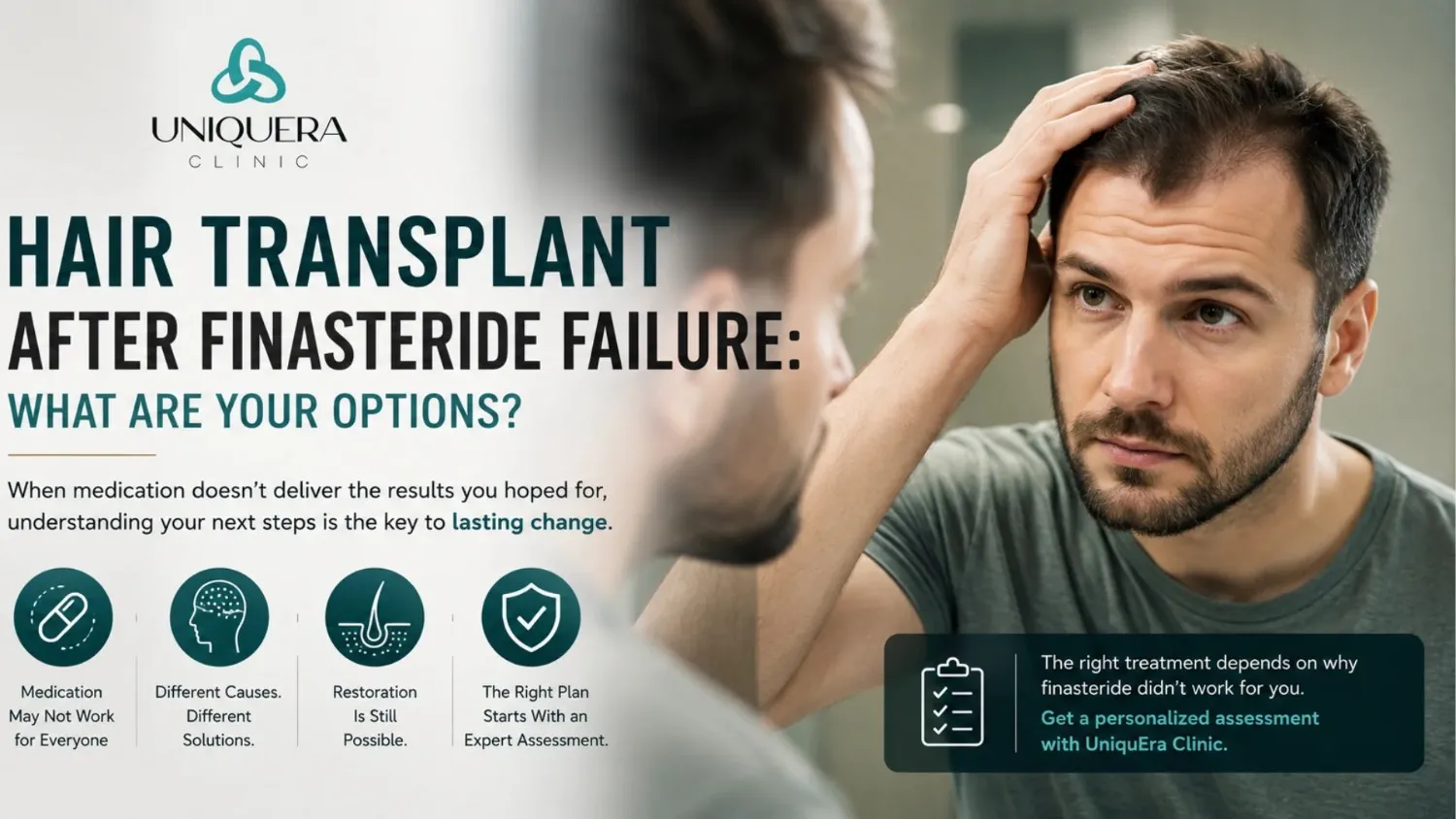

A hair transplant after finasteride failure can be the right next step, but only after understanding what “failure” means in your case. Continued thinning, stabilization without regrowth, and stopping because of side effects call for different plans.
Watching your hair keep thinning after staying consistent with treatment is frustrating. You waited for change, but the mirror still doesn’t reflect what you hoped for. That doesn’t mean you’ve run out of options.
Finasteride can fall short for different reasons. A scalp and donor assessment can show whether your loss is still progressing, whether another non-surgical option may still help, or whether surgery has become the more realistic option. Book a consultation with UniquEra Clinic to understand which path fits your case. |
Finasteride failure usually falls into one of four categories, and each one points somewhere different.
● Continued hair loss. Loss kept progressing even with consistent use.
● Stabilization without regrowth. Loss may have slowed or stopped, but density never improved.
● Intolerance. Treatment stopped because of side effects, not because it failed on its own terms.
● Areas already lost. Some follicles may have reached a stage where medication is unlikely to restore meaningful visible coverage.
These are not the same problem, and treating them the same way is where a lot of hair loss advice goes wrong.
Finasteride can slow hair loss and improve growth for many patients, but the level of response varies. It’s primarily used to preserve hair that’s still susceptible to loss, not rebuild areas where meaningful follicular activity has already been lost.
Finasteride is a preservation tool first. It works by lowering DHT, the hormone linked to shrinking sensitive hair follicles. Some patients respond well and see real improvement. Others stabilize but don’t get the thicker look they pictured. And some keep losing hair regardless. A few things drive that difference:
● Severity of the hair loss at the point treatment started.
● How far the follicles had already miniaturized before treatment began.
● How consistently the medication was taken over time.
● Individual biological response to lower DHT levels.
None of that means something was done wrong. It means one medication can’t answer every version of hair loss.
An alternative to finasteride may still be worth discussing with a doctor, even if you’re not ready to consider surgery. Options generally fall into a few categories:
● Other prescription approaches, based on your specific history with finasteride.
● Topical treatments applied directly to the scalp.
● Scalp-focused therapies, such as low-level light treatment or platelet-rich plasma, which may be considered to support existing hair in suitable cases..
● Combination approaches using more than one method at once.
These treatments are not direct replacements for finasteride and should be considered according to the diagnosis and available evidence. What worked, or didn’t, with finasteride matters for what you try next.
Hair transplant surgery becomes more realistic once you’re dealing with areas where meaningful regrowth is unlikely and your donor area can safely support moving hair to those spots.
Surgery doesn’t stop the biological process behind hair loss. What it actually does is different:
● Relocates resistant donor follicles into thinning or bald areas.
● Restores coverage rather than treating the underlying cause of hair loss.
● Can be combined with an appropriate hair-preservation plan when medically suitable.
It isn’t a substitute for figuring out what caused your original results to fall short in the first place.
Hair transplant vs finasteride comes down to one thing: preserving hair versus replacing it.
| Question | Finasteride | Hair transplant |
| Main purpose | Helps preserve hair that’s still susceptible to loss. | Restores coverage in areas where hair is already gone. |
| Can it rebuild a bald area? | Usually limited. | Yes, when the donor area can support it. |
| Stops all future loss? | No guarantee. | No, untreated native hair can still thin.. |
| Ongoing commitment? | Typically continued while the benefit is wanted.. | The procedure is completed surgically, but later sessions may be needed if hair loss progresses. |
| Depends on donor hair? | No | Yes |
One helps preserve susceptible existing hair. The other restores coverage where hair has already been lost. They solve different problems and may be used separately or together, depending on the patient’s hair loss, medical suitability, and long-term plan.
Preserving hair and restoring hair are different decisions. The right plan depends on what finasteride achieved, how stable your native hair is, and what your donor area can support. Book an assessment with UniquEra Clinic to see whether your case needs preservation, restoration, or both. |
Appropriately selected donor follicles do not depend on finasteride to grow after transplantation because they retain the characteristics of the donor area. Our dedicated guide on hair transplant without finasteride explores this in full for patients weighing up their options. Hair transplantation is based on donor dominance, but this depends on taking follicles from a stable donor zone. That is especially important in diffuse or unpatterned loss.
What still depends on your choices afterward is the rest of your hair:
● Native hair outside the transplanted area can keep thinning over time without support.
● Younger patients, or anyone with hair loss that’s still progressing, usually benefit from a more conservative, carefully staged plan.
Medication is not mandatory for every patient. The decision should be made individually with the appropriate medical professional.
A diffuse thinning hair transplant can work, but it depends heavily on donor strength and whether the thinning pattern has stabilized.
Diffuse thinning spreads loss across a wider area instead of concentrating it in one clear zone, like a hairline or crown. That makes donor assessment more important than usual. Here’s why it changes the calculation:
● The donor area itself may show early signs of thinning, and moving hair from a weakening zone can create a new problem instead of solving the original one.
● Some patients with diffuse thinning are good surgical candidates once the pattern is confirmed stable.
● Others are better served waiting. If native hair is still thinning rapidly, the result may become uneven as surrounding hair continues to fall. If the donor zone is also miniaturizing, the transplanted grafts may not provide a reliable long-term result.
An honest assessment is what tells you which one applies to you.
A receding hairline transplant is usually more straightforward to plan around than diffuse thinning, since the area needing treatment is clearly defined.
Even so, good planning has to look past today’s mirror. Here’s what a careful plan accounts for:
● Where your hairline will likely sit years from now, not just where it sits today.
● The risk of a low hairline, built with grafts placed generously in front, becoming isolated if the surrounding native hair keeps thinning behind it.
● Balancing the frontal zone against the rest of the scalp, rather than treating the hairline as a standalone decision.
Get this wrong, and you can end up with a transplanted section surrounded by hair that’s still receding.
A transplant restores coverage in areas where meaningful natural regrowth is no longer expected. It can’t guarantee that hair outside that area stops thinning on its own.
Here’s what to expect realistically:
● Results build gradually, usually over 12 to 18 month
● The goal is natural-looking coverage suited to your face and age, not a return to teenage density.
● If your hair loss keeps progressing elsewhere on your scalp, that’s a separate conversation worth having early, before it becomes a surprise later.
What should you look for in a clinic after finasteride hasn’t worked?
Look for a clinic that investigates why your treatment didn’t work before recommending surgery. That means the assessment should cover:
● Your current progression, not just where your hair loss stands today..
● Donor density, and whether your donor area shows any thinning of its own.
● How your existing hair should be protected going forward, not just what gets transplanted?
When comparing the best hair clinics in Turkey, look beyond graft numbers and technique names. A responsible hair transplant clinic in Istanbul should assess native-hair miniaturization, donor stability, and likely future progression before recommending surgery.
At UniquEra Clinic, the first step is defining what “finasteride failure” means in your case. Our Medical Directors have over a decade of hands-on hair transplant experience and personally supervise each case. They assess whether the loss has continued, stabilized without enough visible regrowth, or progressed to areas that medication is unlikely to refill.
The assessment then covers:
● Donor density and donor-area miniaturization.
● Stability of the remaining native hair
● Whether the pattern is diffuse or clearly defined.
● Future recession behind the proposed hairline.
● How many grafts can be used without compromising later options.
Technique is selected only after those questions are answered. When waiting or continuing non-surgical management would produce a safer long-term plan, surgery is not rushed. Planning a hair transplant after finasteride failure begins with this distinction, not with a pre-selected graft number or technique.
It can be, when the area of loss is clearly defined, the donor area is healthy, and the plan accounts for hair you might still lose later.
Finasteride not giving you what you hoped for doesn’t mean you’re out of options. It means the next decision should rest on what the medication actually achieved, what it was never going to fix, and how stable your remaining hair is right now.
Do not choose surgery simply because medication disappointed you. The right next step depends on your donor supply, current progression, and whether lost coverage can be restored without compromising future options. Book your consultation with UniquEra today. |
Yes, as long as your donor area is healthy and your pattern is suitable for surgery. What matters first is understanding why finasteride didn’t work in your case.
No. Appropriately selected donor follicles can grow without finasteride, although surrounding native hair may continue thinning.
Don’t stop or change any prescription medication without talking to your doctor first. Your prescribing physician and transplant team should coordinate on timing.
Transplanted follicles taken from a stable donor zone are generally resistant to pattern hair loss. Native hair outside the transplanted area may still continue thinning.
Sometimes. It depends on whether the donor area is strong and the thinning pattern has stabilized rather than affecting the whole scalp.
Other medical or topical options may be considered, depending on why finasteride was unsuitable or ineffective. These should be reviewed with an appropriate medical professional.
Look for a clinic that assesses progression, donor area, and existing hair before recommending a graft count. That assessment matters more than any number quoted upfront.