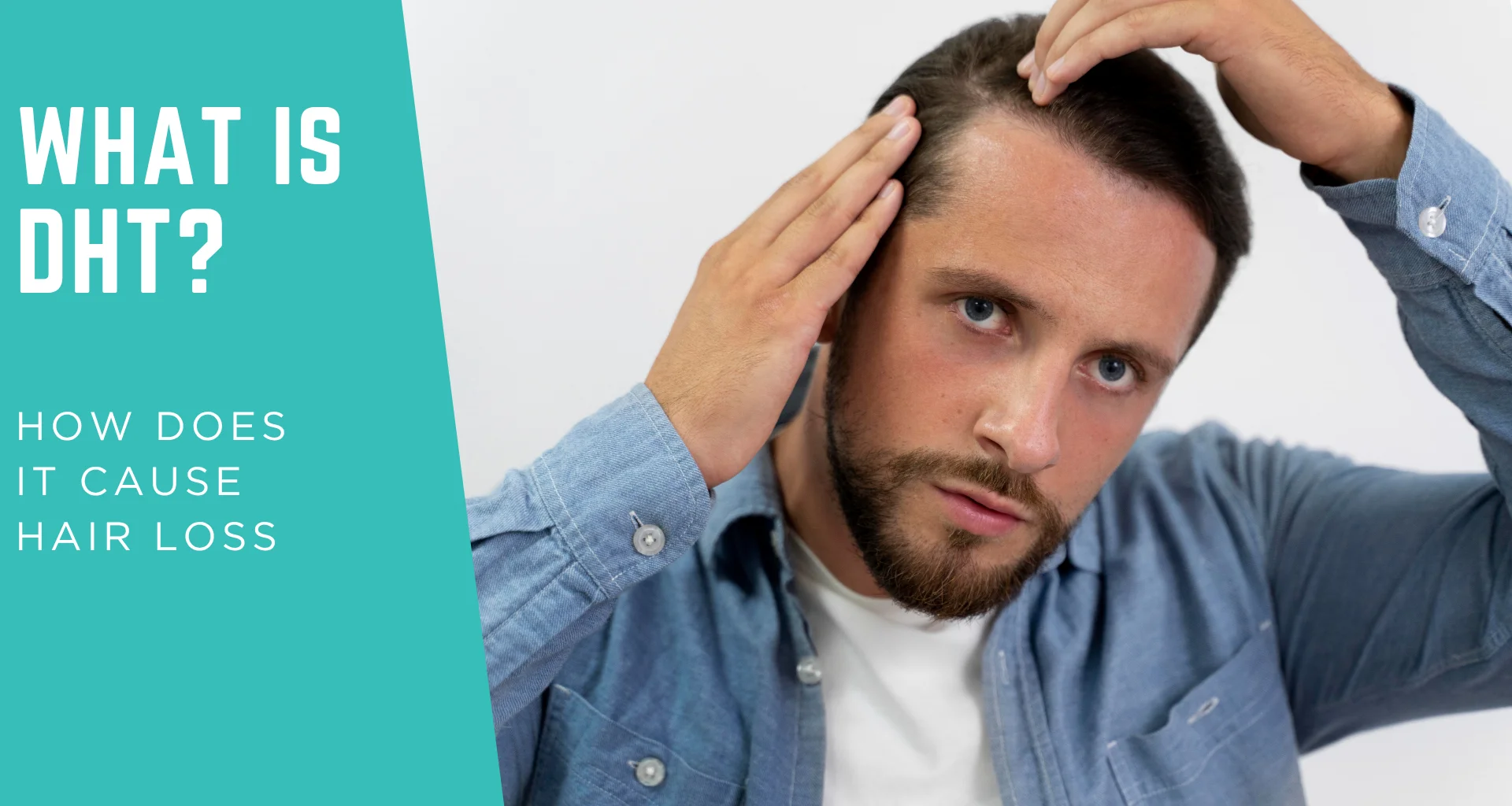

You noticed your hair thinning. Someone mentioned DHT. You searched it and got a wall of medical language that explained very little.
This is the clear version.
DHT hair loss is one of the most common and most misunderstood causes of thinning hair in both men and women. Once you understand what DHT actually does and why it affects some follicles and not others, the decisions in front of you become a lot clearer.
If you are already past the research stage and want to understand what your hair loss means for your specific case, UniquEra’s medical team is available for a private consultation. Bring your questions.
DHT stands for dihydrotestosterone. It is a hormone made from testosterone by an enzyme called 5-alpha reductase.
Both men and women produce it. Men produce more because they have higher testosterone levels, but DHT is present in both sexes.
DHT is not harmful in general. In the body it contributes to:
• Sexual development during puberty
• Muscle development and body hair growth
• Prostate and sebaceous gland function
The problem starts when DHT interacts with genetically sensitive hair follicles on the scalp.
DHT causes hair loss by binding to androgen receptors inside scalp follicles and triggering a process called miniaturisation.
Each hair grows in a cycle. DHT disrupts that cycle in three stages:
1 Growth phase shortens: DHT reduces the time each hair spends actively growing.
2 The resting phase extends: The follicle spends more time dormant, producing nothing.
3 Follicle shrinks: Each cycle produces a thinner, shorter hair until the follicle stops producing altogether.
The follicle does not disappear. It just becomes inactive. This is why DHT hair loss is gradual and why catching it early makes a real difference.
DHT does not cause hair loss because of high DHT levels. It causes hair loss because of how sensitive certain follicles are to DHT. This sensitivity is genetic.
Two people can have identical DHT levels. One loses hair. One does not. The difference is in the follicle receptor, not the hormone itself.
Key insight: Follicles at the back and sides of the scalp are genetically resistant to DHT. They do not miniaturise. This is the scientific reason hair transplants work permanently. Donor hair taken from these areas retains its DHT resistance when moved to thinning zones.
Does DHT Cause Hair Loss in Women Too?
Yes. DHT causes hair loss in women. It presents differently than in men, but the underlying mechanism is the same.
| Male Pattern Baldness | Female Pattern Hair Loss | |
| Pattern | Receding hairline at temples, M shape, crown thinning | Diffuse thinning across top of scalp |
| Frontal hairline | Recedes early | Usually stays intact |
| Progression | Can lead to complete baldness | Rarely complete baldness |
| Cause | DHT miniaturisation in genetically sensitive follicles | Same DHT miniaturisation process |
| When it worsens | Often starts late teens to thirties | Often accelerates after menopause |
Women with higher androgen activity, particularly after menopause when oestrogen levels drop, are more likely to notice DHT-related thinning. Conditions like polycystic ovary syndrome can also elevate androgen levels and accelerate hair loss.
DHT blockers reduce the amount of DHT reaching hair follicles, either by blocking the 5-alpha reductase enzyme or reducing its effects on androgen receptors.
| Pharmaceutical | Natural alternatives | |
| Examples | Finasteride, Dutasteride | Saw palmetto, pumpkin seed oil, green tea |
| How it works | Blocks 5-alpha reductase enzyme | Mildly inhibits DHT production |
| Effectiveness | Clinically proven, significant DHT reduction | Weaker effect, unlikely to stop loss alone |
| FDA approved | Finasteride yes, Dutasteride no for hair | Not applicable |
| Best use | Moderate to significant hair loss | Complementary support in broader plan |
| Requires prescription | Yes | No |
The honest assessment: DHT blockers slow hair loss and in some cases maintain density. They do not reverse miniaturisation that has already occurred. They require continuous use. Stop taking them and DHT levels return.
DHT blocker side effects are real. Understanding them before starting any treatment is important.
Finasteride (Men):
• Reduced libido and erectile changes in around one to two percent of users.
• Mood changes including depression and anxiety reported in small numbers.
• Post Finasteride Syndrome: persistent side effects after stopping. Still debated in medical literature but worth discussing with a doctor before starting.
Dutasteride (Men):
• Stronger DHT reduction but not FDA approved for hair loss.
• Longer half-life means effects persist longer if side effects occur.
Women:
• Finasteride and dutasteride are not approved for women who are pregnant or may become pregnant.
• Can cause developmental abnormalities in a male foetus.
• Postmenopausal women may be considered for finasteride off-label under medical supervision only.
DHT blockers affect hormone levels systemically. A proper medical consultation before starting is not optional.
A hair transplant becomes relevant when DHT has caused significant miniaturisation and medication cannot restore what is already gone.
DHT blockers protect existing hair. They cannot reactivate follicles that have already gone dormant after years of DHT exposure. Once a follicle has miniaturised past recovery, medication will not bring it back.
A transplant moves DHT-resistant follicles from the back and sides to thinning areas. Those follicles retain their resistance permanently. The transplanted hair continues growing because it was never genetically programmed to respond to DHT the way the lost hair was.
At UniquEra Clinic, the technique is chosen based on each patient’s scalp condition, degree of loss, and graft count. Not a default method.
| Technique | Best for | Key advantage |
| FUE Sapphire | Larger areas, broader coverage, 2,000 to 5,000 grafts | Clean channels, high density results |
| DHI Choi Pen | Precision, density, minimal skin trauma | No pre-opened channels, lower trauma |
| Manual FUE | Smaller cases, high aesthetic demand | Minimal scarring, fastest recovery |
Most people wait longer than they should before having this conversation. The earlier the assessment, the more options are available. If you want to understand where your hair loss stands right now, a consultation with UniquEra’s medical team is the clearest next step.
DHT hair loss follows a predictable process. A hormone, a sensitive follicle, a miniaturisation cycle that plays out over years. Understanding it does not stop the process. But it gives you the information to make the right decision about what to do next.
For some that is a DHT blocker started early. For others it is a transplant conversation after years of managed loss. For many it is both. Medication to protect remaining hair and a transplant to restore what is already gone.
The right answer depends on where your hair loss is now, how far it has progressed, and what your goals are. That starts with a proper medical assessment, not a product recommendation.
DHT does not stop. And the longer follicles are exposed to it, the fewer options remain to restore them. If you are serious about understanding your hair loss and what can actually be done about it, book your consultation with UniquEra today.
DHT is a hormone made from testosterone by the enzyme 5-alpha reductase. It contributes to sexual development and body hair but causes follicle miniaturisation on genetically sensitive areas of the scalp.
Follicles at the front, temples, and crown are genetically sensitive to DHT. Follicles at the back and sides are not. This is why loss follows a pattern and why donor hair from resistant areas is used in transplants.
Yes. Women produce less DHT but the same miniaturisation process applies. Female Pattern Hair Loss presents as diffuse thinning across the top of the scalp rather than a receding hairline.
Early stage miniaturisation may respond to DHT blockers. Follicles that have already gone fully dormant generally cannot be restored by medication. A hair transplant is the option for areas of established loss.
Finasteride side effects in men include reduced libido and erectile changes in around one to two percent of users. Mood changes have been reported. Post Finasteride Syndrome is a small but real concern. Women who are pregnant or may become pregnant should not take finasteride or dutasteride.
Testosterone is converted into DHT by 5-alpha reductase. DHT is more potent and binds more strongly to androgen receptors. Both are androgens but DHT has a stronger effect on genetically predisposed scalp follicles.
The clearest indicator is the pattern. Receding hairline and crown thinning in men. Diffuse thinning across the top in women. A scalp assessment by a medical professional confirms this and rules out other causes.
When hair loss has progressed past what DHT blockers can maintain and follicles in affected areas have already miniaturised significantly. A transplant restores. Medication is maintained.
Yes. Transplanted follicles are taken from DHT-resistant areas and retain that resistance permanently. Native hair around the transplant may still be affected by DHT, which is why some patients continue DHT blockers alongside a transplant.
10. What Hair Transplant Techniques Are Used for DHT Related Hair Loss?
FUE Sapphire for larger areas needing broader coverage. DHI with Choi Pen for precision and density with minimal trauma. Manual FUE for smaller cases where scarring must be minimal. The technique is chosen based on your scalp condition and graft count.