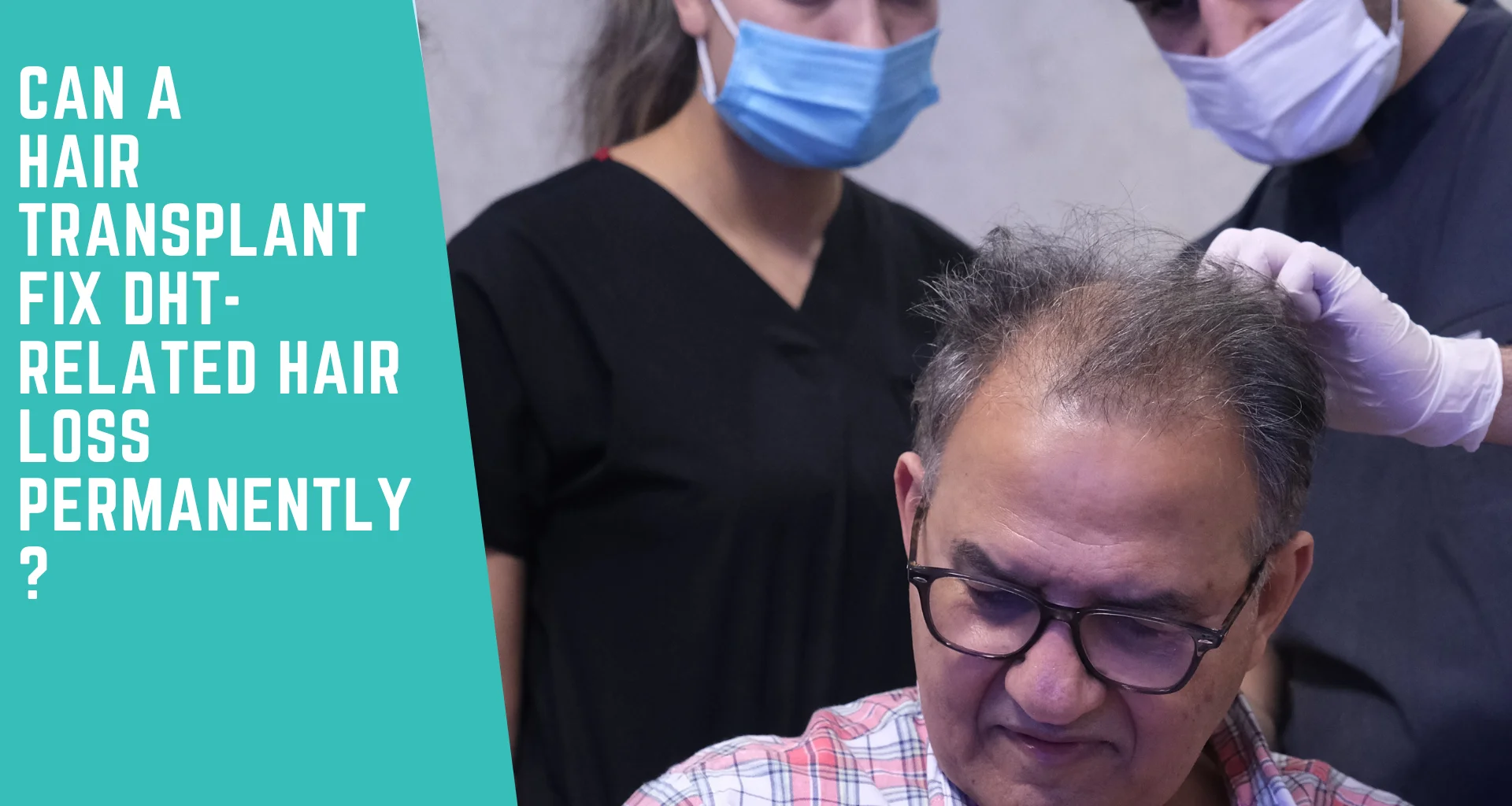

DHT hair loss can be restored long term in transplanted areas, but a transplant does not stop DHT from affecting the native hair around them.
That distinction is what determines whether a result still looks natural years after surgery. The grafts may remain, while untreated hair around the hairline, mid-scalp, or crown can continue thinning.
| Comparing clinic websites and forum threads on this topic usually raises more questions than it answers. A donor assessment from UniquEra’s Medical Directors can tell you, specifically, which part of your hair loss is permanent, which part is still active, and what that means for your plan. Book a consultation with UniquEra to get a clear answer. |
For hair relocated from a stable donor zone, generally yes. For the native hair still growing around it, no.
| Hair type | Response to DHT after surgery |
| Transplanted follicles (stable donor zone) | Generally keep growing long term, resistant to DHT.. |
| Native hair elsewhere on the scalp | Keeps the same DHT sensitivity it had before surgery. |
So the honest answer isn’t a flat yes or no. It’s yes for what’s transplanted, with real limits on what that covers.
DHT is a hormone your body makes from testosterone. In some people, hair follicles on the scalp are genetically sensitive to it. The process runs in stages:
• Testosterone converts into DHT in the body.
• DHT binds to sensitive receptors in certain follicles.
• The follicle gradually shrinks, a process called miniaturization.
• Each growth cycle produces finer, shorter hair.
• Eventually, the follicle stops producing visible hair at all.
Where this happens most determines what you see: a receding hairline, a thinning crown, or an overall loss of density. You can read our full breakdown of the science behind DHT hair loss if you want the deeper explanation.
Follicles taken from a stable donor zone generally retain their original characteristics after transplantation. This principle is known as donor dominance, and it’s the basis of modern hair transplant surgery.
Hair in the stable donor zone is generally less susceptible to the pattern of miniaturization affecting the top of the scalp. When a Medical Director moves those DHT resistant hair follicles to a balding area, they tend to keep growing the way they always did, rather than adopting the pattern around them.
Two things determine whether that holds true for a given patient:
• Whether the donor zone itself is genuinely stable, not already showing signs of miniaturization.
• Whether the follicles were harvested and handled carefully enough to survive the move.
If either of those is off, the resistant part of donor dominance becomes less reliable, which is why an in-person or photo-based assessment matters more than a general rule of thumb. This is also why dht resistant hair follicles from one patient can’t simply be assumed reliable for another. Each donor zone needs its own check.
The transplant itself splits into two categories: what’s biologically settled, and what still depends on the rest of your scalp.
| Part of the result | What can happen over time |
| Follicles taken from a stable donor zone | Generally retain donor characteristics and can continue growing long term. |
| Native hair around the transplant | May remain vulnerable to DHT and continue thinning. |
| Hairline design | Remains visible as the patient ages, so it must anticipate future loss. |
| Donor supply | Finite. Extracted follicles cannot be used again. |
| Overall appearance | May change if surrounding loss progresses or wasn’t included in the original plan. |
This is close to the real answer to is hair transplant permanent. The transplanted follicles may be a long-lasting, permanent hair loss solution for the treated area. The appearance of the whole scalp still depends on donor selection, future native hair loss, and the original treatment plan.
| A transplant can be a genuinely permanent hair loss solution for the areas it covers. Whether it’s the right decision for your whole scalp depends on donor density, how far your native hair has already thinned, and how your loss is likely to progress. Our Medical Directors review that before recommending anything. Book an assessment with UniquEra to see where you stand. |
Yes, if the native hair around it was never DHT-resistant to begin with.
This is sometimes called the island effect. The transplanted hair holds steady while the hair behind or beside it keeps thinning, and over years that can leave a dense patch surrounded by scalp that looks increasingly bare. It isn’t a sign the surgery failed. It’s a sign the surrounding hair was never protected, because nothing in the procedure was designed to do that.
Good planning accounts for this before surgery, not after.
Hair transplant longevity, meaning how well the result holds up over decades rather than months, comes down to donor selection, how conservatively grafts are used, and whether the plan accounts for hair you haven’t lost yet.
• Whether the grafts came from a genuinely stable part of the donor zone.
• Whether enough follicles were kept in reserve for future sessions.
• Whether the hairline was designed for how you’ll look in twenty years, not just next year.
• Whether the crown and frontal areas were prioritized based on your actual pattern, not just what looks best today.
Two patients with identical graft counts can end up with very different long-term results, mostly based on how much of this was considered upfront.
The transplanted hair typically sheds within the first few weeks, a normal part of the healing cycle rather than a sign anything went wrong.
| Timeframe | What’s happening |
| Weeks 1–4 | Initial shedding of transplanted hair (normal, expected). |
| Months 3–4 | Some early regrowth may appear. |
| Months 6–9 | Growth becomes more visible. |
| Around month 12 | Many results have largely matured. |
| Beyond 12 months | Crown growth and final texture may still be developing. |
Do you need medication to protect native hair after surgery?
Not automatically, but it’s often part of the conversation if your native hair is still showing signs of DHT hair loss.
• Transplanted follicles don’t need medication to hold onto their DHT resistance. That part is settled by where the hair came from.
• Native hair is a separate question. Some patients discuss options with their doctor to slow ongoing thinning in untreated areas, since that’s the hair a transplant was never designed to protect.
• This should always be a decision made with a physician, based on your specific case, not something adopted from a blog post.
No. It depends on whether your loss pattern is stable and whether your donor area is strong enough to support it.
| Diffuse thinning | DUPA (Diffuse Unpatterned Alopecia) | |
| Donor zone | Usually stable and dens | May show miniaturization to |
| Transplant suitability | Possible if the pattern is stabl | Often unsuitable, no dependable donor sourc |
| What’s needed first | Confirm the donor zone is holding stead | Donor area trichoscopy and a proper diagnosis. |
Sometimes, if the thinning is following a stable, predictable pattern and the donor zone itself is still dense and healthy. Any thinning hair loss treatment plan should first confirm whether the donor zone remains stable enough for surgery. Getting this distinction right matters, since it decides whether DHT hair loss in this pattern is a good candidate for surgery at all.
Diffuse Unpatterned Alopecia affects the donor zone itself, not just the top of the scalp. When that happens, there’s no reliably resistant area to harvest from, which makes transplantation a poor option regardless of technique.
This is why diffuse loss requires donor area trichoscopy and a proper diagnosis before surgery is recommended. When miniaturization extends through the donor zone, transplantation may not provide a dependable long-term result.
A receding hairline and a crown restoration use donor grafts differently.
| Factor | Hairline | Crown |
| Visual impact | Highest, it’s the first thing people notice. | Lower day to day, but visible from above and behind. |
| Growth pattern | Straightforward frontal design. | Follows a natural spiral, harder to plan around. |
| Donor demand | Moderate, concentrated in one zone. | Can consume donor supply quickly if treated too early. |
| Cost drivers | Area measured, density planned, donor strength. | Same factors, plus spiral coverage and long-term reserve. |
A crown hair transplant plan has to account for the size of the crown, its spiral direction, and how much donor supply is needed elsewhere. Receding hairline transplant cost and crown pricing depend on the area being measured, the density planned, donor strength, and whether one or both zones are being treated.
A number given before any of that is assessed isn’t a real estimate yet. For a fuller comparison across techniques and regions, see our cost comparison guide.
Does FUE, DHI, or FUT change how permanent the result is?
No. DHT resistance comes mainly from selecting follicles within a stable donor zone, not from the extraction or implantation method.
| Technique | What it actually describes | Effect on permanence |
| FUE | Individual follicle extraction from the donor zone. | None. Resistance comes from the donor zone, not the extraction method. |
| FUT | Strip extraction from the donor zone. | None. Same donor-dependent resistance as FUE. |
| DHI | Implantation using a specialized pen, not an extraction method. | None. Affects placement precision, not DHT resistance. |
These choices affect scarring, recovery, graft handling, and placement control. None of them makes a vulnerable follicle resistant to DHT. The permanence of hair transplant surgery depends more on donor selection and surgical planning than on the technique name.
For a side-by-side comparison, our Sapphire FUE vs traditional FUE guide covers the practical differences in more detail.
Look for a clinic that assesses your whole scalp, not just the area you’re worried about. A thorough evaluation should check:
• Donor density across the full donor zone, not just a quick visual glance.
• Existing miniaturization in the native hair, not only the areas already bald.
• How your loss is likely to progress over the next decade.
• Whether the plan reserves donor supply for future needs, rather than using it all now.
Clinics offering what’s marketed as the best Turkish hair transplant experience vary widely on this point. Package pricing and graft counts are easy to compare. Whether a clinic actually checks your donor stability and future loss pattern before recommending a plan is harder to see from a website, which is exactly why it matters more.
At UniquEra Clinic, planning starts by separating three things: hair that’s already permanently lost, native hair that may still be thin, and donor follicles stable enough to use.
Our Medical Directors, who bring over a decade of hands-on hair transplant experience and supervise each case personally, assess:
• Donor density and hair caliber across the donor zone.
• Existing miniaturization, in both the donor area and native hair.
• The size of each recipient zone that needs coverage.
• The likely future pattern of loss over the years ahead.
That assessment determines whether surgery should happen now or after further monitoring, how many grafts can be used without exhausting the donor reserve, whether the hairline, mid-scalp, or crown should be prioritized, and how many grafts should stay in reserve for possible future loss.
The scalp is then planned zone by zone:
| Graft type | Where it’s used | Purpose |
| Single-hair grafts | Frontal hairline. | Creates a soft, natural-looking edge. |
| Two-hair grafts | Just behind the hairline. | Builds density gradually. |
| Larger follicular units | Mid-scalp and crown. | Adds volume across broader areas. |
The goal isn’t just for the transplanted follicles to survive. It’s for the hairline, native hair, crown, and remaining donor supply to still look balanced as you age.
It can provide long-lasting restoration in areas treated with follicles from a stable donor zone. It doesn’t permanently stop DHT-related loss in the native hair around them.
The quality of the long-term result depends on what happens before surgery:
• Identifying a dependable donor zone.
• Measuring current miniaturization.
• Deciding which areas should be prioritized.
• Preserving enough donor hair for possible future change.
A lasting result isn’t created by treating every area immediately. It’s created by making the right decision for the whole scalp.
| Find out what’s permanent before you plan what to restore. An assessment can show which follicles are stable, which native areas may continue thinning, and whether surgery should happen now, later, or as part of a longer-term plan. Book your consultation with UniquEra today. |
Usually not when the follicles come from a stable donor zone. Properly selected dht resistant hair follicles generally retain their donor characteristics, although poor donor selection can affect longevity.
Early miniaturization may respond to appropriate treatment, while areas with advanced permanent loss may require transplantation to restore coverage.
Not always. It depends on whether your native hair is still thinning and should be discussed with your doctor, not decided from general advice.
The pattern should be sufficiently understood before surgery. Rapidly progressing loss may need treatment or monitoring before a safe long-term plan can be confirmed.
The transplanted follicles can last long term when taken from a stable donor zone, but the native crown hair around them may keep thinning on its own.
No. Resistance comes from the donor area the hair was taken from, not the technique used to move it.