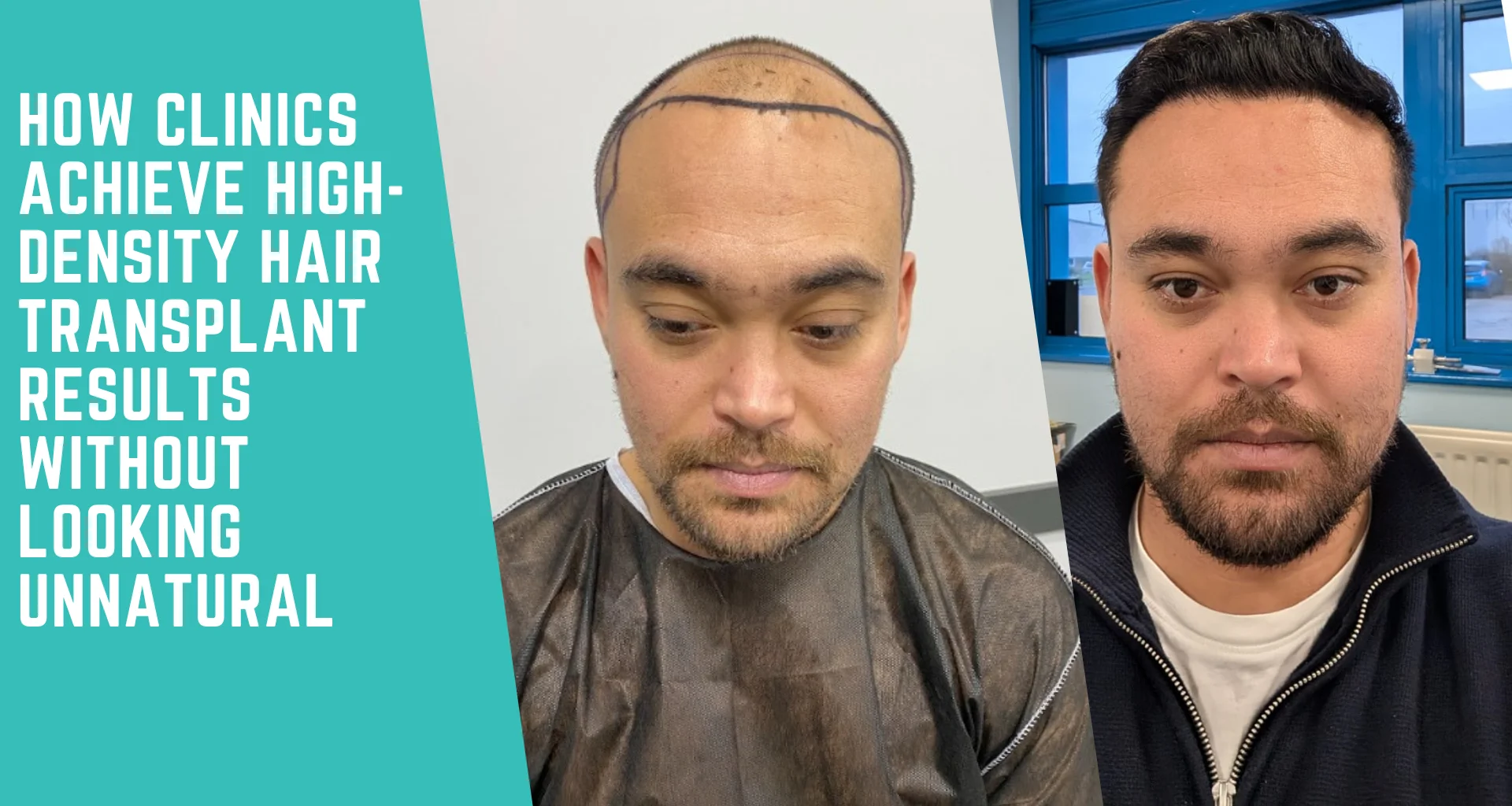

A high density hair transplant does not mean packing in the maximum number of grafts possible. It means placing the right density in the right places, so the result blends in instead of standing out.
That distinction matters more than most patients realize. Almost everyone researching this procedure starts with the same instinct: more grafts must mean a fuller, better result. It’s an understandable assumption. But it’s also the assumption behind some of the most obviously “done” looking transplants out there, the ones with a hairline that sits too flat, too straight, too dense right at the edge. Nobody wants that. What people actually want is hair that looks like it was never touched.
The good news is that a genuinely natural looking hair transplant and a high density result are not opposites. They’re achievable together, but only when density is planned with real care rather than treated as a numbers game.
Not sure what density is realistic for your hair loss pattern? Graft count alone cannot answer that. Your donor supply, hair thickness, recipient area, and future hair loss all shape what can be achieved safely. Book a consultation with UniquEra Clinic to receive a personalized density and donor assessment before choosing your treatment plan.
A high-density hair transplant places more follicular grafts per square centimeter in the recipient area than a standard procedure, closer to the density seen in hair that was never affected by loss. The word “high” here doesn’t mean “maximum.” It means denser than average, planned deliberately for the case in front of the team, not a fixed number applied to every patient.
Exactly what counts as high density depends on several things at once: hair caliber, the composition of each follicular unit, the condition of the native hair nearby, blood supply at the recipient site, and how much donor supply is actually available. A full density hair transplant is a plan built around those specifics, not a single formula.
Many treatment plans use density ranges of roughly 30 to 45 grafts per cm² for standard coverage, while selected zones may be planned at higher densities when the donor supply, scalp condition, and hair characteristics allow it. The number is never chosen in isolation.
Instead of a rigid number per zone, it’s more accurate to think in terms of approach:
| Zone | General planning approach |
| Leading hairline edge | Soft, irregular placement using single-hair grafts. |
| Transition zone | Density increases gradually moving back from the edge. |
| Mid-scalp | Higher visual density, since this is where coverage matters most. |
| Crown | Conservative placement, based on swirl pattern and donor reserve. |
For reference, an untouched, non-balding scalp sits around 80 to 120 follicular units per cm². Nobody replicates that number in a transplant. It isn’t necessary, and for most patients it isn’t possible given donor limits.
No. High density depends on the donor area, not just on what a patient wants. A few things decide whether it’s realistic:
This is exactly why a proper consultation exists. It’s not a formality. It’s the step where an honest answer gets given, even when that answer is “high density isn’t the right call for you yet,” and it should always come before committing to hair transplant surgery.
Because the scalp can only support so much at once. Every graft needs blood supply to survive, and that supply is limited. As recipient sites are placed closer together, the demand on the scalp’s tissue increases. Beyond the safe density for that individual case, graft survival may fall and healing can become less predictable. This is why experienced teams balance visual density with tissue safety instead of chasing the highest possible number.
Overpacking doesn’t just risk lower survival overall. It risks uneven survival, where some grafts thrive and grafts right next to them fail. That’s what creates the patchy, thin-in-places look, which is actually harder to correct later than starting with a conservative plan.
It also helps to understand that a transplanted area does not need to reproduce the scalp’s original follicle count to look full. Hair thickness, curl, color contrast, graft distribution, and styling all affect how dense an area appears to the eye. The goal is visual coverage, not a numerical match to the density that existed before hair loss.
Planning around survival, not just numbers, is what keeps the result a natural looking hair transplant instead of a warning sign.
More grafts only help when they survive. Dense placement has to be balanced with blood supply, recipient-site spacing, and safe healing. At UniquEra Clinic, every treatment plan aims for the strongest coverage that will actually grow in, not the highest number on paper. Book an assessment to understand how density can be planned safely for your scalp.
Natural hairline design is where density planning gets tested the most. Clinics treat the hairline as its own zone with its own rules, separate from the rest of the scalp:
This is where natural hairline design and high density actually depend on each other. Skip any one of these steps and even a technically well-grown transplant can look artificial up close.
Technique matters here more than most patients expect, though no single method guarantees a result on its own. A sapphire FUE hair transplant in Istanbul uses sapphire blades to create the recipient channels. These blades can support more precise incision planning, but the final density still depends on the team’s experience, recipient-site spacing, graft handling, and the patient’s own scalp characteristics.
DHI works differently. During DHI implantation, a pen-shaped tool creates the recipient opening and places the graft in one controlled movement. Patients considering a DHI transplant in Turkey may be offered this method for hairline work or for placing grafts between existing hairs, depending on their case.
A manual hair transplant approach may involve manual graft extraction, manual placement, or both, depending on the clinic and the zone being treated. Its value comes from precision and case selection, not from the word “manual” on its own.
No technique is automatically “the best.” What matters more is whether the technique matches the zone, the patient’s hair characteristics, and the density target. This is one reason a technique-agnostic evaluation during consultation matters more than a clinic’s marketing around any one method. Any hair transplant surgery aiming for high density should be planned around these decisions before the day of the procedure, not figured out in the operating room.
Patience is part of the process. High density hair transplant results don’t show up right away, and judging too early is one of the most common sources of unnecessary worry.
Trying to evaluate density at month four is like judging a house by its foundation. The fullness people are hoping for takes the full year, sometimes longer, to show up.
At UniquEra Clinic, density is planned zone by zone, not as one maximum number across the whole scalp. The Medical Directors first assess the size of the recipient area, the existing hair, the strength of the donor area, and how much coverage can be created safely.
The grafts are then sorted and placed according to where they will create the most natural visual effect:
The total graft number also depends on the patient’s coverage goal. Juliana explained that one case may use around 2,000 grafts for approximately 30% coverage, while another may use around 3,500 grafts for approximately 50%. These are UniquEra planning examples, not fixed formulas. Up to 5,000 grafts is considered only in rare cases with an especially strong donor area.
Technique follows the same logic. Sapphire FUE is generally chosen for larger bald areas, while DHI is used for smaller, more precise cases or placement between existing hairs. The aim is not to place the highest number possible. It is to use each graft where it adds the most natural coverage while protecting the donor area for the future.
Yes, when density is planned by zone rather than maximized across the whole scalp. The hairline needs softness and irregularity. The mid-scalp needs strategic coverage. The crown needs planning around its swirl pattern and future hair loss.
The goal isn’t to reproduce every follicle that once existed. It’s to create enough coverage, direction, and balance for the result to look natural from a normal viewing distance, and to keep looking right as you age. That combination is what turns high density into natural hair transplant results that hold up over time.
That’s the standard worth holding any hair transplant surgery to.
Natural density starts before surgery, and it’s what separates natural hair transplant results from ones that need correcting later. It begins with an accurate donor assessment, careful hairline design, and a technique chosen for your scalp rather than sold as a default. Book your consultation with UniquEra today.
A high-density hair transplant, sometimes called a full density hair transplant, places noticeably more grafts per cm² in the recipient area than a standard procedure. The exact density depends on donor supply, hair caliber, and scalp condition.
There’s no single number that applies to everyone. What matters more is distribution: a soft, irregular hairline, gradually increasing density behind it, and coverage that matches the patient’s own hair characteristics.
Yes. Placing grafts closer than the scalp’s blood supply can support raises the risk of poor healing and uneven survival, which can create a patchy look instead of a fuller one.
No. It depends on donor area quality, hair thickness, scalp condition, and how advanced the hair loss is. A consultation is the only reliable way to know what’s realistic.
Neither is universally better. A sapphire FUE hair transplant in Istanbul supports precise incision planning, a DHI transplant in Turkey offers close control over angle and depth, and a manual hair transplant approach can suit selected zones. The right choice depends on natural hairline design goals and the patient’s own hair.
Most patients see meaningful density by 6 to 12 months, with final results settling in around 12 to 18 months. Earlier judgments are usually premature.