
Your first time hair transplant in Turkey comes with a lot of questions. That is completely normal.
You have been researching for weeks. Maybe months. You have read about Turkey. Seen the before and afters. Compared prices. And now you are sitting with one big question: what actually happens?
Not the glossy version. The real one.
This guide covers the full hair transplant journey in Turkey. From the moment you send your first photos to a clinic, all the way through surgery day, recovery at home, and what your hair looks like twelve months later.
No hype. No scare tactics. Just exactly what to expect.
| Not sure where to start?A free online consultation with UniquEra gives you a personalized graft estimate, technique recommendation, and honest answers before you commit to anything. Book your free consultation with UniquEra today. |
Turkey handles roughly 25% of all hair transplant procedures performed worldwide. Istanbul alone has more specialist clinics and experienced hair restoration teams than most entire countries, making it the most established destination for hair transplant Istanbul patients worldwide.
First, cost. A hair transplant in Turkey typically costs 50-70% less than the same procedure in the US or UK. That gap is not about lower standards. It reflects lower operating costs, a favourable exchange rate, and a high-volume medical tourism infrastructure built over two decades.
Second, experience. Istanbul clinics perform far more cases per year than most Western practices. That volume, when pa ired with proper medical oversight, translates into genuine procedural depth.
One honest note: the country matters less than the clinic. Turkey has exceptional clinics and ones that cut corners. Your job as a first-time patient is to tell the difference before you book. This guide will help you do that.
The journey starts weeks before you land in Istanbul. It starts online, with your consultation.
You send photos. Clear shots of your hairline, crown, and donor area at the back of your head. A reputable clinic reviews them and responds with a personalized assessment.
Here is what a good response includes:
• Your hair loss stage, mapped against the Norwood Hamilton scale, which helps determine the extent of your hair loss and how many grafts you will need.
• An estimated graft range, not a single fixed number.
• A technique recommendation based on your pattern and donor supply.
• An honest note if your expectations need adjusting.
Here is what a red flag looks like:
• A quote within minutes, with no real medical assessment.
• A sales rep pushing you to book before any review has happened.
• Fixed graft numbers promised before seeing your scalp in person.
If a clinic cannot answer basic medical questions before you pay, that tells you something important about how they operate.
A graft is a tiny unit of one to four hair follicles. The number you need depends on the size of your thinning area, your hair characteristics, and how much usable donor supply you have.
| Hair Loss Stage | Approximate Grafts Needed |
| Early thinning (Norwood 2-3) | 1,000 – 2,000 grafts |
| Moderate loss (Norwood 3-4) | 2,000 – 3,000 grafts |
| Significant loss (Norwood 5) | 3,000 – 4,000 grafts |
| Advanced loss (Norwood 6-7) | 4,000 – 5,000+ grafts |
These are starting points, not guarantees. Your actual count is confirmed after your in-person scalp analysis in Turkey. An honest clinic gives you a range and explains why. A clinic chasing a booking gives you a big number and a low price.
Before you pay a deposit, get clear answers to these six questions:
1. Who performs the procedure? A medical doctor or technicians?
2. Will I meet the medical team before surgery begins?
3. How many procedures does the clinic run in a single day?
4. What is included in the package, in writing?
5. What aftercare support is available once I fly home?
6. What happens if I have a complication after I return to the US?
If any of these questions get vague answers or deflection, keep looking.
Package contents vary significantly between clinics. Read what is included carefully. A lower headline price that excludes hotel, medications, and aftercare often ends up costing more. See what a genuine hair transplant package in Turkey looks like before you compare quotes.
| What Reputable Packages Include | What Budget Clinics Often Leave Out |
| Airport transfers (arrival and departure) | Post-operative aftercare support |
| Hotel accommodation near the clinic | Medications and aftercare kit |
| Pre-operative scalp analysis | English-speaking coordinator |
| All medications and aftercare products | Written procedure documentation |
| First wash (day 3) at the clinic | Follow-up consultations after you leave |
| 24/7 support during your stay | Clear escalation process for complications |
| 12-month follow-up consultations | Long-term result monitoring |
Day 1 is your assessment day, not your surgery day. You are collected from the airport by the clinic’s transfer team and taken to your hotel or directly to the clinic, depending on your arrival time.
This is where the planning gets precise. The medical team examines your scalp using digital imaging. Here is what they assess:
• Follicle density in your donor area.
• Distribution and pattern of your hair loss.
• Scalp elasticity and skin condition.
• How many healthy grafts can safely be extracted without over-depleting the donor zone.
• Final graft count and technique confirmation.
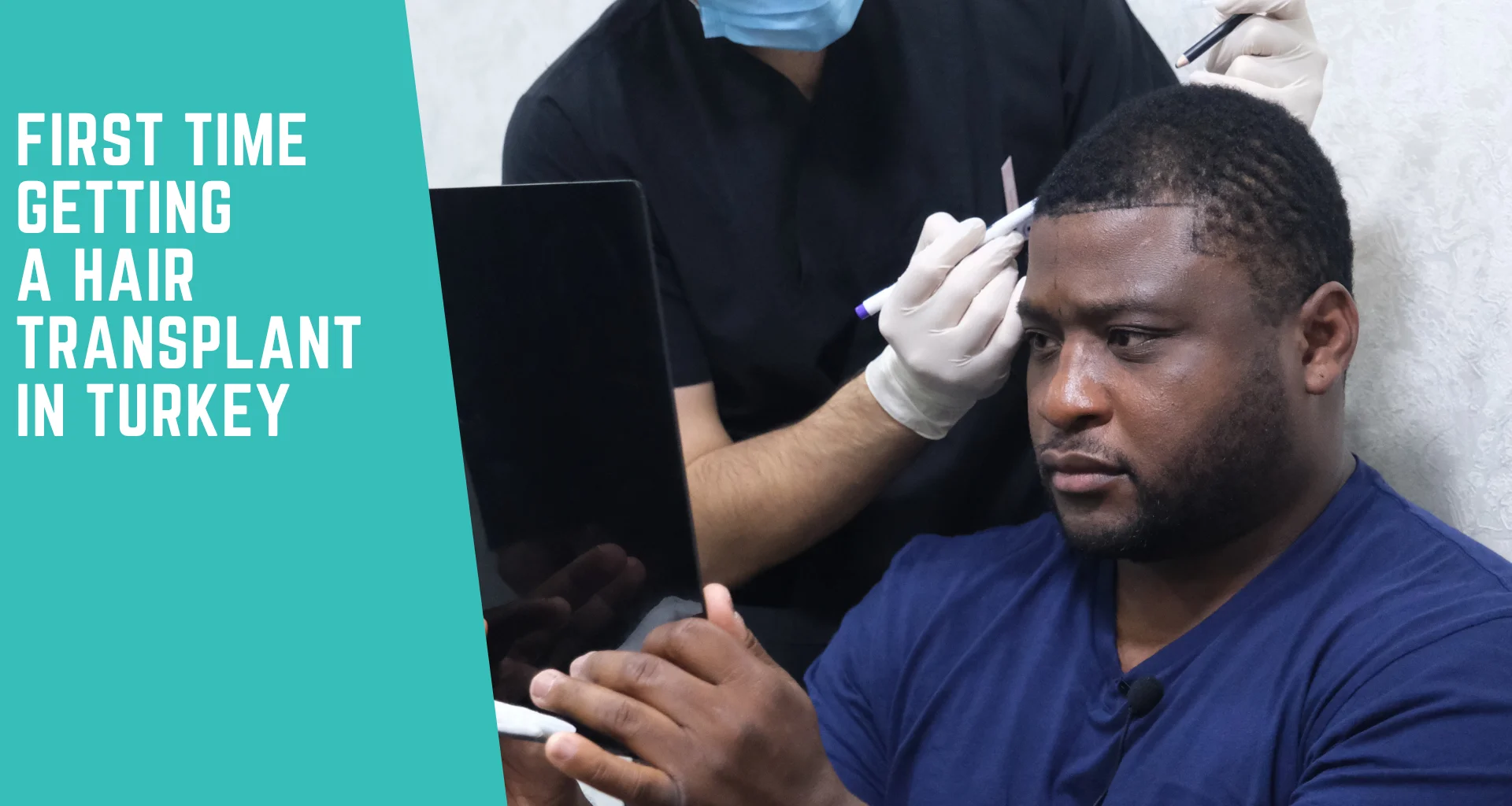
Then comes the hairline design. This is drawn on your scalp using surgical markers before anything else happens. The shape, angle, and position of your new hairline is agreed with you directly. You see it. You confirm it. Nothing proceeds until you are satisfied.
This step matters more than most patients realise. A natural-looking result starts here, not in the operating room.
Yes, at any clinic worth choosing. You should meet the person leading your procedure before surgery begins. Not a coordinator. Not a consultant. The medical lead.
They will:
• Review your scalp analysis findings with you.
• Walk you through the full surgical plan.
• Answer every question you have.
• Confirm your informed consent before anything is signed.
If a clinic only offers you a coordinator meeting and then hands you to a team you have never seen on surgery day, that is the volume-first model. It produces inconsistent results.
Surgery day is the longest day. It runs six to eight hours. But most of that time you are lying comfortably. Here is what the full day looks like.
The honest answer: the anesthesia injection is the most uncomfortable moment. After that, most patients feel pressure, not pain.
Local anesthesia is applied to both the donor and recipient areas of the scalp. Many clinics now use a needleless pre-anaesthesia device first, which numbs the scalp before the injection so you barely feel it going in.
Once you are numb, the procedure is painless. You can watch something on your phone, listen to music, or simply rest. Most first-time patients are surprised by how manageable it is.
A typical session takes six to eight hours, depending on graft count and technique. The day breaks into clear phases:
| Phase | What Happens |
| Morning: Preparation | Hair trimmed, scalp cleaned, hairline finalised, anesthesia applied. |
| Phase 1: Extraction | Grafts removed one by one from the donor area. |
| Midday break | Lunch and rest. Grafts stored in a protective solution. |
| Phase 2: Implantation | Grafts placed into the recipient area with precision. |
| End of day | Scalp cleaned, bandaged, aftercare instructions begin. |
The reason it takes this long is precision. Rushing graft extraction or implantation damages follicles. A good team works carefully, not quickly.
Both are the gold standard techniques used in Turkey — from manual FUE hair transplant to DHI hair transplant Turkey. The right one depends on your specific case, not your preference. Donor strength, remaining native hair, scalp condition, and graft requirements all influence that recommendation.
| FUE (Follicular Unit Extraction) | DHI (Direct Hair Implantation) | |
| How it works | Grafts extracted, channels opened, then placed.. | Extracted and implanted simultaneously using a Choi pen. |
| Best for | Larger areas, higher graft counts. | Density in existing hair, precision hairline work. |
| Shaving required | Usually full shave. | Partial shave possible.. |
| Typical cost | Standard. | Slightly higher due to specialised equipment. |
Your technique is a clinical decision based on your scalp, your hair characteristics, and your coverage goals. A reputable team explains why one suits your case better than the other.
You lie face down during extraction. The medical team works across your donor area, removing follicular units one at a time using a micro-punch tool. You feel nothing beyond mild pressure. Many patients fall asleep during this phase.
The extracted grafts are immediately placed into a preservation solution to keep the follicles viable until implantation begins.
During implantation, you lie face up. Each graft is placed into the planned recipient area following the hairline design agreed the day before. Angle, depth, and direction are set deliberately to produce a natural growth pattern.
Day 3 is your first clinic visit post-surgery. This is a required appointment, not an optional one.
The clinic performs your first wash for you on day 3. Here is exactly how it works:
• A nurse uses lukewarm water and a specialised shampoo.
• Applied with a very light patting motion only. No rubbing. No direct pressure.
• The goal is to gently remove dried blood, surgical debris, and early scabbing.
• Grafts are still settling into position, so no friction is applied.
• The nurse demonstrates the technique so you can continue it correctly at home.
This first wash is one of the most important steps in your recovery. Clinics that skip it or leave it entirely to you without a demonstration are cutting a corner that affects healing.
This is what to expect. All of it is normal:
• Small reddish scabs or crusts around each graft site.
• Mild swelling around the forehead, possibly around the eyes by day 2-3.
• Redness across both the donor and recipient areas.
• Possible minor oozing in the first 24 hours.
The swelling usually peaks around day 3 and clears within a week. The scabs begin falling off naturally between days 7-10. The grafts look rough at this stage. That is expected. This is not what your final result looks like.
Most patients fly home after day 3, following their first wash appointment. By then, grafts have started settling and the risk of disturbance during travel is low.
Some patients prefer to stay five to seven days for additional peace of mind during early healing. Flying itself is not a risk to your grafts after day 3, but the journey requires some thought.
What to wear and bring on the flight home:
• Loose button-up shirt or zip hoodie. Nothing that pulls over your head.
• Travel neck pillow to keep your head from resting directly on a surface.
• Saline spray provided by the clinic. Keeps the scalp moist during the flight.
• Medications in your carry-on bag.
• Clinic aftercare instructions printed or saved to your phone.
Sleep with your head slightly elevated for the first week after you land. Two or three pillows works well.
This is where most first-time patients are caught off guard. Not because anything goes wrong. But because one phase looks alarming when it is actually completely normal.
Here is the full hair transplant timeline in Turkey, from surgery day to twelve months:
| Timeframe | What Is Happening | What You See |
| Days 1-3 | Grafts settling, initial healing. | Redness, scabbing, mild swelling. |
| Days 7-10 | Scabs falling off naturally. | Cleaner scalp, donor area healing. |
| Weeks 2-6 | Shock loss phase. | Transplanted hairs shed. Scalp looks thin. |
| Months 3-4 | New follicle growth begins. | Fine, soft new hairs appear. |
| Month 6 | Growth accelerates. | Clear visible improvement. |
| Months 9-12 | Full density developing. | Natural thickness, final result forming. |
| Month 12+ | Result complete. | Hair behaves like native hair. |
Shock loss is the phase most first-time patients are not prepared for. Understanding what shock loss is and why it happens after a hair transplant can make this stage significantly easier to manage. Between weeks two and six after surgery, the transplanted hair shafts shed. You watch hair fall out. It looks like the transplant is failing.
It is not.
Here is what is actually happening:
• The hair follicles were transplanted successfully.
• Follicles go through natural growth cycles after being moved.
• They enter a resting phase called telogen. The visible hair shaft sheds.
• The follicle itself stays intact beneath the scalp surface.
• New hair grows from that same follicle, usually from month three onwards.
Shock loss is not graft failure. It is a sign the follicles are settling in and preparing to grow. Almost every hair transplant patient goes through it. Knowing this in advance makes it much easier to get through.
The hair transplant results timeline looks like this:
• Month 3-4: Thin, fine hairs emerge. Growth is real but subtle at this stage.
• Month 6: Visible improvement that others begin to notice.
• Month 9-12: Full density develops. Texture and direction settle. Hair can be cut and styled normally.
Patience is the most underrated part of this process. The twelve-month mark is when most patients see results that reflect the full potential of their procedure.
| What to Avoid | How Long |
| Direct sun exposure on scalp | 4 weeks minimum |
| Gym, cardio, heavy exercise | 2-3 weeks |
| Swimming (pool or sea) | 4 weeks |
| Alcohol | First 2 weeks |
| Tight hats or helmets | 2-3 weeks |
| Scratching or touching grafts | 10 days minimum |
| Hair dye or chemical treatments | 3 months |
Your clinic will give you a written aftercare plan. Follow it. Aftercare compliance has a direct effect on graft survival and final density.
At twelve months, transplanted hair behaves like the rest of your natural hair. It grows. It can be cut. It does not fall out with pattern hair loss because it was taken from your genetically resistant donor area.
What natural-looking actually means in practice:
• The hairline does not look drawn on.
• Individual hairs grow at the correct angle and direction.
• There is gradual density variation at the hairline edge, not a hard line.
• From any distance, it is indistinguishable from native hair.
Results vary based on a few honest factors:
• Graft count and placement quality.
• Your hair texture and natural thickness.
• How closely you followed aftercare instructions.
• The realism of your expectations going in.
A good clinic discusses all of these with you before surgery, not after.
One thing worth knowing: a hair transplant does not stop future hair loss in areas that were not treated. Ongoing medical management, such as finasteride or minoxidil, is often recommended alongside the procedure for long-term results. Some patients also explore whether a hair transplant without finasteride is viable for their specific case.
First-time patients ask us one question more than any other: will I be looked after, or will I be processed?
That question matters. And the answer depends entirely on how a clinic is set up.
Here is how UniquEra is structured for first-time international patients:
• Every case begins with a pre-operative scalp analysis, not a sales call.
• Our Medical Directors, with over a decade of hands-on hair transplant experience, personally supervise each case.
• FUE or DHI is chosen based on your scalp assessment, not a price tier.
• We limit our daily case load deliberately. Precision work takes time. Time is the one thing you cannot shortcut in a hair transplant.
• Our medical team has worked together under the same leadership for years. That continuity shows in how cases are planned and how patients are supported.
• Full coordination from your first consultation through to your twelve-month follow-up. You never land without knowing exactly what each day looks like.
• You never go home without a direct line to someone who knows your case.
| Thinking about making the trip?We can walk you through your specific hair loss pattern, give you an honest graft estimate, and answer every question you have before you commit to anything. Book your Hair Transplant consultation today with UniquEra today. |
You now know more than most people do before they book.
The first time is always the most uncertain. That is true of any procedure, in any country.
But the hair transplant journey in Turkey is well-mapped. The process is the same across thousands of patients each year. The timeline is predictable. The healing stages, though sometimes unsettling to experience, are well understood.
What makes the difference is not choosing Turkey. It is choosing a clinic that takes your first time as seriously as you do.
A team that spends time on your assessment. That designs your hairline carefully. That tells you honestly what to expect and is still there twelve months later when your results have fully grown in.
That is what good hair restoration looks like. And that is exactly what is available to you in Istanbul, when you choose the right team.
| Ready to take the first step? We will walk you through everything, answer every question, and help you make the decision that is right for you. Book your Hair Transplant consultation today or call now. |
Yes, when you choose a clinic with proper medical oversight. The key is verifying who performs your procedure and what accreditations the facility holds before you book.
US citizens can get a Turkish e-visa online before travel. Check the Turkish Ministry of Foreign Affairs website for current requirements.
Minimum three days. Day 1 is your consultation and scalp analysis. Day 2 is surgery. Day 3 is your first professional wash. Some patients prefer five to seven days.
At any established clinic serving international patients, yes. If communication is difficult before you arrive, it will not improve once you are there.
The anesthesia injection is the most uncomfortable part. After that, you feel pressure, not pain. Most patients watch TV or sleep through the procedure.
FUE hair transplant places grafts into pre-opened channels, while direct hair implantation uses a Choi pen to extract and implant simultaneously. The right technique depends on your scalp and graft needs.
Mild loss may need 1,000-2,000 grafts, while advanced baldness may require 4,000+. Final numbers depend on donor supply and scalp analysis.
First thin hairs appear around month 3-4. Clear improvement by month 6. Full density and final results between months 9 and 12.
No. Between weeks 2-6, transplanted hair shafts shed while follicles rest beneath the scalp. The follicles are fine. New hair grows from them from around month three.
10. Can I fly home the day after my hair transplant?
Wait until after your day-three wash appointment. By then grafts have started settling. Flying the day after surgery, before that wash, is not advisable.
11. What can I not do after a hair transplant?
No direct sun for 4 weeks, no gym for 2-3 weeks, no swimming for 4 weeks, no alcohol for 2 weeks, no scratching grafts for 10 days. Follow your clinic’s written aftercare plan.
Yes, when the procedure is planned correctly. At twelve months, transplanted hair grows at the right angle and direction and is indistinguishable from native hair.
Reputable packages include airport transfers, hotel, scalp analysis, procedure, medications, day-three wash, and 12-month follow-up. Read the details carefully. What is left out matters as much as what is in.
14. How much does a hair transplant in Turkey cost in 2026?
All-inclusive packages in Istanbul typically range from $2,500 to $5,000. Prices far below this range usually mean corners are being cut somewhere.
A good clinic gives you a direct WhatsApp line to a medical coordinator. Confirm this escalation process before you book. Clinics that go quiet once you leave are a real problem in this industry.
Yes, but with honest planning. A transplant does not stop future loss in untreated areas, including the receding hairline or crown. Your medical team should factor your likely progression into the hairline design.
You need sufficient donor hair, stable or manageable hair loss, and realistic expectations. A proper scalp analysis is the only way to confirm. No clinic should say yes without seeing your scalp in person.
A good clinic limits daily cases, has doctors leading procedures, does proper pre-op analysis, and provides 12-month aftercare. A mill runs on volume, uses technicians for surgical steps, and has minimal follow-up. Read our full guide on how to avoid hair transplant mills in Turkey before you book. The price gap between them is small. The result gap is not.