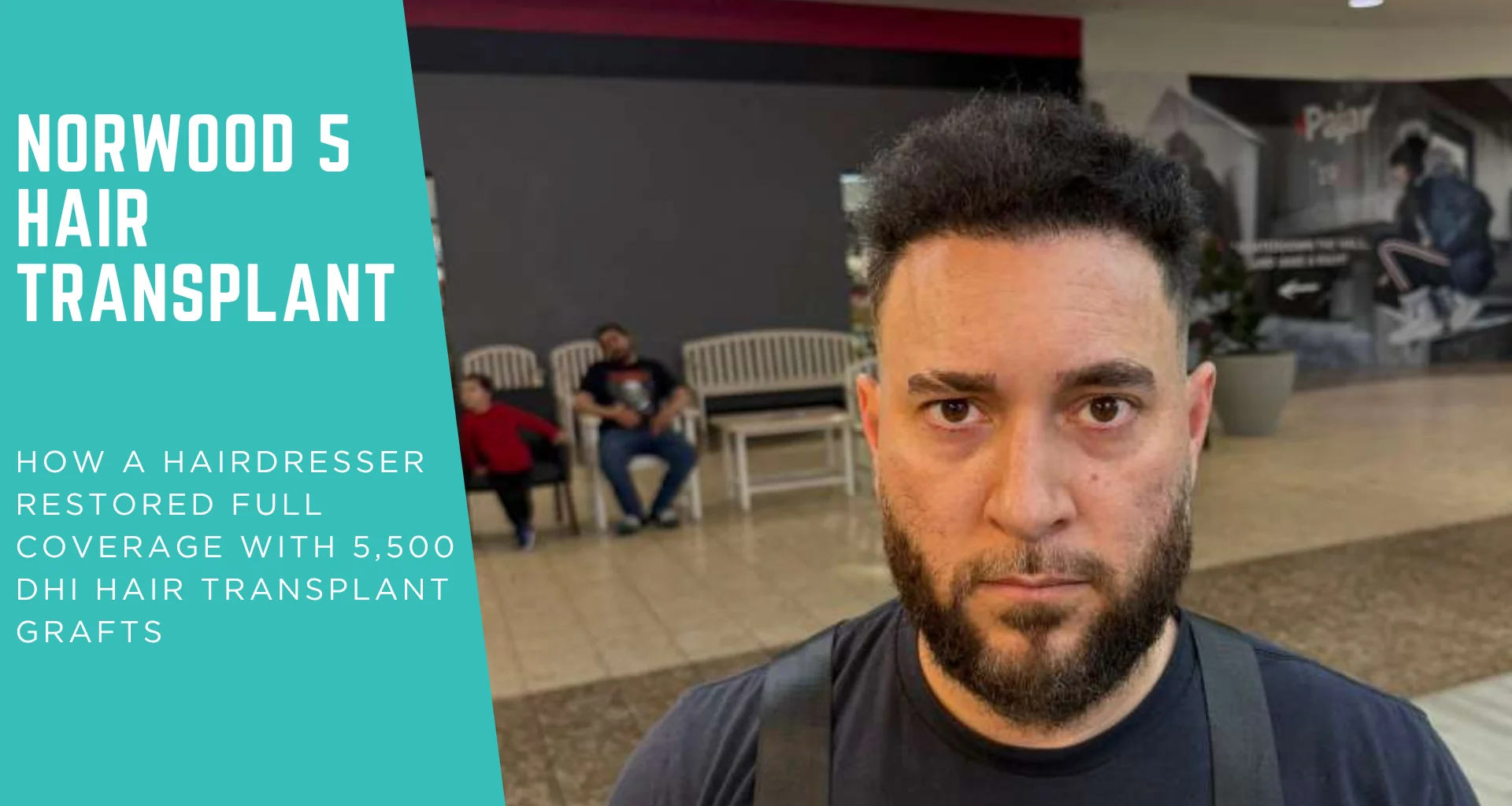

Most Norwood 5 hair transplant cases come with a disclaimer: expect partial coverage. David Centeno’s case didn’t follow that script.
He cuts hair for a living. He runs a salon in Orlando, Florida. He knows what a good hairline looks like. He knows what natural density feels like under his hands.
For 10 years, he watched his own hair go in the opposite direction.
His hairline pulled back. Temples opened up. Mid-scalp thinned. Crown cleared. By the time he started looking for a real solution, he was at Norwood , a very advanced stage of male pattern baldness. The entire top of the scalp was affected. Only a band of hair around the sides and back remained.
He had spent 2 years on prescription hair loss medication. He used concealing hair spray. Neither changed the trajectory.
This case study covers how his hair transplant procedure was planned at UniquEra Clinic in Istanbul Turkey, why a DHI hair transplant was selected, how 5,500 grafts were distributed across a two-day DHI hair transplant procedure, and what his hair transplant results look like 2 years later.
What makes this case worth documenting comes down to three things: the density challenge of covering four full scalp zones, the design precision required across hairline, temples, mid-scalp, and crown in a single plan, and the visibility of the result at 2 years on a patient who evaluates hair for a living.
If your hair loss has progressed to an advanced stage, UniquEra Clinic’s medical team can evaluate your case through a video consultation.
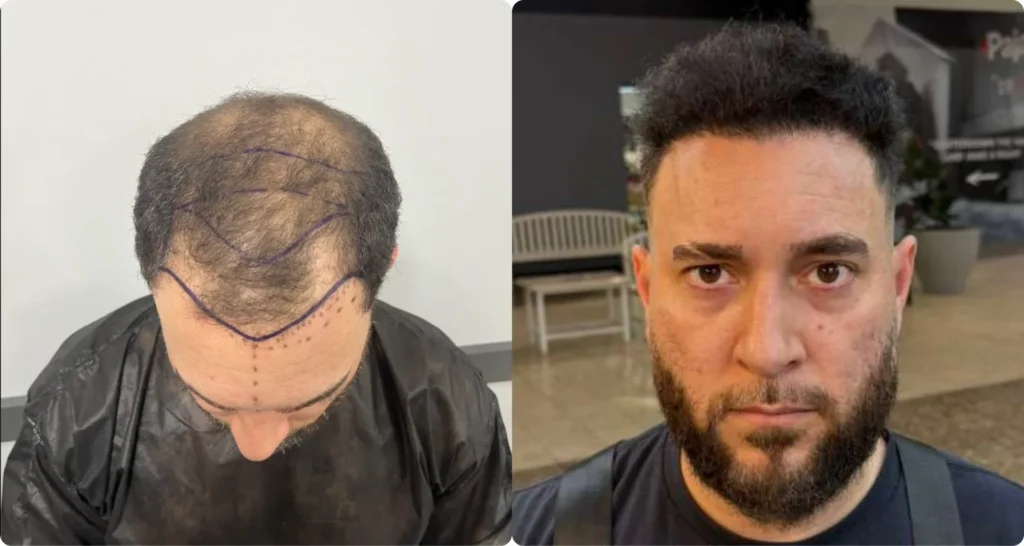
Source – Instagram – David Centeno Hair Transplant
| Detail | David’s case |
| Age | 40 |
| Profession | Hairdresser, Orlando, Florida |
| Hair loss duration | 10 years |
| Diagnosis | Androgenetic alopecia, Norwood 5 |
| Pattern | Hairline, temples, mid-scalp, crown |
| Previous treatments | Prescription hair loss medication (2 years), concealing hair spray |
| How he found UniquEra Clinic | Google search |
Androgenetic alopecia is the most common form of male pattern baldness. It’s driven by follicle sensitivity to dihydrotestosterone (DHT), which causes follicles to miniaturize over time, producing thinner hairs until they stop producing visible hair altogether.
In David’s case, this had been running for a decade across all four scalp zones. The prescription medication he used for 2 years is designed to slow miniaturization by reducing DHT levels. It can stabilize hair loss in earlier stages. At Norwood 5, the follicles in the affected zones had miniaturized past the point where medication alone could reverse the process. The concealing spray gave a visual cover but didn’t address the underlying condition.
The trigger that pushed David to act: his hairline had receded to a point visible to his clients, and his crown was going bald. For someone who works in a salon surrounded by mirrors every day, that’s hard to ignore indefinitely.
As a hairdresser, his appearance is part of his professional credibility. He spent years helping clients with their hair while his own situation kept getting worse.
David found UniquEra Clinic through a Google search. He was comparing hair transplant clinics in Turkey on his own, looking at results, reading about techniques, evaluating what different clinics were actually showing in their case documentation.Many of the top hair transplant clinics in Turkey appeared similar online, which made deeper case analysis important for him. Instead of focusing only on marketing claims from the best hair clinics in Turkey, David focused on documented medical work and consistency.
Two things made him choose UniquEra Clinic over other options: the quality of the medical team’s work and the service standard.
As a hairdresser, David has a trained eye for hair. He can look at a set of before-and-after photos and tell whether the hairline design was planned or rushed, whether the density distribution looks natural or patchy, whether the growth pattern matches how hair actually behaves. The hair transplant results he saw from UniquEra Clinic’s medical team passed that filter.Those hair transplant results looked natural both in density distribution and hairline design under close inspection.
He had already spent 2 years on prescription hair loss medication and used concealing hair spray. Neither changed the trajectory. He needed a hair transplant procedure, and he needed it done by a team whose work he could trust as a professional in the same industry. For David, the biggest concern was whether the hair transplant procedure would still look natural years later.
First consultation: January 19, 2024. Booked: January 25, 2024. Four-day decision.
His only hesitation was Traveling for a hair transplant in Istanbul Turkey was initially David’s biggest hesitation. .Like many international patients considering hair transplant surgery abroad, he wanted clarity on safety, planning, and long-term results before committing. What resolved it: understanding the full hair transplant process ahead of time, seeing case-specific results, and getting clear answers about what was achievable for his level of hair loss.
Full-scalp involvement confirmed. Norwood 5 classification. Hairline, temples, mid-scalp, and crown all affected by advanced follicular miniaturization from androgenetic alopecia.
The case presented three specific clinical challenges: achieving adequate density across the largest possible treatment area, maintaining design precision across four distinct scalp zones with different hair growth angles, and producing a result visible enough to hold up under the scrutiny of a patient who works with hair professionally.
This is where David’s case separated from most Norwood 5 patients.
At this stage, many patients have a weakened donor area. The remaining band of hair may be thin or low-density, which forces the medical team to prioritize zones and accept partial coverage from the hair transplant surgery.
David’s donor area was classified as healthy and rich donor area . Strong occipital density, healthy follicle caliber, enough supply for 5,500 grafts without over-extraction. That’s what made full four-zone coverage possible.
The technique decision came from two factors working together: David had a strong donor area, and he still had existing hairs across the recipient zone. Those two conditions pointed directly to a DHI hair transplant, where the Choi Pen can implant new grafts between existing follicles without damaging them. For a full breakdown of how this technique works step by step, read our complete guide to the DHI hair transplant technique.
| Zone | Graft type | Purpose |
| Frontal hairline edge | Single-follicular-unit grafts (1 hair). | Soft, natural edge. |
| Temples | Singles and doubles. | Facial framing. |
| Mid-scalp | Doubles and triples. | Density and transition. |
| Crown hair transplant | Triples. | Volume and coverage. |
The plan worked front to back in a density gradient. Singles at the very front create the feathered look that makes a hairline pass as natural under close inspection. Behind that edge, density builds through doubles and triples where the eye doesn’t detect the transition.
The procedure was supervised by UniquEra Clinic’s Medical Directors, who carry over a decade of hands-on hair transplant experience and oversee every case from planning through implantation.
What was planned during consultation matched what was executed during the hair transplant procedure.
| Factor | How it applied |
| Strong donor area + existing recipient hair | David had both: dense donor supply for high-volume extraction and remaining hairs in the recipient zone. The DHI hair transplant Choi Pen implants between existing follicles without damaging them. |
| Four-zone precision | Each zone needs different angles, depths, and graft types. DHI gives per-graft control over all three. |
| Design precision requirement | The hairline, temples, mid-scalp, and crown each have different natural growth patterns. DHI allows the medical director to match each zone’s specific angle and direction. |
| High volume capacity | Strong donor supply made 5,500 grafts possible across a two-day DHI hair transplant procedure. |
5,500 grafts in a single day pushes past what most patients’ scalps can handle in one session.
UniquEra Clinic is one of the very few hair transplant clinic in Turkey offering a two-day DHI hair transplant procedure.This is one reason many international patients researching advanced cases shortlist UniquEra Clinic during their decision process The reason most clinics don’t: it requires a medical team experienced enough to manage graft survival, tissue recovery, and implantation precision across two consecutive days at high volume.
Each graft has a limited safe time outside the body, because it needs proper oxygenation and temperature control to stay viable. In clinical practice, around 3,000–4,500 grafts can be safely extracted and implanted in one day while maintaining very high survival rates. If we try to do 5,000–6,000 grafts in a single day, the procedure becomes too long and some grafts would spend too much time outside the scalp, which can reduce survival and final density. For this reason, we divide large cases into two sessions. This allows us to keep each graft within its safe handling time and maintain a very high survival rate, close to 98%, with better overall results.
Day 1: Extraction and graft sorting by follicular unit type. Implantation into mid-scalp and crown. Doubles and triples for density and volume. Crown grafts placed in a whorl pattern matching natural crown growth direction.
Day 2: Continued extraction .Implantation into the frontal hairline and temples. Singles at the edge, doubles behind.
The benefit: higher total graft count with controlled tissue stress. Better conditions for graft survival. And the medical team works at the precision each zone requires without compressing everything into a single session.
If you’re dealing with:
– Visible thinning across the hairline, mid-scalp, or crown..
– Male pattern baldness that hasn’t responded to treatments over time.
– Questions about whether full coverage is possible for your case.
The first step is evaluation. Your donor area quality and follicular status determine what’s achievable. UniquEra Clinic’s medical team can assess this through a detailed video consultation.
| Zone | Hair transplant result at 2 years |
| Frontal hairline | Fully restored, natural edge |
| Temples | Density rebuilt, symmetrical framing |
| Mid-scalp | Full coverage |
| Crown | Volume and coverage achieved |
| Overall | Natural density, symmetry, hairline shape stable |
Two years is full maturation for any hair transplant procedure. The density is stable. Hairline shape holds. Coverage across all four zones is consistent.
David described his emotional state after the procedure as relief and excitement. After a decade of watching his hair thin and 2 years of medication that didn’t reverse the process, the result was tangible.
His confidence increased, and it directly impacted his work. When the person cutting your hair has a well-executed hair restoration himself, that carries its own weight. David said it helped him at his workplace, which makes sense for a hairdresser whose clients see his hair before they trust him with theirs.
Transplanted follicles come from the donor zone, which is genetically resistant to DHT. They continue growing normally in their new location. David’s hair transplant results at 2 years show no signs of regression. His expectation going forward: maintaining the results he has.
Three things aligned in David’s favor:
1. Strong donor area. Most patients at this stage have limited supply, which forces zone prioritization and partial coverage. David’s donor was dense enough for 5,500 grafts across all four zones without over-extraction. That’s what turned a density challenge into a full-coverage case.
2. Two-day DHI hair transplant at UniquEra Clinic. The two-day procedure distributed 5,500 grafts with controlled tissue stress across both sessions. Each zone got the design precision it needed. UniquEra Clinic is the only clinic offering this approach because the DHI hair transplant method causes less tissue trauma than techniques requiring pre-opened channels, and the medical team has the experience to execute at this volume across consecutive days.
3. A patient who knows hair. David is a hairdresser. His bar for natural-looking hair transplant results is set by someone who evaluates hairlines for a living. The visibility of this result matters because it’s being judged daily by a professional eye. That his results meet his own standard at 2 years reflects the precision of the graft planning and execution.
| Element | Detail |
| Patient | David Centeno, 40, hairdresser, Orlando, Florida. |
| Diagnosis | Androgenetic alopecia, Norwood 5, This is the most common form of male pattern baldness seen in advanced hair restoration cases. |
| Hair loss duration | 10 years. |
| Previous treatments | Prescription hair loss medication (2 years), concealing hair spray |
| Emotional trigger | Hairline visibly receding, crown going bald. |
| How he found UniquEra Clinic | Google search, comparing hair transplant clinics in Turkey. |
| Why he chose UniquEra Clinic | Quality of the medical team’s work and service standard. |
| Donor quality | Good (strong occipital density). |
| Hair transplant procedure | DHI hair transplant (Choi Pen), 5,500 grafts, two-day procedure. |
| Graft strategy | Singles at hairline, doubles at temples/mid-scalp, triples at crown |
| Emotional state post-procedure | Relief and excitement. |
| Hair transplant results at 2 years | Full coverage across all four zones, stable density and symmetry. |
| Confidence impact | Increased, helped at workplace. |
David’s case shows what a hair transplant in Istanbul Turkey can achieve at advanced stages when three things align: strong donor supply, a DHI hair transplant technique matched to the complexity, and a medical team that plans each zone as its own problem.
To have your case evaluated the same way, book a consultation with UniquEra Clinic’s medical team.
Yes. What matters is donor strength and planning. Strong donor areas can achieve good coverage. Limited donors require zone prioritization.
Usually 4,000 to 6,000. The exact number depends on your donor supply and coverage plan.
DHI causes less scalp trauma, so procedures can be split across two days. Unlike manual FUE hair transplant methods that require pre-opened channels, DHI allows controlled implantation across both sessions. This improves graft survival and allows precise implantation.
Permanent. Transplanted hair is DHT-resistant and continues to grow long-term.
Check real case studies, team experience, and how they plan graft distribution. Clear medical reasoning matters more than pricing. Our guide on how to compare hair transplant clinics in Turkey gives you a practical checklist before you decide.
Procedure, consultation, medications, and aftercare are standard. See exactly what is covered in a hair transplant package Turkey before you compare clinics.
In most cases, yes. Some patients may need a second session for density.
New growth starts around 3–4 months. Clear results show by 6–9 months.