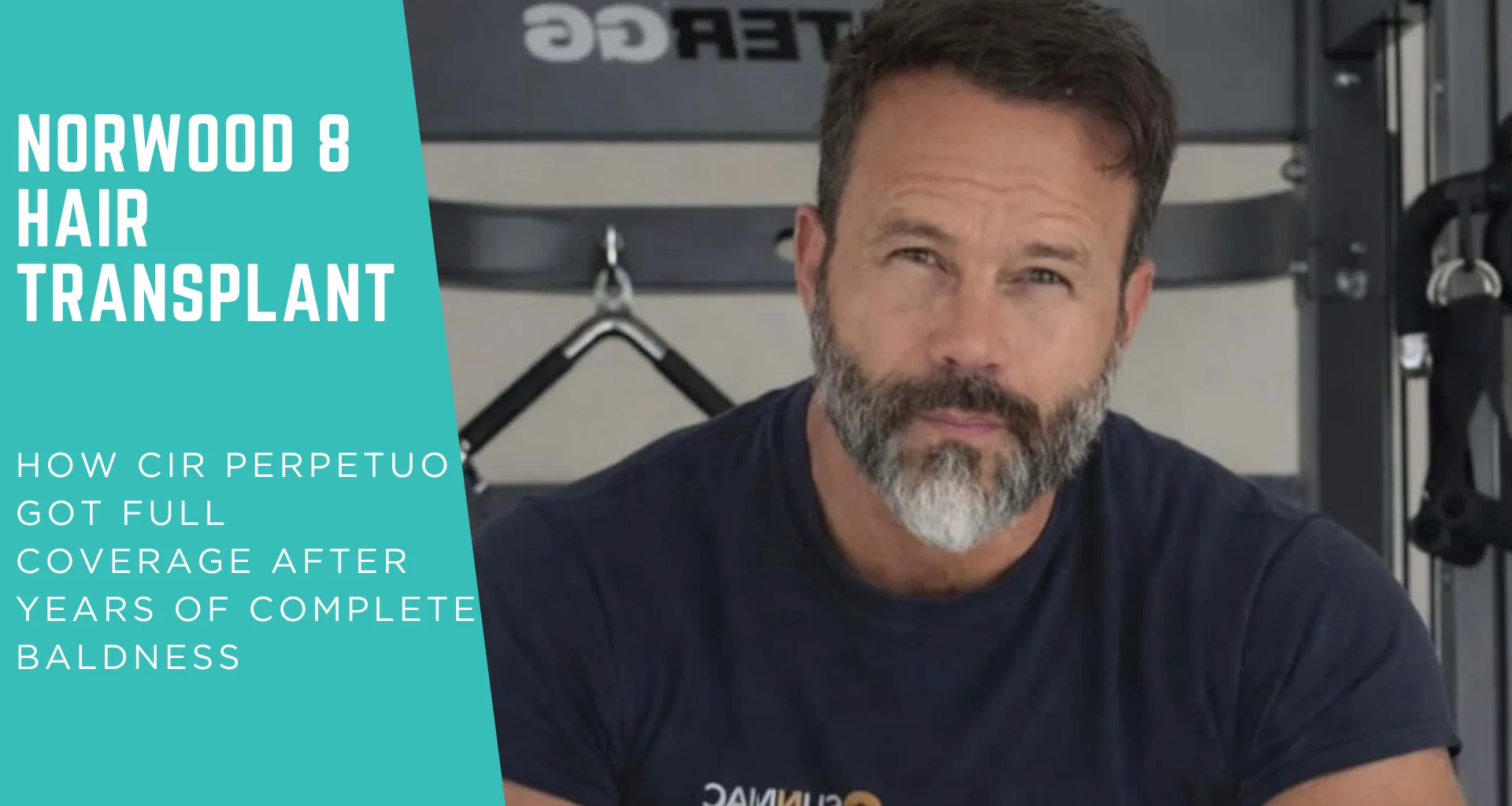

Norwood 8 hair transplant cases are among the most difficult in hair restoration. Most clinics will not take them. The donor area is limited. The area needing coverage is large. The margin for error is small.
Cir Perpetuo had been told no by multiple clinics before he found UniquEra. He had lived with progressive hair loss for more than two decades. He tried oils, shampoos, and vitamins. Nothing worked. Every specialist he visited gave him the same answer. His case was too advanced.
But there is a difference between a case being difficult and a case being impossible.
This is the full story of how Cir went from complete baldness to a natural, full-coverage result across two carefully planned FUE Sapphire sessions. It covers the medical decisions made, the technique chosen, how grafts were planned, and what his life looks like four years later.
If you have advanced hair loss and have been told you are not a candidate, this case study is worth reading carefully.
If you have been told your hair loss is too advanced for a transplant, speaking with a specialist who has handled complex cases can give you a clearer picture of what is actually possible for your situation. Book a free consultation with the UniquEra medical team to find out where you stand.
Cir Perpetuo’s case at a glance
| Element | Detail |
| Patient | Cir Perpetuo, 50, entrepreneur, Florida, USA. |
| Diagnosis | Androgenetic alopecia, Norwood 8. |
| Hair loss duration | 20+ years. |
| Previous treatments | Oils, shampoos, vitamins. |
| Emotional trigger | Saw a friend’s result. Wanted to maintain his appearance. |
| How he found UniquEra | Referral from Pastor Elias. |
| Why he chose UniquEra | Trust, personal referral, service quality, communication. |
| Donor quality | Medium. |
| Technique | FUE Sapphire. |
| Session one grafts | Approximately 3,500. |
| Session two grafts | Approximately 3,000 to 4,000 including beard. |
| Beard donor used | Yes. Extraction from below mouth area. Not a beard transplant. |
| Areas covered | Hairline, temples, mid-scalp, crown. |
| Procedure duration | One day per session. |
| Emotional state after | Excited. |
| Recovery | Smooth. Great Istanbul experience. |
| Result stage | 4 years. |
| Visible changes | Density, hairline shape, symmetry, full coverage. |
| Confidence impact | Significantly boosted. Looks younger, more like himself. |
| Referral impact | Close to 100 patients brought to UniquEra. |
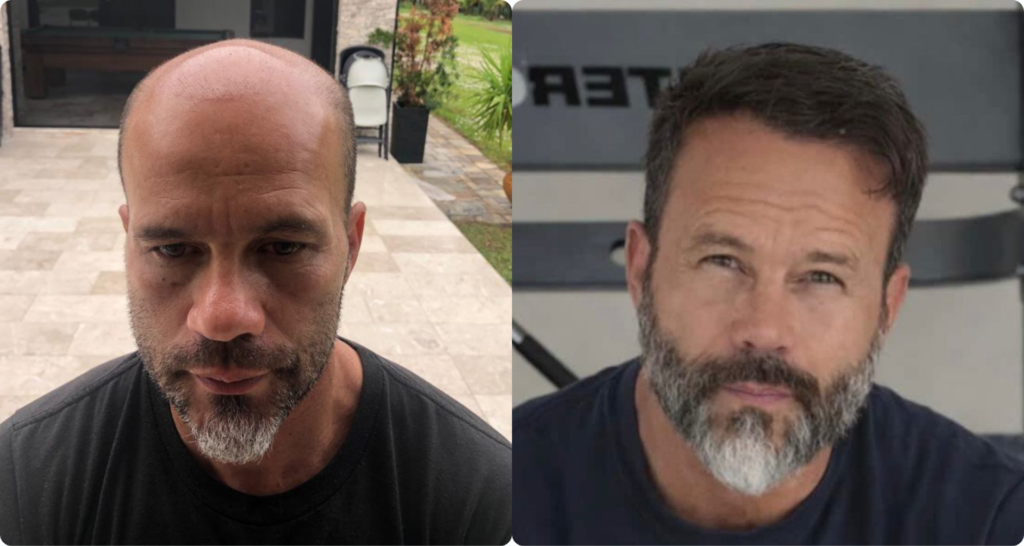
Source – Instagram – Cir Perpetuo hair transplant
| Detail | Cir’s Case |
| Age | 50 |
| Nationality | American. |
| City | Florida, USA. |
| Profession | Entrepreneur. |
| Hair loss duration | 20+ years. |
| Diagnosis | Androgenetic alopecia, Norwood 8. |
| Pattern | Diffuse thinning, then frontal, top, crown. Full advanced baldness. |
| Previous treatments | Oils, shampoos, vitamins |
| How he found UniquEra | Referral from Pastor Elias. |
| Sessions | Two. December 2020 and October 2021. |
| Technique | FUE Sapphire. |
| Total grafts | Approximately 6,500 to 7,500 across two sessions. |
| Result stage | 4 years. |
Cir is an entrepreneur based in Florida. He runs a company and operates in a world where personal image matters. How you present yourself affects how people respond to you professionally and personally.
He came to UniquEra in December 2020 after more than two decades of progressive hair loss. He used to have curly hair. By the time he arrived, it was gone. He had been told by multiple clinics that his case was too far gone to treat.
Androgenetic alopecia is the most common form of male pattern baldness. It is driven by sensitivity to a hormone called DHT, which causes follicles to shrink over time until they stop producing visible hair. In Cir’s case, this had been running for over 20 years across every major zone of the scalp. Oils, shampoos, and vitamins cannot reverse this process once follicles have miniaturised past a certain point.
Most hair transplant clinics in Turkey looked at Cir’s case and said no. The calculation they made was straightforward. Large area to cover. Medium donor supply. High complexity. The risk of a poor result felt too high.
At Norwood 8, hair loss has progressed across the entire top of the scalp. The frontal hairline is gone. The temples are gone. The mid-scalp is gone. The crown is gone. Only a band of hair around the sides and back of the head remains, and even that can be thinner than in less advanced cases.
Two things make this stage difficult for most clinics:
• The area needing coverage is large, often requiring 6,000 or more grafts across two sessions.
• The donor area may not be strong enough to supply that many grafts at a quality that looks natural
When those two things collide, most clinics walk away.
His donor quality was assessed as medium. That means workable but not abundant. Planning a full two-session restoration with medium donor density requires careful judgement at every stage. The team has to decide what to prioritise, how many grafts the donor can safely give per session, and when to bring in additional donor sources like the beard.
UniquEra accepted the case because the medical team had handled cases at this level before. They saw a path. An honest one, with realistic expectations and a clear two-session plan built around what his scalp actually needed.
Hair loss at Norwood 8 is not just a cosmetic issue. For Cir, it changed how he looked and how he felt about himself every day.
Cir used to have curly hair. That was part of how he had always looked and how people recognised him. Losing it changed his face, his silhouette, and how young or old he appeared. He looked older. That matters when you are someone who takes pride in how he presents himself.
As an entrepreneur, Cir is always in front of people. Clients, partners, and associates form impressions quickly. Advanced hair loss changed how he felt walking into those rooms. His self-confidence took a hit, and for someone whose image is tied to his professional presence, that has a real cost.
| Treatment tried | Result |
| Oils | No meaningful change |
| Shampoos | No meaningful change |
| Vitamins | No meaningful change |
He had already done what most patients do before reaching this point. None of it changed the trajectory. At Norwood 8, the follicles in the affected zones had miniaturised past the point where topical products could reverse the process.
The trigger was seeing a friend’s result. His friend had been through a hair transplant and the outcome was clear. Cir saw it with his own eyes. That kind of evidence is more persuasive than any consultation or before-and-after photo online. When someone you know and trust has gone through the process and looks the way they do, the question shifts from ‘is this possible?’ to ‘where do I go?’
He is not someone who gives up easily. The team at UniquEra describe him as a fighter. He takes care of himself. He cares about how he looks. When he saw that something could be done, and when a trusted person in his life had already done it, there was no reason to hold back.
He came to UniquEra through a referral from his friend, Pastor Elias. Elias was not a stranger on the internet. He was someone Cir trusted personally. When Elias recommended UniquEra, the credibility of that recommendation came with it. It was not a cold search. It was a trusted hand-off.
By the time Cir spoke to the UniquEra team, he had already seen what was possible. The consultation was not him trying to be convinced. It was him working out how to make it happen.
| Factor | What it meant for Cir |
| Personal referral from Pastor Elias | Trust was already in place before the first call |
| Seeing a friend’s result firsthand | He had visual proof, not just promises |
| Communication quality | The team was clear, direct, and honest about what was realistic |
| Service experience | He felt comfortable from the first conversation |
| No hesitation about Istanbul | The referral had already answered his doubts |
First consultation call: December 12, 2020. Booked: December 13, 2020. One day.
The decision took roughly 30 minutes from the point of the call. Most patients take weeks. Some take months. Cir moved fast because the trust was already built before the conversation started. The consultation confirmed what he had already half-decided.
He had no objections about traveling to Istanbul. He had no fear of the procedure. He was not comparing prices or shopping around. He simply wanted to come.
FUE Sapphire hair transplant is a method where follicles are individually extracted from the donor area and implanted into small channels opened in the recipient scalp using a sapphire-tipped blade. The sapphire tip allows for clean, precise channel openings with less tissue damage and more control over the angle and direction of the implanted hair.
DHI hair transplant uses a device called a Choi pen to extract and implant follicles in one step, without pre-made channels. It works well when a patient still has existing hair in the recipient area. The Choi pen places new grafts between existing hairs without disturbing them. It is generally preferred for adding density to thinning areas rather than rebuilding completely bald zones.
| Factor | How it applied to Cir’s case |
| Recipient areas were largely bare | No existing hair to protect or work around in bald zones. |
| DHI’s main advantage not relevant | DHI protects existing hair. Cir had none in the bald areas. |
| Large coverage area | FUE Sapphire offers better capacity for rebuilding across large, open scalp zones. |
| Full control over channel placement | Sapphire blade allows precision across hairline, temples, mid-scalp, and crown. |
When the bald area is large and there is no existing hair to protect, FUE Sapphire gives the medical team the right level of control and coverage capacity. DHI was not the right tool for this case.
| Detail | Session one |
| Technique | FUE Sapphire |
| Grafts | Approximately 3,500 |
| Areas covered | Frontal hairline, temples, mid-scalp |
| Duration | One-day procedure |
The frontal hairline, temples, and mid-scalp were prioritised in the first session. These areas carry the most visual impact and respond well to the first phase of treatment. The crown was left for the second session for specific medical reasons explained below.
This was not a complication. It was the plan from the beginning.
In advanced cases like Norwood 8, the donor area cannot safely give everything in one session. Extracting too many grafts at once risks permanent damage to the donor zone. The safer approach is to:
• Extract what the donor can safely give in session one
• Let the donor area recover over around one year
• Return for session two to complete the crown and remaining zones
The crown also has lower blood circulation than other scalp zones. Grafts placed there need a dedicated session with careful density planning. Beard grafts are often introduced in this second phase to support coverage in the crown where scalp donor supply alone may not be enough.
| Detail | Session two |
| Technique | FUE Sapphire |
| Grafts | Approximately 3,000 to 4,000 |
| Donor sources | Scalp and beard |
| Areas covered | Crown, additional density across other zones |
| Gap from session one | Approximately one year |
| Question | Answer |
| Was it a beard transplant? | No. Beard was the donor, not the recipient |
| Where was beard hair extracted from? | Below the mouth area |
| Why use beard hair at all? | Scalp donor alone was not enough to cover the crown fully |
| Does beard hair grow on the scalp? | Yes. Transplanted follicles continue growing in their new location |
When scalp donor supply is medium, beard hair fills the gap. It allowed the team to reach coverage levels across the crown that scalp grafts alone could not achieve.
| Zone | What was done |
| Frontal hairline | Rebuilt from scratch. Natural-looking front edge redesigned |
| Temples | Temple points restored. Restores youthful facial framing |
| Mid-scalp | Filled in to create density and continuity across the top |
| Crown hair transplant | Addressed in session two with scalp and beard grafts |
All four major zones were covered across the two sessions. The crown is typically the hardest zone to fill because of lower blood circulation and the amount of area involved. Bringing in beard grafts in session two made full-zone coverage possible.
How does UniquEra plan grafts differently from other clinics?
This is one of the most important parts of understanding why Cir’s result turned out the way it did. And it is one of the clearest differences between how UniquEra works and how most other clinics operate.
Many clinics pre-assign graft numbers to specific zones before surgery. A patient gets told something like this during their online consultation:
| Zone | Pre-assigned grafts |
| Hairline | 1,000 grafts |
| Mid-scalp | 2,000 grafts |
| Crown | 1,500 grafts |
These numbers are fixed before the patient ever sets foot in the clinic. They are presented as a precise medical plan. In reality, they are often a rough estimate made from a video call, and they become the limit the doctor works within during surgery.
An online consultation cannot accurately assess a scalp the way a physical evaluation can. The doctor on the video call is looking at lighting, camera angles, and compressed video quality. They are not touching the scalp. They are not measuring follicular density with instruments. They are not seeing how the donor area actually behaves under extraction conditions.
What looks like a certain density level on a video call may be completely different when the patient is sitting in the operating chair.
If a zone was pre-assigned 1,000 grafts but actually needs 2,000 grafts to look natural, the doctor is stuck. The plan says 1,000. The patient paid for a plan that says 1,000. So 1,000 is what gets placed, even if the scalp is telling a different story.
The patient ends up with an under-filled zone. Not because of a medical failure. Because of a planning decision made weeks earlier on a video call.
| What pre-fixed zone numbers feel like | What they actually are |
| Precise and scientific | An estimate based on a video call |
| A personalised medical plan | Often a standard template adjusted slightly per patient |
| A commitment from the clinic | A cap that limits the doctor during surgery |
| Reassuring to the patient | Potentially limiting to the outcome |
A specific number per zone sounds impressive in a consultation. It makes the patient feel like everything has been mapped out in detail. But if that number was set during a 20-minute online call, it reflects an estimate, not a medical assessment. And in advanced cases like Norwood 8, an estimate that is off by even a few hundred grafts per zone can show up visibly in the final result.
UniquEra separates what can be responsibly communicated before the patient arrives from what can only be decided when the doctor is working directly with the patient.
What happens during the online consultation:
The team gives a realistic minimum expectation based on the patient’s hair loss stage, pattern, and visible donor condition. For a case like Cir’s, the communication would be something like:
• First session: expect around 3,000 to 3,500 grafts.
• Second session, around one year later: an additional 3,000 to 4,000 grafts depending on donor recovery and crown needs.
• Total across two sessions: approximately 5,500 to 7,000 grafts, potentially including beard donor.
This is an honest range. It is not a fixed commitment and it is not a sales number.
What happens during the procedure:
| Stage | Who decides | Based on what |
| Online consultation | Medical team gives estimate | Video call, photos, hair loss stage |
| Day of procedure | Medical team evaluates in person | Direct physical assessment of scalp and donor |
| During surgery | Doctor decides final graft distribution | What the scalp and donor actually show |
| Zone-by-zone placement | Doctor places grafts as needed | Real condition of each zone, not pre-set quota |
When the patient arrives, the medical team evaluates the actual scalp and donor area directly. They can feel the donor density. They can see how the follicles are extracted. They can assess each recipient zone up close. The final graft distribution is decided during the procedure, based on what the doctor sees in real time.
If a zone needs more grafts than the estimate suggested, the doctor places more. If the donor is responding better than expected, that capacity goes where it is most needed. The doctor is not working against a fixed number. The doctor is working for the patient’s result.
In a Norwood 8 case, every graft counts. The donor area is already under pressure. The coverage area is large. Getting the distribution wrong in even one zone can leave a visible gap that cannot be corrected without another full session.
| Why Flexible Graft Planning Matters More In Advanced Cases |
| Donor supply is limited. Every graft must go exactly where it has the most impact. |
| Large coverage area means any under-filled zone is visible. |
| Crown and mid-scalp needs can only be fully assessed in person. |
| Beard donor grafts may be needed. That decision is made in clinic, not on a call. |
| A fixed plan made on a video call cannot account for what the scalp shows on the day. |
For a case with Cir’s profile, two sessions with beard donor support can deliver approximately 5,500 to 7,000 total grafts depending on:
• How the scalp donor responds to extraction in session one
• How well the donor area recovers before session two
• How much beard donor is available and suitable
• What the crown and remaining zones need after session one results settle
This is a realistic range, not a guarantee. Every case is different. The final number is always determined by what the patient’s donor can safely give, not by what looks good on a consultation document.
If you have an advanced hair loss case and want to understand what is realistically possible for your specific donor supply and coverage needs, the UniquEra medical team assesses each case individually. Book a free consultation to get an honest picture of what two sessions could look like for you.
He came out feeling excited. Not anxious. Not overwhelmed. He could see that something real had happened and he trusted the process enough to feel confident about what was ahead.
His recovery followed the standard path for FUE Sapphire. Some swelling and scabbing in the early days, which is normal and expected. He described his overall Istanbul experience as great. The care he received from the procedure through to his stay left a clear impression.
For a patient traveling internationally for a medical procedure, that experience matters. It builds the confidence to return for a second session a year later and to recommend the clinic to people he knows.
What do his results look like after 4 years?
Four years is a meaningful point for evaluating a hair transplant. The results are stable. What you see is what you have.
| Zone | Result at 4 years |
| Frontal hairline | Fully rebuilt, natural shape and edge |
| Temples | Density restored, symmetrical facial framing |
| Mid-scalp | Full coverage, continuous density |
| Crown | Coverage achieved with scalp and beard grafts |
| Overall | Natural density, symmetry, and hairline shape stable |
Starting from complete baldness at Norwood 8, the two-session approach delivered approximately 50% or more of what a full head of hair looks like visually. For someone who walked in with no hair across the entire top of his head, that is a real transformation.
He no longer walks into rooms carrying the weight of how his hair looks. He presents himself the way he wants to. For someone whose professional life depends on image and presence, that is not a small thing. He looks younger. He looks more like himself. That is the version of him that had curly hair and carried himself with energy.
Cir operates in business environments where how you look affects how people respond to you. The restoration gave him back the ability to show up looking the way he feels.
It proves that Norwood 8 is not automatically a closed door. The right combination of technique, two-session timing, and supplementary donor sources like beard hair can produce results that change a person’s life. The key is a team experienced enough to plan the complexity honestly.
The clinics that refused saw the same facts. Medium donor. Large area. High complexity. UniquEra’s medical team saw the same facts and built a plan around them. Two sessions from the start. Realistic expectations. Beard donor introduced in session two. Graft decisions made during surgery, not before.
Cir did not set out to send patients to UniquEra. It happened because people around him could see what happened. Close to 100 patients came through him over time. Family members. People from his professional circle. When someone in your life goes from Norwood 8 to what Cir looks like four years later, you do not need a brochure.
Cir Perpetuo’s case is not a typical hair transplant story. Most clinics walked away from it. One team built a plan around it.
He came in as a Norwood 8 patient with more than 20 years of progressive hair loss, a medium donor area, and a scalp needing full coverage across every major zone. Across two carefully planned FUE Sapphire sessions, he left with a result that changed how he looks and how he carries himself every day.
The decisions behind that result were not accidental. The technique was chosen for a reason. The two-session plan protected the donor while maximising coverage. The beard was used because the math required it. Graft placement was decided during surgery, not locked into a fixed plan on a video call weeks earlier.
Four years later, the result is still there. So is Cir.
If you have advanced hair loss and want an honest assessment of what is possible for your specific case, the UniquEra medical team works through complex cases individually. Book your free hair transplant consultation to start that conversation.
Yes, in many cases they can. A two-session approach combined with beard donor grafts is often used to achieve meaningful coverage when scalp donor supply alone is not enough.
FUE Sapphire uses a sapphire-tipped blade to open precise channels in the scalp before grafts are placed. It works best for large, bald areas where there is no existing hair to work around.
FUE Sapphire opens channels in the scalp first, then places the grafts. DHI places grafts directly using a Choi pen with no pre-made channels. Read our full FUE Sapphire vs DHI comparison to understand which technique suits your case. DHI suits areas with existing hair that needs density. FUE Sapphire suits areas that are already bald and need rebuilding from scratch.
One session cannot safely extract enough grafts to cover a large bald area without risking permanent donor damage. A second session planned around one year later lets the donor recover and allows the team to complete the crown and remaining zones properly.
Yes. Beard hair is extracted and transplanted to the scalp when scalp donor supply is not enough on its own. This is not a beard transplant. The beard is simply used as an extra source of grafts for the scalp.
Most Norwood 8 cases need between 5,500 and 7,000 grafts across two sessions. The exact number depends on the size of the bald area, donor quality, and whether beard donor grafts are used.
The final graft distribution is decided during surgery, not before. The online consultation gives a realistic estimate. The medical team then places grafts based on what they see directly during the procedure, not a fixed number agreed on a video call weeks earlier.
Most patients see clear results between 9 and 12 months after each session. For a two-session case, the full settled result is visible around one year after the second procedure.
For most patients, yes. The goal is not a perfectly dense head of hair but real, visible coverage that changes how a person looks and feels. Cir’s result four years after his procedure is a clear example of what is possible with the right planning.
Look for a team that has handled Norwood 6, 7, and 8 cases before. Ask if they plan two sessions from the start for advanced cases. Our guide on how to compare hair transplant clinics in Turkey gives you the right questions to ask before you commit. Ask how they make graft decisions during surgery. A clinic that gives honest answers about what is realistic, rather than promising a full result, is worth trusting.