
Your hair transplant donor area decides more about your result than the clinic name or the price you were quoted. It is the hair at the back and sides of your head. It is the only supply you have. And once it is used, it does not come back.
Most people worry about the front. The hairline. The bald patch on top. But the real question sits at the back. Do you have enough good hair to cover what you have lost?
A lot of clinics skip past this. They glance at your scalp, quote a graft number, and move to booking. That is where results go wrong.
This guide walks through how a proper assessment works, what the numbers mean, and how to tell if yours was done right.
Before you compare clinics, prices, or graft counts, the honest first step is finding out what your donor supply can actually support. That one assessment shapes every decision that comes after. In a hair transplant consultation with us, that is exactly where we start. We look at your scalp and tell you what is realistic, not what sells.
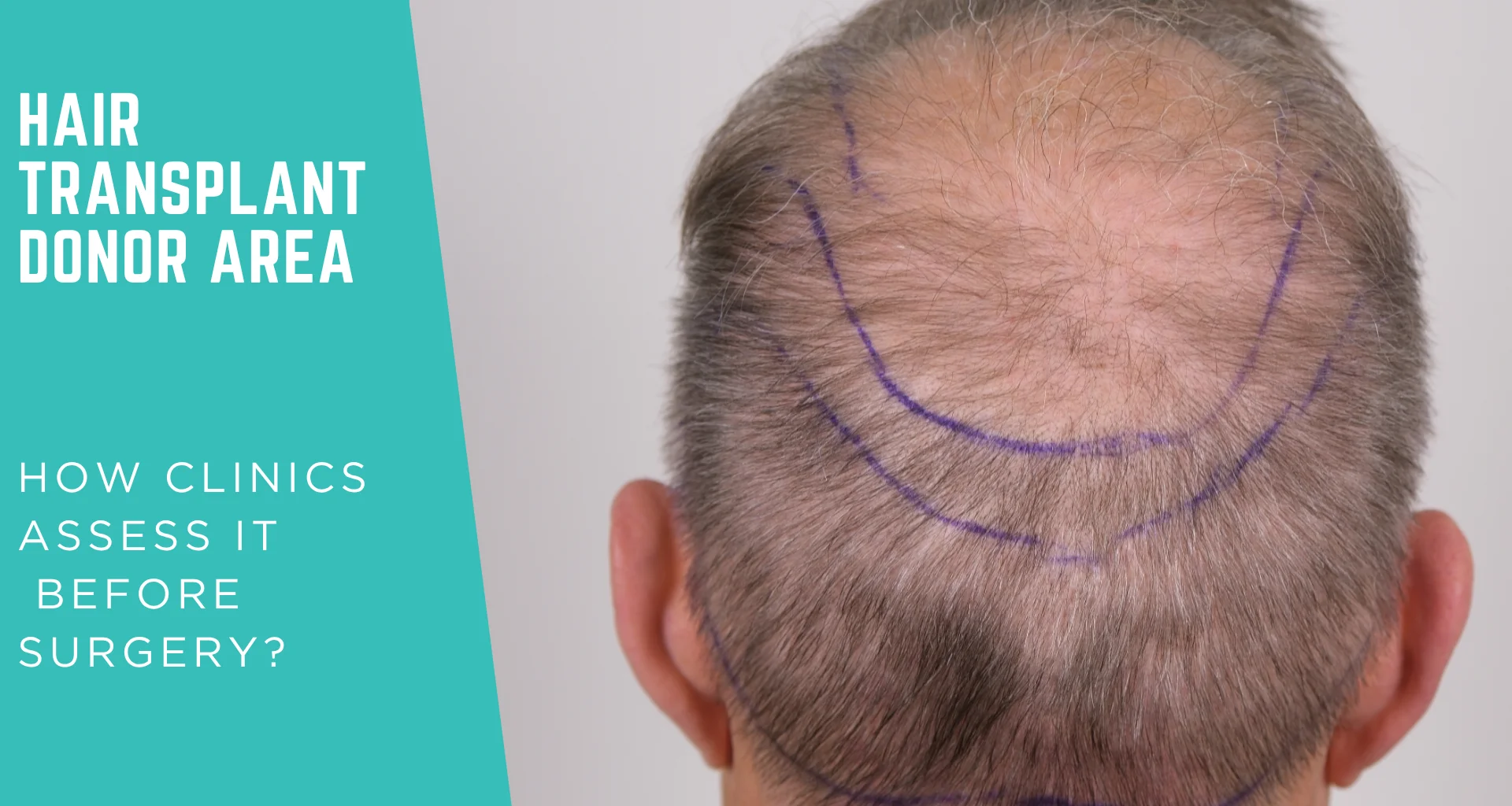
The donor area is the strip of hair at the back and sides of your head that a clinic takes grafts from. This hair is special. It is genetically resistant to the hormone that causes pattern hair loss, so it keeps growing even after it is moved.
That resistance is why it works. When these follicles are placed into a thinning or bald spot, they carry their resistance with them. They keep growing in the new spot for life.
The rest of your scalp does not have this protection. That is why grafts only ever come from the back and sides. Your hair transplant donor area is a fixed, limited supply. A good plan respects that limit instead of pushing past it.
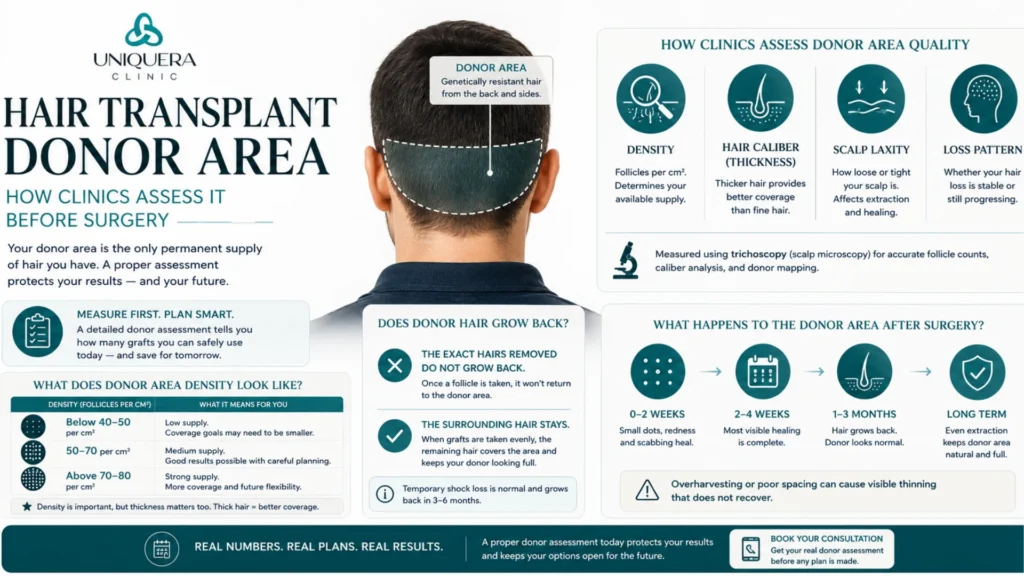
A clinic assesses donor area quality by measuring it, not by eyeballing it. A quick look at your scalp cannot tell anyone how much hair you can safely give. Real numbers come from real tools.
A proper check looks at four things.
| What is measured | Why it matters |
| Density | How many follicles sit in each square centimetre. This sets your supply. |
| Hair caliber (thickness) | Thick hair covers far better than fine hair, so thickness matters as much as count. |
| Scalp laxity | How loose or tight your scalp is, which affects how grafts are taken. |
| Loss pattern | Whether your hair loss is still spreading, which changes the long-term plan. |
Density is checked with a small handheld microscope called trichoscopy. It magnifies your scalp so the team can count follicles in a set area. Photos are taken of dry and wet hair to record your starting point.
Yes. A skilled team can measure your donor area accurately before any surgery is booked. Trichoscopy gives a real follicle count per square centimetre. Diameter is sampled across the scalp. The donor surface is mapped.
This matters because a graft number quoted without measurement is a guess. Two people can have the same size scalp and very different supply. The only way to know yours is to measure it.
Good donor area density sits around 80 follicles per square centimetre or higher. That is the level where most people have enough supply to move a solid number of grafts without thinning the back.
Here is what the numbers mean in plain terms.
| Donor area density | What it means for you |
| Below 40 to 50 per cm² | Low supply. Coverage goals may need to be smaller and honest. |
| 50 to 70 per cm² | Medium supply. Good results are possible with careful planning. |
| Above 70 to 80 per cm² | Strong supply. More coverage and future flexibility. |
Density is not the whole story. A person with medium density but thick hair can get better coverage than someone with high density and fine hair. Thick strands hide the scalp better. This is why a good team measures thickness too, not just the count.
The exact follicles removed from your donor area do not grow back in that spot. When a graft is taken, the whole follicle comes out and moves to the new area. That specific follicle will not return to the back of your head.
So when people ask does donor hair grow back, the honest answer is no for the follicles that were taken. That is exactly why careful planning matters so much.
But this does not mean the back goes patchy. The hair around each extraction point stays. When grafts are spread evenly across a wide area, the remaining hair covers the tiny gaps. Done well, the donor looks the same, even with short hair.
You may also see some temporary thinning around the extraction points early on. This is called shock loss. It is not permanent. That hair grows back within three to six months as the scalp settles.
A graft number only means something when real measurements sit behind it. Getting this right before anything is booked is what protects your result and your future options. If you want a clear read on your own donor supply, we give you the real numbers in your hair transplant consultation before any plan is set.
The donor area after a hair transplant heals with small dot-sized marks that fade over about two weeks. Redness and light scabbing settle first. The surrounding hair keeps growing the whole time and covers the area as it heals.
Early on, the back may feel tight or slightly sore. This eases within a few days. By the one-month mark, most of the visible healing is done.
The long-term look depends on how the grafts were taken. Even, well-spaced extraction keeps the donor looking full. Grafts pulled too heavily from one zone leave visible thinning that does not recover. This is why spacing and restraint matter more than speed. A careful team protects the back so it still looks natural years later.
Your donor area can safely give around 40 to 50 percent of its total supply over your lifetime. For most people, that works out to a reserve of roughly 5,000 to 8,000 hair transplant grafts across all procedures, not a single unlimited pool.
Every one of those hair transplant grafts comes from the same limited reserve, so a good plan holds some back for later.
| Factor | What it affects |
| Total donor supply | Your lifetime ceiling for grafts. |
| Safe extraction limit | Usually 40 to 50 percent, to keep the back looking full. |
| Future hair loss | Grafts you may want to hold back for later. |
The “how many grafts do I need” question only makes sense after this. Wanting 4,000 grafts means little if your safe supply is 5,000 total and your loss is still spreading. A crown hair transplant often needs more grafts than people expect, because the crown swirls and shows scalp easily. Taking too much at once is one of the most common long-term mistakes.
A weak or thin donor area does not always rule out a hair transplant, but it changes the plan. Lower supply means smaller, smarter goals. A team may focus grafts where they matter most, like the hairline, rather than trying to cover everything at once.
Sometimes the honest answer is not yet. If your hair loss is still spreading fast, operating early can create problems later as more hair falls around the transplanted area. A diffuse thinning hair transplant often calls for a more careful approach, because donor supply may already be lower.
In some cases, hair from the beard or chest can add to a limited scalp supply. Scalp hair is still the first choice, but this can help stretch coverage.
A weak donor is not a dead end. Some people are still a strong hair transplant candidate with a smaller plan. Others do better waiting until the loss settles. Either way, it is a reason for careful, realistic planning by a team willing to tell you the truth.
You can tell your donor area was measured properly if the clinic showed you numbers, not just a graft quote. A proper assessment leaves a trail. A guess does not.
Ask these questions before you commit:
• Did they use trichoscopy or a microscope to count density?
• Did they measure hair thickness, not just the count?
• Did they take dry and wet photos of the back?
• Did they give a graft number based on your supply, or a round figure that sounds impressive?
• Did they talk about future loss and holding back reserve grafts?
Watch for red flags. A graft number quoted before anyone looked closely. A promise to cover everything in one go. No mention of your donor limit at all. These signs point to a clinic selling a procedure, not planning a result. A team protecting your long-term outcome will sometimes tell you to wait, and that honesty is worth more than a fast yes.
At UniquEra Clinic, every plan starts at the back of your head, not the front. Before any graft number is discussed, your donor area is measured properly. Density, hair thickness, scalp condition, and loss pattern are all checked and recorded.
This assessment shapes everything that follows. Whether you are considering a receding hairline hair transplant or working with crown thinning, the plan is built around what your donor can genuinely support. Not a number that sounds good in a brochure.
The Medical Directors, with over a decade of hands-on hair transplant experience supervising each case personally, set expectations based on your real supply. For patients considering hair transplant surgery in Turkey, this is the difference between a result that holds up and one that does not. The measurement comes first. The plan follows it.
Your hair transplant donor area is the foundation of your whole result. Not the clinic name. Not the technique. Not the price. The hair at the back of your head sets the ceiling on what is possible.
A good clinic measures it before it plans anything. It counts your density, checks your hair thickness, and tells you the honest truth about your supply. A weak donor means smaller goals. A strong one means more freedom. Either way, you deserve to know your real numbers before you decide.
The biggest mistake is choosing a graft count before anyone has measured what you actually have.
If you have been quoted a graft number without a proper donor check, it is worth getting a second, honest read. Hair loss keeps moving while you wait, and your donor supply does not grow. We start every consultation by measuring your donor area and telling you what is realistic, whether that points toward hairline restoration Turkey or simply a clearer picture of where you stand. Book your consultation with UniquEra today.
Not always. Size helps, but density and hair thickness matter more. A smaller donor with dense, thick hair can give more usable grafts than a large, sparse one.
Sometimes, with a smaller and smarter plan. A weak donor means focusing grafts where they count most, and being honest about coverage limits.
No. Hair thickness matters just as much. Thick strands cover the scalp far better, so a good assessment measures both density and diameter.
Most visible healing takes about two weeks. Redness and scabbing fade first, and the surrounding hair covers the area as it settles.
Yes, in some cases. Beard or chest hair can add to a limited scalp supply, though scalp hair is still the first choice for texture and match.
No. Existing follicles cannot multiply. Medical treatment may improve the thickness of weakened hairs in some people, but it does not add new follicles.
It depends on your donor density and scalp condition. A proper assessment sets the safe extraction limit for your case.
Yes. Donor follicles keep their genetic resistance to pattern hair loss and continue growing in their new location for life.