
The best hair transplant technique for natural results is one of the most searched questions patients ask before booking. And the honest answer surprises most of them.
There is no single technique that is automatically the best. Sapphire FUE and DHI are both marketed as the most advanced option. Both can produce natural results. Both can also disappoint if applied to the wrong case.
In clinical practice, the technique is chosen after evaluation. It follows the diagnosis. It does not lead to it.
This article explains what actually creates natural hair transplant results, how Sapphire FUE and DHI differ, which patients suit which method, and what questions to ask before any technique is recommended to you.
Not sure whether Sapphire FUE or DHI fits your case? Book a private consultation at UniquEra Clinic and get a technique recommendation based on your actual hair loss evaluation.
Is there one best hair transplant technique for natural results?
No. There is no single best hair transplant technique for natural results that fits every patient.
The most natural result comes from matching the technique to the patient’s specific situation. That includes their hair loss stage, donor area strength, hair thickness, scalp condition, hairline goal, crown involvement, and long-term loss risk.
The International Society of Hair Restoration Surgery (ISHRS) states directly on its patient education pages that naturalness in hair transplantation comes from correct incision angle, correct sizing, and correct direction. Not from the technique name.
Source: ISHRS – Hair Graft Placement: The Final Step in Hair Transplantation | ishrs.org/hair-graft-placement-the-final-step-in-hair-transplantation/
A technique is only best when it fits the case. A clinic that recommends the same technique to every patient is making a marketing decision, not a medical one.
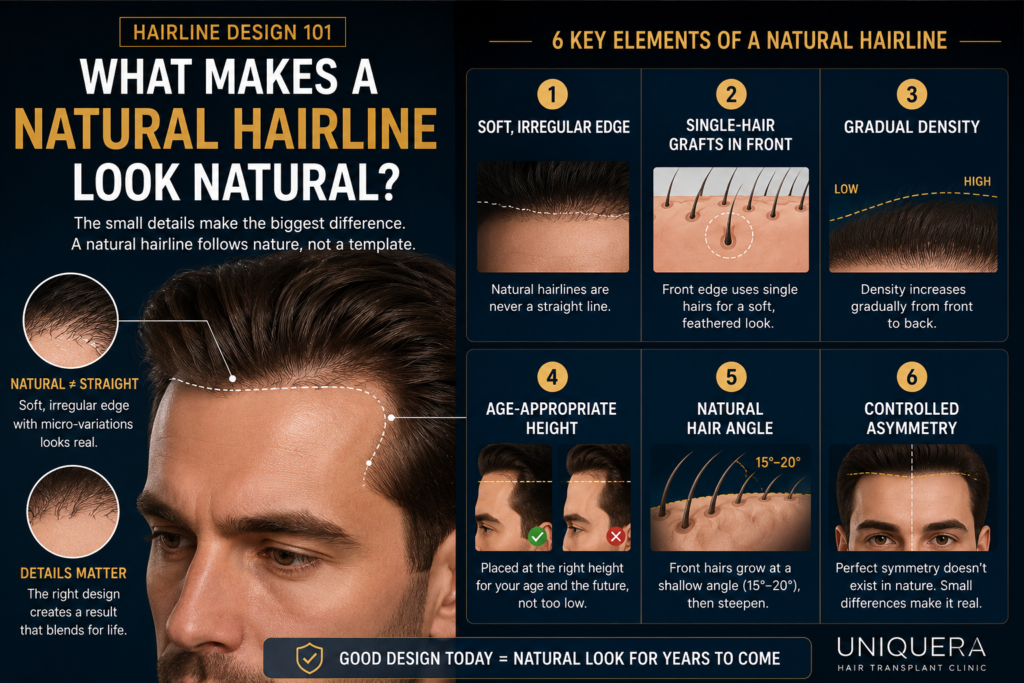
The answer is not the tool used. It is how the procedure was planned and executed.
Natural hair transplant results depend on several clinical decisions made before and during surgery. Technique is only one part of that picture.
A natural hairline is never perfectly straight. Real hairlines have small irregularities, peaks, and subtle variations in density. A transplanted hairline that is too uniform or too low looks artificial immediately, especially in cases of receding hairline hair loss.
Good hairline design accounts for the patient’s age, face shape, donor capacity, and future hair loss pattern. A hairline that suits a 25-year-old may look wrong on the same person at 45 if the hair behind it continues to thin.
This is one of the most technically important factors in any transplant. Hair grows at different angles in different zones of the scalp. Grafts placed at the wrong angle grow in the wrong direction and catch light unnaturally.
Research published in the ISHRS Hair Transplant Forum and referenced in the ISHRS patient resource library identifies zone-specific angulation as a primary driver of natural versus artificial results. The temporal hairline requires the most acute angle, sometimes as low as 5 to 10 degrees. The frontal hairline sits between 15 and 20 degrees. Even slight deviations in the temporal zone create a pluggy appearance detectable at conversational distance.
Not all grafts are the same. A follicular unit can contain one, two, three, or four hairs. Where each type is placed determines how natural the result looks.
The clinical standard is:
Placing triple grafts in the front row creates an unnatural pluggy look in a front hairline transplant. This is one of the most common causes of results that look obviously transplanted. The problem is not the technique. It is the planning.
Natural hair does not grow at uniform density across the scalp. It is denser toward the front and transitions gradually toward the back.
According to clinical hair restoration literature, a natural-looking frontal zone typically uses 40 to 45 grafts per square centimetre, tapering to 20 to 30 at the edges. StatPearls 2024 notes that vascular trauma and oxygen deprivation cause graft failure when density exceeds safe thresholds. In clinical practice, the safe upper limit is generally 40 to 50 grafts per centimetre squared per session.
Source: StatPearls, National Library of Medicine, 2024 | ncbi.nlm.nih.gov/books/NBK547740/
This is a technique of placing grafts like interlocking puzzle pieces in triangular formations rather than in straight rows.
Grafts placed in straight rows create visible lines and allow light to pass between them, making the scalp show through even when density is adequate. Interdigitation creates natural shadow blocking and gives the visual impression of more hair without needing more grafts.
Most clinic articles on technique comparison never mention this. It is one of the clearest markers of experienced surgical planning versus high-volume processing.
The crown has a natural swirl pattern, which is why crown hair transplant planning requires careful graft direction control. Hair grows outward from a central point in a circular direction. Grafts placed without following this direction create an obvious flat spot or irregular growth pattern.
The temples also require specific planning. Male temporal hairlines need more acute, angular implantation. Female temporal hairlines require a softer, more rounded approach. Both are easily recognised when done incorrectly.
| Natural result factor | Why it matters |
| Hairline design | Frames the face. Too low or too straight looks artificial. |
| Graft angle by zone | Wrong angle = unnatural growth direction |
| Single grafts at front row | Creates a soft, natural-looking hairline edge |
| Density gradation | Avoids harsh transition from hair to scalp |
| Interdigitation | Creates shadow blocking and density illusion |
| Crown swirl planning | Follows natural growth direction in circular pattern |
| Temple design | Different approach needed for male vs female anatomy |
The main difference is in the implantation step. Extraction of grafts from the donor area is essentially the same across all three. The variation is in how and where channels are created and how grafts are placed.
| Technique | Simple explanation | Key difference |
| FUE | Grafts extracted one by one from donor area using a micro-punch | Standard extraction method. Implantation uses steel blade channels. |
| Sapphire FUE | Same FUE extraction but channels created with sapphire blade before implantation | Sapphire blade creates smoother, V-shaped micro-channels with less tissue trauma |
| DHI | Grafts extracted then implanted directly using a Choi implanter pen | No separate channel creation. Includes two steps. Extraction and Implantation. |
An important clinical distinction: FUE technically describes the extraction method. In the wider market, it is used to describe the full procedure. Sapphire FUE and DHI are both FUE-based. The difference is in the implantation tool and approach, not in how grafts are removed from the donor area.
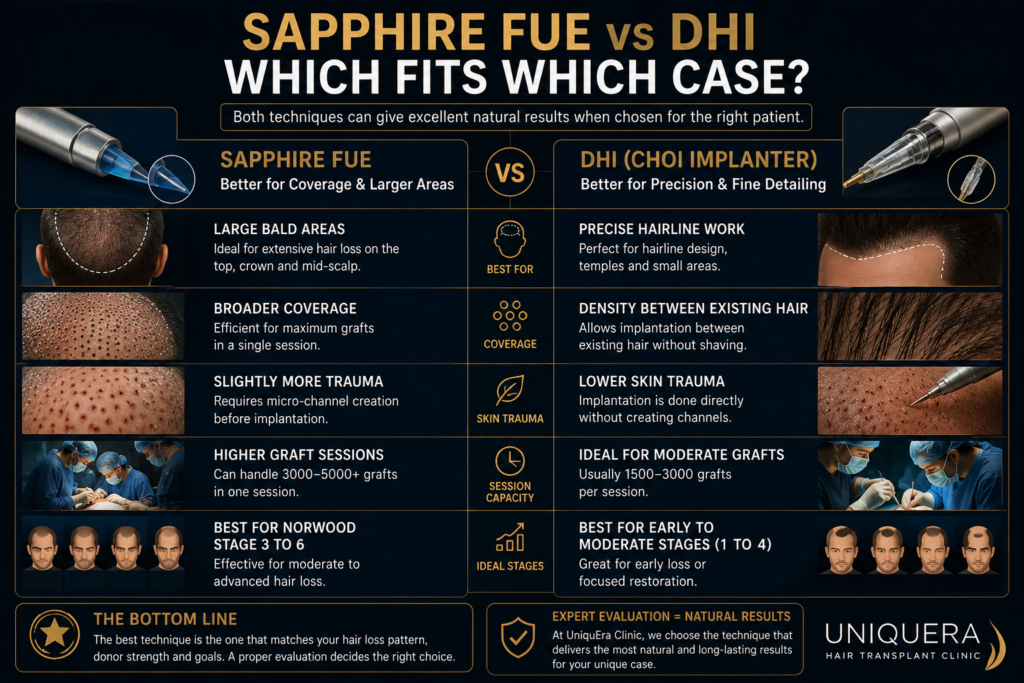
Both can produce natural hair transplant results. The question is not which technique is better overall. It is which technique fits the patient’s case better.
| Factor | Sapphire FUE | DHI |
| Main strength | Broader coverage, higher graft volume | Precision placement, focused density |
| Implantation method | Channels created first, grafts placed after | Direct implantation with Choi pen. No separate channels. |
| Graft count per session | In selected patients with a strong donor area, high graft sessions may be possible. | Typically 1,500 to 3,500 grafts per session |
| Shaving required | Full shaving of donor and recipient area | In some DHI cases, the recipient area may not need full shaving, depending on the plan |
| Best suited for | Larger bald areas, broader coverage planning | Smaller precise areas, density work between existing hair |
| Recovery profile | Slightly faster epithelialization vs standard FUE | Less skin trauma. Faster healing in recipient area. |
| Natural result depends on | Channel angle, depth, density plan, graft sorting | Pen control, angle, direction, graft handling speed |
| Two-day procedure | Not typically used for two-day sessions | Suitable for two-day procedures due to lower skin trauma |
The key message from clinical practice is this: both techniques yield indistinguishable natural results when used for the right patient and executed by an experienced team. The technique is the tool. The plan is what creates the result.
Most clinic websites mention graft survival rates without citing sources. Here is what the published evidence and medical bodies actually report.
A 158-patient study published via the National Library of Medicine (BMC Surgery, 2024) on follicular unit extraction in androgenetic alopecia found that over 90% of hair follicles survived following FUE procedures, with more than 85% of patients achieving above 95% follicle survival at 12 months.
Some studies and clinical reports suggest sapphire blades may reduce tissue trauma compared with standard blades, but results depend on technique and patient factors . This is attributed to the V-shaped precision of sapphire incisions, which cause less tissue vibration and allow cleaner channel edges.
Source: BMC Surgery 2024 / National Library of Medicine – Clinical Outcomes of Follicular Unit Extraction in Androgenetic Alopecia: A 158-Patient Analysis | pubmed.ncbi.nlm.nih.gov
Clinical data consistently reports DHI achieving 90 to 97% graft survival rates. The primary reason is reduced graft exposure time. Because the Choi pen allows extraction and implantation in a continuous process, grafts spend less time outside the body. Graft viability is directly related to how long follicles are exposed to air and temperature variation.
The ISHRS 2025 Practice Census reports that in 2024 to 2025, an estimated 835,000 surgical hair restoration procedures were performed worldwide. Both FUE-based and DHI-based techniques are well-represented in that figure, with technique choice determined by case requirements.
Source: ISHRS 2025 Practice Census | ishrs.org
StatPearls 2024, published via the National Library of Medicine, identifies vascular trauma and oxygen deprivation as primary causes of graft failure when placement density exceeds safe thresholds. Clinical practice generally limits transplant density to 40 to 50 grafts per centimetre squared per session.
This applies to both Sapphire FUE and DHI. No technique can safely override the biological limits of scalp vascularity. A clinic promising extremely high density in a single session warrants careful questioning regardless of which technique they use.
Source: StatPearls 2024, National Library of Medicine | ncbi.nlm.nih.gov/books/NBK547740/
According to the ISHRS 2025 Practice Census, 6.9% of all hair transplant procedures performed in 2024 were repair procedures. That represents a meaningful proportion of patients who required correction of previous work.
Analysis of repair cases consistently shows that most failures are planning failures, not technique failures. The technique was applied correctly. The technique was applied to the wrong case, or to the right case but with poor hairline design, incorrect graft sorting, or absent aftercare.
Source: ISHRS 2025 Practice Census | ishrs.org
When is Sapphire FUE the better choice for your case?
Sapphire FUE hair transplant results tend to be better suited for patients considering a manual FUE hair transplant in Turkey for broader coverage across larger areas.
Sapphire FUE may be the stronger fit when:
• The patient has larger bald areas, typically Norwood stages 3 to 6.
• Both the crown and front need coverage in the same session.
• The graft count required is above 2,500.
• The donor area is strong enough to support a high-volume session.
• The goal is wider area coverage rather than targeted density work.
• The patient can commit to full shaving of the recipient area.
At UniquEra Clinic, Sapphire FUE is the preferred approach for larger baldness cases, typically from 2,000 grafts upward. The sapphire blade allows precise microchannel creation across a broader scalp surface while maintaining natural angle and direction throughout.
DHI hair transplant results tend to be better suited for patients with diffuse thinning hair loss who need precision density work in focused areas.
DHI may be the stronger fit when:
At UniquEra Clinic, DHI with the Choi pen is used for smaller, more precise cases. Because DHI involves direct implantation without separate channel creation, the skin in the recipient area experiences less trauma. This is the reason DHI enables two-day procedures for higher graft volumes at the clinic. The skin remains healthy enough to receive grafts across two consecutive sessions.
DHI vs FUE. Which is better for hairline naturalness?
For hairline naturalness, the technique matters less than the design and graft placement.
A natural hairline requires soft irregularity, single-hair grafts at the front row, correct angle per zone, correct direction, and age-appropriate placement. Neither DHI nor Sapphire FUE automatically provides these. They both require an experienced team and careful planning to achieve them.
DHI can offer an advantage in hairline work because the Choi pen allows the team to control the angle, direction, and depth of each individual graft more precisely. This can be particularly useful in the temporal zone where angles must be most acute.
However, a poorly planned DHI hairline can still look unnatural. A well-planned Sapphire FUE hairline can look completely natural. The plan comes first. The tool follows.
The ISHRS states that incisions must be angled correctly, sized correctly, and directed correctly to assure that hair grows at a natural angle to the scalp. This requirement applies equally to both techniques.
Density depends on donor supply, hair calibre, graft survival, safe spacing, and placement strategy. No technique creates density that the donor area cannot support.
| Density factor | Why it matters |
| Hair thickness and calibre | Thicker hair provides more visual coverage per graft. |
| Donor area strength | Limits how many grafts can be safely extracted. |
| Graft survival rate | Affects how many of the placed grafts actually grow. |
| Safe density per cm2 | Clinical limit of 40 to 50 grafts per cm2 per session. |
| Graft sorting | Correct single, double, triple placement creates density illusion. |
| Interdigitation | Triangular placement blocks light and mimics natural density. |
| Technique choice | Supports the density plan. Does not replace it. |
Both Sapphire FUE and DHI can achieve strong density when the donor area allows it and the team plans correctly. DHI may allow slightly higher density in focused zones because the pen allows more precise close-packing. Sapphire FUE may achieve better overall coverage density across wider areas due to higher graft volume per session.
Yes. A combined approach uses each technique where it genuinely excels within the same procedure.
In a combined session, Sapphire FUE is typically used for extraction and broader recipient area coverage, while DHI is used for the frontal hairline and temporal zones where angle precision matters most. This allows the team to take advantage of both techniques without compromise.
Combined approaches are increasingly used in clinical practice, particularly for patients with complex hair loss patterns involving both the hairline and crown, or for patients who need precision work alongside higher graft volumes.
At UniquEra Clinic, the technique choice, whether Sapphire FUE, DHI, or a combination, is always determined after the patient’s evaluation. The clinic operates on a technique-agnostic philosophy: the method must fit the case, not the other way around.
Want to know whether Sapphire FUE, DHI, or a combined approach fits your hair loss stage? Book a consultation at UniquEra Clinic. The technique recommendation follows the evaluation. Book a free consultation
A Common Reason Many Hair Transplants Look Unnatural Is Not The Technique
This is the section that most clinic articles skip entirely.
When a hair transplant looks obviously done, the most common assumption is that the technique was wrong or the tools were outdated. In most repair cases, neither is true.
According to the ISHRS 2025 Practice Census, 6.9% of all 2024 hair transplants were repair procedures. Analysis of repair patterns consistently shows the following causes:
• Triple or multi-hair grafts placed in the front hairline row.
• Grafts implanted at incorrect angles creating growth in the wrong direction.
• The hairline is placed too low for the patient’s age and future loss trajectory.
• Uniform density across all zones instead of gradual front-to-back tapering.
• Grafts placed in straight rows instead of triangular interdigitated formations.
• Crown swirls are ignored, leaving a flat or irregular growth pattern.
Every one of those failures can happen with any modern technique. They are failures of planning, not of the instrument used.
A peer-reviewed study of 2,896 patients published in clinical literature directly linked poor outcomes to technical errors during recipient site creation, with error rates diminishing significantly when qualified medical supervision was involved throughout the procedure.
This is why the ISHRS explicitly classifies recipient site creation as a non-delegable medical act. The angle, depth, direction, and density of recipient sites determine the naturalness of the final result. These decisions cannot be made by unqualified staff regardless of which instrument is in use.
Can choosing the wrong technique cause unnatural results?
Yes, if the technique is chosen based on marketing rather than the patient’s clinical evaluation.
Poor outcomes from technique mismatch can include:
The problem is rarely the technique itself. It is choosing the technique without proper evaluation of what the patient’s case actually needs.
A clinic should decide after evaluating your specific situation. Technique recommendation that happens before evaluation is a red flag.
A thorough evaluation should cover:
• Your age and how far your hair loss is likely to continue.
• Your Norwood stage and pattern.
• Your donor area density and condition.
• Your hair thickness and calibre.
• Whether existing hair needs to be preserved or worked around.
• Crown involvement and swirl pattern.
• Your hairline goals and whether they are age-appropriate.
• Your future hair loss risk and how it affects long-term planning.
• Whether you have had a previous transplant.
Practice guidelines published in the Journal of Cutaneous and Aesthetic Surgery (2021) state that transparency in hair transplant surgery requires that the role of the medical team performing hair transplant surgery be documented and communicated to the patient before surgery. This includes which technique will be used and why.
At UniquEra Clinic, technique selection happens after a full consultation and written diagnosis report. Patients receive a documented plan that explains the technique chosen, the graft range, the hairline design approach, and the reasoning behind each decision.
Both Sapphire FUE and DHI follow the same post-operative timeline. The technique does not significantly change when results appear.
| Timeframe | What to expect |
| Days 1 to10 | Scabbing around grafts. Mild swelling. Follow the washing protocol exactly. |
| Weeks 2 to 6 | Shock loss begins. Transplanted hairs fall out. Follicles remain. This is normal. |
| Months 3 to 5 | Early regrowth begins. Hairs are thin and fine at first. |
| Months 6 to 9 | Density and thickness improve noticeably. |
| Month 12 | Result approaches final appearance. Natural density visible. |
| Up to 18 months | Some patients continue to improve beyond 12 months. |
Shock loss is the most common concern for patients who were not warned about shock loss after hair transplant recovery. Seeing transplanted hairs fall out in weeks two to six feels alarming. It is a normal part of the growth cycle. The follicle remains in the scalp and will produce new hair. A clinic that explains this before surgery demonstrates a commitment to informed patient care.
Yes, slightly. DHI generally causes less trauma to the recipient area and patients often report faster visible healing in that zone.
| Recovery factor | Sapphire FUE | DHI |
| Recipient area healing | Faster than standard FUE due to sapphire precision. | Faster due to no separate channel creation. |
| Donor area healing | Similar across both techniques. | Similar across both techniques. |
| Scabbing duration | Typically 7 to 10 days. | Typically 5 to 8 days. |
| Return to work | Most patients within 7 to 10 days. | Often within 5 to 7 days. |
| Swelling | Standard post-operative swelling, resolves in days. | Similar, slightly reduced in some cases. |
Recovery differences between the two techniques are real but modest. The more significant factor in recovery quality is how carefully the post-operative protocol is followed rather than which technique was used.
Use these questions to assess whether the clinic is choosing a technique for your case or selling a preferred package.
1. What type of hair loss do I have and how is it likely to progress?
2. Is my donor area strong enough for the result I am hoping to achieve?
3. Why are you recommending this specific technique for my case?
4. Would another technique also work for me? What are the trade-offs?
5. How many grafts are safe for my donor area?
6. How will my hairline be designed and why does it suit my age?
7. How will single, double, and triple grafts be placed across the zones?
8. Can you show me similar Sapphire FUE hair transplant results from patients with my hair type?
9. Can you show me similar DHI hair transplant results from patients with my hair type?
10. What happens during the shock loss phase and when should I expect it?
11. What support do I receive after I return home?
12. How does the plan account for my future hair loss?
A clinic that answers all twelve clearly and without deflection is demonstrating the kind of transparency that clinical guidelines require. A clinic that steers every answer back to the package price or technique name is showing you something important.
Not necessarily. The best hair transplant clinic in Turkey for your case is the one that knows when to use each technique and when not to.
A clinic that offers every technique but applies the same method to every patient is not demonstrating flexibility. It is demonstrating indifference to individual diagnosis.
What distinguishes a serious clinic in this regard:
• They explain both Sapphire FUE and DHI honestly without favouring one.
• They explain which technique fits your case and why the alternative does not.
• They show results from similar cases, not only their best transformations.
• They discuss donor area limits and long-term planning before technique selection.
• They never commit to a technique before evaluating your case.
FUE hair transplant Turkey and DHI hair transplant Turkey are both widely available in Istanbul. The availability is not the differentiator. What matters is whether the team has the experience and honesty to choose correctly between them for your specific situation.
The best technique is the one that fits your diagnosis. Here is a clear guide.
| Patient situation | Technique that may fit | Why |
| Larger bald area, Norwood 3 to 6 | Sapphire FUE | Higher graft volume, broader coverage |
| Smaller precise area or hairline work | DHI | Better angle control, less skin trauma |
| Density between existing hair | DHI | Direct implantation without disturbing existing hair |
| High graft count, two-day procedure | DHI or Sapphire FUE over two days | DHI allows two-day sessions due to lower skin trauma |
| Crown and hairline in same session | Sapphire FUE or combined | Volume and precision both needed |
| Patient wants to keep hair length | DHI | Only donor area needs shaving |
| Weak donor area | Both require cautious planning | Technique cannot override donor limits |
| Complex case mixing zones | Combined Sapphire FUE and DHI | Each technique used where it excels |
Natural results are not created by the name of the method. They come from correct patient selection, careful hairline design, safe donor planning, precise graft sorting, correct angle and direction, and experienced hands guiding every step.
The best hair transplant clinic in Turkey is not the one that pushes one method for everyone, but the one that personalises every hairline hair transplant plan. It is the one that evaluates the patient first and then chooses the technique.
Both modern hair transplant techniques can produce the most natural looking hair transplant when applied correctly to the right patient. Both can disappoint when applied without proper planning or to the wrong case.
The right clinic does not push one technique before understanding your hair loss. It evaluates your donor area, your pattern, your goals, and your long-term risk first. Then it recommends the approach that fits.
That is how patients get natural hair transplant results that last.
UniquEra Clinic is a technique-agnostic hair transplant clinic in Turkey. Whether your case calls for FUE hair transplant Turkey, DHI hair transplant Turkey, or a combined approach, the recommendation follows your evaluation. Book a free consultation and get a personalised technique assessment.
There is no single best technique. The right method depends on your hair loss pattern, donor area, hair type, and goals. Sapphire FUE suits larger coverage cases. DHI suits precision and density work. Both can produce natural results when matched correctly to the patient.
FUE refers to extracting grafts individually from the donor area. DHI refers to direct implantation using a Choi pen without creating separate channels. In Sapphire FUE, channels are created first with a sapphire blade, then grafts are placed. DHI skips the separate channel step entirely.
Neither is universally better. Sapphire FUE is better suited for larger coverage areas and higher graft volumes. DHI is better suited for precision work, focused density, and two-day procedures. The right choice follows a proper evaluation.
It depends on the case. DHI offers more precise angle control and is better for targeted hairline or density work. Sapphire FUE is more efficient for covering larger bald areas. Many patients benefit from both techniques used together in one session.
The most common causes are triple grafts placed in the front hairline row, incorrect graft angle, a hairline that is too low or too straight, uniform density without gradation, and grafts placed in rows rather than interlocking triangular formations. These are planning failures, not technique failures.
Most patients see early growth between months three and five. The result approaches its final appearance at around twelve months. Some patients continue to improve up to eighteen months after surgery.
Yes. DHI is widely available at experienced clinics in Istanbul. At UniquEra Clinic, DHI with the Choi pen is used for precision cases and two-day procedures. Technique selection follows evaluation, not preference.
The most natural looking hair transplant comes from the correct technique applied to the right case, with precise graft angle, correct density gradation, natural hairline design, and proper graft sorting. Both Sapphire FUE and DHI can produce undetectable results in expert hands.
The Choi implanter pen holds a single graft and pierces the scalp at a controlled angle and depth, implanting the follicle in one motion. This removes the need for pre-made channels and reduces graft exposure time, which supports higher survival rates.
Yes. A combined approach uses Sapphire FUE for extraction and broader coverage areas, while DHI is used for the frontal hairline and temporal zones where precision matters most. This hybrid method is increasingly used for complex cases requiring both volume and detail.