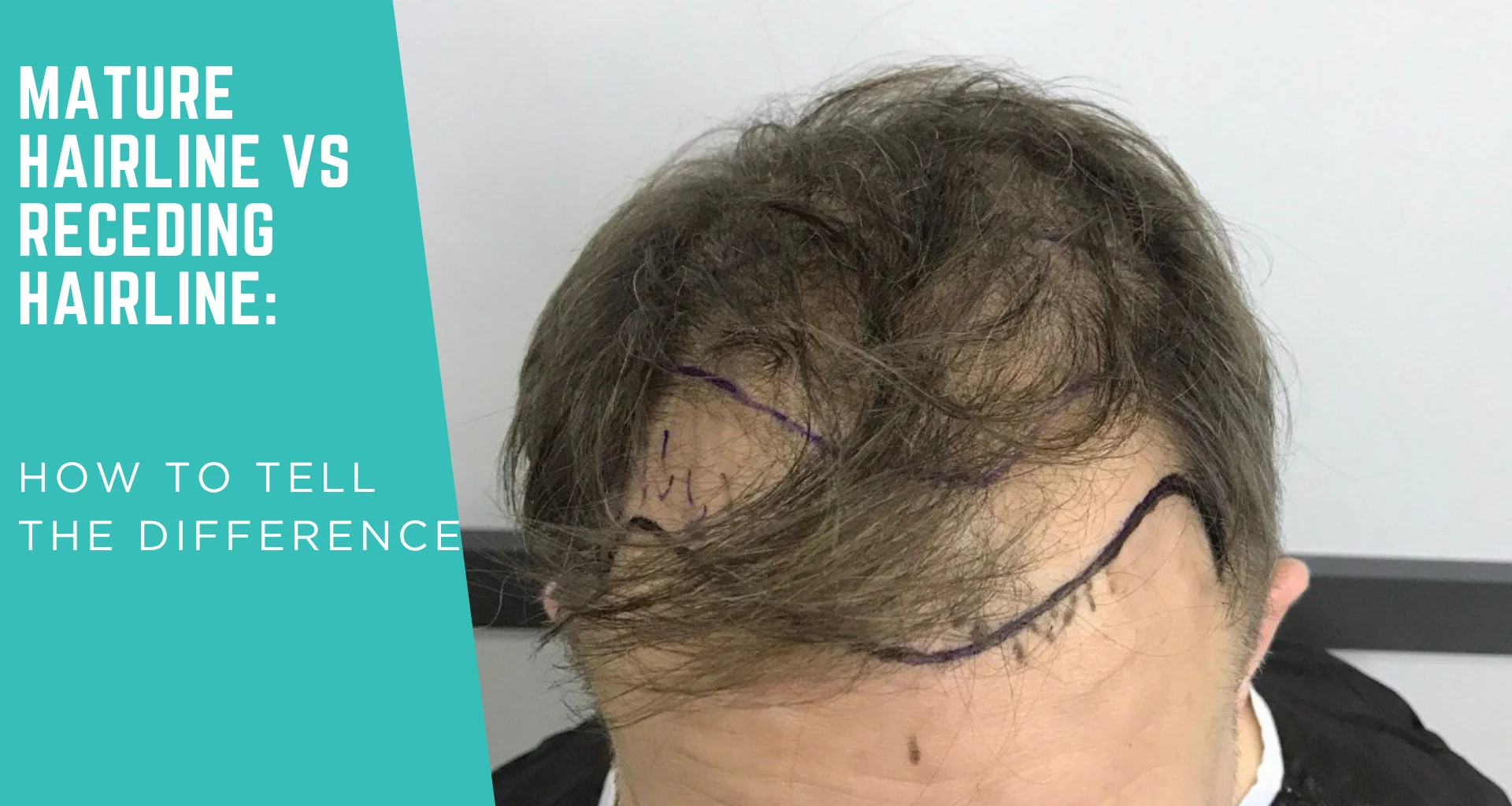

Your hairline has shifted. You have noticed it. Maybe someone else mentioned it. Maybe you caught it in a bathroom mirror under bad lighting and have been quietly thinking about it since.
Before you start comparing before and afters online or researching clinics, there is one thing worth knowing first: not every hairline change is hair loss. Most men’s hairlines move naturally in their 20s and then stop. That is called hairline maturation. It is normal. It is not a problem.
But some hairlines keep moving. And that is a different conversation entirely.
Here is how to tell which one you are dealing with.
| Not sure what you are looking at in the mirror?Our Medical Directors at UniquEra review photos and give honest assessments. No pressure. No sales pitch. Just a clear answer on where you stand and what, if anything, makes sense to do about it. Book a free consultation with UniquEra to find out. |
A mature hairline is a natural, one-time shift that happens to most men between their late teens and early 30s. It is not hair loss. It is hairline maturation. The hairline moves back slightly and then stays put.
• Subtle M or U shape at the temples.
• Even and symmetrical on both sides.
• Hair behind the hairline stays full and thick.
• Shift of roughly 1 to 1.5 cm from the juvenile hairline.
• No change year on year once it settles.
A mature hairline is not a warning sign. It is simply what an adult male hairline looks like.
A receding hairline is an early sign of male pattern baldness, or androgenetic alopecia. Unlike hairline maturation, it does not stop on its own.
The cause is a hormone called DHT. In men sensitive to it, DHT causes hair follicles to shrink and eventually stop producing hair — read our full breakdown of the science behind DHT hair loss.
• Temples are further back than they were 1 to 2 years ago..
• Temple corners are deepening, not stable.
• Front hair feels thinner, softer, or wispy.
• Scalp visible at the front under good lighting.
• Hairline looks different year on year, not just once.
| Cause | Detail |
| Genetics | Main driver. DHT sensitivity is inherited from either side of the family. |
| DHT hormone | Binds to follicles, causes shrinkage and miniaturization over time. |
| Stress | Can speed up existing loss but does not create male pattern baldness. |
| Nutrition | Deficiencies can accelerate loss in susceptible individuals. |
| Medications | Some medications trigger or worsen hair loss. |
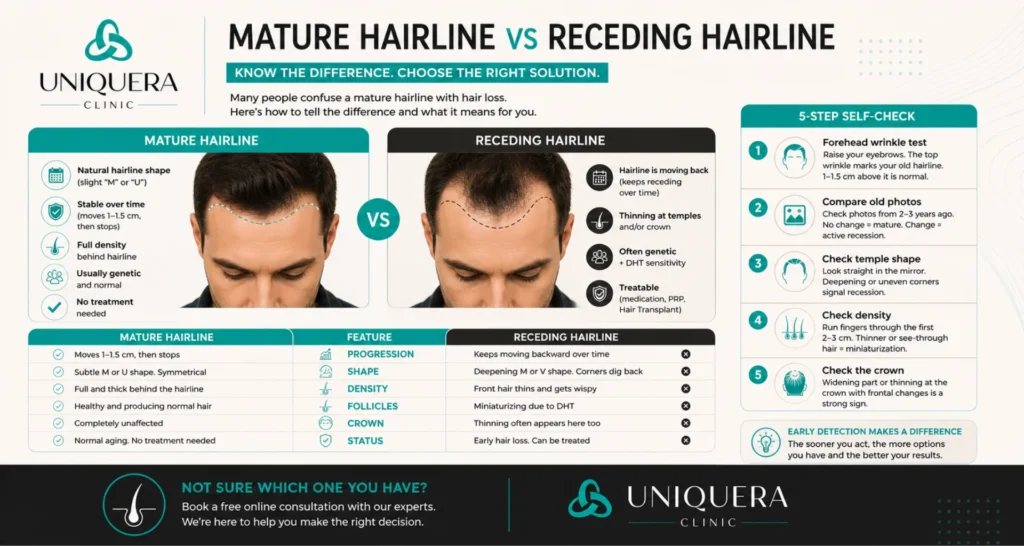
The clearest way to understand the difference between a mature hairline and a receding hairline is to look at what each one does over time.
| Feature | Mature Hairline | Receding Hairline |
| Progression | Moves 1 to 1.5 cm, then stops. | Keeps moving backward over time. |
| Shape | Subtle M or U. Symmetrical. | Deepening M or V. Corners dig back. |
| Density | Full and thick behind the hairline. | Front hair thins and gets wispy. |
| Follicles | Healthy and producing normal hair. | Miniaturizing due to DHT. |
| Crown | Completely unaffected. | Thinning often appears here too. |
| Status | Normal aging. No treatment needed. | Early hair loss. Can be treated. |
Use a good mirror, your phone camera, and a photo from 2 to 3 years ago.
1. Forehead wrinkle test. Raise your eyebrows. The top wrinkle marks your old hairline. A mature hairline sits about 1 to 1.5 cm above it. Further back than that points to recession.
2. Compare old photos. Look at your temple corners in photos from 2 to 3 years ago. A mature hairline does not shift year on year. Visible change means active recession.
3. Check temple shape. Press hair back and look straight at the mirror. Sharp, deep corners that are uneven side to side are a recession signal.
4. Check density behind the hairline. Run fingers through the first 2 to 3 cm. If it feels thinner than hair further back, or you can see scalp through it, follicles may be miniaturizing.
5. Check the crown. Use your phone to look at the top of your head. A widening part or soft patch there alongside frontal changes is a strong sign this is more than maturation.
Two or more flags, especially steps 3, 4, and 5? Get a proper assessment. Early loss is easier to address than loss that has been running for years.
| If two or more of those steps raised a flag, the window to act is now, not later. The longer you wait, the fewer options you have. Book a free consultation with UniquEra today. |
Yes. This is where many men get caught off guard.
A mature hairline and a receding hairline are not two types of people. They are two points on the same timeline. A stable mature hairline can begin receding years later if DHT sensitivity is in the genetics.
The Norwood scale tracks this hair loss progression:
| Norwood Stage | What it looks like |
| Stage 1 | Juvenile hairline. No recession. |
| Stage 2 | Mature hairline. Slight temple lift. Normal. |
| Stage 3 | First signs of actual hair loss. Clear temple recession. |
| Stage 4 to 5 | More temple and crown involvement. |
| Stage 6 to 7 | Significant loss. Both areas merging. |
Most men stop somewhere in the middle. But once recession starts, follicles do not recover without treatment.
Receding hairline treatment options fall into two categories.
| Type | What it does |
| Non-surgical | Slows or stabilizes active loss. Works best when follicles are still producing hair. Cannot restore bald areas. |
| Hair transplant | Restores density in areas already lost. Permanent results using donor follicles resistant to DHT. |
Non-surgical options include topical treatments, oral medications targeting DHT, and platelet-rich plasma therapy. These are available through dermatologists and specialist clinics.
When loss has moved past what non-surgical options can manage, a receding hairline transplant becomes the right conversation.
Three things need to be in place before a hair transplant for a receding hairline makes sense:
| Condition | Why it matters |
| Loss is stable | If surrounding hair is still falling, gaps can form around transplanted grafts. |
| Donor supply is healthy | All grafts come from the back and sides. Limited donor means limited options. |
| Realistic expectations | A transplant restores. It does not stop future loss in untreated areas. |
Men in their early 20s with fast, early recession are sometimes better served waiting. Operating into an evolving pattern creates problems later. The honest answer is sometimes: not yet.
Most receding hairline transplants need between 1,500 and 2,500 grafts. The exact count depends on depth of recession and donor density.
Hairline transplant before and after timeline:
| Timeline | What happens |
| Months 1 to 2 | Transplanted hair sheds. Normal. Called shock loss. Not failure. |
| Months 3 to 4 | New growth begins. Fine hairs emerge. |
| Month 6 | 50 to 60 percent of the final result visible. |
| Months 10 to 12 | Full density and texture. Hair can be cut and styled normally. |
At the front edge, single-graft follicles create a natural transition. Doubles sit behind for density. Triples further back for volume.
Istanbul is where most international patients now go for hairline restoration turkey. The reason is simple: experienced teams doing this work full time, at a fraction of the cost of the US or UK.
The cost difference is structural. Overheads in Istanbul are lower. The clinical quality, when the team is experienced, is not.
What to check before booking any hair transplant clinic turkey:
• Who designs your hairline?
• Who carries out extraction and implantation?
• What the follow-up process looks like after you return home?
The clinic matters more than the country. Quality varies significantly within Turkey.
UniquEra starts every receding hairline case with an honest timing assessment. If the pattern is still changing, the recommendation is sometimes to wait.
When the timing is right, here is how each case is handled:
| Step | What UniquEra does |
| Hairline design | Planned around your face shape and future loss pattern. |
| Technique | Chosen case by case based on your pattern and coverage needs. |
| Graft placement | Singles at front edge, doubles behind, triples into mid-scalp. |
| Oversight | Medical Directors supervise every case personally. |
| Coordination | VIP transfer, in-clinic stay, aftercare kit included. |
| Follow-up | Check-ins at 1, 3, 6, and 12 months after procedure. |
Patients travel to UniquEra from the US, UK, Canada, and across Europe. The same team that plans your procedure monitors your results through the full first year.
A mature hairline moves back slightly in your 20s and then stays put. A receding hairline keeps going.
The 5-step self-check gives you a starting point. Old photos, the wrinkle test, density behind the hairline, and the crown together give a clearer picture than any single observation alone.
If two or more checks raised concern, getting a proper assessment is the right move. Knowing what you are dealing with changes what your options are.
| Every month a receding hairline goes unaddressed, more ground is lost. Some of it can be recovered. Some cannot. The sooner you know, the more your options stay open. Book your consultation with UniquEra today. |
A receding hairline is the first visible stage of male pattern baldness, not the full condition. Not every man with early recession will progress to significant baldness.
There is no fixed age. Around 25 percent of men show early signs by 21. The most common window is late 20s to mid-30s. Genetics drives timing more than age.
Stress does not cause male pattern recession. It can trigger temporary shedding across the whole scalp, which is different. In men already predisposed, stress can accelerate existing loss.
You can slow it and sometimes stabilize it without surgery. Non-surgical receding hairline treatment works best when follicles are still active. It cannot restore areas already lost.
Most receding hairline transplants need 1,500 to 2,500 grafts. Mild recession sits at the lower end. Deeper temple loss and wider zones need more. Confirmed during a medical assessment.
DHI hair transplant Turkey gives precise angle control at the front edge. Sapphire FUE hair transplant Turkey suits larger coverage. Many cases combine both. The right choice depends on your specific pattern.
Growth starts at months 3 to 4. Around 50 to 60 percent is visible by month 6. Full density settles between months 10 and 12.
The transplanted grafts are permanent. They come from DHT-resistant donor zones. Native hair around them is not protected, so hairline design accounts for future loss progression.
Yes, when you choose a hair transplant clinic turkey with experienced practitioners directly involved in the procedure. The risk is not Turkey. It is choosing on price without checking who does the actual work.
Good candidates have a stable loss pattern, healthy donor supply, and realistic expectations. If loss is still fast-moving, waiting or combining with non-surgical support first is often better.
Yes. Most patients receive an initial assessment through photos and an online consultation before making travel plans.