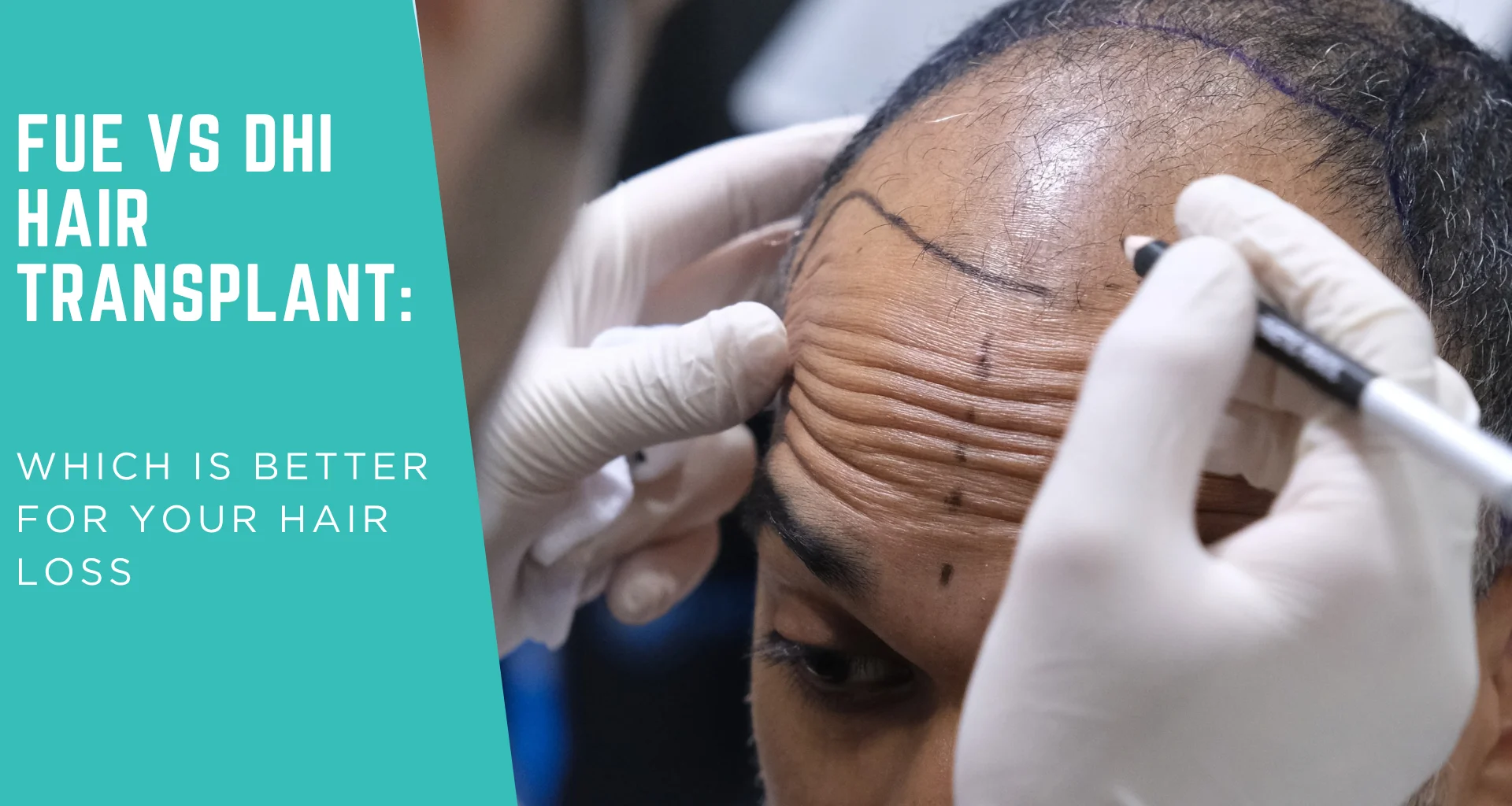

FUE vs DHI hair transplant is probably the first comparison you search when you start looking at clinics in Turkey.
Within an hour, you have read three articles, spoken to two clinics, and received three different recommendations. One says DHI. Another says, Another says, FUE Sapphire Hair transplant . A third says you need both.
Now you are more confused than when you started.
Here is something most of those articles skip: the answer is not as simple as most clinics make it sound. And the recommendation you receive often says more about the clinic than it does about your hair.
This article explains how both methods work, what the real differences are, and how the decision should actually be made.
| Not sure which method fits your case? Get a personalised hair analysis from UniquEra’s medical team before making any decision. |
The biggest myth is that DHI is the premium option and FUE is outdated.
This gets repeated constantly. Patients arrive having read that DHI is newer and assume choosing it automatically means a better result.
It does not.
Both techniques use the same extraction process. Follicles are removed one by one from the donor area in exactly the same way. The only difference is how those grafts are placed at the end.
A well-executed FUE will outperform a poorly planned DHI. The technique name is not what you should be evaluating.
FUE stands for Follicular Unit Extraction. It is the most widely used hair transplant method in the world.
The process has three steps:
1. Grafts are extracted one by one from the donor area at the back of the scalp.
2. A specialist opens tiny channels in the recipient area using a sapphire blade.
3. Grafts are placed into those channels using medical forceps.
The channel opening step is the most important part of the whole procedure. The depth, angle, and direction of each channel decide how natural the hair grows and whether the graft survives. It is done entirely by hand. No machine controls it.
Get the angle wrong, and the graft may not grow at all.
• The bald area is larger.
• A high number of grafts is needed, typically 2,000 to 5,000
• Broad coverage across the scalp is the main goal.
DHI stands for Direct Hair Implantation. It uses the same extraction as FUE . The difference comes at implantation.
Instead of opening channels first and placing grafts second, DHI combines both into one motion. A choi pen hair transplant device loads the graft and implants it directly, without pre-opening channels.
The person holding the pen controls direction, angle, and depth entirely through skill and feel. This makes the result completely dependent on the experience of whoever is doing it.
• The treatment area is smaller.
• Hairline refinement is the goal
• Existing native hair needs to be protected during implantation.
• A two-day procedure is needed. Because DHI skips the channel opening step, it causes less surface trauma. Higher graft sessions can be split safely across two days.
| Factor | FUE Sapphire | DHI Choi Pen |
| Extraction method | Same for both. | Same for both. |
| Implantation tool | Sapphire blade + forceps. | Choi pen. |
| Channel opening required | Yes. | No. |
| Best suited for | Larger bald areas, high graft count. | Smaller areas, precision work. |
| Existing hair protection | Good. | Excellent. |
| Two-day procedure | Not typical. | Yes, possible. |
| Procedure time | Faster. | Longer. |
| Typical cost | Lower. | Higher. |
| Recovery | Similar. | Similar. |
Both can produce natural, permanent results. This table shows technical differences only. It does not tell you which one is right for your case. That requires a proper evaluation.
This is the question nobody talks about. And it is the one that confuses patients most.
You consult three clinics and get three different answers. It feels like someone must be wrong.
Sometimes that is true. But often it comes down to something simpler: clinics recommend what they know best.
A clinic that runs DHI only has a team trained for DHI. Its entire workflow is built around one method. It is not going to recommend FUE. Not because FUE is wrong for you, but because DHI is all they do.
The same applies the other way around. High-volume FUE clinics are not pausing to assess whether DHI might suit your case better.
This is not always negligence. But it is a real pattern worth knowing before you book.
The question to ask any clinic:
“How did you decide this method is right for my specific case?”
If the answer does not involve reviewing your photos, assessing your donor area, and thinking about your long-term hair loss pattern, the recommendation is not patient-led.
| Already received conflicting advice from different clinics? Share your photos with UniquEra’s medical team for a clear second opinion. |
Which hair transplant method is better for your type of hair loss?
The right technique is not a general rule. It follows your specific situation. Here is how hair loss type typically maps to method.
DHI is usually preferred. The area is smaller, existing hair needs protection, and precise placement at the receding hairline hair transplant gives the most natural result.
The crown needs a higher number of grafts to achieve visible density. FUE Sapphire is often used here because of the volume required. Results also depend heavily on donor capacity.
Diffuse thinning hair transplant means hair is thinning across the scalp rather than receding in one area. DHI works well here because grafts can be placed between existing hairs without disturbing them.
For larger bald areas, FUE Sapphire is the standard approach. High graft counts are needed and FUE handles that volume more efficiently.
These are the most complex cases. The right technique depends on what was done before and what the donor area looks like now. An evaluation is always needed first.
Decision guide by hair loss type:
| Hair loss type | Typically recommended | Main reason |
| Receding hairline | DHI. | Precision, native hair protection. |
| Crown thinning | FUE Sapphire. | Higher graft volume needed. |
| Diffuse thinning | DHI or combination. | Placement between existing hair. |
| Advanced baldness | FUE Sapphire. | Broad coverage, high graft count. |
| Repair case | Evaluated individually. | Depends on previous work and donor. |
The same technique does not suit every patient. Here are three illustrative examples based on typical evaluation patterns.
A patient presenting with a slightly receding hairline and a healthy band of existing native hair would typically be evaluated for DHI. The area is smaller. The Choi pen allows precise placement between existing follicles without disrupting them. Graft count is moderate. Precision matters more than volume here.
A patient with significant baldness across the front and top of the scalp, and a strong donor area at the back, would typically be evaluated for FUE Sapphire. The coverage goal requires a high graft count. FUE handles that volume efficiently. Channel opening with a sapphire blade allows the team to control density and direction across a wider surface.
A patient with thinning distributed across the scalp and some crown loss may be evaluated for a combination approach. DHI is used where native hair needs protection. FUE Sapphire is used where broader coverage is needed. The split is decided by zone, not by a single technique preference.
These scenarios are illustrative, not prescriptive. Every case is evaluated individually. Donor quality, skin type, hair caliber, and long-term loss pattern all factor into the final recommendation.
Most comparison articles skip this part entirely.
Manual fue hair transplant vs DHI results are not decided by the technique name. They are decided by what happens at each step and who is doing it.
Donor quality. The donor area has a limited number of healthy grafts. How they are extracted and managed affects both your current result and your options for any future procedure.
Extraction precision. Around 10% graft loss during extraction is normal. More than that signals a problem. Grafts are fragile. They can be broken or dried out before they ever reach the scalp.
Channel quality in FUE. The channels opened by the sapphire blade decide hair direction and graft survival. Wrong angle or wrong depth means the graft does not grow. This step is entirely handmade.
Graft sorting and placement logic. Grafts come in single, double, and triple follicular units. Single grafts go at the hairline. Doubles sit behind. Triples go toward the crown for volume. Place a triple graft at the hairline, and the result looks unnatural. This sorting and placement requires experience and attention, not just technique.
Team consistency. The person who extracts should work in coordination with the person implanting. When different team members handle different steps without communication, quality drops.
The technique is the tool. The team using it is what determines your result.
Recovery is similar for both methods. DHI skips the channel opening step, which means slightly less surface trauma in some cases. In practice, most patients go through the same healing process regardless of technique.
| Timeline | What to expect |
| Days 1 to 7 | Redness, scabbing, and some tenderness in the donor and recipient area. |
| Week 2 | Scabs clear, sensitivity reduces. |
| Month 1 | Shock loss. Transplanted hairs shed. This is normal. |
| Month 3 | Early regrowth begins. |
| Month 6 | Visible density improvement. |
| Month 12 | Final result visible. |
DHI hair transplant recovery does not follow a noticeably different timeline to FUE. Both require the same aftercare: keep the scalp clean, avoid direct sun, do not touch the grafts in the first few days, and follow your clinic’s post-op instructions.
How quickly you heal depends on skin type, graft count, age, and how closely you follow aftercare guidance.
FUE hair transplant cost in Turkey is not determined by technique alone. Several factors affect what you pay and what that price actually covers.
| Cost factor | FUE Sapphire | DHI Choi Pen |
| Procedure time | Faster, lower labour cost. | Longer per graft, higher labour cost. |
| Tools used | Sapphire blade. | Choi pens (more expensive, disposable). |
| Graft range | Higher count may increase the cost. | Lower to moderate count. |
| Two-day option | Not typical. | May add cost for two-day sessions. |
| Typical price range | Lower. | Often higher. |
On fue transplant cost: a lower price on the same graft count does not mean the same result. The difference between a quality clinic and a high-volume operation shows in extraction precision, team experience, and how the donor area is planned and protected.
What you are paying for is not the equipment. It is the experience behind it.
The answer depends on your hair loss pattern, donor area, and what you are trying to achieve.
A patient with a slightly receding hairline and strong native hair: typically DHI. Smaller area, precision work, and existing hair protection.
A patient with advanced baldness across a large area: typically FUE Sapphire. High graft count, broader coverage, efficient procedure.
A patient with diffuse thinning and early crown loss: often a combination of both, decided by zone.
The best hair transplant method is the one recommended after a proper evaluation of your case. Not the one with the most marketing behind it.
UniquEra, considered the best hair transplant clinic in Istanbul, does not start with a technique. It starts with the patient.
Before any method is recommended, the medical team evaluates:
• The extent and pattern of hair loss.
• Donor area density and how much can be safely used now and in the future.
• Whether existing native hair needs to be protected.
• Whether a two-day procedure is appropriate for the case.
• What realistic density is achievable based on available grafts.
Medical Directors Dr. Atakan and Charu have over a decade of hands-on hair transplant experience and supervise every case. They have worked under the same leadership for years. The team assessing your case is the same team performing it.
UniquEra works exclusively in hair restoration. That focus means the team handles a depth and variety of cases that multi-service clinics rarely accumulate. The technique chosen for you follows what your evaluation shows, not what the clinic is optimized to deliver at volume.
Most new patients arrive through referrals. That pattern comes from consistent evaluation-first planning, not marketing.
FUE and DHI are both effective methods. Both can produce natural, permanent results. Both can also produce poor results when the planning is weak or the team lacks experience.
The technique is one variable in a longer list. What matters more is whether the clinic evaluated your case before recommending a method, whether the team has the experience to execute it well, and whether your donor area is being managed with your long-term hair loss in mind.
A clinic that starts with the technique and then fits you into it is working backwards.
| Ready to find out which method is right for your hair loss? UniquEra’s medical team will assess your case and give you a clear, honest plan. Book your consultation with UniquEra today. |
Neither is universally better. The right choice depends on your hair loss pattern, donor area, and coverage goals. A well-planned FUE can outperform a poorly executed DHI, and vice versa.
DHI takes longer per graft, costs more, and is not always suitable for large bald areas. The result depends heavily on the skill of the person using the Choi pen.
FUE requires a precise channel opening step that demands significant experience. In areas with existing native hair, there is a slightly higher risk of disruption compared to DHI.
Cost depends on the clinic’s experience level, technique used, what is included in the package, and the complexity of your case. Graft count alone does not set the price.
Most 2,500 graft FUE procedures are completed in a single day. Exact timing depends on your scalp and the clinic’s team workflow.
Visible healing takes around 7 to 14 days. New growth typically starts around months 3 to 4 and continues improving through month 12.
Transplanted hairs can remain permanent because they come from the donor area, which is genetically resistant to hair loss. Native hair that was not transplanted may continue to thin over time. This is why long-term planning at the time of the procedure matters.
Density depends on donor quality, graft count, and implantation technique. It is not decided by whether DHI or FUE is used.
Natural results come from hairline design, correct graft placement, and team experience. The technique itself is less important than the planning and execution behind it.
A qualified medical team evaluates the extent of hair loss, donor availability, existing hair density, and long-term goals before recommending a technique. The evaluation should always come before the recommendation.
Many patients can have a second procedure if the donor area was properly managed the first time. Poor donor management during the first session can limit future options significantly.
The best DHI hair transplant in Turkey comes from a clinic that chooses the technique based on your evaluation, not one that applies it to every patient by default. Consistent medical teams, careful donor management, and honest consultations are the real markers of quality.