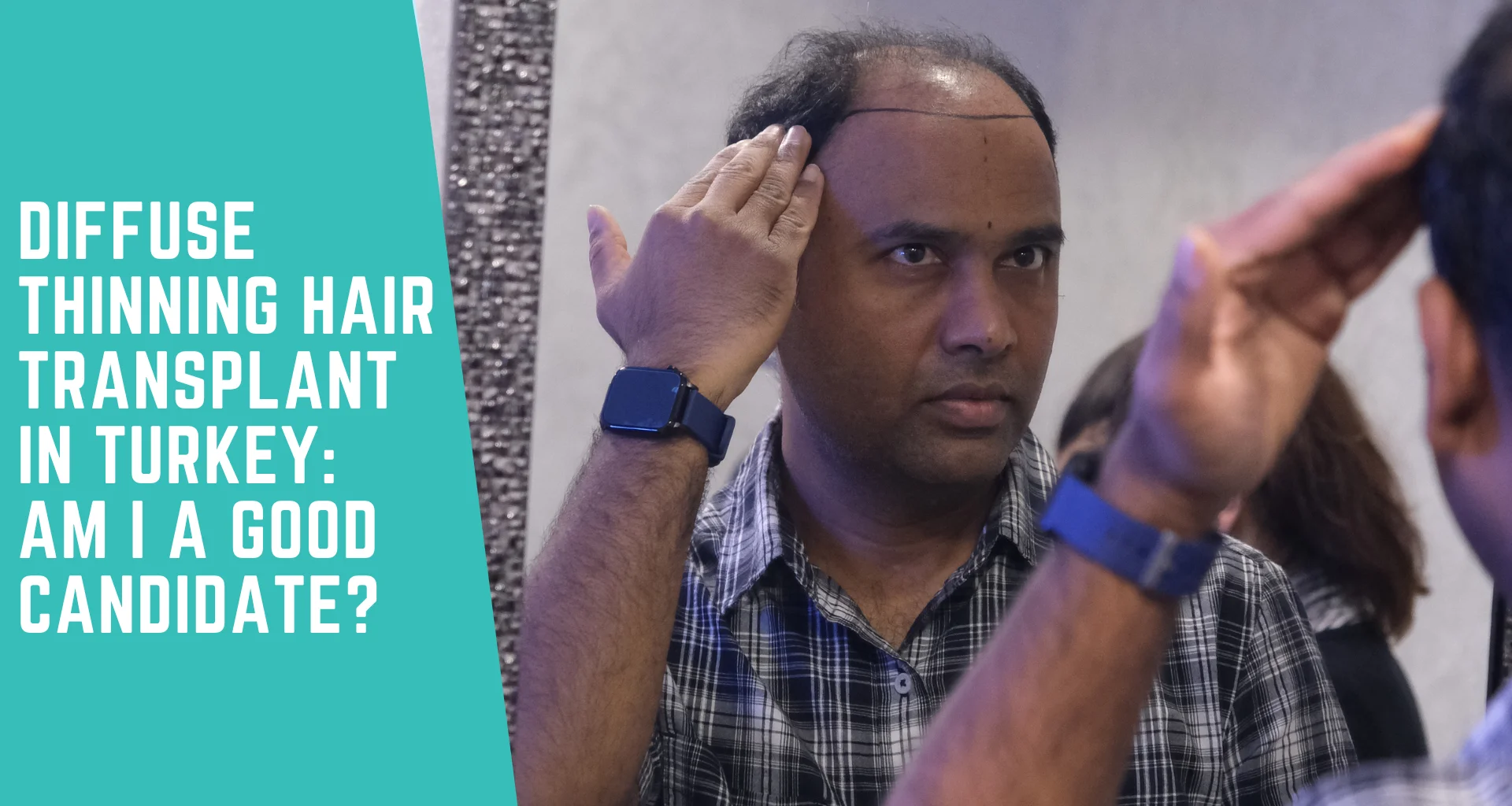

Diffuse thinning hair loss feels different from regular baldness. There is no single bald patch. Hair is still there, but less of it everywhere at once. The scalp shows through more. Photos look different.
The question most people arrive at is a practical one: can I actually get a hair transplant, or is my case too complicated?
Some diffuse thinning patients are excellent candidates. Others are not ready yet. The difference comes down to three things: your donor area, your hair loss stability, and the type of diffuse thinning you have.
Many people assume they are candidates because they still have hair. Others assume they are not because they can see their scalp.
Both assumptions are often wrong.
A donor assessment can reveal whether your thinning is transplantable, whether your donor area is strong enough, and whether waiting could reduce your future options. Send your photos to UniquEra team for a free candidacy assessment.
Diffuse thinning looks like an overall reduction in hair density across the scalp, with no single bald patch. Hair is still present but visibly finer and thinner everywhere at once.
• No clear receding line or bald zone – just reduced density overall
• Scalp becomes visible under normal lighting or in photos.
• Hair feels finer and looks flatter over time
• Often dismissed as normal aging until the thinning becomes significant.
By the time most people look into a hair transplant consultation in Turkey, the thinning has already been progressing for years. Our detailed guide on diffuse thinning and how it differs from other hair loss explains the pattern in full.
You are likely a candidate if your donor area is still dense, your hair loss has been stable for at least 12 months, and you have no active medical cause for shedding.
• My hair at the back and sides still looks reasonably dense.
• My thinning has not changed much in the last 12 months.
• I am not experiencing sudden rapid shedding right now.
• I have no undiagnosed medical condition causing my hair loss.
• I understand a transplant adds density, not full restoration.
If most of these apply, you are worth assessing. If several do not, read the section on what stops someone from being a candidate first.
Yes, many diffuse thinning patients can get a hair transplant. But the type of diffuse thinning matters more than the amount of hair lost.
There are two types. One typically makes you a good candidate. The other usually does not. The difference is whether your donor area is also affected.
DPA patients can usually get a hair transplant. DUPA patients usually cannot, because the donor area is also thinning and cannot supply stable grafts.
| Question | DPA | DUPA |
| Donor area stable? | Yes | No |
| Good transplant candidate? | Usually yes | Usually no |
| Long-term graft survival? | Strong | Uncertain |
DPA (Diffuse Patterned Alopecia): hair thins across the top and crown. Back and sides stay dense. Grafts from that area are permanent. Surgery works well.
DUPA (Diffuse Unpatterned Alopecia): thinning affects the entire scalp, including the back and sides. The donor area is also affected. Grafts may not last long-term.
You cannot tell which type you have from a mirror. Trichoscopy at a hair transplant clinic in Turkey confirms it.
DPA and DUPA Can Look Almost Identical in the Mirror.
One is usually a good transplant candidate. The other often is not. The difference cannot be confirmed from photos alone. Find out which type you have before committing to surgery.
These are the five signs that suggest you are likely suitable for a diffuse thinning hair transplant in Turkey.
• 1. Your donor area at the back and sides looks dense.
• 2. Hair loss has been stable for at least 12 months.
• 3. You have DPA, not DUPA.
• 4. No active medical condition is causing your hair loss.
• 5. You want improved density, not full volume restoration.
These are the five signs that surgery is not the right step yet.
• 1. Your hair is still shedding rapidly.
• 2. You are under 25, and your pattern is still changing.
• 3. Thinning has spread to your back and sides too.
• 4. A medical cause like thyroid or iron deficiency, has not been treated.
• 5. Your donor area was already used in a previous procedure.
You are a good candidate if your donor area is healthy, your hair loss is stable, and your expectations match what a transplant can realistically deliver.
The donor area is the hair at the back and sides of your scalp. Grafts taken from here must be permanent after transplant.
Diffuse thinning male patients with a stable, dense donor area are among the most suitable for hair transplant for diffuse thinning. A trichoscopy scan measures donor density objectively and detects miniaturisation — when follicles are shrinking but not yet gone. This is the most important piece of information in the whole assessment.
Has my hair loss stopped or slowed down?
If you are still in an active shedding phase, adding grafts now risks an uneven result as surrounding hair continues to thin. Most clinics want 12 to 24 months of stability before recommending surgery.
A transplant adds density. It does not restore the full volume from years ago. Patients who understand this evaluate their results clearly and are far more satisfied with the outcome.
Being told you are not a candidate yet is not the end. It usually means the timing is wrong, not that surgery will never happen.
• DUPA pattern confirmed — donor area is also thinning, cannot supply stable grafts.
• Hair loss still progressing quickly — surgery in this phase risks poor long-term results.
• Under 25 — pattern still evolving, better to wait for stability.
• Underlying medical cause not yet identified or treated.
• Donor area already depleted from a previous procedure.
Real patient examples: who qualifies and who does not
Here are three scenarios that show how candidacy decisions are made for diffuse thinning cases.
• Age 32, crown and mid-scalp thinning
• Back and sides dense, DPA confirmed by trichoscopy
• Loss stable for 18 months, no active medical cause
• Plan: 2,000 to 2,500 grafts using DHI hair transplant Turkey.
• Outcome: suitable candidate, single session plan
Patient B: not ready yet
• Age 28, rapid shedding ongoing
• DUPA pattern — back and sides also showing thinning
• Medical cause not yet identified
• Surgery deferred — PRP recommended to support existing hair while medical cause is investigated
Patient C: staged approach
• Age 41, widespread diffuse thinning across the crown and full top
• Donor area is healthy but limited supply
• DPA confirmed, loss stable
• Plan: 2,500 grafts in session one, reassessment at 12 months for session two
• Outcome: good candidate for a planned two-session approach
Many patients who are advised to wait eventually become excellent candidates after their pattern stabilizes or an underlying issue is addressed.The key is identifying the reason early. Get a professional assessment before making assumptions about your options.
A hair transplant can cause temporary shock loss of nearby hair, but this resolves within a few months and is not permanent. Damage to existing follicles is very rare when the technique and team are right.
What matters more for diffuse thinning cases is how surgery is planned. Because the thinning zone still contains living follicles, the team must work between them carefully.
• Implantation must be placed with greater precision than in standard cases.
• Channel depth and angle must avoid disrupting nearby follicles.
• The technique chosen directly affects how much existing hair is at risk.
DHI hair transplant in Turkey is generally the safer choice when existing hair is still present. The Choi pen places each graft directly with no pre-cut channel, which reduces disruption to native hair around the placement point.
Why is diffuse thinning harder to plan than regular baldness?
Diffuse thinning is harder to plan because there are no clear empty zones. The recipient area still has living hair, the donor area may look fine but measure lower than it appears, and every decision carries more risk than a standard case.
• Conservative extraction needed to protect the donor area long-term.
• Grafts placed between existing follicles — higher precision required.
• Graft counts are more conservative — a staged plan is often safer than one large session.
• Technique must protect living follicles in the recipient zone, not just fill space.
This is why not every hair transplant clinic in Turkey handles diffuse thinning well. These cases demand more planning, more precision, and more experience than standard transplants. Knowing the red flags when choosing a hair transplant clinic in Turkey is especially important for complex cases like diffuse thinning.
DHI is generally better for diffuse thinning cases where existing hair is still present. FUE Sapphire is used when thinning zones are broader, and there is less remaining hair to work around.
| DHI (Choi Pen) | FUE Sapphire | |
| Best for | Areas with existing hair are still present. | Larger, more open thinning zones. |
| How it works | Direct graft placement, no pre-cut channel. | Sapphire blade opens channel first, graft placed with forceps. |
| Shaving | Minimal or none in eligible cases. | The donor area is usually shaved. |
| Risk to existing hair | Lower — no open channel near the graft. | Slightly higher in dense native areas. |
| At UniquEra | Preferred for diffuse with retained hair. | Used for advanced diffuse with broader bare zones. |
Many diffuse cases use a combination of both techniques in the same session. DHI, where native hair needs protection. Sapphire FUE hair transplant in Turkey, where thinning is more advanced.
Choosing between DHI and FUE Sapphire is not something you need to figure out on your own. We assess your scalp first and recommend the technique based on what we actually see, not what is easier to perform. If you want to know which approach fits your case, a consultation with UniquEra is the right next step.
How many grafts do you need for diffuse thinning?
Most diffuse thinning cases need between 1,500 and 4,500 grafts, depending on the area affected and current density.
| Area of thinning | Approx. graft range | Notes |
| Crown only | 1,500 to 2,500 | Often single session |
| Crown and mid-scalp | 2,500 to 3,500 | May be staged |
| Full top of scalp | 3,000 to 4,500 | Usually staged |
| Widespread diffuse | Assessed per case | Highly individual |
Most diffuse cases are planned across two sessions 12 to 18 months apart. This protects the donor area long-term rather than depleting it in one sitting.
Diffuse thinning caused by androgenetic alopecia cannot be fully reversed without a hair transplant. Non-surgical options like PRP can slow the process and support existing follicles, but they do not restore lost density permanently.
For patients not yet at the surgical stage, non-surgical support options exist as a bridge:
• PRP (Platelet-Rich Plasma) — uses growth factors from your own blood to slow shedding and support follicle health. One of the more common diffuse hair loss treatments is used before surgery.
• Stem cell scalp therapy — used at some clinics for patients with weakened but still-active follicles
The best treatment for diffuse thinning depends on whether your donor area is ready for surgery. UniquEra does not recommend specific medications. The team advises honestly on whether surgery is right for you now, or whether another approach makes more sense first.
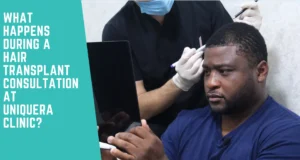
A hair transplant consultation in Turkey for diffuse thinning covers four things: a remote photo review, an in-person scalp evaluation, a trichoscopy scan, and a full graft and staging plan.
Send clear photos from all angles: top, crown, sides, back. The team gives an initial read before you book anything. Photos cannot confirm candidacy, but they can rule out obvious non-candidates.
A full medical review on arrival. Not a brief handshake before surgery. This is where DPA vs DUPA is confirmed and the donor area is properly assessed.
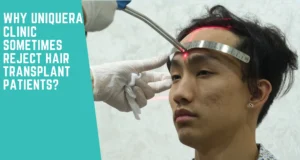
Trichoscopy is a magnified scalp scan. It measures follicle density and detects miniaturisation in the donor zone — the single most important piece of data for diffuse thinning candidacy.
The team reviews how long your pattern has been stable, family history, and medical factors. From this, they build a graft count, technique recommendation, and staging plan if needed. Your plan is built from your assessment, not a package menu.
UniquEra evaluates every diffuse thinning case with trichoscopy first, donor mapping second, and technique selection third. Nothing is recommended before the scalp is properly assessed.
Assessment process:
• Trichoscopy scan to check donor density and detect miniaturisation.
• Full donor mapping to confirm how many grafts can be safely extracted.
• DPA vs DUPA confirmation before any surgical discussion.
• Staging plan built if donor supply needs to be managed across two sessions.
How the procedure is handled:
• Channel opening is done entirely by hand. Manual hair transplant Turkey cases at this level require it. The angle and depth of each channel determine whether surrounding follicles survive.
• DHI hair transplant in Turkey is used when existing hair in the recipient area needs to be protected.
• Sapphire FUE hair transplant in Turkey is used for more advanced diffuse cases with broader bare zones
• Both techniques are available under one roof. The choice is based on your scalp, not a price tier.
What makes the difference:
• Medical Directors with over a decade of hands-on hair transplant experience, supervising each case.
• Limited cases per day — luxury hair transplant Turkey at UniquEra means full senior team attention on each patient.
• No fixed packages — your plan is built from your assessment results, not selected from a menu.
• If you are looking for the best hair transplant clinic in Turkey for diffuse thinning, ask any clinic how they handle staging and donor protection. That question separates serious clinics from volume operations.
The honest answer to “Am I a candidate?”
Diffuse thinning hair transplant in Turkey works well for the right patients. It requires a stable donor area, a pattern that is not still actively progressing, and expectations that match what surgery delivers.
If those three things are in place, surgery is a realistic path. If one is not, the right move is finding out why and addressing it first. That is good planning, not failure.
Every month of delay is another month of ongoing thinning. The earlier the assessment happens, the more options remain on the table.
Diffuse thinning is one of the few hair loss patterns where timing can change what is possible later.A proper assessment tells you whether you are a candidate now, whether you should wait, or whether another approach makes more sense first. Book your free diffuse thinning assessment with UniquEra.
Frequently Asked Questions
Yes, when the donor area is healthy and the plan is realistic. A transplant adds meaningful density. Most DPA patients see significant improvement after a planned one or two-session procedure.
Yes. DPA has a stable donor area, while DUPA affects the donor area too, making surgery much less predictable.
Clinics use trichoscopy to measure donor density and detect follicle miniaturisation before recommending surgery.
Most cases need between 1,500 and 4,500 grafts, depending on donor density, scalp size, and the area affected. .
Not necessarily. Whether 3,000 grafts is appropriate depends on your donor supply and treatment goals.
DHI is preferred when existing hair needs to be protected. FUE Sapphire is used for more advanced thinning with broader bare zones. Many diffuse cases use both techniques in the same session.
Androgenetic diffuse thinning does not reverse on its own. PRP and other non-surgical diffuse hair loss treatments can slow progression and support follicle health, but are not a permanent fix.
Not always. The rate and final extent depend on genetics and whether treatment starts early. DPA tends to progress more slowly and predictably than DUPA.
A trichoscopy scan measures density and detects miniaturisation. If your back and sides look similar to several years ago, that is a positive sign. Only a proper assessment confirms it.
Yes, at established clinics with a qualified team and a verifiable track record. Turkey has some of the most experienced hair transplant teams in the world.
Turkey typically offers comparable outcomes at significantly lower cost. The concentration of high-volume, experienced teams in Istanbul means diffuse thinning cases are treated regularly, not occasionally.
Most patients fly home 3 to 5 days after surgery. Plan around a week in Istanbul to cover the procedure and initial recovery. Your clinic will confirm the exact timing based on your healing progress.