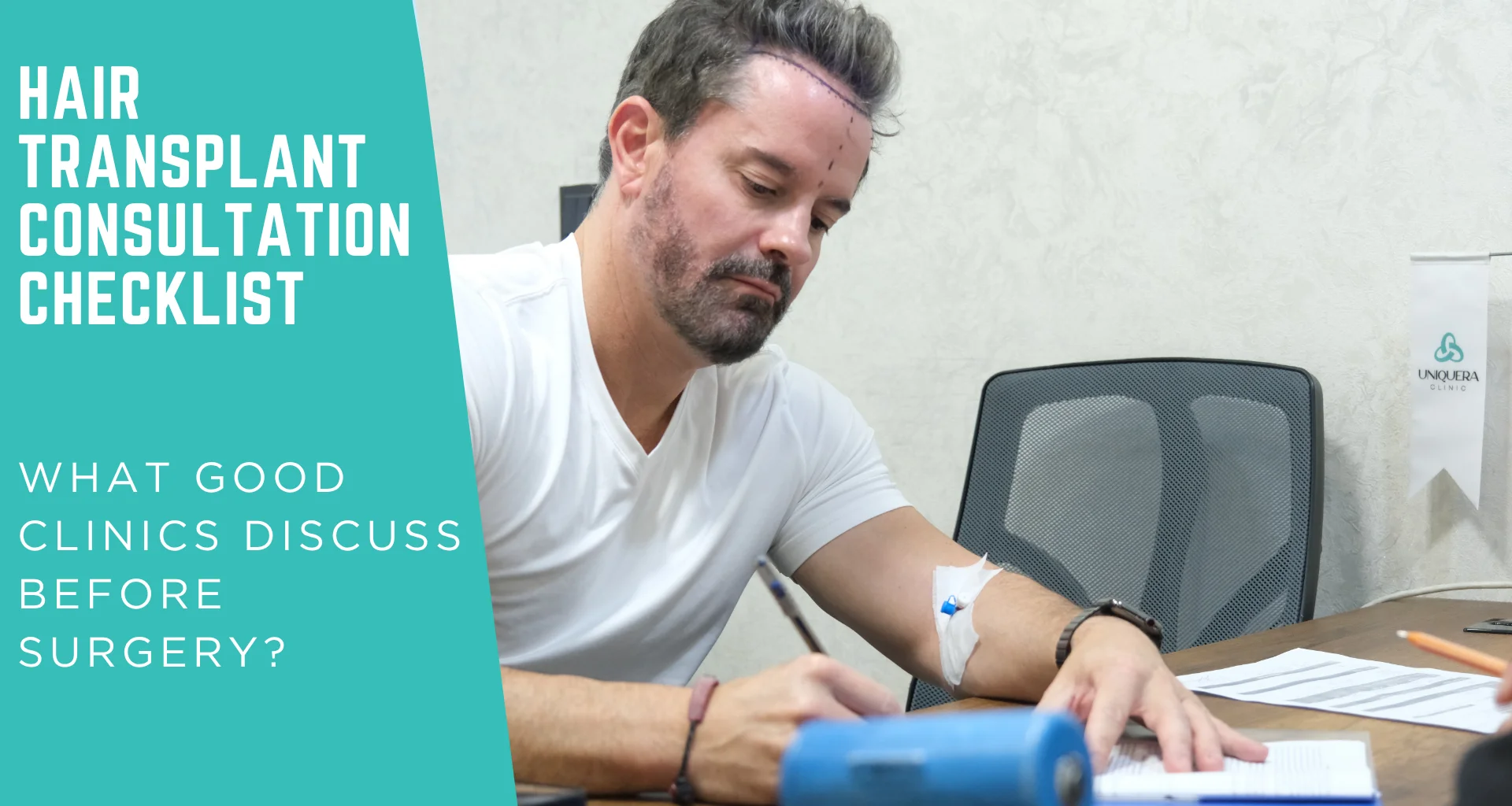

Hair transplant consultation is where your entire procedure gets planned. Most patients do not know that. They go in thinking they will get a quote. They come out with a number and a date. No one asked about their hair loss history. No one checked if they were ready. That is not a consultation. That is a booking call.
The difference matters more than most people realise. If a clinic skips the right steps before surgery, those gaps do not disappear. They show up in the result.
This checklist covers what good clinics actually discuss before surgery. Use it to evaluate any clinic you speak to, including ones in Istanbul. If they cover all of these points, you are in the right hands. If they skip most of them, that tells you what you need to know.
| Understand Your Hair Before You Decide on Surgery. The quality of your consultation shapes every decision that follows, from graft count to hairline design and long-term results. At UniquEra Clinic, every consultation begins with understanding your hair loss, donor area, and future goals before any treatment is recommended. Book your consultation and receive a personalised treatment plan built around your case. |
A hair transplant consultation is a structured medical assessment. It is not a sales pitch. What happens during a hair transplant consultation at a good clinic follows a clear order: first the clinic evaluates you, then it makes recommendations. The order matters. Recommendations that come before evaluation are not medical advice.
Here is what a complete consultation covers:
• Medical candidacy: whether you are a good candidate right now.
• Hair loss diagnosis: what is causing it and whether it is stable.
• Donor area analysis: what your scalp can realistically supply.
• Graft calculation: how many grafts your case requires.
• Hairline design: what is appropriate for your face and your future.
• Technique selection: DHI, sapphire, or manual FUE based on your case.
• Hair transplant expectations: what results look like, and when.
• Written treatment plan: confirmed in writing before any payment.
If a clinic you spoke to skipped more than two of these, that is worth knowing before you decide anything.
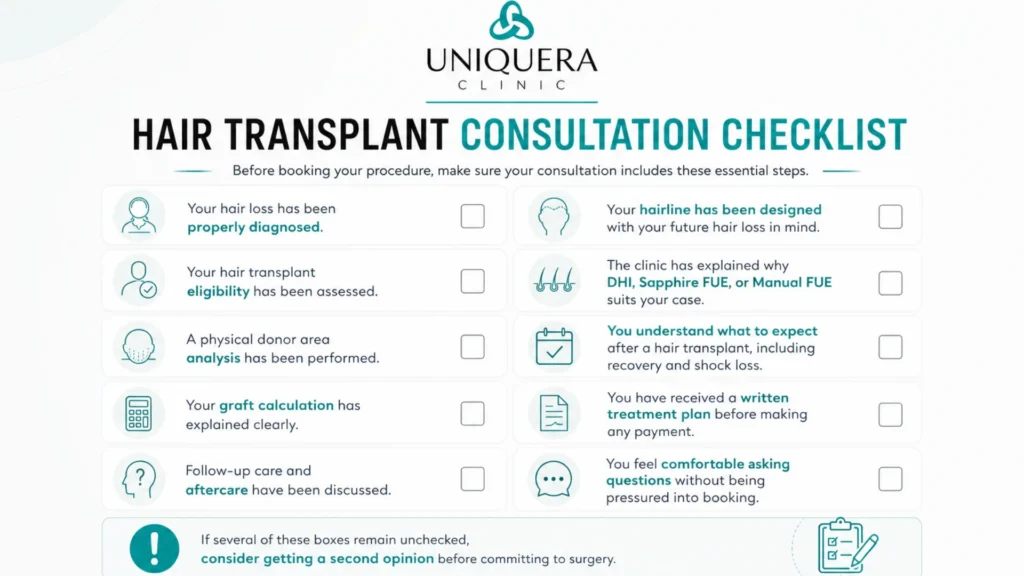
Before booking your procedure, make sure your consultation includes these essential steps.
✓ Checklist Item
| Your hair loss has been properly diagnosed. |
| Your hair transplant eligibility has been assessed. |
| A physical donor area analysis has been performed. |
| Your graft calculation has been explained clearly. |
| Your hairline has been designed with your future hair loss in mind. |
| The clinic has explained why DHI, Sapphire FUE, or Manual FUE suits your case. |
| You understand what to expect after a hair transplant, including recovery and shock loss. |
| You have received a written treatment plan before making any payment. |
| Follow-up care and aftercare have been discussed. |
| You feel comfortable asking questions without being pressured into booking. |
If several of these boxes remain unchecked, consider getting a second opinion before committing to surgery.
Hair transplant eligibility is the first thing a good clinic evaluates. Not every patient who wants a hair transplant should have one right now. Good clinics are honest about that.
The candidacy check covers four things:
Before anything else, a responsible clinic runs basic blood tests. At UniquEra, this includes checks for HIV, Hepatitis B and C, blood glucose, and other markers that affect surgical safety. These are non-negotiable. They happen before any procedure is planned. They also rule out conditions that could affect healing or graft survival.
Hair loss diagnosis tells the clinic what they are working with. Androgenetic alopecia (genetic hair loss) behaves differently from alopecia caused by stress, thyroid issues, iron deficiency, or medication. The cause affects both candidacy and technique.
Active, fast-moving hair loss is often a reason to wait. If the pattern is still shifting, operating into it creates a result that looks unnatural within two or three years. A clinic that never raises this is skipping one of the most important questions in the assessment.
Patients under 25 require careful planning. Hair loss patterns at this stage are often still changing. A hairline designed for a 22-year-old who continues to lose hair in his 30s may look completely out of place a decade later.
Good clinics look at your family history, your current Norwood stage, and how fast your loss is progressing. They use that to plan conservatively, protecting donor supply for the future rather than overspending it now.
Donor area analysis is the most important part of the physical assessment. Your donor area is the zone at the back and sides of your scalp where grafts come from. This is the raw material for your entire procedure.
The clinic examines the density, caliber, curl pattern, and health of follicles in your donor zone. At experienced clinics, this is done through direct physical examination. In advanced cases, tools like trichoscopy can magnify the scalp to assess follicle health at a level the naked eye cannot see. This step determines how many healthy grafts are available.
On average, a healthy donor area has 80 to 100 follicular units per square centimeter. Most patients have a lifetime supply of roughly 5,000 to 7,000 grafts available across all sessions. Once those grafts are used, there are no more.
This is why clinics that promise 5,000 or 6,000 grafts in one session without examining the donor area first are a red flag. They may be overharvesting, which causes visible thinning at the back and cannot be reversed.
A clinic with good standards will assess donor density first and tell you honestly what your case can support. Sometimes that number is lower than what the patient hoped for. That is a clinic protecting your long-term result.
Graft calculation is not guesswork. It comes from combining three things: the size of the area to be covered, the desired density, and the donor supply available. These numbers meet in the middle.
The Norwood scale helps estimate the coverage required. A Norwood Stage 3 patient typically needs 1,500 to 2,500 grafts. Stage 5 can require 3,500 to 5,000. But these are starting points, not fixed numbers. Hair caliber, curl, color contrast with the scalp, and individual donor density all shift the final figure.
Any specific graft count given before a physical scalp examination is an estimate at best. Good clinics tell patients this clearly.
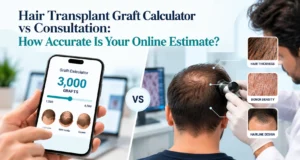
Online photo assessments can give a rough ballpark. They cannot confirm donor density, detect miniaturization, or spot early diffuse thinning. Studies suggest photo-based estimates are accurate only 40 to 60 percent of the time. In-person physical assessments reach 90 to 95 percent accuracy.
At the consultation, the graft count should be explained in terms of what it will cover, what density it achieves, and whether a second session might be needed later as hair loss progresses. If a clinic gives you a number without explaining the reasoning behind it, ask them to walk through how they arrived at it.
| Norwood Stage | Approximate Graft Range | Key Consideration |
| Stage 2 to 3 | 1,000 to 2,000 grafts | Early recession. Conservative planning protects future donor supply. |
| Stage 3 to 4 | 2,000 to 3,000 grafts | Hairline and mid-scalp. Technique choice matters here. |
| Stage 4 to 5 | 3,000 to 4,500 grafts | Larger coverage. Donor density assessed carefully. |
| Stage 5 to 6 | 4,000 to 6,000 grafts | May require two sessions to protect donor zone. |
Table: Approximate graft counts by Norwood stage. Final numbers confirmed after physical donor area assessment only.
Hairline design is a visible, long-term decision. It is also the step most patients spend the least time thinking about in the consultation.
A well-designed hairline accounts for three things:
• Your current face shape and proportions so the result looks natural now..
• Your projected future hair loss so the line does not look isolated as surrounding hair thins.
• Age-appropriate positioning so the result ages well over the next 10 to 20 years.
A clinic that rushes past hairline design, or lets the patient set the line without clinical input, is skipping the most important aesthetic decision of the procedure. The hairline is permanent. It needs to be designed by someone who understands how hair loss progresses, not just where it currently sits.
At the consultation, the proposed hairline should be drawn on your scalp with a marker. You and the medical team should agree on it in writing before you go into the operating room.
Technique selection should be a medical decision. It should come after your scalp has been assessed, your donor area evaluated, and your coverage goals understood. If a clinic tells you which technique they use before examining you, that is the wrong order.
Here is how each technique applies to different cases:
DHI hair transplant uses a Choi pen to extract and implant in a single step. There is no pre-opened channel. This means less tissue trauma and more precise angle control at the hairline. DHI hair transplant in Istanbul is often chosen for hairline work, smaller recipient areas, and patients who need density in areas with existing hair that should not be disturbed.
DHI also allows two-day procedures for higher graft counts, since the donor area recovers faster between sessions without the open channel step.
Sapphire FUE uses blades tipped with synthetic sapphire to open recipient channels before implantation. The blade creates very fine channels with minimal trauma. This approach works well for larger coverage areas: full crown restoration, wide hairline reconstruction, or mid-scalp density in advanced cases. Sapphire hair transplant is one of the most commonly performed approaches at premium Istanbul clinics.
Manual FUE hair transplant uses hand-operated extraction tools. In experienced hands, this gives precise control over individual follicle extraction, which matters in patients with tightly packed donor zones or unusual follicle angles. Manual hair transplant in Turkey is used when extraction precision is the priority, often in combination with DHI or sapphire implantation.
Most cases do not require just one technique. A patient with a sparse hairline and a thinning crown might use DHI for the front and sapphire for the crown. The right clinic recommends based on your case, not on what their team does by default.
| The Best Technique Is the One That Fits Your HairDHI, Sapphire FUE, and Manual FUE all have different strengths. The right choice depends on your donor area, hair loss pattern, and long-term goals.At UniquEra Clinic, we recommend the technique that suits your scalp, not a one-size-fits-all approach. Book your consultation to receive a treatment plan designed specifically for your case. |
What should a clinic tell you about hair transplant expectations and recovery?
Hair transplant expectations are set in the consultation, not after surgery. A clinic that avoids this topic is leaving patients unprepared for the months between the procedure and the result.
The first two weeks involve scabbing, redness, and mild swelling at the recipient area. This is normal.
Weeks two to four: the transplanted hair sheds. Learn more about what is shock loss after a hair transplant and why it looks like the transplant has not worked, when it actually has. It has. The follicles are resting before they re-enter the growth phase. This is one of the most common reasons patients panic unnecessarily after surgery.
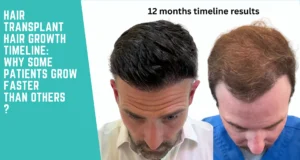
Months three to four: new hair begins to emerge. It is often fine and sparse at first.
Month six: around 50 to 60 percent of the final result is visible.
Months ten to twelve: full density settles. Hair can be cut, styled, and treated normally.
Good clinics also explain:
• That transplanted hair is permanent but native hair around it can continue to thin.
• That a second session may be needed later as loss progresses.
• What shock loss looks like and when it ends?
• When to contact the clinic if something looks unusual?
• The full aftercare plan, including products, washing schedule, and follow-up appointments.
Knowing what a good consultation covers also means recognising when one is missing the mark. Here are the clearest warning signs:
| Red Flag | What It Signals |
| Technique recommended before seeing your scalp | The clinic applies a default, not a clinical decision specific to you. |
| Graft count given from a photo alone | Without physical assessment, this number has very low accuracy. |
| No discussion of candidacy or timing | The clinic is not evaluating you. It is selling to you. |
| Outcome guarantees | No ethical clinic guarantees results. Hair transplant outcomes depend on biology, not promises. |
| High graft count as a selling point | Clinics pushing volume without donor limits risk overharvesting your donor zone permanently. |
| No written treatment plan before payment | Anything agreed verbally can change. A good clinic documents everything in writing. |
| No follow-up plan discussed | Recovery requires structured aftercare. A clinic that skips this conversation skips the recovery too. |
What Does a Consultation Look Like at UniquEra Clinic?
At UniquEra Clinic, the consultation is designed to answer one question before anything else: what is the right treatment for your hair, not what procedure can be sold.
Your journey begins with a video consultation and photo assessment. An experienced medical consultant reviews your hair loss history, goals, and scalp condition before preparing a written treatment plan.
Instead of receiving only a quotation, you receive a clinical report outlining the initial diagnosis, recommended approach, and the next steps. This gives you time to review everything and ask questions before making any commitment.
After arriving in Istanbul, blood tests are completed before the consultation with UniquEra’s Medical Directors, who have more than a decade of hands-on hair transplant experience.
During this assessment, your donor area is examined, graft count is confirmed, your hairline is designed, and the most suitable technique is finalised. Every recommendation is documented in writing before the procedure begins.
As part of the VIP hair transplant Turkey experience, international patients receive airport transfers, English-speaking support, hotel coordination, a clinic aftercare kit, and structured follow-up at one, three, six, and twelve months.
Many patients come to UniquEra after consultations that focused on price rather than planning. The difference is simple: the treatment plan comes before the procedure.
A good hair transplant consultation covers a specific set of clinical steps. It is not a price discussion. It is a full medical assessment that results in a written plan, a realistic timeline, and an honest answer about whether you are ready for surgery right now.
Use this checklist when you speak to any clinic. If they address every point above, you are in the right place. If key items are missing, especially candidacy, donor area analysis, and hairline design, ask why before you commit to anything.
The clinics that produce the best long-term results are the ones that are willing to slow down at the consultation stage. That is where the outcome is actually determined.
| Every Successful Hair Transplant Starts With the Right Plan. Your consultation should leave you with a clear understanding of your hair loss, donor capacity, treatment options, and realistic expectations for the future. Book your consultation with UniquEra Clinic and receive a personalised assessment and written treatment plan before taking the next step. |
A hair transplant consultation is a medical assessment that determines whether you are a good candidate for surgery, how many grafts you need, and what technique suits your case. It is not a price meeting.
The clinic assesses your hair loss diagnosis, checks medical candidacy, analyses the donor area physically, estimates graft count, designs the hairline, and recommends a technique. A written treatment plan is produced at the end.
Ask who carries out the physical assessment, how the graft count was calculated, whether your hair loss is stable enough for surgery now, and what the written plan includes. Ask specifically who performs extraction and implantation on the day.
Donor area analysis is a physical examination of the back and sides of your scalp to assess follicle density, hair caliber, and how many grafts can safely be extracted without visible depletion. It determines the realistic ceiling for your procedure.
Graft calculation combines the size of the area to be covered, the target density, and the donor supply available. It cannot be accurately done from a photo alone. A hands-on scalp assessment is required for a reliable number.
Transplanted hair sheds in weeks two to four, which is normal. New growth starts around month three to four. Around 50 to 60 percent of the result is visible by month six. Full density settles between months ten and twelve.
Red flags include: technique recommended before the scalp is examined, graft counts given from photos only, no candidacy discussion, outcome guarantees, and no written treatment plan before payment.
DHI uses a Choi pen for direct implantation with no pre-opened channels, making it precise for hairline work. Sapphire FUE opens recipient channels with a sapphire blade before implantation and suits larger coverage areas. The right choice depends on your specific case.
Yes. The initial remote consultation at UniquEra is free. It includes a video assessment, a written PDF report with diagnosis and initial plan, and no obligation to proceed until you are ready.
Yes. The first consultation is done remotely by video. The in-person assessment happens on the day of arrival in Istanbul, before the procedure is confirmed. Nothing is finalised until the physical scalp assessment is complete.
VIP hair transplant Turkey refers to an international patient experience that includes airport transfer, English-speaking clinic support, hotel coordination, an aftercare kit, and structured remote follow-up after returning home. UniquEra Clinic provides this for patients traveling from the US, UK, Canada, and Europe.
Hair transplant eligibility depends on whether your hair loss is stable, whether your donor area has enough density, your age, your medical history, and your expectations. A proper in-person consultation is the only way to confirm candidacy accurately.