
Hair transplant Turkey vs Canada is one of the most common comparisons Canadian patients make. And it usually starts with one number: the price.
Canada averages CAD $10,000 to $20,000. Turkey comes in at CAD $5,000 to $9,000 all-in, including flights, hotel, and the procedure. That gap is real, and it stops most people in their tracks. Some also ask the broader question: what is the best country for a hair transplant? The honest answer is that it depends less on the country than on the clinic. But Turkey, specifically Istanbul, has become a serious option for patients who do their homework. Many patients searching for the best country for hair transplant eventually realise that the clinic matters far more than the country itself
But the price is not actually the decision. What matters is whether you end up with a Medical Director who designed your hairline properly, a donor area that hasn’t been overharvested, and a result that still looks good in ten years. That can happen in both countries. It can go wrong in both countries too.
This guide breaks down the actual differences in the hair transplant Turkey vs Canada decision: cost, technique, team structure, follow-up, and how to avoid the mistakes that lead to poor results regardless of which country you pick.
The hair transplant Turkey vs Canada comparison is ultimately about long-term planning rather than simply finding the lowest price.
The cost difference gets attention. The wrong decision costs more.
The biggest mistake is choosing a clinic before knowing whether you are actually a candidate. Get a donor assessment before comparing prices, packages, or countries.
Book your free assessment with UniquEra. Know your numbers before you decide anything.
How much does a hair transplant cost in Canada vs Turkey?
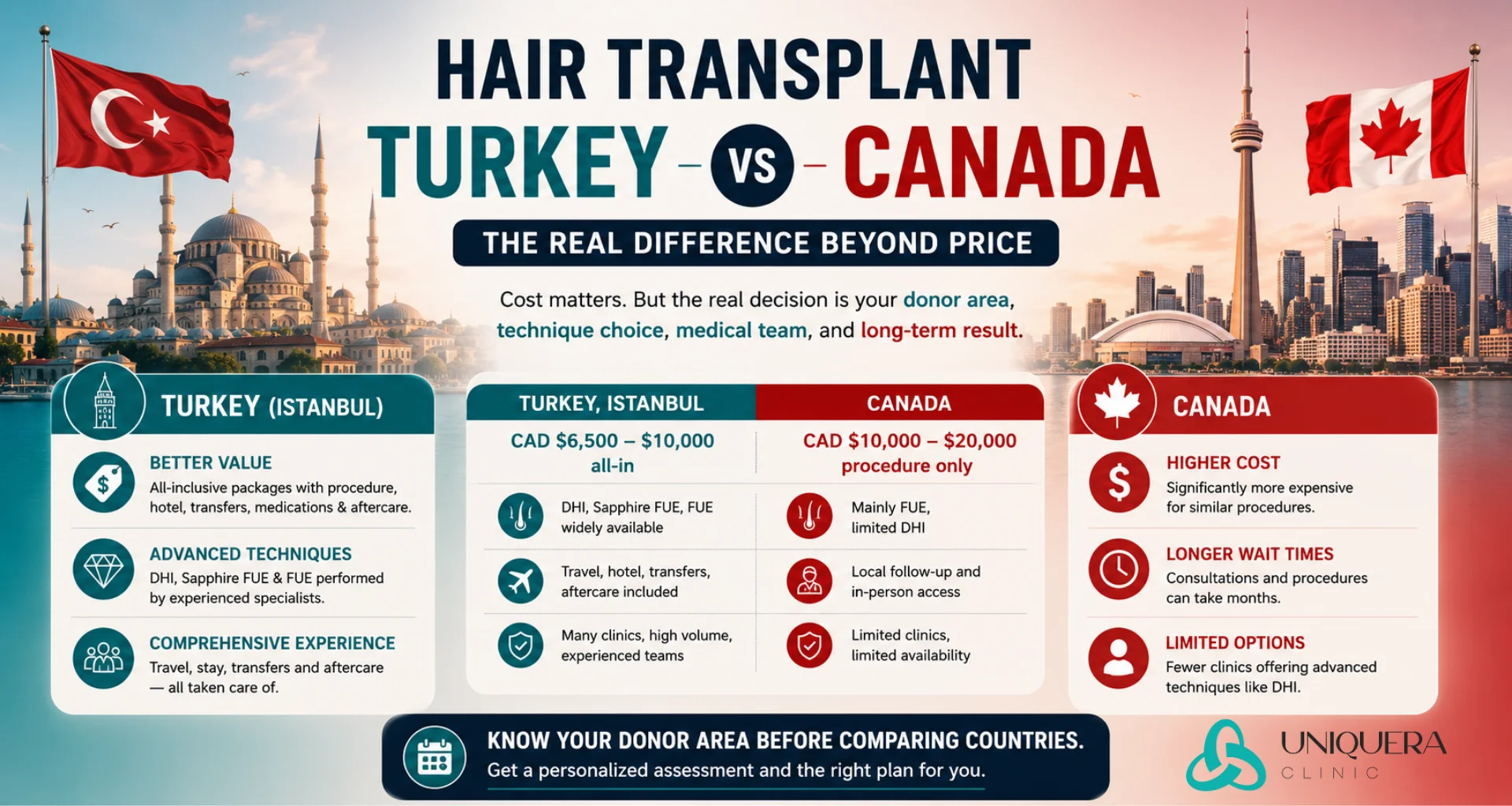
The hair transplant cost in Canada and Turkey is genuinely different. Canadian clinics price per graft, with most procedures landing between CAD $10,000 and $20,000. That fee covers the surgery only — see our full breakdown of FUE hair transplant cost in Turkey for comparison. Travel, accommodation, and follow-up are separate costs on top.
Turkey works on all-inclusive package pricing. A reputable Istanbul clinic typically covers the procedure, hotel, airport transfers, medications, aftercare kit, and PRP in one fee. Add round-trip flights from Toronto or Montreal and your total comes to roughly CAD $6,500 to $10,000. The savings on the hair transplant cost canada vs turkey comparison are real and typically range from CAD $5,000 to $10,000.
The table below shows where the two markets sit. After this, cost stops being the relevant question. Looking only at the hair transplant cost Canada vs Turkey can lead patients to overlook the factors that influence their final results.
| Canada | Turkey (Istanbul) | |
| Average procedure cost | CAD $10,000-$20,000 | CAD $4,500-$8,000 |
| Includes hotel + transfers | No | Yes (package) |
| DHI availability | Limited | Widely available |
| Sapphire FUE | Rarely offered | Standard at reputable clinics |
| All-in cost (incl. flights) | CAD $10,000-$20,000 | CAD $6,500-$10,000 |
For many patients, the hair transplant Turkey vs Canada decision becomes much easier once they compare the overall treatment experience instead of the procedure cost alone.
The hair transplant cost Canada vs Turkey comparison only tells part of the story because planning quality and long-term outcomes matter just as much.
This is where the two markets actually separate in a practical way, not just on cost.
Canadian clinics mostly offer standard FUE (Follicular Unit Extraction) and FUT, the strip method. A handful offer DHI. Sapphire FUE, where a sapphire-tipped blade creates the recipient channels for better healing and density, is rarely performed in Canada. Most clinics offer one technique and apply it regardless of the patient’s specific case.
What Turkey offers
Istanbul is one of the few places where all three methods, standard FUE hair transplant, Sapphire FUE hair transplant, and DHI hair transplant, are performed at scale and refined across a wide range of hair loss patterns. High-volume clinics there often accumulate more experience with complex cases, which can improve consistency when the same experienced team remains involved throughout.
A Sapphire FUE hair transplant Turkey procedures remain the most commonly requested option among international patients, though DHI hair transplant Turkey procedures are increasingly popular for patients focused on density and hairline refinement. That repetition matters for precision, particularly in extraction depth, graft handling, and channel placement across a full session.
| Technique | Best for | Scarring | Density | Recovery |
| Standard FUE hair transplant | Most hair loss patterns | Minimal | Good | 7-10 days |
| Sapphire FUE hair transplant | Sensitive scalp, faster healing | Minimal | Good to very good | 7-10 days |
| DHI hair transplant | High density, beard, eyebrow | None (pen implanter) | Excellent | 5-7 days |
The right technique depends on your donor density, how much coverage you need, and your hair type. Any hair transplant clinic Turkey worth considering should offer all three and recommend based on your case, not a default protocol.
| FUE, Sapphire FUE, or DHI? |
| The right technique depends on your donor density and coverage goals, not what the clinic happens to offer. Find out which approach actually fits your case. |
| Book your free assessment with UniquEra. We tell you which technique makes sense for your scalp, not ours. |
Most comparison articles stop at cost and technique. This is where the hair transplant Turkey vs Canada comparison becomes less about geography and more about the quality of planning behind every procedure. These three things matter more.
Your hairline is a visible, long-term decision. How well it looks in five or ten years depends almost entirely on whether the person who designed it understood your face structure, projected how your hair loss will progress, and built the frontal line around that future, not just where your hairline sits today.
This is a clinical judgment skill, not a technical one. It improves with volume. A practitioner who has designed 2,000 hairlines reads faces differently to one who has designed 200. Ask any clinic you are evaluating: who designs the hairline, and can you see examples from patients with a similar Norwood stage to yours?
Overharvesting is one of the most common long-term mistakes in hair transplants. If too many grafts are taken from a limited donor zone, you end up with visible thinning at the back and sides. That cannot be reversed.
Good medical teams assess donor density first and set expectations based on what the graft reserve can genuinely support, not what sounds impressive in a brochure. Providers pushing high graft counts as a selling point are often the ones most likely to overharvest. This risk exists in both Canada and Turkey.
In Canada, the practitioner typically performs or closely supervises the full procedure. In Turkey, the team model varies considerably. At reputable clinics, an experienced practitioner leads the key stages, particularly extraction and implantation, while trained technicians assist. At lower-tier clinics, technicians handle most of the work while the named practitioner appears briefly.
This is the single most important thing to verify before booking anywhere in Turkey. Ask directly: what does the lead practitioner do specifically, and for how long are they present during my procedure?
Canada has a clear advantage here. If something looks off at week six or month three, you can walk into the clinic. Turkey follow-up is remote after the initial post-op check. For most patients this does not change outcomes. But it does mean you need to follow aftercare instructions closely and know when to seek local help.
The risk in Turkey is not the reputable centres. It is the large number of lower-tier operators who have built a business around price rather than outcomes — learn how to avoid hair transplant mills in Turkey.
Warning signs to watch for:
• All-inclusive pricing below USD $1,500 to $2,000.
• No clear information on which practitioner performs your procedure.
• High graft count promises before anyone has assessed your donor supply.
• No before-and-after photos from patients with a similar hair type to yours.
• Pressure to book before having a proper consultation.
Technician-led procedures without proper supervision carry a higher risk of poor graft survival, overharvesting, and hairlines that do not age well. Overharvesting in particular is permanent.
There is also a travel consideration: flying long-haul too soon after surgery raises blood clot risk. Most guidelines suggest waiting ten to fourteen days before a long flight home.
Canada’s regulated environment lowers the quality floor, but volume is the main practical gap. A practice performing fifty to one hundred transplants a year accumulates less experience across different hair loss patterns than an Istanbul team doing cases daily. That difference shows up most in complex cases.
The other risk is delay. Hair transplant costs in Canada push some patients to keep waiting. Hair loss continues in the meantime, the graft reserve narrows, and the eventual procedure becomes harder to plan. For patients who have done this calculation and landed on hair transplant Turkey vs Canada as the core question, that delay cost is worth factoring in.
There is no single best country for a hair transplant. What patients are really asking when they phrase it that way is: can I trust a clinic abroad with something this permanent? Choosing the right hair transplant clinic Turkey option matters far more than chasing the lowest advertised price. The same is true in Canada. Instead of asking which is the best country for hair transplant, ask which clinic offers the safest planning, experienced team, and realistic long-term results.
That said, here is a realistic breakdown of who each option suits.
• You have done the research and found a medically-led clinic with documented results, where an experienced team supervises each case.
• You want access to Sapphire FUE or DHI without paying double the Canadian price.
• You are comfortable with the travel and the remote follow-up model.
• Budget is a genuine constraint and delay is not a viable option.
• You want local follow-up and direct access to your clinic post-procedure.
• Your case is complex and may require multiple sessions over time.
• You are not willing to invest the time needed to properly vet international options.
• Anyone considering a clinic with pricing far below the market average in either country.
• Anyone with significant hair loss who needs a realistic donor area assessment before setting expectations.
• Anyone with underlying health conditions requiring closer medical oversight.
Most patients focus on the wrong things. Here is a quick reset.
• ‘Turkey is cheaper so it must be worse’.
• ‘Canada is regulated so it must be safer’.
• Highest graft count offered.
• Price per graft as the main metric.
• Is the lead practitioner present throughout your procedure, or is it technician-led?
• Has a proper donor area assessment been done before any graft count is mentioned?
• Is the technique recommendation based on your specific case, or the clinic’s default?
• Does the clinic have documented results from patients at your Norwood stage?
• What does follow-up look like once you are back in Canada?
1. Request a video consultation before booking anything.
2. Ask for before-and-after photos specifically matching your hair type and loss pattern.
3. Confirm exactly what the lead practitioner does during the procedure and how long they are present.
4. Ask what happens if you have concerns three to six months post-procedure.
5. Read verified patient reviews, not testimonials on the clinic’s own website.
UniquEra is a premium hair transplant clinic in Istanbul. A significant portion of the patient base comes from North America, including Canada, which means the clinic is set up for the specific practical needs of patients traveling from abroad.
A few things that matter practically for Canadian patients:
For most patients, the best country for a hair transplant is the one where the right clinic and treatment plan come together.
If you are comparing hair transplant Turkey vs Canada seriously, UniquEra is worth including in that comparison. Not because it is the cheapest option in Istanbul, but because it is built for patients who want clear information before they commit to anything.
When comparing hair transplant Turkey vs Canada, choosing the right medical team will have a much greater impact than choosing the country itself.
Hair transplant Turkey vs Canada is not really a question about geography. It is a question about finding a team that plans your procedure properly, respects your donor area, and produces a result that holds up over time.
Turkey gives you access to techniques like Sapphire FUE and DHI at a fraction of Canadian prices, and the volume means teams there have a level of technical repetition that is hard to match. Canada gives you proximity and easier follow-up. Both can deliver excellent results. Both have options that go badly wrong.
If you are figuring out which is the best country for a hair transplant for your specific situation, the answer starts with a proper donor area assessment. That tells you how many grafts you actually have available, which technique makes sense, and what kind of result is realistic. Everything else is secondary to that.
| Every year of delay changes the calculation. |
| Hair loss continues. Donor supply does not increase. Before choosing Turkey or Canada, find out what your scalp can realistically support. |
| Book your consultation with UniquEra today. |
Yes, when performed at a reputable centre with experienced supervision and proper medical protocols.
Most patients save between CAD $5,000 and $10,000, even after flights and accommodation are included.
There is no single best country for a hair transplant. The medical team, planning process, and clinic standards matter more than geography.
DHI is available at some Canadian clinics, while Sapphire FUE is far more common in Istanbul than in Canada.
Look for documented practitioner involvement, transparent follow-up processes, and before-and-after results from patients at your hair loss stage.
Yes. Most reputable centres provide structured remote follow-up during the first year, typically at one, three, six, and twelve months.
Most patients stay four to five days for consultation, procedure, and early recovery checks.
For some complex cases, yes. For many routine cases, structured remote follow-up from a reputable Istanbul centre works well.
Yes. Most providers can give an initial estimate through photos. The final graft plan is confirmed during the in-person assessment once donor density is measured directly.