
Folliculitis after hair transplant is something many patients notice but very few expect. You followed the aftercare. You were careful. A few weeks in, you spot small red bumps near the grafts. Maybe some itching. Maybe something that looks like a tiny pimple near a graft site.
Your first thought is: did something go wrong?
Usually, no. Folliculitis after a hair transplant is one of the most common things that happens during recovery. Fewer than 3% of patients develop it when aftercare is followed properly. It is almost always mild and temporary.
But knowing what it is, what it looks like, and when you actually need to act makes a real difference to your result. That is what this guide covers. You can also read our full hair transplant aftercare guide for the complete recovery protocol.
Send a clear photo of your scalp and our medical team will tell you whether it looks like normal healing, folliculitis, or something that needs attention.
Get your free scalp assessment from UniquEra.
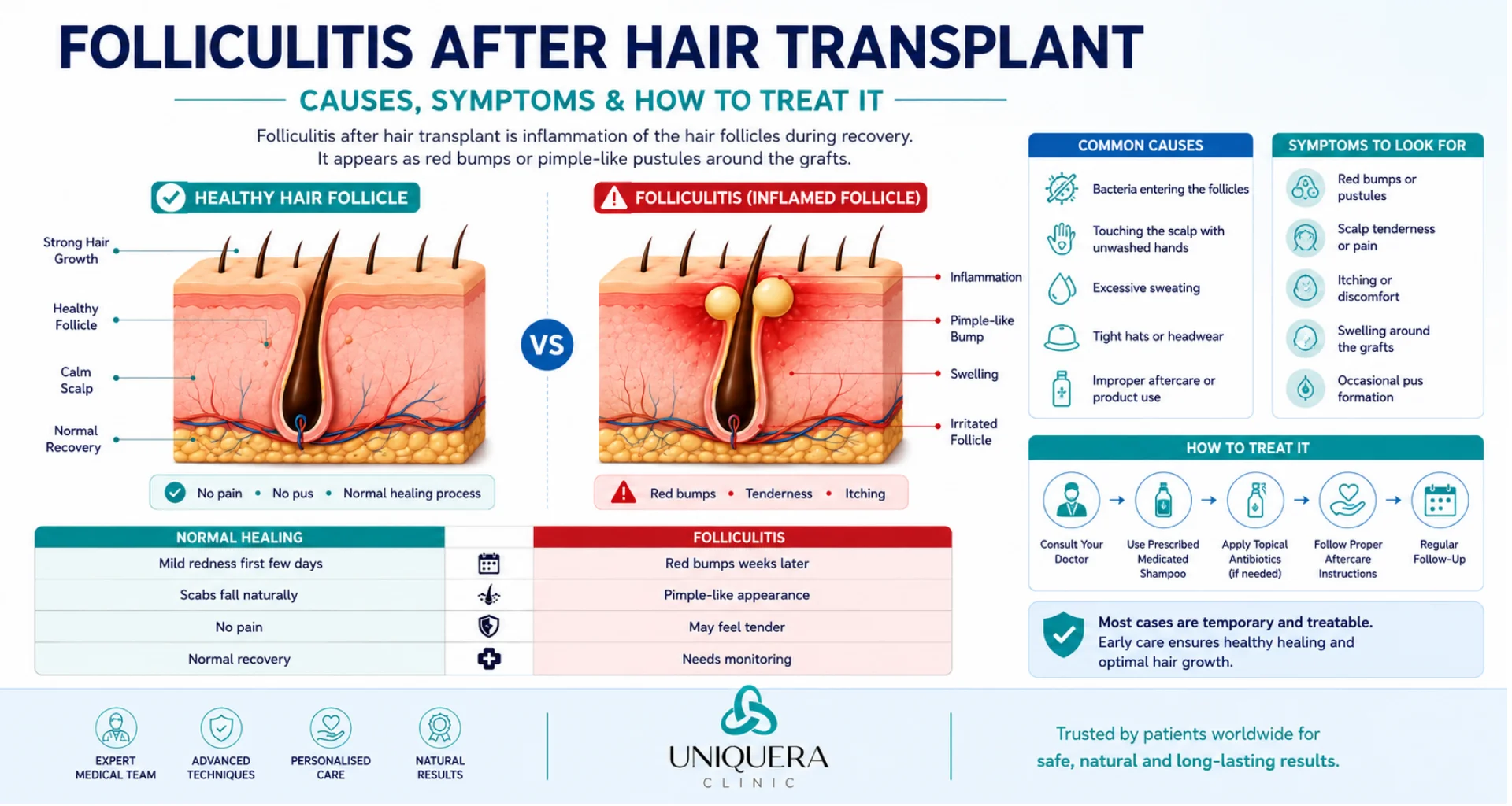
Folliculitis after a hair transplant is inflammation of the hair follicles during the healing period. It shows up as small red bumps, pimple-like pustules, or mild swelling around the transplanted area or the donor zone.
The follicles are adjusting to their new location. The scalp is healing. In some patients, that process triggers a mild inflammatory reaction. The bumps are not a sign the grafts have failed. They are a sign the body is working through recovery.
The condition appears in a small percentage of patients and in most cases resolves on its own with basic care.
There are two distinct types, and they behave differently.
This is the more common type after hair transplant procedures. The body mounts an inflammatory response to the transplanted grafts, to ingrown hairs forming as new growth begins, or to the physical trauma of the procedure itself. No bacteria are involved. It tends to be milder and often clears without treatment.
This happens when bacteria, most often Staphylococcus aureus, enter the follicle through the micro-wounds on the scalp. It is less common but more noticeable. The bumps tend to be redder, may contain pus, and are more likely to need medical attention.
| Feature | Sterile Folliculitis | Bacterial Folliculitis |
| Cause | Body’s immune response, ingrown hairs | Bacterial infection (Staph. aureus). |
| Appearance | Small red bumps, mild swelling | Red pustules, possible pus, more inflamed. |
| How common | More common after transplants | Less common. |
| Treatment | Usually resolves on its own | May need antibiotics or topical medication. |
| Risk to grafts | Very low | Higher if left untreated. |
Several things can trigger folliculitis during the hair transplant healing process. Here are the most common:
• Bacterial infection. Bacteria enter the follicles through micro-wounds on the scalp, especially if hands touch the area or hygiene slips.
• Ingrown hairs. As new hair begins to grow, some shafts curl back into the skin rather than breaking through cleanly. This creates localised inflammation that looks like folliculitis.
• Sebum buildup. Natural oils can clog healing follicles, particularly in the first weeks when washing is restricted.
• Friction and pressure. Hats, pillowcases, or repeated touching irritate the grafts and trigger inflammation.
• Compromised immune response. Patients with diabetes or autoimmune conditions may be more prone, as the body’s ability to fight minor infections is reduced.
The symptoms are fairly distinct but can sometimes be confused with normal healing signs. Here is what to watch for:
| Symptom | What it looks like | What it means |
| Red bumps or pustules | Small pimple-like spots around graft roots. | Early folliculitis or ingrown hai. |
| Scalp tenderness | Sore or sensitive to touch near grafts | Inflammation under the skin. |
| Itching | Persistent itch around transplanted area. | May be normal healing or early folliculitis. |
| Yellowish crusting | Honey-coloured crust forming weeks after procedure. | Sign of infection, needs attention. |
| Warmth or swelling | Skin feels warm, area looks puffy. | Active inflammation, monitor closely. |
| Pus-filled blisters | White or yellow fluid inside bumps. | Bacterial folliculitis likely. |
Normal healing scabs after a hair transplant are small, dark red, and fall off within 7 to 10 days. Folliculitis bumps look different. They appear later, resemble acne, and may have fluid inside. If you cannot tell the difference, contact your clinic and send a photo.
The timing of folliculitis varies between patients. It can appear early in recovery or months later, and the cause tends to differ depending on when it shows up.
| Recovery stage | What is happening | Folliculitis risk |
| Days 1 to 7 | Scalp healing from procedure, grafts anchoring. | Low. Any redness is usually post-procedure inflammation. |
| Weeks 1 to 3 | Scabs forming and shedding, follicles settling. | Moderate. Sterile folliculitis most likely if it appears. |
| Month 1 | Shock loss phase, scalp quieter. | Low. Most scab-related issues have resolved. |
| Months 2 to 4 | New hair begins pushing through. | Higher. Ingrown hairs and sterile folliculitis peak here. |
| Months 4 to 6 | Active regrowth phase. | Moderate. Bacterial folliculitis possible if hygiene slips. |
| Month 6 onwards | Hair growing, healing complete. | Low. Isolated cases from ingrown hairs still possible. |
In the first few weeks, any bumps that appear are usually part of the normal response to the procedure. The follicles are settling into their new location and the scalp is still inflamed. Sterile folliculitis is most likely at this stage. These early bumps are generally mild and tend to resolve with gentle cleaning and the aftercare protocol from your clinic.
This is the more common window for folliculitis. New hair shafts are pushing through the scalp. Some of them get trapped under the skin rather than breaking through cleanly. This triggers the ingrown hair response, which looks and feels like folliculitis.
Seeing bumps at 2 or 3 months is actually a sign that new growth is happening — though it is worth understanding the full recovery picture, including what shock loss after a hair transplant looks like. That said, it still needs to be managed properly to avoid escalation.
Both. Folliculitis can develop in either zone, and the donor area is often overlooked because patients focus on the transplanted site.
In the transplanted area, folliculitis is often linked to new hair pushing through or to blocked follicles in the recipient site.
In the donor area, it can develop from hair fragments left behind during extraction, minor infection in the extraction sites, or the sebaceous glands reacting to the removal trauma.
The symptoms and treatment approach are the same regardless of location. Monitor both areas during the hair transplant healing process.
No. Itching after a hair transplant is very common and almost always a normal part of recovery. As the scalp heals and new nerves reconnect, the skin becomes sensitive and itchy. This is especially noticeable around weeks 2 to 4.
Folliculitis involves visible bumps or pimples, not just itch. Isolated itching without any visible bumps or tenderness is nearly always normal healing.
The distinction matters because scratching during this phase can cause folliculitis by introducing bacteria or dislodging early grafts. Follow the washing protocol from your clinic and use any aftercare sprays they provide if the itch is intense.
Most cases stay mild and resolve within days of basic care. Use this table to decide whether to manage it at home or contact your clinic.
| Status | Signs you are seeing | What to do |
| [GREEN] Normal | Small bumps, mild itch, no pain, appearing in first 3 weeks | Continue aftercare. Warm compress. Monitor. |
| [AMBER] Monitor | Bumps not improving after 7 days, slight tenderness, yellowish crust forming | Send photos to your clinic. They will advise on next steps. |
| [RED] Contact clinic | Spreading redness, significant pain, pus, fever, bumps present for over 2 weeks | Contact your clinic same day. Prescription treatment likely needed. |
If you are unsure which category you fall into, contact your clinic. The cost of reaching out early is zero. The cost of waiting when you should not is real.
Not sure whether your scalp falls into the green, amber, or red category?
Our team reviews recovery photos every day and can help you understand whether what you are seeing is normal or requires treatment.
Send your photos for a free medical review.
Treatment depends on severity. Most cases need nothing more than what you already have in your aftercare kit.
• Warm compress. Apply a clean, warm cloth to the affected area for 10 to 15 minutes, two to three times a day. This reduces inflammation and encourages the bumps to drain naturally without squeezing.
• Clinic-approved shampoo. Continue using the antibacterial or medicated shampoo from your aftercare kit. These are formulated to clean the scalp without disturbing the grafts.
• Keep the scalp clean. Wash gently on the schedule your clinic gave you. Do not skip washing to avoid the area. Keeping the scalp clear of oils and debris is the main line of defence against worsening.
• Avoid friction. No hats, no rough pillowcases, no hands on the scalp unless clean.
For persistent or worsening cases, your medical team may recommend:
• Topical antibiotic cream such as Mupirocin or Fusidic acid to reduce localised bacterial infection
• Oral antibiotics such as Doxycycline for spreading bacterial folliculitis that does not respond to topical treatment
• Medicated shampoo containing chlorhexidine or ketoconazole where fungal involvement is suspected
• Do not pop or squeeze the bumps. This spreads bacteria and raises the risk of scarring near the grafts.
• Do not scratch the area. Breaking the skin creates new entry points for infection.
• Do not apply random over-the-counter creams without clearing them with your clinic first. Some ingredients are too harsh for a healing scalp.
Mild sterile folliculitis typically clears within 3 to 14 days with basic hygiene and warm compress treatment.
Bacterial folliculitis treated with antibiotics usually resolves within 7 to 14 days of starting the medication.
Cases that persist beyond two weeks, or that keep returning in the same area, need a clinical review. Repeated folliculitis in the same spot may indicate an ingrown hair that needs direct treatment.
In most cases, no. Hair grafts are placed at a depth that provides reasonable protection. Mild or sterile folliculitis rarely affects graft survival.
The risk increases with severe or untreated bacterial folliculitis. Prolonged inflammation around a graft site can interfere with how the follicle anchors and begins to grow. Scarring from a severe infection, though uncommon, can permanently affect the follicle.
Early action is the most important variable. A manageable case left untreated can become a complicated one. Caught early, the treatment is simple and the result is unaffected.
Yes, significantly. Folliculitis after a hair transplant is not just a random healing event. In many cases, it is a downstream consequence of what happened in the procedure room.
The factors that increase folliculitis risk are mostly within the clinic’s control:
• Extraction quality. Follicles that are damaged during extraction are more susceptible to inflammation during healing. Skilled, careful extraction reduces the trauma each graft experiences.
• Implantation precision. Grafts placed at the wrong angle or depth sit awkwardly in the skin, making it harder for the new hair shaft to break through cleanly. This increases the likelihood of ingrown hairs and the folliculitis that follows.
• Overpacked recipient areas. When too many grafts are placed in a small area, the tissue between them becomes compromised. Reduced blood flow to that zone slows healing and raises infection risk.
• Graft handling time. The longer a graft spends outside the body before implantation, the weaker it is. Clinics with efficient, coordinated teams keep this window short.
• Sterile environment and protocols. Folliculitis caused by bacterial infection during the procedure itself is rare when a clinic follows rigorous sterile technique. It is less rare when they do not.
This is why the choice of hair transplant clinic in Istanbul matters beyond cost. Two patients can receive the same technique and have very different healing experiences based entirely on the quality and care of the team performing the procedure.
At UniquEra, every case is supervised personally by Medical Directors with over a decade of hands-on hair transplant experience. Extraction and implantation are not delegated to unsupervised technicians. The level of care during the procedure directly reduces what a patient has to manage in recovery.
The technique used during a hair transplant affects how much trauma the scalp experiences, which in turn affects the likelihood of folliculitis developing. Here is how the main methods used at clinics in Turkey compare.
In DHI hair transplant Turkey, grafts are placed directly into the scalp using a Choi implanter pen. No pre-made channels are cut in advance. This means less open wound time, reduced contact between grafts and the external environment, and a lower risk of contamination during implantation. For patients with sensitive scalps or a history of skin reactions, DHI’s closed technique is a meaningful advantage in reducing post-procedure folliculitis risk.
Sapphire FUE hair transplant Turkey uses sapphire-tipped blades to create the recipient channels. Sapphire is harder and smoother than steel, which allows for finer, more precise incisions. The channels close more quickly and cause less surrounding tissue damage. This reduces the window during which bacteria can enter and lowers the inflammatory response post-procedure, making it a strong option for patients prone to skin reactions.
Manual FUE hair transplant involves extracting each graft individually by hand, without a motorised tool. At UniquEra, this is offered only for smaller graft counts where the aesthetic demand justifies the additional time and precision required. The manual approach produces extremely clean extraction sites with minimal surrounding tissue disruption. The donor zone heals faster and with very little visible scarring, which reduces the window for folliculitis to develop there.
The decision on technique is always made by the medical team based on your scalp condition, hair type, and graft count. The right match for your case matters more than the label.
When patients contact us during their recovery with concerns about their scalp, folliculitis is one of the most common things we review. Here is what we typically see and how cases tend to play out.
The majority of cases flagged during months 2 to 4 are sterile folliculitis linked to new hair pushing through. The bumps are small, not spreading, and the patient has no fever or significant pain. In most of these cases, we advise continuing the aftercare routine, adding a warm compress twice daily, and monitoring for a week. Most resolve without any prescription.
A smaller group of cases show signs of bacterial involvement. These tend to present with more redness, some tenderness, and bumps that are not improving after 5 to 7 days of basic care. In these cases, we coordinate a short course of topical or oral antibiotics with the patient’s local doctor, or prescribe directly depending on the patient’s location and the clinic’s protocol.
A very small number of cases show spreading infection or a persistent bump in the same location across multiple weeks. In these situations, a direct clinical assessment is usually warranted, either by returning to the clinic or by visiting a local dermatologist with full documentation from the transplant.
The pattern is consistent: early contact leads to faster resolution. Patients who wait until symptoms are severe take longer to recover and occasionally see localised impact on graft density in the affected area. Patients who reach out early almost never do.
This is one of the most common concerns for patients who travel internationally for their procedure. You have the hair transplant done, you follow everything correctly during your stay, you fly home. A few weeks later, bumps appear. Your regular doctor may not be familiar with post-transplant scalp conditions. You are not sure who to call.
Here is what to do:
1. Take clear photos of the affected area in good lighting, including the surrounding scalp for context.
2. Note when the bumps first appeared, how many there are, whether they are spreading, and whether there is any pain, warmth, or discharge.
3. Contact your hair transplant clinic directly. A clinic with a proper international patient support process will have a way to receive photos and respond with specific guidance. This is not the same as a generic FAQ page or a chatbot. You need a real medical response from someone who knows your case.
4. If the clinic advises local treatment and you need a prescription, a general practitioner can prescribe topical antibiotics based on the appearance. Tell them it is post-transplant folliculitis so they understand the context and do not treat it as standard scalp acne.
5. Do not wait more than a week if symptoms are worsening. The earlier the treatment, the simpler it is.
At UniquEra, patients who travel from the US, UK, Canada, and other countries have access to the medical team through a structured remote follow-up process after returning home. The team that supervised your case can review photos, advise on what you are seeing, and coordinate next steps if a prescription is needed. You are not handed a printed sheet and sent home. Continuity of care is part of how this clinic operates from day one.
Good post hair transplant care is the main way to reduce folliculitis risk. These steps matter most:
Folliculitis after a hair transplant is not a sign that something went wrong. For many patients, it is just how the scalp responds to healing. It is common. It is usually mild. With the right care, it resolves cleanly and does not affect the final result.
What matters is knowing what to look for, responding early, and not managing it alone when the signs are escalating.
Most cases clear up in under two weeks. Persistent or spreading cases need a clinical eye. And if you had your procedure with a clinic that offers real remote follow-up, you should never be in a position where you do not know who to call.
Most folliculitis cases are harmless. The challenge is knowing which ones are not.
If you’re seeing bumps, redness, itching, or anything that doesn’t look right, send us a photo. Our medical team will review it and tell you whether it’s normal healing, folliculitis, or something that needs treatment.
Request Your Free Scalp Assessment.
Use a warm compress and follow your clinic’s washing protocol. If the bumps are spreading, painful, or producing pus, contact your clinic.
Yes. Most sterile folliculitis resolves on its own within a few days with proper scalp hygiene.
No. Popping the bumps can spread bacteria, increase inflammation, and irritate nearby grafts.
Most cases clear within 3 to 14 days. Symptoms lasting longer than two weeks should be reviewed by a clinic.
Mild folliculitis rarely affects grafts. Severe or untreated infections can impact follicles if left unmanaged.
Usually not. Itching alone is a normal part of healing, while folliculitis typically includes visible bumps or pimples.
Scabs appear during the first 7-10 days and naturally fall away. Folliculitis appears later and looks more like acne or pimples.
Yes. This is actually one of the most common periods because new hairs are emerging through the scalp.
No. Folliculitis is usually a temporary skin reaction and does not mean the grafts have failed.
If the bumps are spreading, becoming painful, producing pus, or not improving after a week, send photos to your clinic for review.