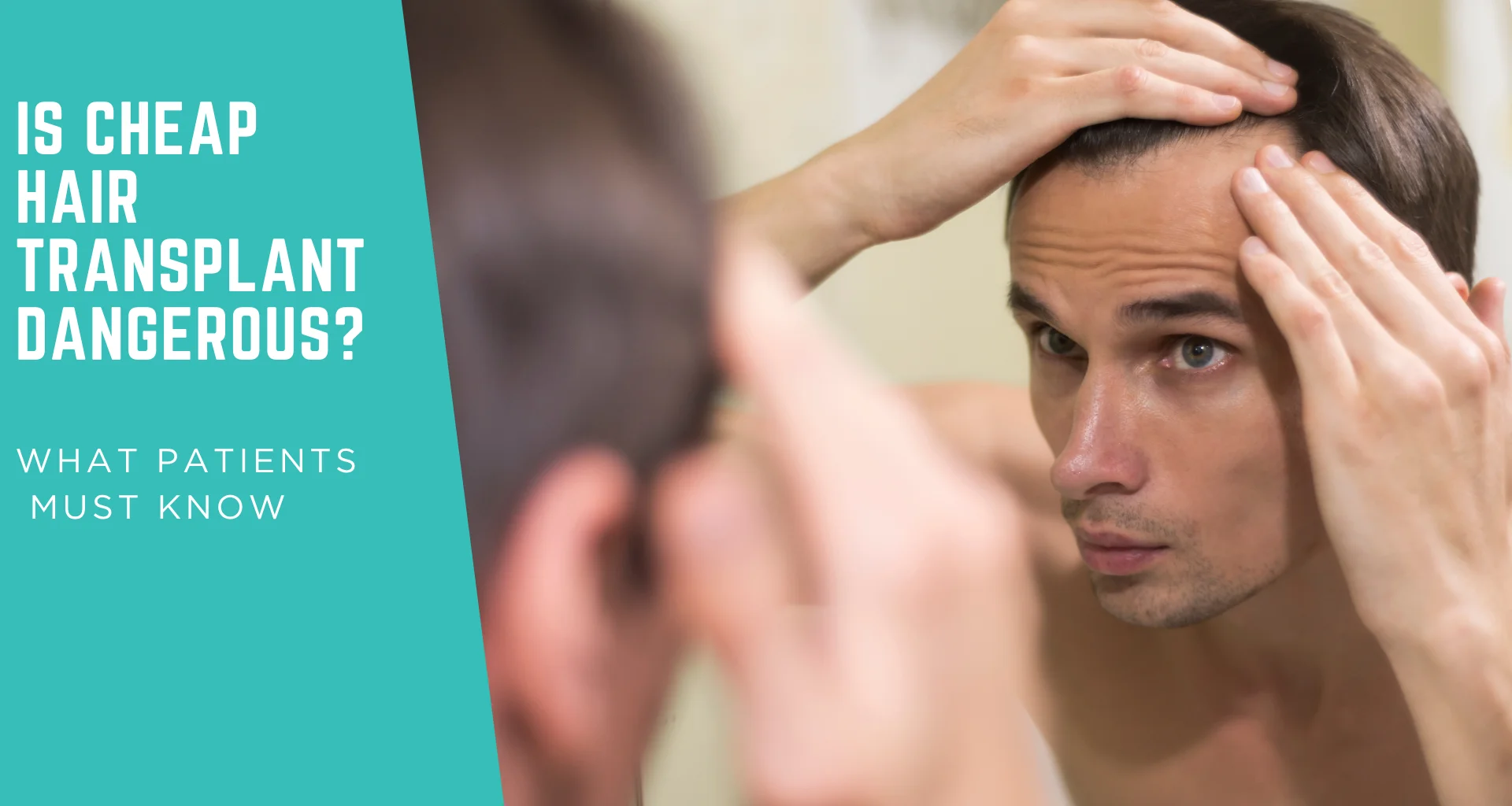

Cheap hair transplants are not automatically dangerous. The real risk comes from clinics that cut corners in medical supervision, donor management, and aftercare.
Cheap hair transplant risks are probably why you are reading this right now.
You searched for hair transplants in Turkey. You saw the prices. $2,000 to $3,000 for something that costs $15,000 back home. It sounded good.
Then you started reading. Horror stories. Botched hairlines. Infections.
Here is the problem. Most of what you read mixes truth with fear.
Some clinics are risky. But not every affordable hair transplant is unsafe.
What actually decides your result is not the price. It is the process behind it. And that is exactly what we help our patients understand before they ever step into our clinic.
This guide breaks it all down. What makes a transplant risky? What to check. How we think about each case. And how to tell the difference between a clinic that cuts corners and one that just operates where costs are lower.
If you are already at the stage where you want someone to look at your case honestly, book a free video consultation with our medical team. We will tell you what we see and what makes sense for you.
Not the country. Not the price. The process.
A hair transplant becomes dangerous when medical control is weak during surgery or missing after it. This can happen at any price point, in any country.
A hair transplant surgery is risky when:
• No doctor is present during the procedure
• Too many patients are treated in one day
• The donor area is over-harvested
• No proper consultation happens before surgery
• Aftercare does not exist after you leave
Let us walk through each one. Because understanding these is more useful than reading ten scary articles.
In some clinics, the procedure is handled entirely by technicians, without a doctor actively involved during surgery.
Technicians can assist with certain steps, but a hair transplant is still a medical procedure. It requires proper oversight, especially during the key stages that shape the final result.
One of those stages is channel opening. This step determines how your hair will grow. The direction, the angle, and the overall density all depend on how precisely it is done.
If this part isn’t handled correctly, the result can look unnatural regardless of how many grafts are implanted.
At our clinic, this step is performed by senior medical directors themselves. It’s done manually, with full control over placement and design, and is not delegated.
A proper hair transplant surgery takes a full day. Extraction alone runs 2 to 4 hours. Channel opening needs precision. Implantation needs patience.
If a clinic is running 6 to 10 patients daily, something is being rushed. Either procedures are sloppy, or unsupervised assistants are doing most of the work.
We treat 1 to 2 patients per day. That is it. Because doing this right takes a full day of focused attention from the team.
What is donor over-harvesting?
It is when too many grafts are taken from the back and sides of your head, causing visible thinning or permanent damage that cannot be reversed.
The donor area at the back of your head is limited. It doesn’t regenerate once grafts are removed.
Taking too many grafts from this area can leave it looking thin or uneven over time. That’s why the number of grafts should never be based on a fixed package or a target number.
In some cases, higher graft counts are suggested because they sound more appealing. But what matters is how much your donor can safely support, not how much can be extracted in one session.
At our clinic, donor density is evaluated first. The graft count is planned around that, even if it means recommending fewer grafts than expected.
At some clinics, the “consultation” is a WhatsApp message. Two photos. A price. Book your flight.
That is not a consultation.
A real one includes scalp analysis. Your hair loss stage. Your medical history. Your expectations. And a treatment plan built around your specific case, not a fixed package.
We send every patient a detailed medical report before they book. Diagnosis. Technique recommendation. Graft count. Realistic expectations. If we think a hair transplant is not the right option, we say so.
This is the one that gets patients hurt the most. Because everything seems fine on surgery day. The problem shows up weeks later when nobody is watching.
Many cheap hair transplant clinics have zero follow-up. You fly home. Done. No calls. No check-ins. Nobody reviewing your healing.
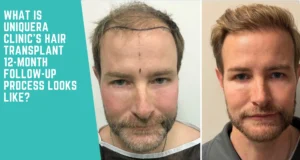
We schedule follow-ups at 1, 3, 6, and 12 months. Our WhatsApp support does not disappear. We have had patients message us at 2 AM worried about a scab. We respond. That is not a policy on a wall somewhere. That is just how we work.
Surgery is one day. Aftercare is a year. That is where the real difference between clinics shows up.
The real cheap hair transplant risks are not about price or geography. They are about process failures. Here are the specific ones that matter.
Infection rates in hair transplant surgery are under 1% when proper sterility is maintained. But in clinics that cut hygiene corners, reuse tools improperly, or skip blood screening, the risk climbs.
We run blood tests before every surgery. HIV. Hepatitis. Non-negotiable. If any clinic skips these, that tells you everything.
What is the graft survival rate?
The percentage of transplanted follicles that successfully take root and grow after surgery.
Careful procedures get 90 to 95% survival. Rushed clinics see transection rates of 20% or higher. That means you pay for 3,000 grafts but only get the benefit of maybe 2,400.
Some graft loss is normal. Even at our clinic. We tell patients this upfront. If a clinic promises 100% survival, they are not being honest with you.
Factory clinics use the same hairline template for every patient. Straight across. Too low. Too dense in front.
We design every hairline individually. Single grafts go in front for a soft, natural edge. Double and triple grafts go behind for density. We draw it, adjust it, and get your approval before surgery starts.
A hairline that looks good at 30 should still look natural at 50. That requires planning, not templates.
FUE and DHI both leave minimal scarring when done right. But careless extraction, a punch that goes too deep or at a wrong angle, causes visible scars that do not go away.
This one is worth sitting with. Your donor hair is limited. If a clinic damages it, no amount of money brings it back. No second procedure fixes it.
That is why we are conservative with graft counts. Sometimes 2,500 now with a touch-up later is smarter than 5,000 in one session that strips your donor area and leaves you with nothing for the future.
This is the part that makes our blog different from the others. Because this is the stuff we tell patients in consultation that most clinics never put in writing.
If your donor density is low, a transplant might not give you the coverage you are imagining. We would rather tell you that in a free consultation than let you find out after surgery.
Some patients need medication first. Some need a combined approach. Some need to wait. And a few need to hear that a transplant is not the answer for their situation.
A clinic promising 5,000 grafts is not always giving you more value than one recommending 2,500.
If the donor area cannot support 5,000, those extra grafts come at a cost. Thinner donor zone. Visible damage. Weaker overall result.
Even in the best hands, about 10% of grafts are lost to normal human error during extraction. Roots break. Follicles get squeezed. It happens. Clinics that admit this are being honest. Clinics that promise zero loss are not.
The right technique depends on your case. Not on what sounds more advanced.
| Situation | Technique | Why |
| Large bald area, Norwood 4-6 | FUE Sapphire | Covers more surface area in one session with high graft counts |
| Existing hair still present | DHI Choi pen | Direct implantation without shaving, better density control between existing hair |
| Hairline precision needed | DHI Choi pen | Allows precise angle and direction control for natural-looking frontal area |
| Very large case, 4000+ grafts | FUE Sapphire or 2-day DHI | May need split session to maintain graft quality and avoid donor damage |
| Crown area coverage | FUE Sapphire | Triple grafts placed efficiently for volume in crown zone |
We decide on technique after seeing your scalp. Not before. If a clinic tells you the method before examining you, they are selling a package, not planning your surgery.
The main difference is not the technique. It is how much time, supervision, and care goes into each step.
Most patients assume higher price means safer results. That is not always true.
| Factor | Cheap mill (Turkey) | Quality clinic (Turkey) | US clinic |
| Price range | $1,500-$2,500 | $3,000-$6,000 | $10,000-$15,000 |
| Doctor present | Often no | Yes, full supervision | Yes |
| Patients/day | 6 to 10 | 1 to 2 | 1 to 2 |
| Consultation | WhatsApp + price | Video + medical report | In-person or video |
| Graft survival | Lower (rushed) | 90-95% | 90-95% |
| Technique decision | Fixed package | Based on scalp assessment | Doctor decides |
| Aftercare | None or minimal | 1, 3, 6, 12 months | Varies |
| Grafts offered | 4,000-5,000+ (inflated) | Based on donor reality | 1,000-1,500/session |
| Hairline design | Same for everyone | Custom + future-proof | Custom |
| Repair risk | Higher | Lower | Lower |
The middle column is where most of our patients land. And where most patients who did their homework end up choosing.
$1,500 for a full hair transplant in Turkey is cheap. It usually means corners are cut somewhere, staffing, tools, time, or aftercare.
$3,000 to $6,000 in Turkey is a fair price. It covers experienced medical directors, proper tools, a full day of focused surgery, and a year of follow-up.
$10,000 to $15,000 in the US is a premium price. It reflects higher operating costs, not always higher skill.
The sweet spot for most patients is fair, not cheap and not premium.
This is the part most scary articles skip. And the part that matters most if you are trying to make a real decision.
Rent in Istanbul is a fraction of rent in New York. Same for salaries and medical supplies. A clinic can pay experienced staff, keep facilities sterile, and use quality tools while charging much less.
Turkey has a massive medical tourism market. Over 20,000 patients fly in every month. That much competition keeps pricing honest. Clinics that deliver bad results lose their reputation fast.
In the US, prices reflect malpractice insurance, facility overhead, and smaller patient volume. A US doctor might do 2 to 3 surgeries per week. Our medical directors do 1 to 2 per day, five to six days a week. That builds hands-on experience at a level that is hard to match.
What is a hair transplant procedure?
A hair transplant procedure is a medical process where hair follicles are taken from a donor area and implanted into thinning or bald zones. The two main techniques are FUE Sapphire (channel opening with sapphire blade) and DHI (direct implantation with Choi pen). The right choice depends on the patient’s scalp condition, hair loss stage, and donor quality.
The price gap between Turkey and the US is about economics. Not about medical quality.
Yes. Turkey is one of the most popular destinations for hair transplants in the world. Over 20,000 patients fly in every month. The country has experienced medical teams, licensed facilities, and a government that regulates medical tourism.
The question is not “Is Turkey safe?” The question is “Is this clinic safe?” And now you know exactly how to check.
Whether you choose us or someone else, use this checklist before booking any clinic.
A safe hair transplant clinic will have:
• A named, licensed doctor who supervises your procedure.
• 1 to 2 patients per day, not 6 to 10.
• A proper video consultation before you pay anything beyond a deposit.
• A written treatment plan with graft count, technique, and realistic expectations.
• Follow-up scheduled for at least 12 months.
• Direct communication after surgery (WhatsApp, video calls).
If 2 or 3 of these are missing, look elsewhere.
If a clinic cannot name the doctor supervising your case, red flag. If the name changes every time you ask, a bigger red flag.
Our Medical Directors are Chari and Atakan. Their names do not change. Their experience is verifiable. They handle the critical steps of every surgery personally.
1 to 2? Good. “It depends”? Caution. 5 or more? Factory, no matter how nice the website.
Good clinics have a clear answer. Bad clinics go quiet. This single question will tell you more about a clinic than anything on their website.
Some clinics show a low number but charge extra for hotel, blood tests, aftercare, transfers. Others include the full journey.
A $3,000 quote that covers everything can be better value than a $5,000 quote covering surgery alone.
This is where our approach is different from most clinics. We do not sell packages. We make decisions based on what your scalp actually needs.
Every case starts with a video consultation with our medical consultant. Not a sales call. An actual assessment.
We look at your hair loss pattern, your donor density, your age, your expectations. If a transplant does not make sense for you right now, we will say that. We have turned patients away because the timing was wrong or the expectation did not match reality.
If your bald area is large and you need high coverage, we go with FUE Sapphire. If you have existing hair and need precision density work, we use DHI with Choi pen.
Some patients need a two-day DHI session because doing it in one day would rush the implantation and hurt graft quality. We would rather add a day than compromise the result.
The technique is decided after the evaluation. Not before.
We check how many grafts your donor area can safely give without visible damage. If that number is 2,500, we say 2,500. Even if you want 4,000.
Overpromising grafts is how donor areas get destroyed. We would rather give you a conservative first session with room for a future touch-up than strip your donor zone in one go.
A hairline at 28 and a hairline at 48 are different. Hair loss continues. If we design your hairline too low or too dense today, it will look unnatural in ten years when the hair behind it keeps thinning.
We plan for where your hair is going, not just where it is now.
If you want to see how this process works for your specific case, book a free video consultation. We will review your hair loss, explain what technique and graft count make sense, and give you a written plan.
Here is exactly what the process looks like at our clinic. Step by step, so you know what to expect.
• Private video consultation with our medical consultant
• Detailed medical report sent to you (diagnosis, technique, graft count, realistic expectations)
• If we think a transplant is not right for you, we tell you before you spend anything
1. VIP transfer from airport to hotel.
2. Blood tests at the clinic (HIV, Hepatitis screening).
3. In-person consultation with the senior medical director.
4. Hairline design drawn and agreed on paper with you.
5. Pre-op photos before and after shaving.
6. Anesthesia, with optional twilight sedation for a pain-free experience.
7. Graft extraction by the medical team.
8. Grafts sorted and preserved in medical solution.
9. Channel opening by the senior medical director (sapphire blade or DHI Choi pen).
10. Implantation with sorted grafts. Singles for hairline. Doubles and triples for density.
11. Post-op care and detailed aftercare instructions.
Our Medical Directors have over a decade of hands-on hair transplant experience and supervise each case. Channel opening is done entirely by hand. No machine. No shortcut. No delegation.
Next morning, you return for a post-op wash and instructions. You get a kit with shampoo, lotion, and medication.
Then the long-term support begins. Check-ins at 1, 3, 6, and 12 months. WhatsApp access that stays active. Photo reviews. Honest feedback on your progress.
If something concerns you at any point, you reach us directly. Not a form. Not an email queue. Us.
The price is not the problem. The process is.
Your donor hair is limited. It does not regenerate. A bad extraction cannot be undone. A stripped donor zone cannot be rebuilt.
That is why this decision is about process. Not price.
The patients who end up needing repair did not get there because they went to Turkey. They got there because they did not ask the right questions. They did not check if a doctor was in the room. They picked the cheapest number and hoped for the best.
You do not have to make that mistake.
Affordable does not mean unsafe. It means verify before you fly. Ask the questions from this guide. If a clinic gives clear, honest answers, you are probably in good hands. If they dodge, rush, or pressure you, keep looking.
Book a free video consultation with our medical team. We will review your hair loss, explain what technique and graft count make sense for your case, and give you a written plan. Just an honest conversation so you can decide with clarity.
It depends on the clinic. A $2,000 procedure at a factory running 10 patients a day is risky. A $3,000 to $6,000 procedure with doctor supervision, real consultation, and 12 months of aftercare is a completely different experience. Check what is behind the price, not just the price itself.
Lower operating costs. Rent, salaries, and supplies in Istanbul cost a fraction of US prices. Turkey also has a deep pool of experienced specialists and over 20,000 patients arriving monthly. The price is lower because of economics, not because quality is automatically worse.
Five questions. Who is the doctor supervising your surgery? How many patients per day? Can I get a video consultation before paying? What happens if I have problems after flying home? What is included in the price? A clinic that answers all five clearly is worth your time.
Yes. Quality clinics in Turkey charge $3,000 to $6,000 for a full hair transplant procedure including consultation, surgery, hotel, transport, and 12 months of follow-up. That is a fraction of US pricing for equal or better experience levels.
At a good clinic, you have WhatsApp support, scheduled check-ins, and the ability to send photos for fast medical review. At a bad clinic, you are on your own the moment you board your flight. Verify aftercare before you book.
Named, licensed medical director. Registered with Turkey’s Health Ministry. Real patient reviews. Before-and-after photos of similar cases. And a video consultation before you pay. If they will not let you talk to a medical professional before taking your money, that is your answer.
A luxury hair transplant in Turkey means 1 to 2 patients per day. Senior medical director supervision. Custom hairline planned for your future, not just today. Advanced techniques chosen per case. A full aftercare program with 12 months of follow-up. VIP transfers and hotels. “Luxury” does not mean marble floors. It means your case gets the time, expertise, and attention it actually needs.