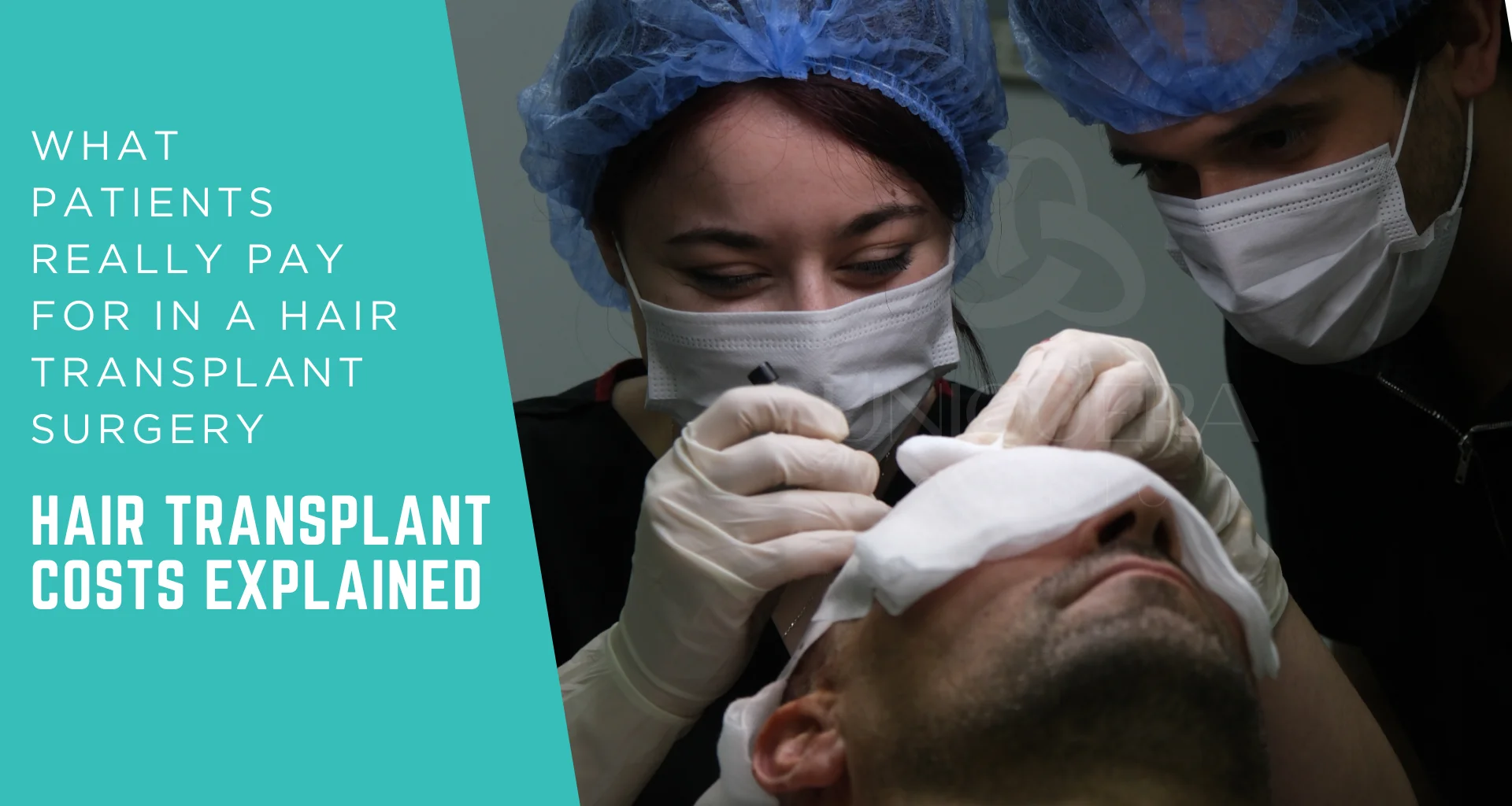

If you’ve been researching hair transplant costs, you’ve probably noticed something that doesn’t make sense at first.
Clinics in Turkey often charge far less than clinics in the United States or Western Europe. Sometimes less than a third.
Naturally, that creates doubt.
Some people assume it must mean lower quality. Others wonder if clinics elsewhere are simply overpriced. Most patients are stuck in between, unsure what to trust.
The truth is simpler, and less extreme, than what most marketing makes it sound.
Hair transplant cost is not just about the country or the number of grafts. It reflects how the surgery is performed, who is involved at each stage, how donor hair is treated, and how much long-term planning goes into the result.
This is also why two clinics in the same city can charge very different prices for what looks like the “same” procedure.
In this article, we’ll explain why hair transplant surgery costs less in Turkey, what those price differences actually represent in real terms, and where patients unknowingly pay a much higher price later when cost becomes the only decision factor. It also explains why premium clinics like UniquEra Clinic price their procedures higher and what patients receive in return.
Before comparing countries or clinics, it’s important to understand what you are actually paying for in a hair transplant surgery.
1. Number of grafts required
More grafts mean longer surgery time, more handling, and higher complexity. This is the most visible factor, but not the most important one.
2. Surgeon involvement
Some clinics rely heavily on technicians. Others have surgeons actively involved in planning, extraction, and implantation. This difference has a direct impact on results and pricing.
3. Time spent per procedure
Fast surgeries cost less. Slower, controlled surgeries protect graft survival and donor hair, but increase operating costs.
4. Technique used
FUE hair transplant, also known as manual FUE, Sapphire FUE, and DHI transplant all require different tools, skill levels, and time commitment.
5. Donor area planning
Clinics focused only on today may extract aggressively. Clinics that plan for future hair loss work conservatively to preserve donor supply. That planning increases cost but protects long-term outcomes.
6. Medical and safety standards
Sterile environments, proper anesthesia monitoring, graft storage conditions, and structured aftercare all add cost, but reduce risk.
This is why two clinics can quote very different prices for what seems like the same procedure.
Before explaining why Turkey is cheaper, it helps to see the broader picture.
| Region | General Cost Range | What This Usually Includes |
| United States | High | Surgeon time is expensive, high clinic overhead. |
| Western Europe | High | Strong regulation, high labor costs |
| Turkey | Lower | Hair transplant turkey has a Lower operating costs, high surgical volume. |
| Premium clinics in Turkey | Mid-range | Surgeon-led care with global standards. |
Turkey’s pricing advantage is real. But the range inside Turkey itself is wide.
Once cost drivers are clear, price variation becomes easier to understand.
Neither approach is always explained clearly during marketing. The difference usually becomes visible months or years later.
Different techniques require different levels of precision, time, and surgical control.
| Technique | Key Characteristics | Cost Impact |
| FUE hair transplant | Manual extraction and implantation. | Moderate |
| Sapphire FUE | Finer channel creation, reduced tissue trauma. | Higher |
| DHI (direct hair implantation) | Implant-by-implant control of angle and depth. | Higher |
Advanced techniques take longer and require more surgical involvement. This increases cost, but improves graft survival and natural appearance.
Lower prices can look appealing at first. But in hair transplant surgery, cost decisions are rarely neutral. When prices drop sharply, it usually means the procedure itself has changed.
Those changes often show up later.
| Area | What Changes | Long-Term Impact |
| Donor Area | Overharvesting, incorrect extraction angles, poor graft handling. | Permanent loss of donor hair, limited options if more surgery is needed. |
| Hairline & Density | Template-based designs, technician-led placement. | Unnatural hairlines, uneven density, visible transplant look. |
| Safety & Recovery | Reduced supervision, weaker hygiene protocols. | Higher infection risk, slower healing, possible complications. |
| Correction Risk | Poor planning and graft misuse. | Repairs are harder, more expensive, and not always possible. |
| Psychological Cost | Visible or disappointing results. | Ongoing self-consciousness and regret. |
Key point:
–Lower cost often means higher risk for the patient.
-In hair transplantation, errors cannot be reversed once donor hair is damaged.
Istanbul’s position as a global leader in hair restoration creates unique advantages:
Volume expertise: The high concentration of clinics and patients means our surgeons perform more procedures annually than most Western surgeons do in their entire careers. This translates to refined skills and extensive experience with diverse hair types and patterns.
Competitive excellence: The saturated market forces clinics to differentiate through quality, not just price. Only the best survive and thrive.
Medical tourism infrastructure: Established systems for international patients ensure smooth, stress-free experiences from initial inquiry through post-operative care.
Cost efficiency without compromise: Economic factors allow us to offer world-class care at accessible prices without sacrificing quality, safety, or results.
After understanding where low-cost clinics cut corners, the next question is natural.
What exactly changes when a clinic charges more?
At premium clinics, the higher cost is not about branding or luxury. It reflects how risk is reduced, donor hair is protected, and results are planned for the long term.
| Area | What Premium Clinics Do Differently |
| Surgeon Involvement | Surgeons lead planning and critical surgical steps instead of delegating them entirely to technicians. |
| Donor Preservation | Extraction is planned to protect future graft supply, not just maximize graft count in one session. |
| Technique Choice | Advanced options like Sapphire FUE and DHI are used when medically appropriate, not as upsells. |
| Procedure Pace | Fewer patients per day, slower implantation, and controlled graft handling. |
| Graft Survival | Better storage, minimal out-of-body time, and precise placement improve survival rates. |
| Long-Term Planning | Hairlines and density are designed with future hair loss in mind. |
This approach takes more time, more surgical involvement, and more resources. That is what increases cost.
Premium clinics do not charge more simply for branding. They charge more to reduce risk. At UniquEra Clinic, we’ve established ourselves as one of the best hair transplant clinics in Istanbul not by cutting corners, but by investing in excellence at every level. Here’s what sets us apart:
The goal is not maximum graft count in one day, but sustainable, natural results over time.
Hair transplant cost is not just about where you go. It’s about how the surgery is planned, who performs it, and whether the clinic is thinking beyond the first year.
Turkey offers a genuine cost advantage, but the smartest decision comes from understanding what is included, what is excluded, and what cannot be undone once donor hair is lost.
Choosing the right clinic is less about paying more and more about avoiding irreversible mistakes.
If you’re considering a hair transplant and want clarity on what level of care fits your goals and long-term plans, a proper medical consultation is always the safest first step.
Contact the best hair clinics in Turkey today for a personalised consultation and discover why discerning patients worldwide choose Istanbul for world-class hair restoration at exceptional value.
1. Why is there such a big price gap between clinics offering the same number of grafts?
Because graft count alone does not reflect surgeon involvement, technique quality, or donor preservation.
2. Is Turkey cheaper because the quality is lower?
No. Turkey is cheaper mainly due to operating costs and volume. Quality depends on the clinic, not the country.
3. Should I choose a clinic based on price alone?
Price should be considered, but only after understanding who performs the surgery and how donor hair is handled.
4. Are premium clinics worth the extra cost?
For patients concerned about natural results, donor preservation, and long-term planning, premium clinics reduce risk.
5. Is a hair transplant in Turkey safe?
Yes, a hair transplant in Turkey can be safe when performed at a medically supervised clinic with experienced surgeons, proper hygiene protocols, and structured aftercare. Safety depends on the clinic, not the country.
6. Does Turkey have cheap hair transplants?
Yes, Turkey offers a wide price range. Some clinics are affordable due to efficiency and volume, while others are cheap because they reduce medical oversight, donor planning, or post-operative care.
7. Does a hair transplant last forever?
Transplanted hair is generally permanent because it is taken from donor areas resistant to hair loss. However, untreated native hair may continue thinning, which is why long-term planning matters.
8. Is hair transplant surgery painful?
Hair transplant surgery is usually not painful. Local anesthesia is used during the procedure, and most patients experience only mild soreness or tightness during recovery.
9. Are hair transplants worth the cost?
Hair transplants can be worth the cost for patients with stable hair loss and realistic expectations. The value comes from permanent results and avoiding long-term spending on temporary solutions.
10. What is the best age for a hair transplant?
There is no fixed best age. Surgery is usually more predictable once hair loss patterns stabilize, often after the mid-20s. Donor quality and pattern stability matter more than age alone.
11. Which country is best for hair transplant surgery?
The best country depends on the clinic and surgeon rather than geography. Turkey, the USA, and parts of Europe all have high-quality clinics when proper medical standards are followed.
12. How much does a 5,000 graft hair transplant cost in Turkey?
The cost varies widely based on surgeon involvement, technique used, and donor management. Large graft sessions at premium clinics cost more due to time, complexity, and medical planning.
13. How much area does 3,000 hair grafts cover?
Three thousand grafts typically cover the frontal hairline and mid-scalp or provide moderate density across a thinning area. Coverage depends on hair thickness, curl, and scalp contrast.
14. Can I get the cheapest hair transplant and still get good results?
Lower price alone does not guarantee poor results, but ultra-cheap clinics often involve higher risk. Good outcomes depend on surgical planning, graft handling, and donor preservation.