
You have narrowed your choice down to a few clinics.
The prices look similar. The before-and-after photos look good. Every clinic talks about experienced teams, advanced techniques and natural results.
Then one question becomes difficult to ignore:
Who is actually going to perform my hair transplant?
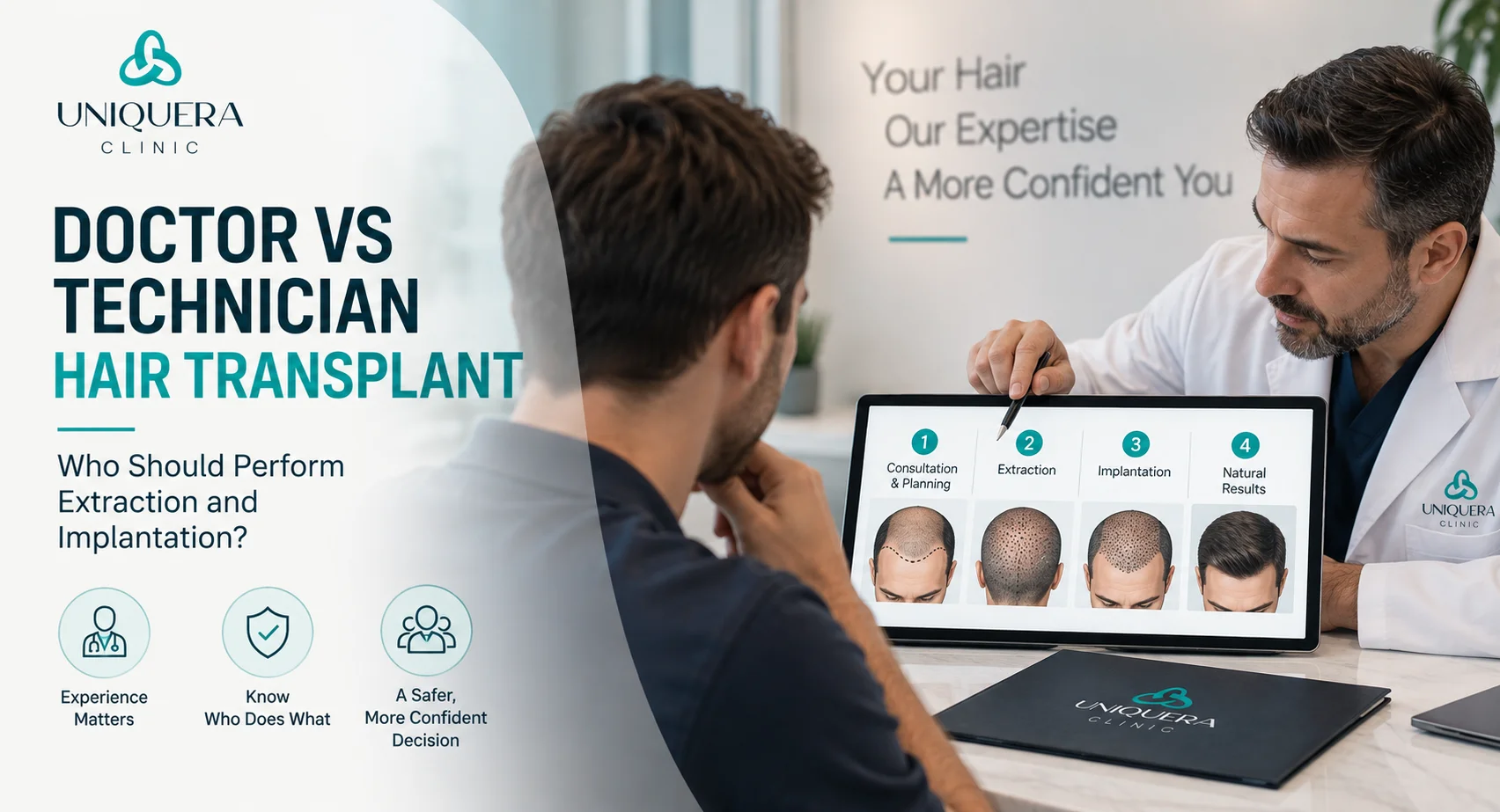
The doctor vs technician hair transplant question matters because a hair transplant is not one single task performed from beginning to end.
It involves separate stages, including:
Different people may be responsible for different parts.
So instead of asking only:
“Will a doctor perform my hair transplant?”
Ask:
“Who will perform each stage, what experience do they have, and who is responsible for my case?”
Not sure who would actually perform each stage of your transplant? Share your photos with UniquEra Clinic and get a clear explanation of the proposed team, technique and treatment plan before you decide.
Get Your Free Hair Assessment
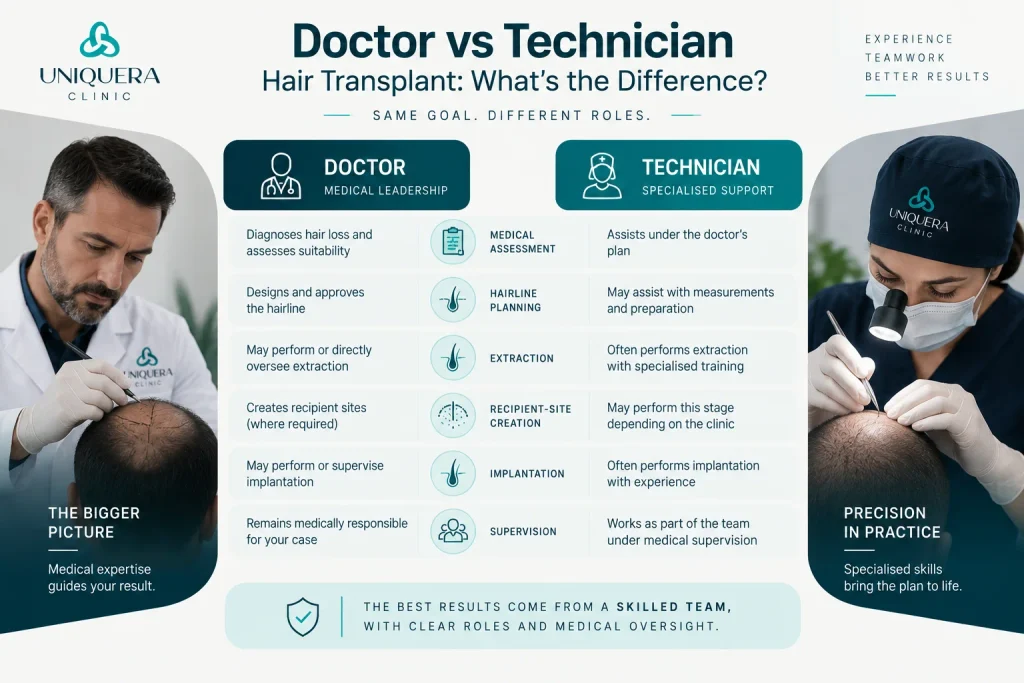
The word “technician” can mean very different things from one clinic to another.
At one clinic, it may describe an experienced healthcare professional who has spent years working specifically in hair restoration.
At another, the person’s training or medical background may be difficult for the patient to verify.
The word “doctor” can also create the wrong impression.
A clinic may market itself around one doctor’s name, but that does not automatically mean that doctor personally performs every part of every procedure.
That is why the title alone is not enough.
You need to know who does what.
| Stage | What Happens | What You Should Ask |
| Medical assessment | Hair loss, donor area, medical history and suitability are reviewed. | Who makes the final medical decision? |
| Hairline planning | Hairline position, coverage and graft distribution are planned. | Who designs and approves my hairline? |
| Extraction | Follicular units are removed from the donor area. | Who performs my extraction? |
| Recipient-site creation | Channels are created where required by the technique. | Who performs this stage? |
| Implantation | Grafts are placed into the recipient area. | Who implants my grafts? |
| Supervision | The procedure and patient condition are monitored. | Who remains responsible for my case? |
For a full step-by-step explanation, read our guide on who performs hair transplant surgery.
There is no useful answer based only on the words “doctor” or “technician.”
The real answer depends on:
Hair transplantation is usually a team procedure.
The concern is not simply whether more than one person works on the patient.
The concern is whether the people involved are properly trained for the work they are doing and whether somebody has clear medical responsibility for the case.
Patients researching a hair transplant in Turkey often find very different clinic structures.
Some are built around one surgeon’s name.
Others operate with medical directors, specialists, nurses and other trained healthcare professionals working together.
For patients, the better question is not:
“Do you use technicians?”
Ask instead:
“What exactly does each person do during my procedure?”
A clinic should be able to explain:
If these responsibilities cannot be explained clearly before you travel, that is more concerning than the job title itself.
During FUE extraction, individual follicular units are removed from the donor area.
Those grafts are limited.
Once follicles have been taken from the donor area, the clinic cannot simply replace them.
That makes extraction one of the stages where experience matters most.
The person extracting grafts needs to work according to the donor plan while controlling:
Poor extraction can damage grafts.
It can also leave certain parts of the donor area noticeably thinner if too many grafts are taken from concentrated areas.
That matters even more if you may require another procedure in the future.
So if you are comparing an FUE hair transplant Turkey package, do not judge it only by a number such as “4,000 grafts.”
Ask:
Who will extract those 4,000 grafts?
And:
How was that number decided based on my donor area?
You can read more in our guide on how clinics assess the donor area before hair transplant surgery.
Hairline design should be treated as part of the treatment plan, not as a quick drawing before surgery.
The person planning the hairline needs to consider:
A lower hairline is not automatically a better hairline.
Using too many grafts at the front can reduce the number available for other areas or for future procedures.
At UniquEra Clinic, the final hairline and graft plan are confirmed during the in-person assessment before the procedure starts.
Nothing is considered final based only on photographs sent before travelling.
In Sapphire FUE, recipient channels are created before the grafts are implanted.
These channels influence where the transplanted follicles are positioned.
Their:
can all affect how the transplanted hair eventually sits.
This is why channel opening should not be treated like a routine production-line step.
At UniquEra Clinic, recipient-channel creation where applicable is handled within the senior medical structure and monitored as part of the surgical plan.
The planned hair direction and graft distribution are decided before implantation begins.
DHI changes the way grafts are implanted.
With DHI, an implanter pen is used during placement.
But the pen itself does not decide where a graft should go.
The person using it still needs to understand:
Grafts are not all identical either.
Some follicular units contain one hair.
Others may contain two or three hairs.
Single-hair grafts are generally more suitable for the frontal edge because they create a softer transition.
Larger follicular units can be placed farther behind where more visual density is required.
So if you are researching a DHI hair transplant Turkey package, do not stop at:
“Do you use Choi pens?”
Ask:
“Who will be using the Choi pen during my procedure?”
Not necessarily.
This is where the doctor vs technician hair transplant discussion often becomes too black and white.
Hair transplantation is commonly performed by a team.
Different people may be responsible for:
The presence of several team members does not automatically make a clinic unsafe.
What matters is whether responsibilities are clearly defined.
You should know:
Who assessed my donor area?
Who approved my graft number?
Who designed my hairline?
Who performs extraction?
Who implants my grafts?
Who supervises the procedure?
That gives you far more useful information than simply seeing a doctor’s photograph on the clinic’s website.
The job title alone cannot answer that question.
There is a major difference between an experienced medical professional performing a defined role within a supervised team and an unknown person independently performing work without clear medical responsibility.
Before deciding whether you are comfortable with the clinic’s setup, ask about:
At UniquEra Clinic, experience is judged by hands-on work, not simply by how many procedures somebody has observed.
The clinic’s internal hiring standard also requires people working in the medical team to demonstrate practical hair transplant experience before taking responsibility for procedural work.
Before paying a deposit, ask these questions directly:
A clinic should be able to answer these without avoiding the question.
If you ask who performs extraction and the answer becomes a discussion about hotel packages, celebrity patients or graft numbers, ask again.
You should know these answers before paying a deposit. Send us your photos and UniquEra Clinic will explain who would handle each stage of your proposed procedure, from donor planning through extraction and implantation.
Ask About Your Hair Transplant Plan
Ask before you travel.
Do not assume that the person shown most often on Instagram or the clinic website will automatically perform your procedure.
Ask the clinic to explain the proposed structure for your case.
You should understand:
Transparency before booking matters because once you have flown abroad and arrived at the clinic, changing your decision becomes much harder.
At UniquEra Clinic, a hair transplant is structured as coordinated medical teamwork rather than being marketed around the idea that one person physically performs every part of a multi-hour procedure.
The patient first has a remote consultation with a Medical Consultant.
After arriving in Istanbul and completing the required pre-operative checks, the patient has an in-person consultation.
The donor area is physically assessed.
The proposed graft count is reviewed.
The technique is confirmed.
The hairline is designed.
The treatment plan is finalized before the patient enters the procedure room.
Medical Directors are involved in areas including:
Experienced Hair Restoration Specialists work within defined parts of the procedure, including:
The aim is not to hide a team behind one person’s title.
It is to make sure each stage is handled by someone with the right experience for that responsibility.
You can read more about this process in how UniquEra Clinic designs a personalized hair transplant plan.
The biggest warning sign is often not the presence of technicians.
It is not knowing who is doing what.
Look more carefully if a clinic:
Technique names should never replace these answers.
DHI tells you something about implantation.
FUE tells you something about extraction.
Neither tells you how experienced the person holding the instrument is.
For more checks, read how to choose a safe hair transplant clinic in Turkey.
Do not choose based on the title alone.
Choose based on the people, responsibilities and medical structure behind your procedure.
Before booking a hair transplant in Turkey, find out:
Who assesses you?
Who plans the transplant?
Who protects your donor area?
Who extracts the grafts?
Who implants them?
Who supervises the procedure?
Who remains responsible for your case?
Your decision should not depend on one doctor’s photograph, a technique name or an impressive graft number.
You should know who will actually be handling your hairline, donor area and grafts before you travel.
Send UniquEra Clinic your photos for a free consultation. We will review your case, explain the recommended FUE or DHI approach and walk you through how your medical team would be structured before you make your decision.
Book Your Free Consultation
The answer depends on what part of the procedure is being performed, the person’s qualifications, local regulations and how the medical team is supervised. Ask the clinic exactly which stages the person performs.
Rules depend on the country and on the specific stage of the procedure. Patients should ask clinics to explain the medical qualifications and responsibilities of everyone involved rather than assuming the same rules apply everywhere.
Extraction is a skill-dependent part of FUE because the donor follicles are limited and can be damaged during removal. Ask who performs extraction at the clinic, what their medical background is and how much hands-on FUE experience they have.
Qualified medical team members may be involved in implantation depending on applicable regulations and the clinic’s medical structure. The clinic should clearly explain who implants your grafts and who supervises that work.
DHI procedures can involve several medical team members. Ask specifically who performs donor extraction, prepares the grafts, uses the implanter pen and supervises the treatment.
There should be clear medical responsibility throughout the procedure. Instead of asking only whether a doctor is “present,” ask what that person’s actual role is and how closely your case is being supervised.
Ask about their medical education, hair restoration training, years of hands-on experience and exact role during your procedure. A clinic should be able to answer clearly.
The label alone does not tell you enough. A clinic marketed around a doctor can still delegate large parts of the procedure, while a team-based clinic may have experienced medical professionals working under clear supervision. Find out who actually performs each stage before deciding.