Head Medical Consultant & Patient Care at UniquEra Clinic
Complete baldness isn’t just about appearance. It quietly chips away at confidence, identity, and how someone moves through everyday life. Unlike thinning hair-where you can still work with angles, products, and camouflage-true baldness leaves no room for tricks. The crown is bare, the temples recede, and eventually, the entire top can become smooth and shiny.
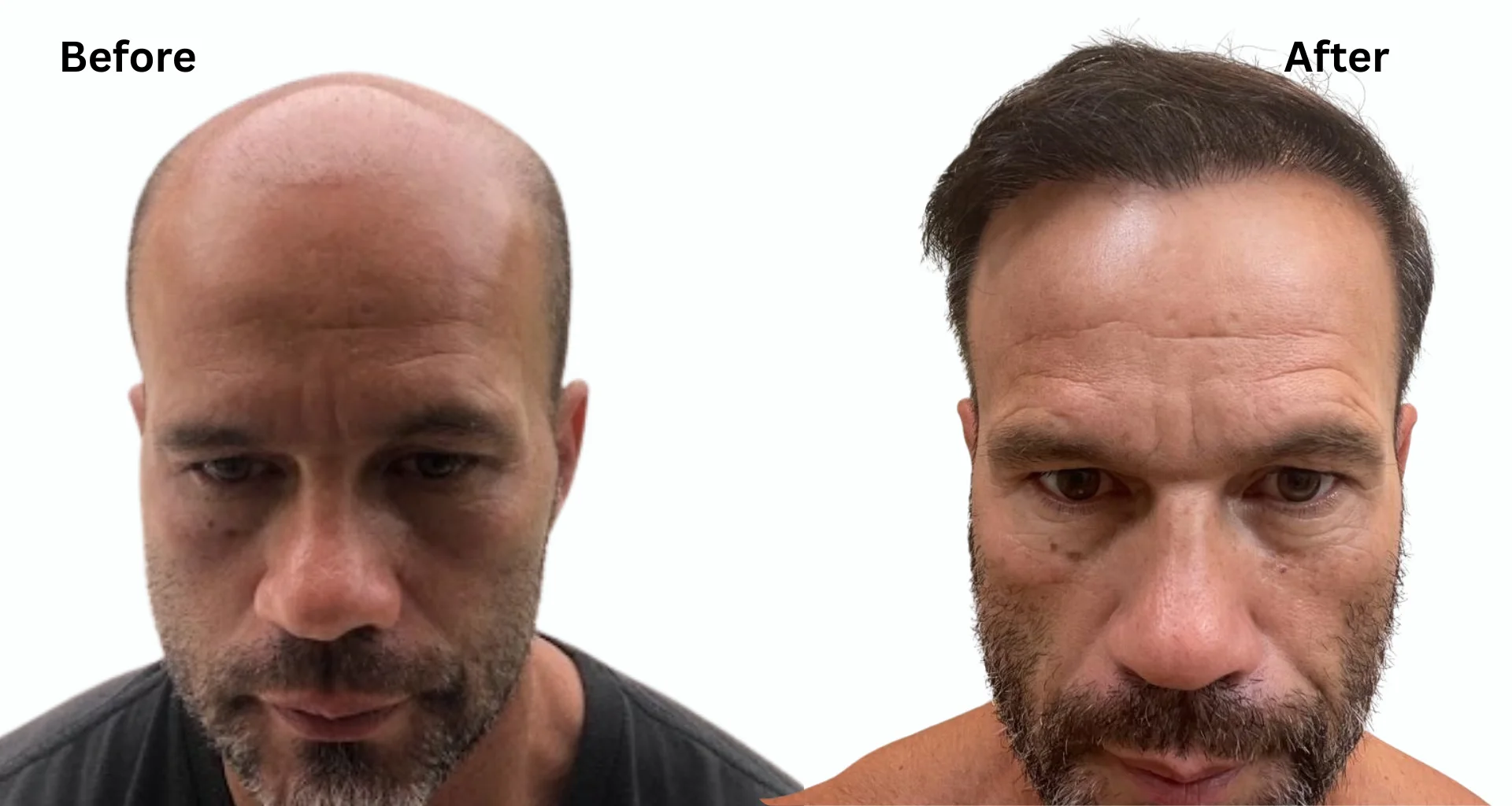
But what many don’t realize is that even in these advanced stages, hair restoration might still be possible. The real question is: Do you still have viable donor hair? Because that’s what truly determines if a transplant is possible-not the size of your bald spot.
This guide offers expert insights based on medical standards, not assumptions. You’ll learn when surgery is realistic, how expert hair transplant clinics in Turkey like UniquEra assess completely bald cases, and what your options look like if you’re not a surgical candidate.
Understanding “Complete Baldness” – What Does It Really Mean?
Baldness isn’t a one-size-fits-all diagnosis. Hair restoration specialists use scales like the Norwood-Hamilton classification for men. Grades Norwood 6 and 7 reflect advanced hair loss:
Norwood 6: Almost complete loss on top, with some hair on the crown and sides
Norwood 7: Only a thin “horseshoe” of hair remains on the back and sides
But here’s the key point-being bald on top doesn’t automatically disqualify you from surgery. What matters more is whether the donor areas (sides and back) still contain strong, healthy follicles that haven’t miniaturized.
Norwood Grade
Bald Area
Donor Hair Status
Transplant Possibility
Norwood 5
Front & crown thinning
Good density
High
Norwood 6
Top bald, sides still strong
Moderate
Selective coverage possible
Norwood 7
Full baldness, weak donor
Poor or mixed
Limited / Not viable
Is a Hair Transplant Worth It If You’re Completely Bald?
When transplantation is often worthwhile:
You have adequate donor hair (3,000-4,000+ grafts safely available)
You accept strategic enhancement rather than full coverage
You understand staging may be necessary
Your goal is natural improvement, not teenage-level density
You’re committed to 12-18 month maturation timeline
When alternative paths may be better:
Minimal or no viable donor hair exists
Unrealistic expectations about achievable density
Major health conditions compromising healing
Financial constraints preventing quality care
Preference for immediate results over gradual surgical transformation
Success in advanced baldness means “regaining balance and confidence,” not “turning back the clock 20 years.” If you embrace realistic goals, transplantation can be genuinely transformative even with Norwood 6-7 patterns.
What Makes Hair Transplantation Possible?
Hair transplants aren’t about growing new hair. They work by redistributing what you already have. Surgeons extract follicles from areas genetically resistant to balding and implant them in bald zones.
If these donor areas are depleted or weak, there’s nothing to relocate. That’s why availability of donor grafts determines what’s possible.
Simple equation:
Donor Supply = How many grafts can be safely extracted
Recipient Demand = How much area needs coverage
In advanced baldness, you’re often trying to cover a wide area with a limited supply-so expert planning becomes everything.
What Weakens Donor Viability:
Low density: Below 70 grafts/cm² is often insufficient for safe harvesting
Miniaturization: Even donor zones may have weak, shrinking hairs
Scarring or prior surgeries: May have already used up or damaged donor sites
How Expert Hair Transplant Clinics in Turkey Plan Surgery for Complete Baldness?
Strategic approach for Norwood 6-7 patients:
Comprehensive donor evaluation first: Precise measurement of scalp donor density and quantity. Assessment of beard/body donor viability if needed. Calculation of safe extraction limits.
Age-appropriate, realistic design: Creating slightly higher, mature hairlines rather than aggressive low positioning. Avoiding ultra-dense placement that would look unnatural on older patients or consume excessive grafts.
Priority zone focus: Frontal third and mid-scalp receive primary attention-these frame the face and provide maximum cosmetic impact. The Crown receives lighter coverage or staged secondary procedures.
Donor conservation: Using 3,000-4,000 grafts strategically often produces better satisfaction than attempting 6,000+ grafts that deplete donor areas and create extraction complications.
Staged planning consideration: Sometimes recommending 2 procedures separated by 12-18 months allows conservative first sessions with evaluation before committing remaining donor reserves.
Can’t I Just Cover Everything?
You might need 6,000 to 8,000 grafts to restore a completely bald head with decent density. But most donors can only safely provide 3,000–4,000 grafts.
Instead of chasing “full coverage,” expert surgeons focus on framing the face-typically the hairline and mid-scalp-so the result looks natural, even if the crown remains thin.
This selective strategy offers high-impact improvement without overharvesting.
How Many Grafts Do You Really Need?
Factor
Impact on Graft Requirement
Baldness Extent
Norwood 6 may need ~5,000; Norwood 7 up to 8,000
Hair Texture
Coarse/curly hair provides more visual density
Scalp Elasticity
Tighter scalp = harder to extract, limits grafts
Desired Density
Light coverage: 25–30/cm², Dense: 45–50/cm²
Donor Zone Strength
Determines how much can be harvested safely
Most completely bald patients receive strategic restoration with 3,000–4,000 grafts.
What Results Can You Expect If You’re Fully Bald?
Expectation
What It Really Means
Frontal Framing
You’ll regain a hairline and mid-scalp shape
Crown coverage
Usually light or skipped entirely
Natural appearance
Yes-if hairline is age-appropriate
One-time fix?
Sometimes. Others may need 2 stages
Full teen density?
Not possible in most advanced cases
When well-planned, this still creates dramatic visual improvement without overpromising.
Can Facial or Body Hair Be Used?
Yes-Body Hair Transplant (BHT) is a valid option for patients with depleted scalp donors. It involves using hair from:
Beard (most preferred)
Chest, back
Pros:
Increases available graft count
Beard hair blends well in crown or filler zones
Limitations:
Lower survival rate (60-75%)
Different growth pattern from scalp hair
More time-consuming extraction
Best practice: Beard grafts are blended with scalp hair and placed strategically (e.g., crown or rear zones) where differences are less noticeable.
Non-Surgical Solutions if You’re Not a Candidate
If your donor area is too weak for surgery, here are options worth considering:
Hair Systems: Non-surgical, adhesive-based solutions using human hair
LLLT (Laser Therapy): May preserve weak follicles-not regrow bald spots
PRP/Mesotherapy: Works best for early-stage thinning, not total baldness
None of these replace transplantation, but they offer confidence-boosting improvements.
What Not to Fall For?
Some clinics or products promise complete restoration with miracle methods. Here’s what to avoid:
Synthetic hair fibers: Risk of infection, inflammation, and poor aesthetics
Unregulated “cheap” clinics: Often use non-physicians, overharvest donors, and exaggerate promises
“Stem cell therapy”: In most clinics, it’s just glorified PRP-not actual stem cell science
Overuse of hair fibers and concealers: Can clog pores, irritate skin, and worsen the problem
Choose only physician-led, licensed clinics with experience in advanced Norwood cases.
Why Turkey Leads in Advanced Hair Transplants?
Turkey isn’t just popular for medical tourism. It’s the global capital for complex hair restoration-especially for men with severe baldness (Norwood 6–7). Patients from all over the world travel here not just for affordability, but for outcomes that rival or exceed those in the US or Europe.
Here’s why Turkey dominates the hair transplant field:
High volume of advanced cases – Surgeons in Turkey perform thousands of transplants every year, gaining hands-on experience with difficult cases Western clinics rarely see.
Advanced techniques – Clinics routinely use Direct Hair Implantation (DHI) &Sapphire hair transplant in Turkey, ensuring minimal scarring, natural angles, and efficient graft survival
Streamlined medical tourism – Packages typically include accommodation, airport transfers, translators, post-op support, and follow-ups.
Transparent consultations – Leading clinics offer honest assessments of graft supply, realistic coverage, and long-term viability before patients even book flights.
Cost-effective quality – You get expert-level care at a fraction of US or UK prices, without compromising on safety or technique.
UniquEra Clinic, As part of the UniquEra International Group, handles high-Norwood patients from around the world, using precision tools, thorough diagnostics, and long-term planning for believable, balanced results.
UniquEra Clinic’s Approach to Baldness
At UniquEra, no decision is made lightly-especially for high Norwood cases. Every patient goes through:
1. Full Diagnostic Assessment
Donor mapping with trichoscopy
Beard/body hair viability check
Norwood stage + future progression prediction
2. Custom Plan Based on Priorities
Restore hairline and mid-scalp for framing
Use 3,000–4,000 grafts strategically, preserving future options
3. Realistic Expectations
If full coverage isn’t feasible, we say it clearly
If surgery isn’t ideal, we suggest alternatives
4. Group Standardization
UniquEra clinics follow standardized techniques like Sapphire hair transplant, DHI (Direct Hair Implantation) and long-term patient tracking-important for procedures with visible 1–2 year maturation cycles.
Final Thought:
You don’t need to settle for the “bald look” if it doesn’t feel like you. With the right strategy, even advanced baldness can be softened, reshaped, and improved. The key is working with professionals who prioritize long-term planning over short-term promises.
UniquEra Clinic – expert hair transplant in Turkey has helped many with high-grade baldness regain confidence-not by offering magic, but by applying science, honesty, and craftsmanship to every case.
Want a real answer for your specific case? Request a virtual consultation and get a personalised assessment today.
FAQ: Completely Bald and Considering Hair Transplant
1. If my entire top is smooth and shiny, can I still get a Hair transplant? Possibly, if healthy donor hair remains on your sides and back. The smooth top becomes the recipient area; surgery relocates donor follicles there. Assessment determines if your donor supply is sufficient.
2. What if my donor hair is also very thin? Thin donor areas limit options. Extraction must be extremely conservative (15-20% maximum). Coverage will be strategic, not comprehensive. BHT from beard may help supplement in some cases.
3. Can beard/body hair alone work with no scalp donor? Technically possible but not ideal. Body hair survival is lower, texture different, extraction more difficult. Best results combine scalp and body hair. Pure BHT is a last-resort option.
4. How many grafts does complete baldness need? Theoretically 5,000-8,000+ for full coverage, but donor capacity rarely supports this. Realistic planning uses 3,000-4,500 grafts strategically for frontal emphasis, accepting lighter crown coverage.
5. Will results look natural if I can’t cover everything? Yes, when properly designed. Natural-looking hairline and frontal density with gradually thinning crown appears more authentic than uniform but sparse coverage everywhere.
6. What if I have no usable donor hair at all? Surgical transplantation isn’t appropriate. Options include SMP (scalp micropigmentation), hair systems, or acceptance. Honest clinics don’t force surgery on unsuitable candidates.
7. How can I get an honest assessment from UniquEra before traveling? Virtual consultation via photos and medical questionnaire. Our team provides realistic evaluation of donor capacity and likely outcomes before you commit to travel.