
Have you ever wondered why your hair stops growing past a certain length? You wait. You change products. You trim less. Yet it never moves beyond a fixed point. Meanwhile, someone else grows thick, waist-length hair with minimal effort. The difference is rarely shampoo. It is usually biology.
Inside every follicle is a growth clock called the anagen phase. That phase determines how long your hair can grow before it naturally sheds.
If that window is short, your maximum length is short.If that window is long, your hair grows longer.Understanding that difference changes everything.
In this article, we’ll explore what truly controls your hair growth cycle and which approaches may help your follicles stay in growth mode longer.
If you’re unsure whether your hair growth has reached its natural limit or is being shortened by something correctable, a structured scalp evaluation can provide clarity.
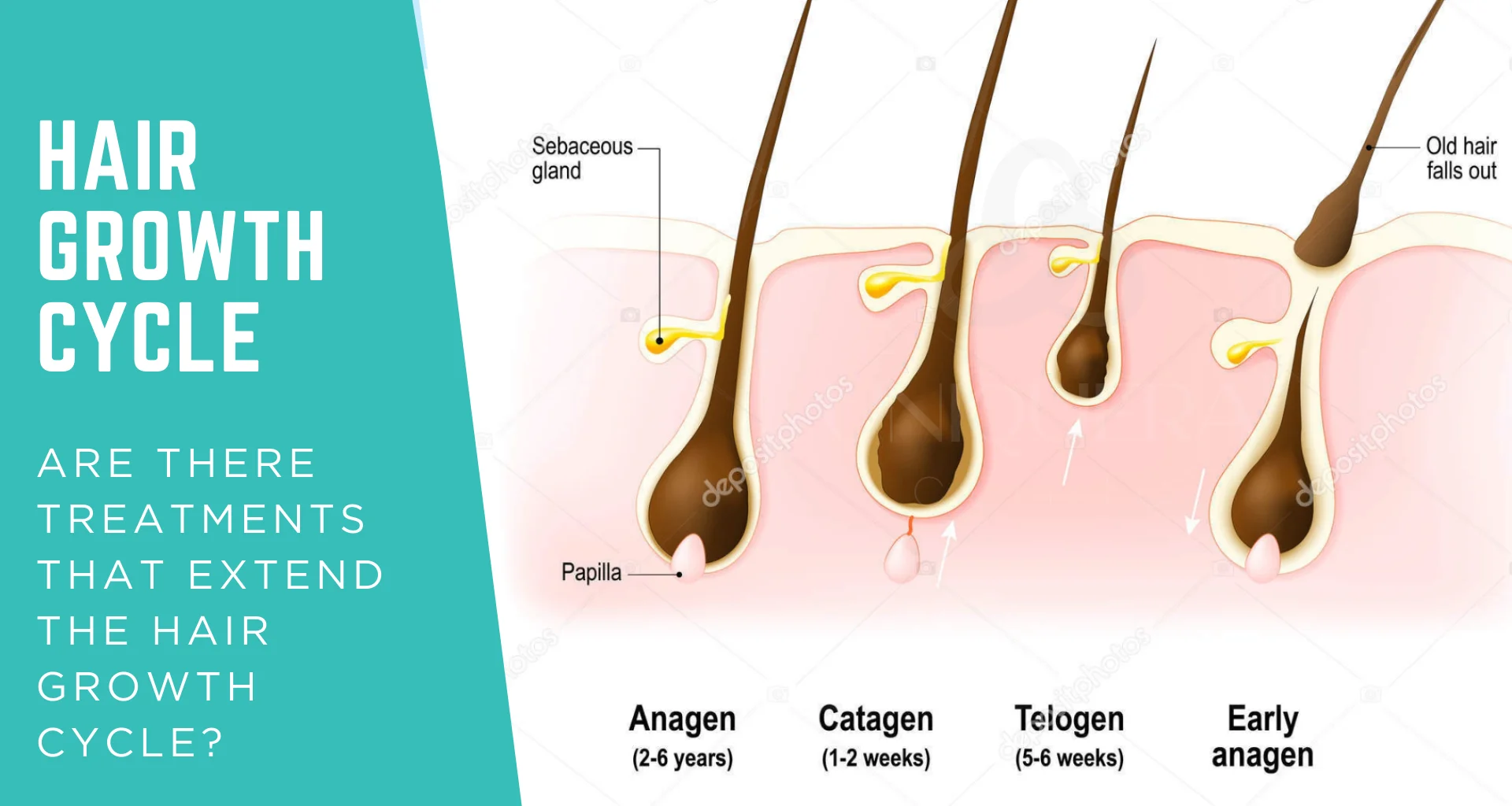
Hair does not grow continuously. Each follicle moves through repeating biological stages. During the anagen phase, each anagen follicle is metabolically active, deeply anchored, and continuously producing new hair fiber.
| Stage | What Happens | How Long It Lasts | % of Hair in This Stage |
| Anagen (Growth Phase) | Hair actively grows from the root. Cells divide rapidly, adding ~1 cm per month. Follicles are deeply anchored and nourished. | 2–7 years | 85–90% |
| Catagen (Transition Phase) | Growth stops. The follicle shrinks and detaches from blood supply. | 2–3 weeks | 1–3% |
| Telogen (Resting Phase) | Hair rests in the follicle. No active growth occurs. | 2–4 months | 10–15% |
| Exogen (Shedding Phase) | The old hair sheds, and a new anagen phase begins underneath. | Overlaps with telogen | Varies |
At any given time, most of your scalp hair is in the anagen growth phase.
Hair grows roughly 1 cm per month during anagen.
So:
That’s double the potential growth. This is why many patients ask how to increase anagen phase duration or how to keep hair in anagen phase longer. While you cannot exceed genetic limits, you can prevent premature shortening.
If your anagen phase of hair growth naturally lasts 3 years, no oil or serum will turn it into 7. But many people do not reach even their natural limit because something is shortening that window early.
Your anagen phase is influenced by both genetics and internal health signals.
| Factor | Effect on Anagen | Can It Be Optimized? |
| Genetics | Sets natural range (2–7 years) | No |
| Age | Gradual shortening over time | Partially |
| DHT (Hormone) | Causes follicle miniaturization | Yes |
| Thyroid function | Disrupts cycle timing | Yes |
| Iron / Protein deficiency | Pushes follicles into early telogen | Yes |
| Chronic stress | Triggers telogen effluvium | Yes |
| Scalp inflammation | Weakens follicle stability | Yes |
You cannot change your DNA. But you can prevent correctable factors from cutting your growth phase short.
You cannot override your genetic ceiling. But many people operate below their biological potential because something is shortening their growth window.
Think of genetics as your maximum capacity. Everything else determines whether you reach it.
A person genetically capable of a 5-year anagen phase may only experience 3 years due to:
That 2-year difference can mean 24 cm of lost growth potential.
This is why hair may feel “stuck,” even though the follicles are still alive.
If your hair feels stuck at a certain length, your first instinct may be to change products. But the real issue often sits deeper. Inside the follicle.
Before medical treatments, the foundation matters. Many people shorten their anagen phase unintentionally through stress, nutritional gaps, or scalp neglect. For most people, the best way to stimulate hair growth is to fix what’s shortening the growth phase first, then add targeted treatments if needed.
Natural support cannot override genetics. But it can help you reach your biological maximum.
To stimulate hair growth naturally, follicles need adequate circulation, protein availability, micronutrients, and hormonal balance. That activity requires oxygen, protein, micronutrients, and hormonal balance.
Here are the natural factors that directly influence anagen duration:
Yes. Hair follicles are among the most metabolically active cells in the body.
Nutrient deficiencies can push follicles prematurely into telogen (resting phase).
| Nutrient | Why It Matters | Food Sources |
| Protein | Keratin production. Hair shaft structure. | Eggs, fish, poultry, legumes |
| Iron | Oxygen delivery via hemoglobin. Prevents early telogen shift. | Spinach, red meat, lentils |
| Vitamin D | Regulates follicular cycling. Deficiency linked to disrupted anagen. | Sunlight, fortified foods |
| Biotin (B7) | Supports keratin infrastructure. | Nuts, seeds, eggs |
| Omega-3 | Reduces scalp inflammation. | Salmon, walnuts, flaxseed |
Adults generally require 0.8–1g protein per kg body weight daily to maintain tissue health.
Iron deficiency, especially in women, is one of the most common reversible causes of shortened growth cycles.
Possibly, yes.
Mechanical stimulation improves local blood circulation. Increased blood flow enhances oxygen and nutrient delivery to active follicles.
A 2016 study showed that 4 minutes of daily standardized scalp massage increased hair thickness after 24 weeks.
How to do it:
Consistency matters more than force.
Yes. Significantly. Chronic stress elevates cortisol, which can trigger telogen effluvium, a condition where large numbers of follicles shift from growth to resting phase simultaneously.
Normal shedding: 50–100 hairs/day. Stress-related shedding: 200–300 hairs/day.
Stress management supports follicular stability:
Hair reflects internal stability. Learning how to keep hair in anagen phase naturally starts with removing the internal factors that force follicles into premature rest.
Indirectly. Hair products do not change follicle biology. But minimizing breakage preserves the length your anagen phase produces.
Avoid:
Preserving length is different from increasing growth. Both matter.
When natural optimization is not enough, medical therapies can help stimulate hair follicles and prolong anagen within biological limits.
If natural support is not enough, the next question becomes how to stimulate hair follicles directly and safely stimulate hair growth at the cellular level.
Yes. PRP delivers growth factors that improve follicle activity and blood supply.
Typical protocol:
Yes. LLLT uses red light (650–900 nm) to stimulate mitochondrial activity in follicular cells. Increased ATP production supports prolonged growth activity.
A review in the American Journal of Clinical Dermatology reported a 35% increase in hair count after 16 weeks .
| LLLT Details | Duration |
| Frequency | 2–3 sessions weekly |
| Session duration | 15–30 minutes |
| Downtime | None |
| Visible change | 3–6 months |
Non-invasive. No recovery required.
It delivers vitamins and amino acids directly into the scalp to support follicle metabolism. Used in cycles of 3-6 sessions.
Emerging research suggests regenerative therapies may help miniaturized follicles re-enter active growth. Typically considered in more advanced thinning.
Natural support works best when:
Medical treatments become relevant when:
The key is evaluation, not assumption.If your hair never grows past a certain point, it may not be weak.
It may be exiting growth mode too early.The difference between a 3-year and 5-year anagen phase can mean 24 additional centimeters of potential growth.
Understanding what shortens that window is the first step. If you’re unsure whether your growth phase is functioning at its full capacity, a structured hair cycle assessment can clarify what’s realistic in your case.
Hair transplantation moves follicles from the donor area to thinning regions. But relocation alone does not guarantee strong growth. This matters even more if you’re planning a DHI hair transplant or FUE hair transplant Istanbul, because follicle biology affects regrowth speed and thickness.
The real success factor is how well those follicles re-enter and sustain the anagen phase after surgery.
After transplantation:
If the follicle’s biological health is strong, it transitions back into growth more efficiently and produces thicker, more stable hair.
Even after successful surgery, these can reduce growth quality:
A transplant restores hair. Anagen strength determines how well that hair performs long term.
Extending the anagen phase is not about adding random treatments. It starts with understanding whether your growth cycle actually needs intervention.
1. Medical Director Led Evaluation
Your hair cycle is assessed through trichoscopy, donor density analysis, medical history, and growth pattern review. The goal is to identify whether shortening of anagen is genetic, hormonal, nutritional, or stress-related.
2. Cause-Based Treatment Planning
Not all thinning is the same.
Treatment is aligned with biology, not trends.
3. Surgical Precision with Biological Support
When transplantation is involved, techniques like DHI and FUE Sapphire aim to preserve follicle integrity. PRP or LLLT may be added to support healthy re-entry into anagen.
4. Honest Boundaries
If your anagen phase is already near its genetic maximum, that is communicated clearly. Treatment is recommended only when meaningful improvement is realistic.
5. Structured Follow-Up
Hair growth unfolds over months. Monitoring and protocol adjustments are part of the process.
If you’re unsure whether your growth phase is underperforming or simply reaching its natural limit, a proper evaluation can clarify that.
Your hair may not be weak. It may be exiting the anagen phase too early.
The difference between a 3-year and 5-year growth window can mean 24 cm of potential length.
You cannot change genetics. But you can correct what shortens your growth phase prematurely.
If you want clarity on whether your hair is underperforming or simply reaching its natural limit, a structured evaluation can provide answers.
Book a consultation with UniquEra’s Medical Directors for a detailed hair cycle assessment and evidence-based guidance tailored to your biology.
The anagen phase typically lasts 2–7 years for scalp hair. Most people fall within the 3–5 year range. Body hair has a much shorter anagen phase, lasting only weeks to months.
You cannot exceed your genetic maximum. However, treatments like PRP and LLLT may help you reach the upper end of your natural range by improving follicle health.
About 85–90% of scalp hair is in active growth (anagen). Around 10–15% is in telogen, and 1–3% is in catagen. Shedding 50–100 hairs daily is normal.
Anagen hair feels firmly anchored and resists gentle pulling. It grows steadily at about 1 cm per month. Telogen hair sheds easily and has a small white bulb at the root.
Yes. Clinical studies show PRP can stimulate follicle activity and may prolong anagen by improving blood supply and cellular signaling.
Stronger anagen capacity improves graft survival, growth speed, and long-term thickness after transplantation.
Protein (eggs, fish, legumes), iron (spinach, red meat), biotin (nuts, seeds), omega-3 (salmon, walnuts), and vitamin D all support follicle function.