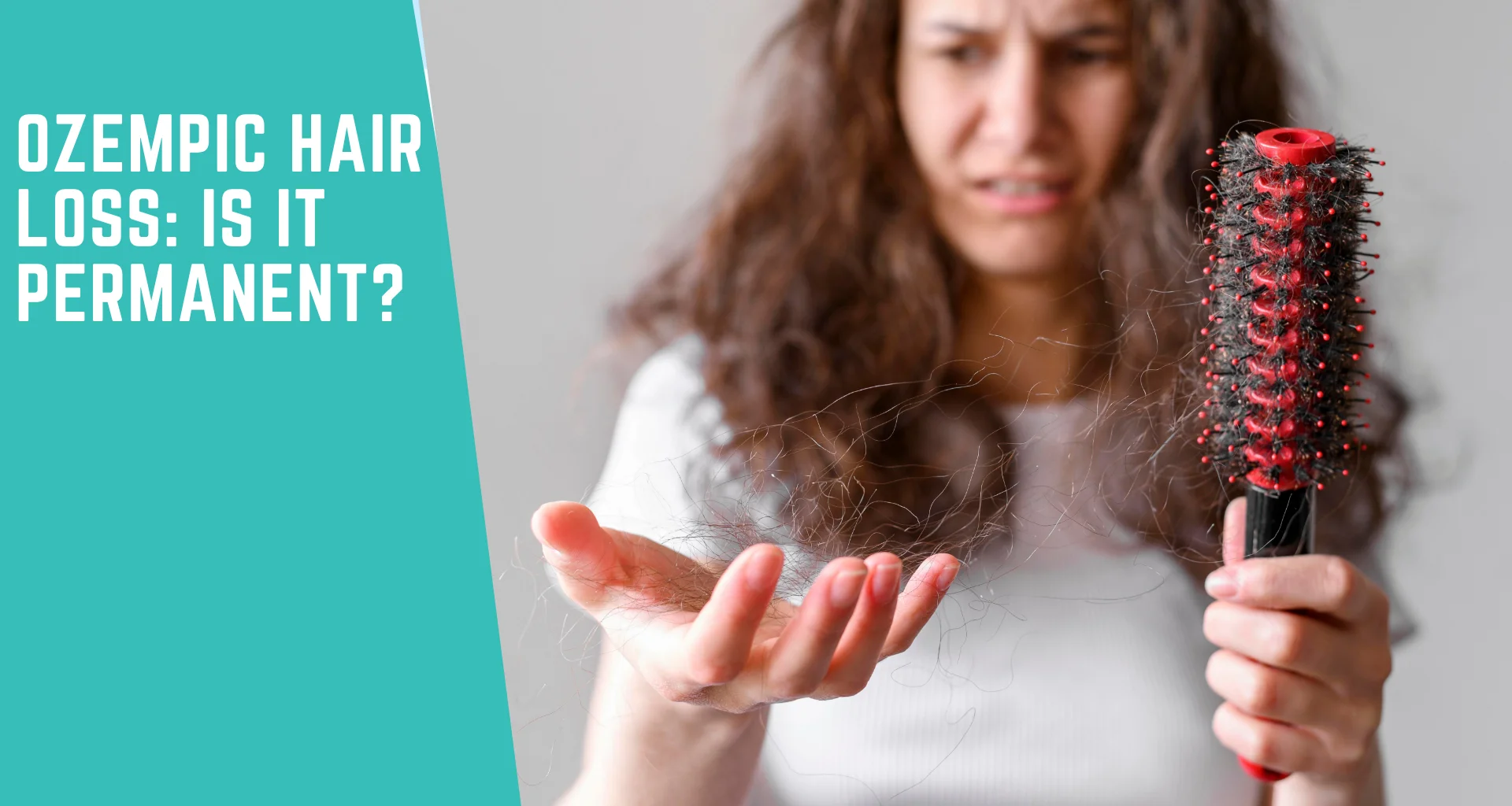

Ozempic hair loss is usually temporary. In most cases it is caused by rapid weight loss, low protein, or nutritional gaps, not direct damage from the medication.
But it is not always that simple. Sometimes the shedding is a signal that something else was already developing, such as male pattern baldness, female pattern hair loss, thyroid imbalance, low iron, or scalp inflammation.
So the real question is not just whether Ozempic causes hair loss. It is what type of hair loss you have, and whether the follicle can still recover.
This guide covers both.
If your shedding started after Ozempic and you are unsure whether it is temporary or something deeper, a private hair assessment at UniquEra Clinic can help you find the cause before choosing any treatment.
Does Ozempic cause hair loss?
Ozempic may be linked with hair loss in some patients, but it does not usually mean the medicine is directly damaging the hair follicles.
Ozempic contains semaglutide. Some patients using semaglutide report increased hair shedding, particularly during periods of rapid weight loss. The bigger trigger is often what happens after appetite drops.
When you eat less, protein intake falls, weight drops quickly, the body experiences stress, and nutrient levels may follow. This can push more hairs into the shedding phase.
Ozempic side effects on hair loss are mostly indirect. The medication reduces appetite. Poor nutrition does the rest.
Ozempic cuts appetite sharply. Many people eat far less than they realise, dropping protein and calories to levels the body cannot sustain hair growth on. Hair growth needs energy, protein, vitamins, and a stable body environment. When those drop, hair becomes a lower priority.
Ozempic reduce appetite. For many people that means eating much less without realising how low their nutrition has dropped.
Common reasons behind Ozempic hair thinning:
| Trigger | How it affects hair | Note |
| Rapid weight loss | Can shock the hair growth cycle | One of the most common triggers. Hair enters a resting phase when the body loses weight too fast. |
| Low protein intake | Weakens hair growth support | Hair is made of keratin, a protein. Without enough dietary protein, new hair growth slows or stops. |
| Low iron or ferritin | Can increase shedding | Low ferritin is one of the most overlooked causes of hair loss. Get tested before assuming the cause. |
| Low vitamin D or zinc | May worsen thinning | Both play a role in follicle cycling. Deficiencies are common in people eating less during weight loss. |
| Low appetite | Reduces total nutrition | Ozempic reduces hunger significantly. Many people undereat for months without realising it. |
| Body stress | Pushes hair into the shedding phase | Physical stress from rapid weight change can trigger telogen effluvium, a temporary but heavy shed. |
| Existing genetic hair loss | May become more visible during weight loss | Ozempic does not cause this. It can make existing thinning easier to notice. |
This is why one person may take Ozempic with no hair issues, while another notices heavy shedding a few months in.
Usually, Ozempic hair loss is not permanent.
If the cause is temporary shedding, the follicles are still alive. They are resting and shedding more than usual. Once the body stabilises, hair can start growing again.
It may not recover fully if another condition is also present:
• Male pattern baldness or female pattern hair loss
• Thyroid imbalance
• Low ferritin or iron
• Scalp inflammation
• Alopecia areata
• Scarring scalp disease
Temporary shedding can grow back. Permanent follicle miniaturisation needs proper hair loss treatment.
Shedding typically starts around two to four months after rapid weight loss or major diet changes.
| Timeline | What may happen |
| Month 0 | Ozempic starts |
| Month 1-2 | Appetite drops. Weight loss begins. |
| Month 2-4 | Hair shedding may start |
| Month 4-6 | Shedding may peak |
| Month 6-9 | Regrowth may become visible |
| Month 9-12 | Density may slowly improve |
If shedding continues beyond nine to twelve months, or your hairline and crown keep getting thinner, a crown hair transplant assessment may eventually become relevant and the cause may not be simple Ozempic-related shedding.
Hair loss after Ozempic usually looks like diffuse shedding. Hair falls from all over the scalp, not just one area.
You may notice:
• More hair in the shower.
• More hair on the pillow.
• Hair coming out while brushing.
• A thinner ponytail.
• More visible scalp.
• Hair feels weaker after washing.
This is different from receding hairline hair loss or crown-focused thinning patterns , which usually affects the hairline, temples, crown, or mid-scalp in a recognizable pattern.
Ozempic-related shedding often looks similar to diffuse thinning hair loss, where density reduces across the scalp instead of one isolated area.” Pattern baldness follows a set pattern at the hairline, temples, or crown. The treatment for each is different.
| Sign | Ozempic-related shedding | Pattern baldness |
| Pattern | All-over shedding | Hairline, temples, crown |
| Timing | Starts after weight loss | Gradual over time |
| Hair type | Normal hairs shed | Hairs become thinner over time |
| Recovery | Often improves on its own | Usually needs treatment |
| Transplant need | Usually not needed early | Possible if loss is stable |
Sometimes both happen together. Ozempic does not cause pattern baldness, but rapid weight loss can make existing thinning more visible.
Not sure which type of hair loss you have? We can review your hair loss pattern, photos, and history before suggesting any next step.
Book a free video consultation
The cause must be identified before any thinning hair treatment begins. Without a proper diagnosis, you may be treating the wrong thing.
A specialist may suggest:
• CBC
• Ferritin and iron studies
• Vitamin D
• Zinc
• Thyroid panel
• B12 and folate
• Hormonal review if needed
• Scalp examination
• Trichoscopy. This uses a handheld magnification device to examine individual follicles at scalp level, checking root health and identifying miniaturisation patterns.
• Density mapping. This measures thinning across different scalp zones to show where loss is most active.
These tests help separate temporary shedding from permanent hair loss before any treatment decision is made.
The most effective steps are fixing nutrition, correcting deficiencies, and giving your body time to stabilise.
Start with protein. Low protein is one of the most common drivers of shedding during weight loss. Hair needs amino acids to grow. Aim for consistent protein at every meal.
Do not add more restrictions on top of Ozempic. The medication already reduces appetite significantly. Extreme dieting on top of that makes shedding worse.
Get your blood markers checked. Iron, ferritin, vitamin D, zinc, B12, and thyroid all affect hair. Do not guess. Get tested.
If your scalp is itchy, oily, or inflamed, treat that separately. Scalp inflammation increases shedding and will not resolve on its own.
Be gentle with your hair. Tight hairstyles, bleaching, aggressive brushing, and heat styling all add stress to already weakened follicles.
One thing to be clear about: do not stop Ozempic without speaking to your prescribing doctor first. That is a medical decision, not a hair decision.
The best hair loss treatment depends entirely on the cause. There is no single answer that works for every patient.
If it is temporary shedding, the focus is on:
If Ozempic revealed underlying genetic thinning, a hair specialist or dermatologist may discuss medical treatment options suited to your case. What is appropriate depends on your age, health, hormone profile, and the type of hair loss confirmed through diagnosis.
PRP is one option some clinics use to support follicle recovery in early thinning. A hair transplant evaluation or a manual FUE hair transplant may become relevant once shedding stabilises and permanent loss is confirmed.
The wrong move is treating every patient the same. A patient with temporary shedding should not be rushed into any treatment. A patient with confirmed pattern hair loss should not be told to just wait indefinitely.
Minoxidil may help if there is ongoing thinning or pattern hair loss. It will not fix low protein, low iron, thyroid problems, or fast weight-loss stress by itself.
PRP may help patients with weak follicles, early thinning, or slow recovery after shedding. It is not a solution for every case.
If the main issue is poor nutrition, low ferritin, or an unstable weight-loss phase, that needs to be corrected first. Starting treatment before the root cause is addressed wastes time and money.
A hair transplant is usually the wrong choice if you are still actively shedding.
It is likely too early if:
• Hair loss started recently
• Shedding is all over the scalp with no clear pattern
• Weight is still dropping quickly
• Nutrition is poor
• Blood markers are low
• The donor area is weak
A good clinic should be honest enough to say not yet when surgery is not the right step. Rushing into a transplant during active shedding wastes grafts and produces poor results.
A transplant can help if Ozempic revealed permanent pattern hair loss that does not recover after the body stabilises.
This may apply if you have:
• A receding hairline
• Crown thinning
• Stable male pattern baldness
• Areas where follicles have miniaturised
• Thinning that does not improve after nutrition correction and medical review
In these cases, the transplant is not treating temporary Ozempic shedding. It is restoring areas where follicles are no longer growing properly.
Finding the best hair transplant clinic in Turkey after Ozempic means looking beyond price and graft count. Here is what actually matters:
A clinic that skips these steps and moves straight to booking is not doing a proper assessment.
In most cases, yes. Wait until:
• Weight has stabilised
• Shedding has reduced
• Nutrition is corrected
• Blood markers are within normal range
• The hair loss pattern is clear
• The donor area has been properly assessed
Do not plan surgery while the cause is still unclear.
It may grow back if the cause was temporary shedding and the body stabilises.
But stopping Ozempic does not guarantee regrowth if the real issue is pattern baldness, thyroid imbalance, low iron, or scalp disease.
Do not stop Ozempic without speaking to your prescribing doctor. Stopping abruptly can affect blood sugar control.
Food will not reverse every type of hair loss. But it can support recovery when shedding is linked to nutrient gaps or rapid weight loss.
Focus on:
• Protein sources: eggs, fish, chicken, Greek yogurt, lentils, beans, tofu, nuts
• Iron-rich foods: leafy greens, red meat, lentils, fortified cereals
• Vitamin C to support iron absorption: berries, citrus, bell peppers
• Zinc and B12: nuts, seeds, whole grains, dairy
The goal is enough protein, enough calories, and a balanced diet. Hair recovery is a slower process than weight loss.
In one year, stop waiting and get a proper assessment. Temporary shedding usually resolves within six to nine months. If it has not, the cause is likely something else. Pattern hair loss, thyroid imbalance, low ferritin, or scalp inflammation can all look like Ozempic shedding at first.
Signs that warrant a specialist visit:
A specialist can check your blood markers, examine the scalp, and tell you whether what you have is still temporary or needs treatment.
Waiting another six months without a diagnosis is not a plan.
For most people, the shedding is temporary. Once weight stabilises, nutrition improves, and the body rebalances, hair typically starts recovering on its own.
It can persist, or seem permanent, if Ozempic has revealed a deeper issue such as male or female pattern baldness, thyroid problems, iron deficiency, or scalp inflammation.
The right step is always diagnosis first. Identify the cause before choosing any treatment.
If your hair has not recovered after Ozempic, or you are seeing clear thinning in the hairline, crown, or overall density, book a consultation with UniquEra Clinic. We can help you understand whether you need recovery support, thinning hair treatment, or a medically planned hair transplant in Turkey. Book a free consultation
Some patients report hair loss after Ozempic. In most cases it is linked to rapid weight loss, low food intake, stress, or nutrient gaps, not direct damage from the medication.
Usually no. Temporary shedding improves once the body stabilises. It may persist if there is an underlying condition such as pattern baldness or thyroid imbalance.
Many cases improve within six to nine months once the trigger is corrected. Full density recovery can take longer.
Ozempic reduces appetite, which can lead to low protein and calorie intake. That nutritional stress is the main driver of shedding, not the medication itself.
Speak with your doctor, eat enough protein, correct any deficiencies, treat scalp issues, and get a proper hair diagnosis before starting any treatment.
It may, if the cause was temporary shedding. But stopping Ozempic is not always needed and should only be decided with your prescribing doctor.
It depends on the cause. Temporary shedding may only need nutrition correction and time. Pattern hair loss may need minoxidil, finasteride, PRP, or transplant evaluation.
Not if it is active temporary shedding. A transplant may help only once permanent pattern hair loss is confirmed and the loss has stabilised.
See a specialist if shedding has been heavy for more than six months, the hairline or crown is thinning, or you have itching, redness, scaling, pain, or patchy loss.
Ozempic shedding is diffuse, affects all areas, and usually improves. Pattern baldness follows a recognisable pattern at the hairline, temples, or crown, and does not reverse without treatment.