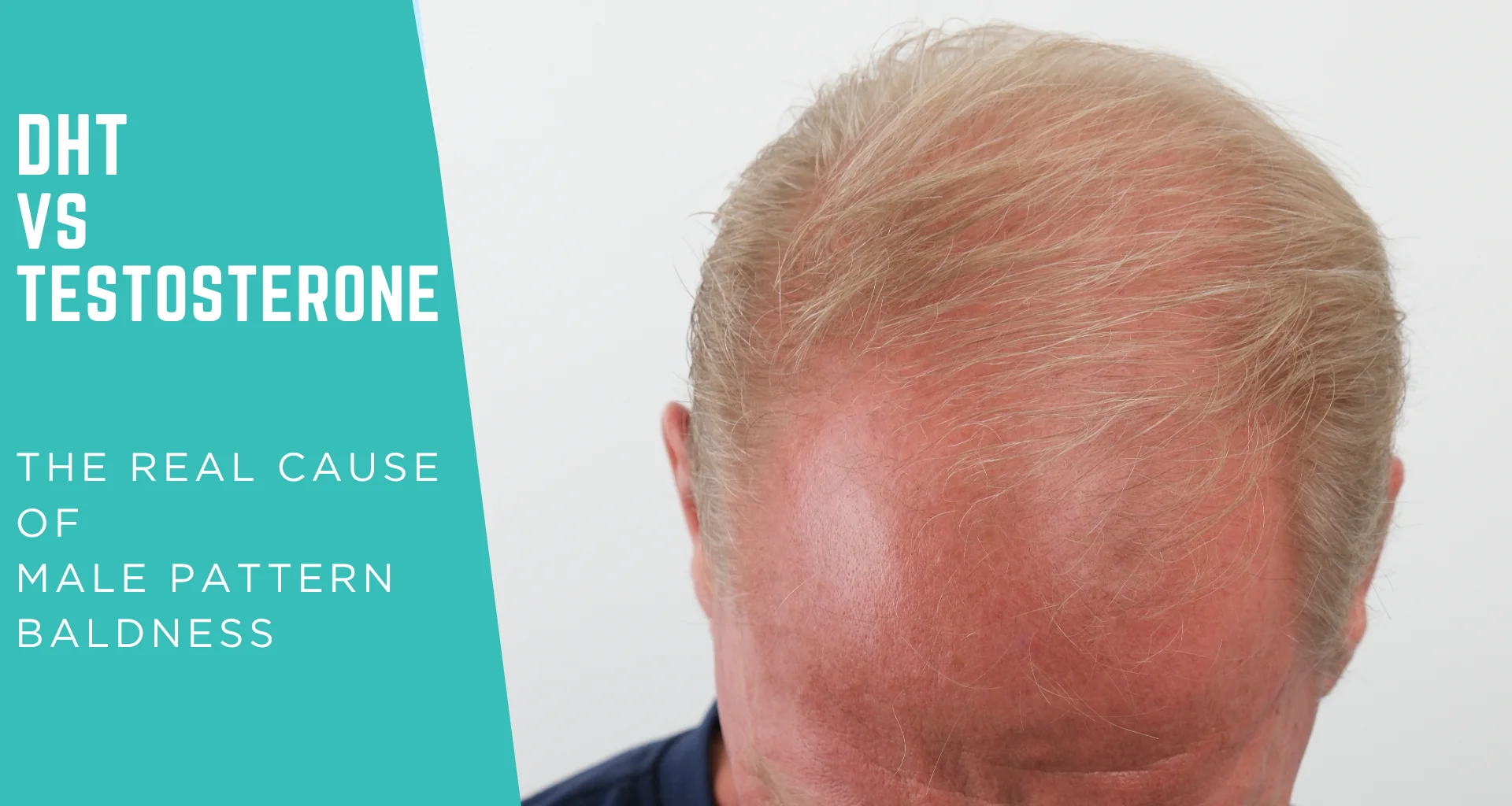

You started checking in different lighting. Adjusting how you style it. Tilting your head slightly in photos. Little things you do not talk about but have become a quiet routine.
Then someone said it. High testosterone causes baldness. Maybe a friend. Maybe something you read. And now you are not sure whether to feel reassured or more concerned.
Many people search- does testosterone cause hair loss ?
Here is what science actually says. Testosterone is not what causes male pattern baldness. Not directly. The real mechanism involves a hormone your body makes from testosterone, a genetic sensitivity most men never know they have, and a process that starts years before the hair loss becomes obvious.
Understanding the real cause does not just answer a question. It tells you exactly what can be done about it and when.
If you are already seeing a receding hairline or thinning crown and want to understand what your specific situation means for treatment, UniquEra’s medical team is available for a direct consultation.
No. Testosterone does not directly cause male pattern baldness.
Many men with significant hair loss have completely normal testosterone levels. Some have below average. The hormone level itself is not what drives the process.
What matters is how much testosterone converts to a more potent derivative called DHT, and how sensitive your follicles are to it. Two men with identical testosterone levels can have completely different hair loss outcomes.
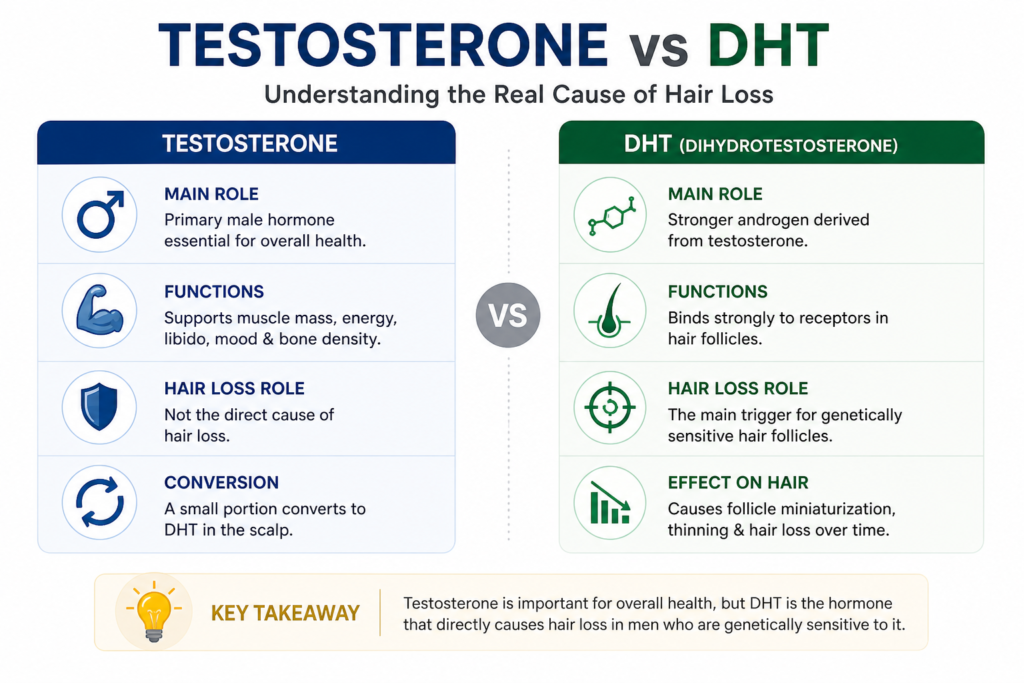
DHT is a hormone made from testosterone. The enzyme 5-alpha reductase converts a portion of circulating testosterone into DHT in scalp tissue.
The connection between DHT and hair loss comes down to follicle sensitivity, not simply how much DHT exists in your blood.
| Testosterone | DHT | |
| Type | Primary male androgen | Derived androgen, testosterone metabolite |
| Made by | Testes, adrenal glands | Converted from testosterone by 5-alpha reductase |
| Potency | Standard | 2 to 3 times more potent |
| Binds to follicle receptors | Weakly | Strongly, stays bound longer |
| Role in hair loss | Indirect, as a substrate | Direct cause of follicle miniaturisation |
| Can convert to estrogen | Yes | No |
Only around 10% of circulating testosterone converts to DHT. Yet that 10% drives over 95% of male pattern baldness cases.
DHT binds to androgen receptors in scalp follicles two to three times more strongly than testosterone. Even in small quantities it has a disproportionately powerful effect on genetically sensitive follicles.
DHT causes male pattern baldness by binding to androgen receptors in susceptible scalp follicles and triggering a progressive miniaturisation process – learn more about the science behind DHT hair loss.
It works in stages:
1 DHT binds to the follicle receptor: In genetically sensitive follicles, even normal DHT levels trigger a response.
2 The growth phase shortens: Each hair spends less time actively growing. Hairs become thinner and shorter with each cycle.
3 The resting phase extends: The follicle sits dormant for longer between cycles.
4 The follicle shrinks: Over months and years it produces hair so fine it is barely visible.
5 The follicle goes dormant: It stops producing hair altogether. Still present but no longer active.
This process plays out over years. It is why male pattern baldness is gradual and follows a recognisable pattern across the scalp.
Genetics is the dominant factor. Around 80% of bald men have bald fathers.
The key variable is how sensitive your follicle receptors are to DHT. This is determined by a gene variant on the X chromosome. Men who carry it have follicles that over-respond to DHT even at normal levels. Research shows this variant gives a four times higher risk of early male pattern baldness.
You can have low testosterone, low DHT, and still lose your hair. If your follicles are programmed to react to whatever DHT is present, the level almost does not matter.
Two other factors play a role. Men with higher 5-alpha reductase activity in the scalp convert more testosterone to DHT locally, even when blood levels look normal. And local DHT inside the follicle can be much higher than a blood test suggests.
Androgenetic alopecia is the medical term for male pattern baldness. It affects around 50% of men by age 50.
It needs two things to develop. DHT activity and a genetic predisposition to follicle sensitivity. Without both, the pattern does not follow.
In men it starts with a receding hairline at the temples. Then thinning at the crown. Over time those two areas connect. The earlier it is caught, the more options exist – from medication to a receding hairline transplant. . The earlier it is caught the more options exist. By the time most men act, over 50% of density in the affected area is already gone. Medication works best early. The longer follicles are exposed to DHT, the fewer options remain to recover them.
| Stage | What it looks like | Treatment relevance |
| Early, Norwood 1 to 2 | Slight recession at temples | DHT blockers most effective. Maximum hair to protect. |
| Moderate, Norwood 3 to 4 | Clear M shape, visible crown thinning | Blockers plus transplant conversation. Hairline and crown restoration viable. |
| Advanced, Norwood 5 to 6 | Significant loss connecting hairline and crown | Transplant primary solution. Donor area planning critical. |
| Severe, Norwood 7 | Thin band remaining at sides and back | Transplant possible depending on donor density. Realistic expectations essential. |
TRT can accelerate hair loss in men who are already genetically predisposed. It does not cause hair loss in men who are not.
TRT raises circulating testosterone. More testosterone means more available for conversion to DHT. In men with sensitive follicles, that increased conversion speeds up a process that was already happening.
In men without the genetic predisposition, elevated testosterone from TRT does not lead to meaningful hair loss.
Men on TRT who are concerned about hair loss can combine therapy with a DHT blocker under medical supervision. That decision should always be made with a qualified doctor.
You cannot stop DHT production entirely without significant side effects. But you can reduce its impact on hair follicles and slow the progression of male pattern baldness meaningfully. The goal is to reduce its effect on genetically sensitive follicles through the right DHT hair loss treatment plan.
| Treatment | What it does | What it cannot do |
| Finasteride | Blocks 5-alpha reductase, reduces DHT by up to 70% | Reverse established miniaturisation or regrow dormant follicles |
| Dutasteride | Stronger DHT reduction | Guarantee results or suit all patients |
| Minoxidil | Improves blood flow, extends growth phase | Block DHT or address the hormonal cause |
| Natural blockers | Mildly reduces DHT production | Replace pharmaceutical options for significant loss |
| Hair transplant | Permanently restores DHT-resistant follicles | Stop DHT affecting remaining native hair |
Does Blocking DHT Regrow Hair?
In early stage thinning, yes partially. Reducing DHT allows weakened but still active follicles to recover some density. Around 65% of men see visible improvement after two years on finasteride.
It does not work on follicles that have already gone fully dormant. That is the honest limit of what DHT blockers achieve.
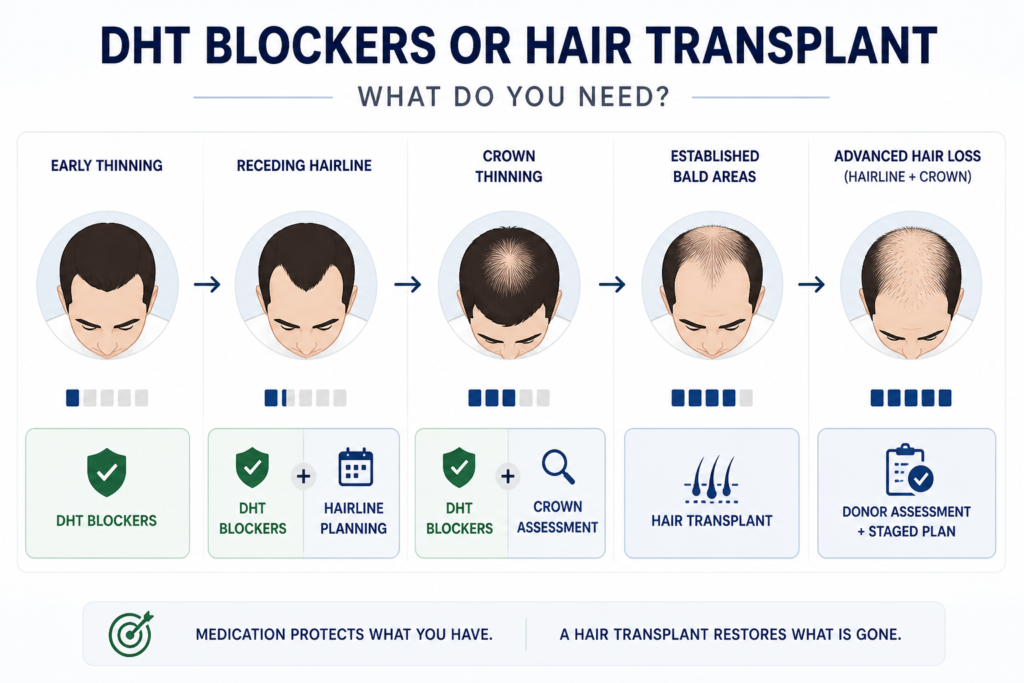
A hair transplant becomes the right answer when androgenetic alopecia has progressed past what DHT blockers can maintain or recover.
A hair transplant for male pattern baldness, also called a hair transplant for androgenetic alopecia, is usually considered when the hairline, crown, or mid-scalp has lost density that medication alone cannot bring back.
Medication protects what is there. A transplant restores what is already gone. These are different jobs and neither replaces the other.
Donor follicles from the back and sides of the scalp are genetically resistant to DHT. When moved to thinning areas they keep growing permanently. They were never programmed to respond to DHT the way the lost hair was.
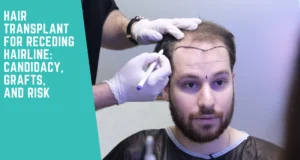
For a hair transplant for receding hairline, the goal is not just filling the temples. A good receding hairline transplant must rebuild the frame of the face with natural direction, soft single grafts, and age-appropriate density.
One important truth: a transplant does not stop DHT from affecting the native hair that remains around it. Many patients combine a transplant with ongoing DHT blocker therapy. The transplant restores. The medication protects what surrounds it.
At UniquEra Clinic, rated the best hair transplant clinic in Istanbul, every case is assessed individually. The technique, graft count, and approach are chosen based on your degree of loss, donor area quality, and goals.
For patients considering hairline restoration Turkey options, UniquEra Clinic focuses first on donor safety, natural hairline design, and long-term planning instead of promising the same technique to every patient.
A diffuse thinning hair transplant is planned differently depending on whether the loss is in the hairline, mid-scalp, or crown. A hair transplant for thinning crown often needs careful graft distribution because crown patterns spread in a circular direction and can consume many grafts. This is why a thinning hair transplant should be planned around donor supply, not only the visible bald area.
| Case type | Technique | Why |
| Receding hairline, moderate loss | DHI with Choi Pen | Precision placement, natural hairline angles, minimal trauma |
| Thinning crown, broader coverage | FUE Sapphire | Broader coverage, higher graft count, clean channel opening |
| Small case, high aesthetic demand | Manual FUE | Minimal scarring, precise extraction, ideal for visible areas |
| Combined hairline and crown | FUE Sapphire or DHI on assessment | Case-specific. Never pre-decided. |
If you are at an early stage, timing is the most important variable you have. If you are already seeing significant thinning, your options depend entirely on what your donor area looks like. Either way, the answer starts with a proper assessment. UniquEra’s medical team is available to give you an honest picture of where you stand.
Male pattern baldness is not a testosterone problem. It is a DHT sensitivity problem that genetics determines and DHT triggers.
Reduce DHT early and you protect what you have. Restore DHT-resistant follicles to areas of established loss and you get permanent results. Combine both and you address it as completely as current medicine allows.
Where you are in that progression determines your next step.
DHT does not stop. The follicles it has already affected will not recover on their own. If you are serious about doing something about it, book your consultation with UniquEra today
No. Many men with significant hair loss have normal or below average testosterone. The real factor is follicle sensitivity to DHT, not testosterone level.
Testosterone is the primary male androgen. DHT is made from it by 5-alpha reductase. DHT is two to three times more potent and binds more strongly to follicle receptors. Around 10% of testosterone converts to DHT but that fraction drives over 95% of male pattern baldness.
Yes. If your follicles carry a genetic sensitivity to DHT, even low DHT levels trigger miniaturisation. Hormone level is not the deciding variable. Follicle receptor sensitivity is.
Follicles at the temples, front, and crown are genetically sensitive to DHT. Follicles at the back and sides are not. This is why hair loss follows a pattern and why donor hair keeps growing permanently after a transplant.
In early stage thinning, partially yes. Finasteride produces visible improvement in around 65% of men after two years. It does not reactivate follicles that have already gone fully dormant.
The medical term for male and female pattern baldness. It requires DHT activity and a genetic predisposition to follicle sensitivity. Affects around 50% of men by age 50 and follows a progressive pattern of recession and crown thinning.
TRT can accelerate hair loss in men already predisposed to male pattern baldness by increasing testosterone available for DHT conversion. It does not cause hair loss in men without the genetic predisposition.
Follicles that have fully miniaturised and gone dormant do not recover on their own. Early stage loss can be slowed with DHT blockers. Established loss in dormant follicle areas is permanent without a hair transplant.
When androgenetic alopecia has progressed past what medication can maintain. When follicles in thinning areas have already miniaturised significantly. When the goal is permanent restoration, not just slowing further loss.
A transplant permanently restores DHT-resistant follicles to areas of established loss. It does not stop DHT affecting native hair around the transplant. Most patients combine a transplant with ongoing DHT blocker therapy for a complete approach.