
Female hair transplant for traction alopecia is one of the least documented procedures in hair restoration, and one of the most needed. Traction alopecia is a condition where timing changes everything. Early-stage cases can recover. Advanced cases cannot.
By the time most patients seek help, the follicles are already fibrosed. Permanently inactive.
That was the situation in Katrina Brown’s case.
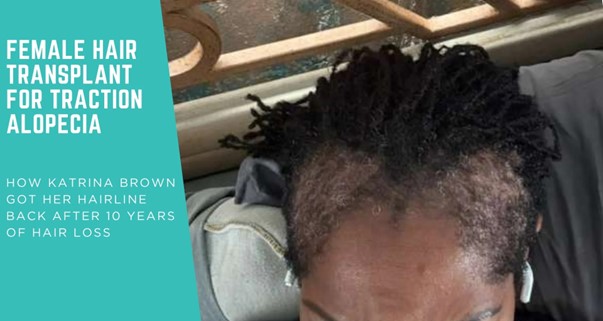
At 56, after more than a decade of tension-based hair loss from tight braiding, her frontal hairline and temples showed no active follicles remaining. Topical treatments hadn’t worked. They couldn’t. The cellular structures responsible for hair growth in those zones had already been replaced by scar tissue.
Katrina owns a beauty salon in Georgia. She’s african woman who works in an industry where she helps other women feel good about their hair every day. For 10 years, she couldn’t do that for herself. Her self-esteem had taken a real hit.
This case study breaks down exactly how her case was evaluated, why a DHI hair transplant was chosen, and how 3,000 grafts were used to rebuild a natural female hairline at UniquEra Hair Transplant Clinic in Istanbul Turkey.
If your hair loss pattern looks similar to Katrina’s, UniquEra Clinic’s medical team can evaluate your case through a detailed video consultation.
| Element | Detail |
| Patient | Katrina Brown, 56, beauty salon owner, Georgia, USA |
| Diagnosis | Traction alopecia with follicular fibrosis, frontal and temporal zones |
| Cause | Long-term tight braiding (10+ years) |
| Life impact | Low self-esteem, affected confidence as a beauty professional |
| Previous treatments | Topical regrowth products (ineffective, fibrosis already present) |
| Emotional trigger | Seeing her son’s hair transplant results at UniquEra Clinic |
| How she found UniquEra Clinic | Son (spine surgeon, prior UniquEra patient) referred her |
| Why she chose UniquEra Clinic | Trust built through son’s experience, liked the team and communication |
| Donor quality | Medium |
| Hair transplant procedure | DHI hair transplant (Choi Pen), 3,000 grafts, one-day procedure |
| Graft strategy | Singles at hairline edge and temples, doubles and triples behind the hairline edges |
| Medical Director | Cagri Celik |
| Emotional state post-procedure | Excited & confident |
| Hair transplant results at 6 months | Hairline restored, temple density increasing, natural symmetry |
| Expectation | More density through month 12 |
| Confidence impact | Happier, more comfortable wearing natural hair |
Traction alopecia is hair loss caused by repeated mechanical pulling on the follicles. It is one of the most common conditions requiring traction alopecia treatment through surgical hair restoration. It is not hormonal. It is not driven by dihydrotestosterone sensitivity like androgenetic alopecia. It is physical damage from sustained tension, applied over years.
The condition moves through two phases.
Early phase: Follicles are inflamed but still functional. You might notice baby hairs getting weaker, small bumps along the hairline, some tenderness. Stop the tension here and regrowth is still possible.
Late phase: Repeated trauma causes follicular fibrosis. The dermal papilla, the structure at the base of each follicle that generates new hair, gets replaced by scar tissue. The follicle can no longer cycle through anagen, catagen, and telogen. It becomes permanently inactive.
Studies estimate one-third to one-half of african women experience hair loss in their lifetime. Traction alopecia is one of the primary causes, driven by styles like cornrows, box braids, tight weaves, and sewn-in extensions that apply sustained force to the frontal and temporal zones. Hairline thinning in women and temple hair loss in women from these styles is far more common than most people realize.
Katrina’s loss followed this pattern. Frontal hairline recession and temple thinning, both consistent with long-term braid tension over a 10-year period.
Katrina, like many women dealing with female hair loss, only learned about this distinction after her condition had already passed the reversible stage.
This is where many patients get confused.
Treatments like PRP (platelet-rich plasma), low-level laser therapy (LLLT), or mesotherapy can stimulate weakened follicles, extend the anagen phase, and improve thickness. But they cannot regenerate a fibrosed follicle.
In Katrina’s case:
– No miniaturized hairs were present in the frontal or temple zones.
– No follicular activity remained in the affected areas.
– Dermal papilla structures were replaced by scar tissue.
That changes the entire treatment path.
Topical or injectable treatments work on follicles that are weakened but alive. Once the follicle has fibrosed, there is no living structure left to stimulate. At that stage, the only viable option is hair transplant surgery, taking healthy follicles from the donor zone and placing them where active follicles no longer exist.
Katrina had tried over-the-counter topical treatments before coming to UniquEra Clinic. They had no effect. As a beauty salon owner, she understood why. She could see the products weren’t doing anything, and she had enough industry knowledge to know they couldn’t.
This is where a proper hair transplant consultation becomes the first real step forward.
Her son referred her. He is a spine surgeon with a high-profile medical career, and he had his own hair restoration procedure done at UniquEra Clinic before Katrina ever considered it.
The emotional trigger that pushed Katrina to act: seeing her son’s results. After years of dealing with her own hair loss, seeing what was possible on someone she knew personally showed her that a real solution existed. That was the turning point.
When someone with a surgical background, someone who evaluates clinical environments and team competency professionally, chooses a hair transplant clinic in Turkey for his own care and then sends his mother to the same team, that reflects a specific kind of trust.
Katrina’s first consultation was March 20, 2025. She booked on May 25, 2025. The two-month gap was driven by a mix of excitement and natural emotions, which is common for first-time patients, especially women who haven’t seen many documented female cases to reference. The time gave her space to review her son’s results, talk to the consulting team, and arrive at her decision at her own pace.
What she told the team about why she chose UniquEra Clinic: she liked the people. She liked the way the team communicated. Combined with the trust her son had already built through his own experience, that was enough.
https://www.instagram.com/reel/DQBZ01Pj0Or/?utm_source=ig_web_copy_link&igsh=MzRlODBiNWFlZA==
Two patients with traction alopecia can need completely different approaches. The hair transplant evaluation is where those differences get identified.
The team assessed whether the follicles in Katrina’s frontal and temple zones were miniaturized (alive but producing thinner hairs) or fully fibrosed (scarred, producing nothing).
Result: follicular fibrosis in both zones. No miniaturized hairs remaining. Permanent loss confirmed.
Years of traction can alter tissue laxity and texture in the affected areas. The team evaluated whether Katrina’s recipient zone could support healthy graft placement and provide adequate blood supply for graft survival.
Result: tissue quality was sufficient for implantation.
Katrina’s occipital and parietal donor zones were classified as medium quality. Sufficient follicular density for the planned DHI hair transplant procedure, but strategic harvesting was required to avoid over-extraction and preserve the donor area’s natural appearance.
Natural hairline design for female patients is a different discipline than for male patients. Female hairlines are rounder, softer, and sit lower. The team mapped a curvature specific to Katrina’s facial proportions.
The density plan used a two-tier graft distribution:
Frontal hairline edge: Single-follicular-unit grafts (1 hair per graft). Singles create the soft, feathered edge that makes a hairline look natural. Multi-unit grafts at the front would appear pluggy and artificial.
Behind the edge and add temples on frontal hairline edge, because we use singles grafts: Double and triple-follicular-unit grafts (2-3 hairs per graft) for density buildup where the eye doesn’t detect the transition.
The planning process focused on matching the design discussed during hair transplant consultation with what would be executed during the procedure, a principle UniquEra Clinic consistently follows across all cases.
If you’re experiencing:
– Receding hairline from braids or extensions.
– Hairline thinning or temple hair loss that hasn’t improved over time.
– No visible regrowth despite treatments.
The first step is not treatment. It’s diagnosis. A proper hair transplant evaluation determines whether your follicles are still active or permanently inactive, and that distinction changes everything about what comes next.
You can request that evaluation through UniquEra Clinic’s medical consulting team.
UniquEra Clinic doesn’t default to a single technique. The medical team selects the approach based on the clinical specifics of each case.
| Factor | DHI hair transplant (chosen) | FUE Sapphire hair transplant |
| Area size | Small, focused zones (hairline + temples) | Better suited for large coverage areas |
| Precision | High, per-graft control of angle, depth, direction via Choi Pen | Moderate, dependent on pre-made channel accuracy |
| Hairline work | Ideal for soft, natural female hairline edges | Not recommended for female hair transplant |
| Tissue trauma | Minimal, direct implantation | Slightly higher due to separate channel creation step |
| Donor efficiency | Maximum, less graft handling between extraction and implant | Good, but more steps increase handling time |
For patients comparing techniques, understanding the difference between DHI vs FUE hair transplant helps clarify which approach fits specific cases.
Katrina’s case involved frontal hairline and temples only, where precision matters more than coverage area. The Choi Pen hair transplant technique was the correct approach for this type of focused female hair transplant.
| Detail | Katrina’s case |
| Procedure | DHI hair transplant (Choi Pen) |
| Total grafts | 3,000 |
| Graft types | Singles at hairline edge and temples, doubles and triples behind the hairline edges |
| Areas treated | Frontal hairline, both temple zones |
| Duration | One-day procedure |
| Medical Director | Cagri Celik |
| Date | August 22, 2025 |
Grafts were harvested individually from the occipital donor zone and sorted by follicular unit type: singles separated from doubles and triples. This sorting is what makes targeted placement possible.
Medical Director Cagri Celik loaded each graft into the Choi Pen and implanted them one at a time. Singles placed along the hairline edge at shallow angles (10-15 degrees) to match the natural forward lay of female hairline hairs. Multi-unit grafts placed behind the edge and in the temples at slightly steeper angles for density.
Medical team notes: donor quality medium. Primary objective was frontal density restoration and hairline reconstruction.
Katrina described her full experience in Istanbul positively. Comfortable with the staff and medical team throughout her stay.
Days 1-3: Mild swelling possible around the forehead. Small crusts at each graft site.
Week 1-2: Crusts shed naturally. Scalp heals. Most patients return to daily activities within 7-10 days.
Months 1-3: Transplanted hairs enter telogen effluvium (shedding phase). Normal. The follicular units are alive beneath the surface, resetting their growth cycle.
Months 3-6: New growth becomes visible. Density increases gradually. This aligns with the typical hair transplant recovery timeline for DHI procedures.
Tension-based hairstyles need to be avoided in the transplanted zone going forward. The transplanted follicles are healthy, but they respond to mechanical force the same way natural follicles do. Protecting them from repeated tension is part of maintaining the result long-term.
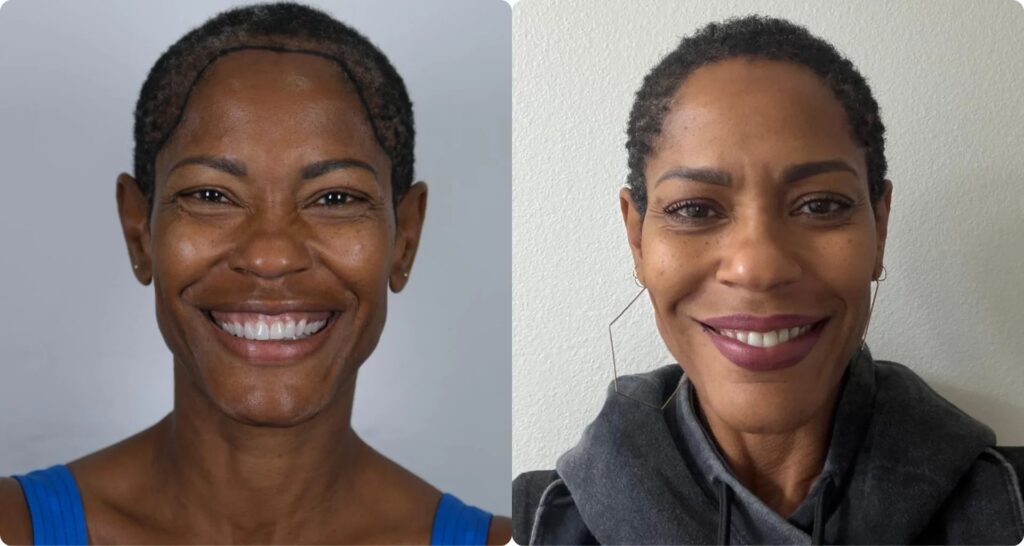
Frontal hairline: Restored. Natural curvature matching the design mapped during her pre-op consultation.
Temple zones: Density visibly increased in both areas.
Symmetry: Left and right sides balanced, which was a specific objective from the planning phase.
Confidence: Katrina says she feels happier with her appearance and comfortable wearing her natural hair than she has in years.
Katrina described her emotional state after the procedure as super excited and feels like a reborn.. After a decade of watching her hairline recede and products that didn’t work, the result was real.
At 6 months, she is approximately 60-70% of her final density. DHI hair transplant results continue developing through month 12. Her expectation going forward: more density as the remaining growth fills in over the next several months.
Katrina’s case is a clear example of how hair restoration changes once follicles are no longer active.
At that stage, technique selection becomes the deciding factor. Donor management becomes limited. And natural hairline design has to be precise enough to still look natural years later.
This is not about adding hair. It is about rebuilding structure in a zone where the body has stopped producing it, using follicular redistribution planned for that specific patient’s anatomy, loss pattern, and donor supply.
For women dealing with traction alopecia, Katrina’s case shows what the process looks like when the hair transplant evaluation is thorough, the DHI hair transplant technique aligns with the clinical situation, the graft strategy is tailored to the individual, and the team has the experience to execute it. For a woman who spent a decade searching for a solution, that process finally delivered one.
To have your case evaluated the same way, you can book a hair transplant consultation with UniquEra Clinic’s medical team.
Can you get a hair transplant at Norwood 7?
Yes. The outcome depends on donor area quality and graft distribution planning. Strong donor supply can achieve full coverage.
How many grafts are needed for advanced male pattern baldness?
Between 4,000 and 7,000. David received 5,500 DHI hair transplant grafts across all four zones in a two-day procedure.
Why does UniquEra Clinic offer two-day DHI hair transplant procedures?
DHI implants directly without pre-opened channels, causing less tissue inflammation. This allows a second day of implantation. UniquEra Clinic is the only clinic offering this for high-volume cases.
How long do hair transplant results last?
Permanently. Transplanted follicles are genetically resistant to DHT. David’s hair transplant results at 2 years show stable density with no regression.
How do you choose the right hair transplant clinic in Turkey?
Look at real documented case studies, ask about the medical team’s experience, technique selection process, and graft planning. That matters more than pricing.
What’s included in a hair transplant package in Turkey?
Typically the procedure, consultations, post-op medications, aftercare, transfers, and accommodation. At UniquEra Clinic, aftercare extends over 9 months with a proprietary product line.