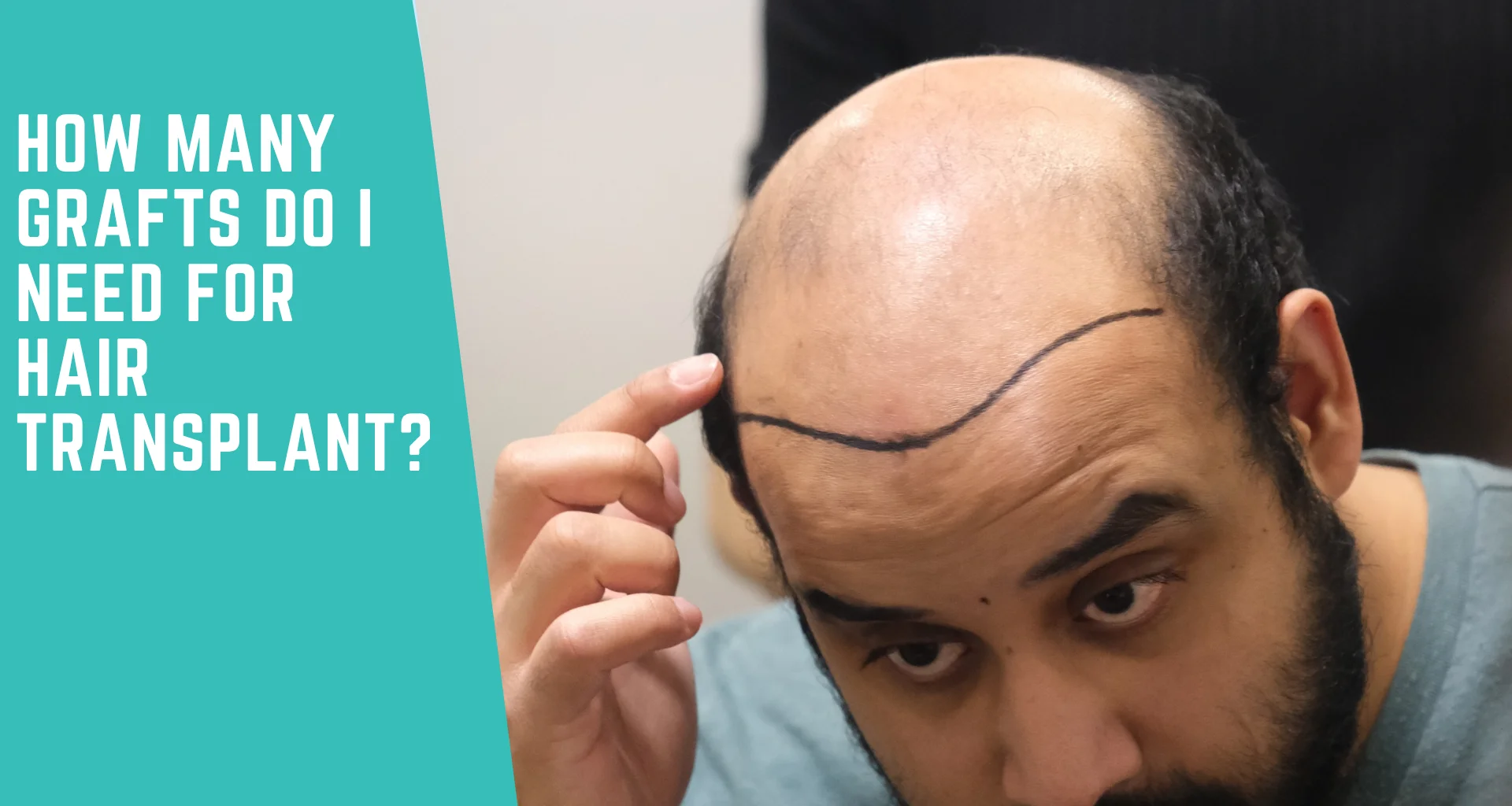

How many grafts do I need for hair transplant? It is one of the first things patients want to know, and the honest answer is: it depends on your hair loss stage, the area you want covered, and the quality of your donor area.
Most people need somewhere between 1,500 and 4,500 grafts. But that range is wide for a reason. A receding hairline at 28 is a completely different case from front-to-crown baldness at 45.
This guide gives you clear answers by Norwood stage, by zone, and by what each graft count actually looks like. You will also find sections on hair transplant density, overharvesting risks, and how many grafts are too many. Patients often ask how many grafts are needed for hair transplant procedures at different stages of loss. This guide answers that clearly, without the vague ranges other sites give you.
Most patients who contact us are surprised that the graft number they expected is not the number they actually need. A free consultation shows what your donor area can realistically support before you make a costly mistake.
Book your free consultation at UniquEra
A hair graft is a small piece of scalp tissue containing one to four hair follicles, plus the surrounding skin that nourishes them.
Hair transplant grafts are the building blocks of every procedure, and the number available often determines what result is realistically possible.
During a hair transplant, grafts are removed from the donor area at the back and sides of the head. That zone is genetically resistant to hair loss. The grafts are then placed into areas where hair has thinned or stopped growing entirely.
One graft typically holds one to four hairs. On average, a graft contains around two to two-and-a-half hairs. So 2,000 grafts can produce roughly 4,000 to 5,000 individual hairs in the treated area.
Many clinics advertise hair counts, not graft counts. ‘5,000 hairs transplanted’ sounds significant, but it could mean just 2,000 to 2,500 grafts. Always ask your clinic for the graft count. That is the correct unit of measurement in hair transplant planning.
The Norwood Hamilton scale maps male hair loss across seven stages. It is the standard tool used to estimate how many grafts a patient needs. These are starting estimates, not fixed numbers.
| Norwood Stage | Hair Loss Description | Estimated Grafts Needed |
| Stage 1-2 | Mild recession at the temples. The hairline starts pulling back. | 500-1,500 |
| Stage 3 | Noticeable recession at temples and frontal hairline. | 1,500-2,500 |
| Stage 4 | Deeper frontal loss. Crown begins thinning. | 2,500-3,500 |
| Stage 5 | Significant front and crown loss. Band of hair narrowing. | 3,500-4,500 |
| Stage 6 | Front and crown merge into one large bald area. | 4,500-5,500 |
| Stage 7 | Only a thin rim of hair remains at the sides. | 5,500-6,000+ |
Important: these ranges assume a healthy donor area. If your donor density is lower than average, the achievable graft count drops regardless of your Norwood stage.
The hair transplant donor area is often the biggest factor in determining how many grafts can be safely extracted and implanted.
Graft needs vary depending on which zone you are restoring. Hairline work needs far fewer grafts than full scalp coverage.
| Zone | Estimated Grafts | Notes |
| Hairline and temples only | 1,000-2,000 | Most common starting point for early loss. |
| Crown only | 1,500-2,500 | Requires careful density planning. |
| Frontal scalp only | 2,000-3,000 | Front to mid-scalp region. |
| Front and crown combined | 3,000-4,500 | Most common for Norwood 4-5. |
| Full head coverage | 4,000-5,000+ | May require two sessions. |
Two men with the same Norwood stage can receive recommendations that differ by more than 1,000 grafts. Hair characteristics, scalp size, donor quality, and future hair loss all change the calculation. That’s why online graft calculators are only a rough guide. Understanding what happens during a hair transplant consultation gives you a clearer picture of how your graft count is actually determined.
Want to know what your scalp actually needs? Send your photos to UniquEra for a personalised graft estimate and donor assessment.
A receding hairline typically needs 1,000 to 2,000 grafts. Early recession can be addressed with 1,000 to 1,500. More advanced frontal hairline loss may need closer to 2,000 to 2,500.
Crown hair transplant procedures usually need 1,500 to 2,500 grafts. The crown is a larger area than most patients expect. It also requires long-term planning because it is the zone most affected by ongoing hair loss.
Full coverage from hairline to crown typically requires 4,000 to 5,000 grafts or more. For Norwood 6 or 7 cases, two planned sessions are often the better approach.
Here is what each graft count delivers in practice, based on average donor quality and standard density targets.
| Graft Count | What It Covers | Best For |
| 1,000 grafts | Small frontal zone or one temple. Subtle improvement. | Early hairline recession, Norwood 2. |
| 2,000 grafts | Frontal hairline with around 30% area coverage. | Norwood 3-4, first-time patients. |
| 3,000 grafts | Front to mid-scalp. Visible density across the main bald area. | Norwood 4, moderate loss. |
| 4,000 grafts | Front and crown combined. Strong coverage across the top. | Norwood 4-5, advanced cases. |
| 5,000 grafts | Near-full scalp coverage. Requires a very strong donor area. | Norwood 6, selected candidates. |
A 2000 grafts hair transplant typically restores the frontal hairline and covers the front zone of the scalp. At UniquEra, 2,000 grafts deliver around 30% overall coverage. It is a solid result for Norwood 3 to early Norwood 4 patients who are focused on rebuilding the hairline rather than covering the full top.
Single follicle grafts are placed along the hairline edge for a natural look. Double follicle grafts go just behind to build density. The result looks natural because placement is planned by zone, not just by number.
A 3000 grafts hair transplant covers the frontal scalp and extends into the mid-scalp zone. It produces visible density across the area that patients see most in the mirror. For Norwood 4 cases with a moderate donor area, this is often the right session size. It gives strong front-to-middle coverage without over-taxing the donor zone in one sitting.
A 4000 grafts hair transplant addresses both the front and the crown in a single session for patients with a strong donor area. This is a significant session, and most clinics approach it carefully. Graft survival rates depend on how quickly each follicle is implanted after extraction. At UniquEra, the team’s experienced hands keep that window tight.
A 5000 grafts hair transplant provides near-full scalp restoration. It is rare in a single session because it requires an unusually rich donor area. More often, 5,000 grafts are spread across two sessions to protect donor density and give each batch of grafts the best survival conditions. The DHI technique makes two-day procedures manageable because the skin trauma between sessions is lower.
The biggest mistake patients make is assuming that more grafts automatically mean a better result. The right number is the one that achieves your goal without compromising future options. Get a personalised graft plan before choosing a clinic, package, or procedure.
Hair transplant density refers to how many grafts are placed per square centimetre of scalp. It determines how thick and full the final result looks.
Understanding density matters because a high graft count does not always mean high density. Grafts spread too thin across a large area can look sparse, even if the total number sounds impressive.
| Coverage Goal | Grafts per cm2 | Result |
| Light coverage or camouflage | 30-40 grafts/cm2 | Reduces visible contrast. Not full density. |
| Natural-looking result | 40-50 grafts/cm2 | Standard for most hair transplant cases. |
| High-density frontal zone | 50-60 grafts/cm2 | Used at the hairline and front, where density shows most. |
Natural scalp density in a healthy adult is around 65 to 85 follicular units per cm2. A hair transplant cannot fully replicate that. The goal is sufficient density to look natural, not to match what was there originally.
The hairline and frontal zone need the highest density because that is what people see. The crown and mid-scalp can carry slightly lower density and still look full because of how light hits those areas.
At UniquEra, density is planned by zone. Single follicle grafts go at the hairline edge. Double follicle grafts build density behind it. Triple follicle grafts go into the crown and mid-scalp for volume. This structured placement means your grafts produce a better visual result than raw numbers alone suggest.
Two people at the same Norwood stage can need very different graft counts. Here is why.
Two patients at Norwood 4 can receive very different recommendations. This confuses people. Here is the real reason.
• Scalp size. A larger scalp means a larger bald area. Same Norwood stage, more cm2 to cover, more grafts required.
• Hair calibre. A patient with thick, coarse hair achieves the same visual density with fewer grafts than a patient with fine, thin hair.
• Desi red result. One patient wants a natural hairline. Another wants full front-to-crown density. The target changes the graft count significantly.
• Donor quality. A patient with dense donor hair can afford to place more grafts per cm2 and still have reserves. A patient with thinner donor hair needs a more conservative plan.
• Future hair loss. A patient whose loss is still progressing needs grafts distributed differently to account for areas that may thin in the coming years.
This is why online graft calculators are only a rough guide. They cannot assess these five variables. A proper consultation at UniquEra reviews all of them before a number is set.
One thing we see regularly is patients focusing on the graft number rather than the result. Two patients can receive exactly 3,000 grafts and end up with very different outcomes because hair thickness, scalp size, and donor quality are rarely the same.
Overharvesting is one of the most serious and preventable problems in hair transplant surgery. It happens when too many grafts are removed from the donor area, leaving it visibly thin or permanently depleted.
Overharvesting means extracting more grafts than the donor area can safely give. The back and sides of the scalp have a finite supply of follicles. Take too many, and the donor zone shows visible thinning that cannot be reversed.
Choose a clinic that assesses your total donor capacity before quoting a graft count. The plan should work within your donor limits, not around them.
Not every extracted graft survives the process. Grafts are living tissue. Even with expert handling, a portion is lost during extraction, sorting, and implantation.
At UniquEra, the honest figure is around 10% loss. If 3,000 grafts are extracted, roughly 2,700 to 2,800 are usable. Most clinics do not mention this. We do, because it changes how session planning should work. Your target graft count should always account for this reality.
There is no single number that is ‘too many’ for every patient. But there are clear limits that matter.
The right number of grafts is not the maximum possible. It is the number that achieves your goal while protecting your donor area for the future.
Yes, you can get more than 5,000 grafts however, it requires specific conditions.
• Your donor area must be unusually dense and healthy.
• Extraction is typically split across two sessions to protect donor integrity and maximise graft survival.
• Body hair (beard, chest) can supplement scalp grafts in rare advanced cases, though body hair has a different growth cycle and texture.
• Sessions of 6,000 to 7,000 grafts are possible for Norwood 7 patients, but are uncommon and require careful planning.
At UniquEra, the maximum in a single session is around 5,000 grafts, and only when the donor area genuinely supports it. Two-session DHI procedures are the preferred route for large cases because DHI causes less scalp trauma, allowing the second session to proceed without extended recovery time between.
Most clinics work within a range of 2,500 to 4,000 grafts per session. This limit exists for clear medical reasons.
For patients needing 4,500 to 6,000+ grafts, two sessions are the recommended route. At UniquEra, the DHI technique is used for two-day procedures when needed. Because DHI does not require pre-opened channels in the scalp, there is less trauma between sessions, and the second day can proceed safely.
No. More grafts do not automatically produce a better outcome.
What actually determines the result:
• Graft survival rate. A graft placed poorly or handled badly may not grow, regardless of the total count.
• Angulation. Each graft must be placed at the correct angle to match the natural hair growth direction. The wrong angle looks unnatural at any density.
• Density distribution. Strategic placement across zones produces a better result than packing one area with maximum grafts.
• Hairline design. The frontal hairline needs single follicle grafts placed with precision. Volume here creates an artificial look.
The goal is natural coverage across the whole scalp. A clinic that leads with the highest graft count available is not necessarily the one that delivers the best result.
Manual FUE hair transplant in Turkey is available and appropriate in specific cases, but it is not a standard recommendation for most patients.
In standard FUE extraction, a motorised punch device removes each graft. In manual FUE, the punch is turned by hand for each individual graft. The advantage is a cleaner donor zone with less scarring and faster recovery. The disadvantage is that it is extremely time-intensive.
• Manual FUE works well for cases up to around 1,000 to 1,500 grafts.
• For sessions of 3,000 or 4,000 grafts, manual FUE is physically impractical. Even skilled operators cannot maintain precision across that volume in a single day.
• It is best suited to early hairline cases, touch-up procedures, or patients where minimal donor scarring is a high priority.
At UniquEra, manual FUE is available when the case genuinely calls for it. It is not promoted as a premium option for every patient. If your case is small, the donor zone appearance is a priority, and the graft count fits, it is worth discussing in your consultation.
An accurate graft count cannot come from an online calculator. It needs a proper medical assessment. Here is what that looks like.
Online tools are a rough starting point. They cannot assess your donor area, your hair texture, or your scalp size. A consultation does.
Many patients comparing a hair transplant in turkey package focus on graft numbers first. A better approach is to understand how those graft numbers were calculated and whether the donor area can safely support them.
At UniquEra, graft planning starts with your scalp, not a package price or a standard number.
UniquEra is a hair transplant specialist clinic in Istanbul, Turkey. Every procedure is focused on hair restoration only. That level of specialisation matters when the quality of a result comes down to how each graft is placed, one by one.
Patients travelling from the US, Canada, and across Europe choose UniquEra because it is one of the best hair transplant clinics in Turkey for cases that need careful, experienced planning, not just high graft volume.
Most reputable hair transplant Turkey package providers include consultation, donor analysis, graft estimation, accommodation, transfers, and aftercare. The important question is whether the graft estimate is based on a genuine assessment or a standard package.
There is no single answer. It depends on your Norwood stage, the zone you want to restore, your donor area quality, and how your hair loss may progress over time.
Most patients fall somewhere between 1,500 and 4,500 grafts. Those with more advanced loss may need 5,000 or a two-session plan. The only way to get a number you can trust is a proper medical assessment.
If you are looking at hair transplant clinics in Turkey, the question to ask is not just how many grafts. Ask how the number was determined, how overharvesting is being avoided, and who will be performing each step of the procedure.
The wrong graft count can leave you under-covered, overharvested, or needing a correction later. Before you commit to any clinic, get a graft plan based on your actual donor area, not a generic estimate.
Most patients need between 1,500 and 4,500 grafts. The exact number depends on your Norwood stage, the zone being treated, and your donor area capacity. Only a medical consultation gives you an accurate figure.
Yes, for early to moderate hair loss. A 2000 grafts hair transplant restores the frontal hairline and gives around 30% area coverage. It works well for Norwood 3 to early Norwood 4 patients.
For many patients, yes. 3,500 grafts covers the front and part of the crown with around 50% overall coverage. It suits Norwood 4 to 5 cases with a healthy donor area.
4,000 grafts is a significant session but not unusual for advanced cases. A 4000 grafts hair transplant addresses both front and crown in one sitting. Most clinics cap single sessions at this level to protect graft survival rates.
A receding hairline transplant typically needs 1,000 to 2,000 grafts. Early recession can be addressed with 1,000 to 1,500. More advanced frontal hairline loss may need closer to 2,000.
Crown transplants usually need 1,500 to 2,500 grafts. The crown is larger than most patients expect. It also needs long-term planning because it is the area most affected by ongoing hair loss.
It depends on your donor area. Extracting beyond 50 to 60% of total donor density risks visible thinning that cannot be reversed. For most patients, keeping a single session to 3,000 to 4,000 grafts is the safer approach. The goal is the right number, not the maximum possible.
Yes, but only if your donor area genuinely supports it. Sessions above 5,000 grafts are usually split across two days. Body hair can supplement scalp grafts in advanced cases, though it is a secondary option.
It depends on how many you need. Most clinics cap single sessions at 2,500 to 4,000 grafts. Patients needing more are better served by two sessions, which protects graft survival and donor area health.
A 3,000-graft session typically takes eight to ten hours, including anaesthesia, extraction, and implantation. The exact time depends on the technique used and team size.
Overharvesting means removing more grafts than the donor area can safely give. It leaves the donor zone permanently thin. Avoid it by choosing a clinic that assesses your total donor supply before setting a graft number and that plans around your long-term hair loss, not just the current session.
A second session is needed when the required graft count exceeds what can safely be done in one sitting, when hair loss continues after the first session, or when the patient wants to increase density later. Planned two-session approaches often produce better long-term results than forcing too many grafts into a single day.
Yes. Most patients receive an initial estimate after submitting photos of their scalp and donor area.
Because density goals, donor assessments, and long-term planning differ. A higher graft number is not always the better recommendation.