
If you’re considering hair treatment for hair loss, one of the first questions that comes up is simple on the surface and confusing underneath. “How many grafts do I need?” People usually ask this because something has changed. The hairline is thinning. The crown looks wider. Photos don’t look the same anymore. And once you start searching, you see numbers everywhere. 2,000 grafts. 4,000 grafts. 6,000 graft mega sessions.
That’s where uncertainty starts.
Because graft numbers are not fixed. They are not chosen from a chart. And they are never the same for two people, even if their hair loss looks similar.
This guide explains how graft numbers are actually calculated, why two people can need very different graft counts for the same visual result, what safe limits look like, and how clinics like UniquEra Clinic plan natural hair restoration without exhausting the donor area.
You can request a medical graft assessment to understand what’s realistic for your scalp and donor area before committing to surgery.
A hair graft is a naturally occurring unit of hair follicles taken from the donor area, usually the back and sides of the scalp, and implanted into thinning or bald areas.
Each graft may contain:
When clinics talk about graft numbers, they are not talking about individual hairs. They are talking about these follicular units.
This matters because
There is no single number that applies to everyone.
How many grafts you need depends on:
This is why ethical clinics avoid giving exact graft numbers before examining the scalp and donor area.
If you want a real estimate for your case, the right next step is a medical evaluation, not an online calculator.
Hair loss is commonly classified using the Norwood scale. Early stages need fewer grafts. Advanced stages require careful planning and often staged procedures.
Hair behaves differently on every scalp. Thickness, curl, and color all change how much coverage a graft provides.
Your donor hair is limited. Safe planning focuses on what can be taken without creating visible thinning or patchiness.
Natural restoration does not mean maximum density everywhere. It means placing grafts where they create the most visual impact.
This is one of the most misunderstood parts of hair transplant planning.
Two patients can appear to have the same level of hair loss and still need very different graft numbers to achieve the same look.
Here’s why.
| Factor | Patient A | Patient B | Graft Impact |
| Hair thickness | Fine | Coarse | Patient B needs 20–30% fewer grafts. |
| Hair color | Dark hair, pale skin | Grey hair, light skin | Patient B shows less scalp contrast. |
| Curl pattern | Straight | Wavy | Patient B achieves visual density faster. |
| Donor density | 70 grafts/cm² | 100 grafts/cm² | Patient B has more planning flexibility. |
Natural hair restoration uses:
This is why graft placement matters more than graft count.
When patients ask how many hair grafts do I need, surgeons usually start by mapping hair loss using the Norwood scale.These are general ranges, not promises.
These are planning ranges, not targets. A responsible hair transplant clinic adjusts them based on donor safety and long-term appearance.
Different zones need different strategies.
This is why area planning matters as much as total count. In real cases, a video consultation with a medical consultant helps map grafts zone-by-zone based on your scalp, hair type, and future loss, not just numbers.
The donor area contains hair that is genetically resistant to hair loss. This zone is limited.
In most people:
Taking more than this risks:
Safe donor planning is what separates natural results from regret later.
No. More grafts do not automatically mean better results.
This is where many patients get misled.
Your donor hair is a finite resource. Once removed, it cannot be replaced.
Overharvesting happens when:
This can lead to:
A natural hair transplant protects both the result and the donor area.
Natural scalp density is about 80–100 grafts per cm². Transplanting at that density is unsafe.
A realistic transplanted density is usually:
This allows:
Different areas need different density. The hairline needs precision. The crown needs softness. Uniform density everywhere looks artificial.
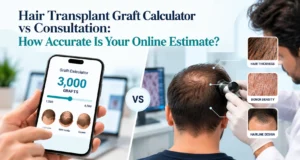
A graft calculator can’t see your scalp. It can’t measure your donor density. It can’t predict how your hair will age.
What it can do is give you a false sense of certainty before you’ve spoken to a doctor.
Real planning requires examination, not estimation.
Online graft calculators seem helpful, but they miss critical variables.
They:
They are useful for curiosity, not planning. Real graft counts require scalp examination and donor analysis.
Yes, in many cases.
After full healing, usually 8–12 months, additional grafts can be placed between existing ones to increase density. This is only possible if the donor area was protected during the first procedure.
Because clinics plan differently.
Some focus on:
Others focus on:
If two clinics give very different graft counts, ask why. The explanation matters more than the number. This is why patients searching for the best hair transplant in Turkey should look beyond graft counts and focus on donor safety, planning logic, and long-term results.
If you want to understand what graft range is medically safe for your donor area, you can request a detailed graft analysis with UniquEra Clinic before making any decisions.
The hair transplant procedure influences how grafts are extracted and placed.
For example:
There is no universal “best hair transplant method.” The best approach depends on how grafts will be used, not just the tool.
Sometimes, yes. Not because the first surgery failed, but because:
A well-planned first procedure keeps options open instead of exhausting resources.
When donor supply is limited, ethical clinics may recommend:
Hair transplant surgery is not always the best hair replacement option for every patient. Honest planning matters more than selling surgery.
Red flags include:
Ethical clinics assess donor capacity first, then plan graft numbers accordingly.
Patients looking for the best hair transplant in Turkey are usually not searching for the highest graft number. They are searching for results that look natural now and still make sense years later. At UniquEra Clinic, graft planning starts with evaluation, not packages.
The medical team assesses:
Grafts are planned to:
No graft number is finalized before examination.
“How many grafts do I need?” is the right question.
But the better question is:
“How many hair grafts can I use safely to look natural now and later?” because How many hair grafts you need is not a number you choose, but one that’s medically planned.
Natural hair restoration is not about chasing numbers. It’s about planning within limits.
Natural hair restoration comes from:
The goal is not maximum grafts. The goal is hair that looks natural today and still makes sense years from now.
If you want a clear, honest graft estimate based on your scalp and donor area, you can request a consultation with UniquEra Clinic and get answers before committing to surgery.
1. How many hair grafts do I need for a hair transplant?
It depends on your hair loss stage, donor density, hair characteristics, and desired coverage. There is no universal number.
2. Is 5,000 grafts too many?
Not always, but only if donor density supports it. High graft counts without donor analysis increase long-term risk.
3. Can two people need different grafts for the same hair loss?
Yes. Hair thickness, curl, color contrast, and donor density can change graft needs by 20–30% or more.
4. How do I know if a clinic is overpromising on graft count?
If a clinic guarantees a specific number before examining your scalp or claims very high graft extraction without donor analysis, that’s a red flag.
5. Are online graft calculators accurate?
No. They ignore donor safety, hair characteristics, and future hair loss.
6. Is more grafts always better?
No. Overharvesting can damage the donor area and limit future options.
7. Can graft count be increased later?
Yes, if the donor area is preserved properly during the first procedure.
8. Is hair transplant the best hair replacement option?
It is the most permanent option when donor hair is available, but not suitable for everyone.
9. Do all clinics calculate grafts the same way?
No. Some focus on numbers. Reputable clinics focus on outcomes and long-term planning.
10. How do I know if a clinic is overpromising on graft count?
If a clinic guarantees a specific graft number before examining your scalp, or if they claim you can safely extract 5,000+ grafts in a single session without showing donor density analysis, those are red flags. Ethical clinics assess donor capacity first, then plan grafts accordingly.