
Walk into any decent hair transplant consultation and someone’s probably going to mention the “Norwood Hamilton Scale.”
Maybe they’ll point to a chart on the wall. Maybe they’ll say something like “you’re at Stage 3” or “we’re looking at Stage 5 progression here.”
If you’re thinking “what the hell is a Norwood Scale and why does it matter?”-you’re not alone. Most people have never heard of it until they start researching hair loss seriously.
But here’s the thing: this classification system isn’t just medical jargon. It directly affects whether you’re actually ready for a hair transplant, how many grafts you’ll need, what results you can realistically expect, and how much the whole thing’s going to cost.
Understanding where you fall on the Norwood Hamilton Scale is basically step one of figuring out your hair restoration plan. Let’s break down what it actually is and why it matters so much.
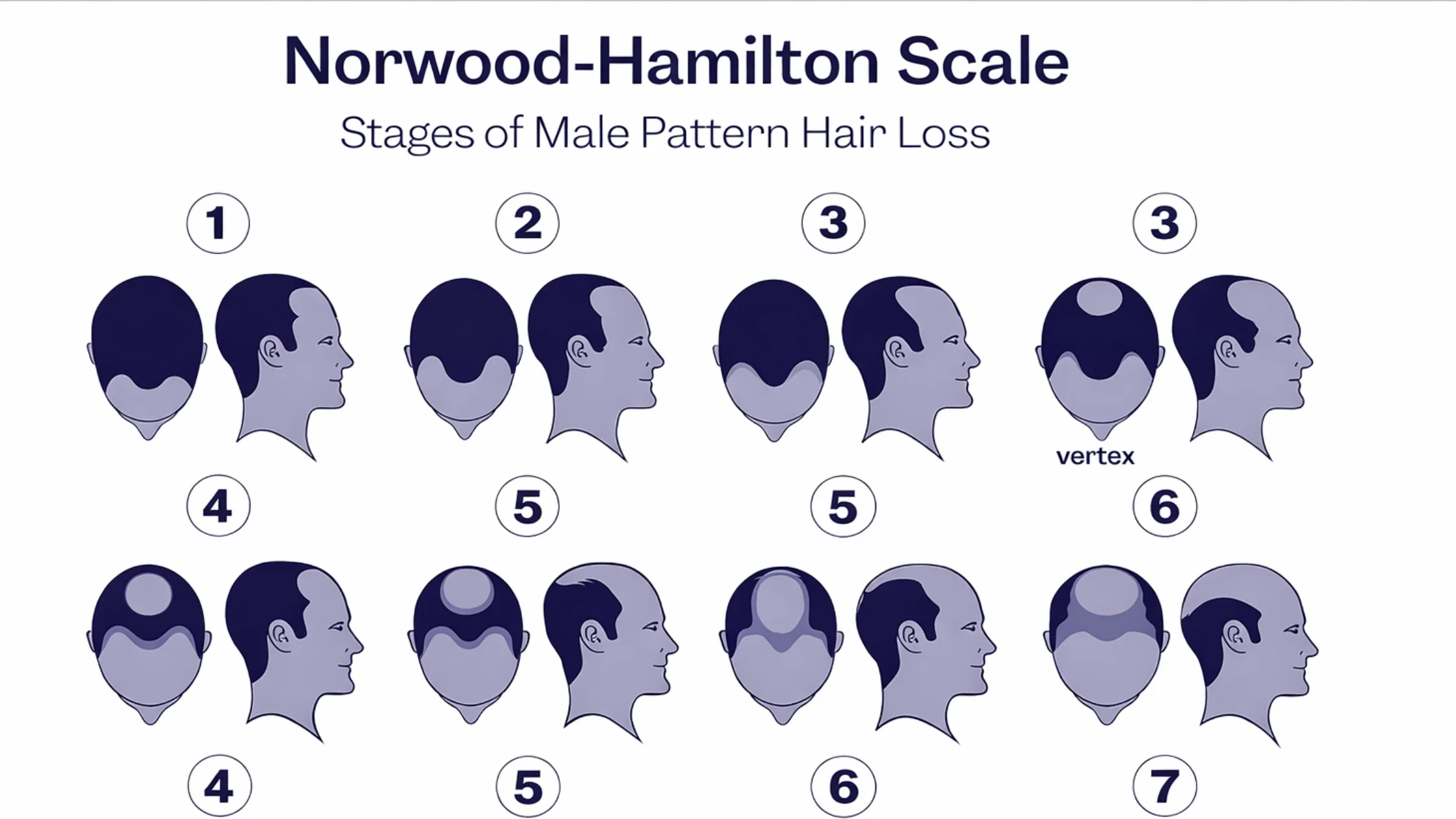
The Norwood Scale-sometimes called the Norwood-Hamilton Scale-is basically a map of male pattern baldness. It shows the seven main stages of how male hair loss typically progresses, from early temple recession all the way through to advanced baldness.
Dr. James Hamilton created the original version back in the 1950s. Then Dr. O’Tar Norwood refined it in the 1970s, which is why his name stuck.
Think of it like a roadmap. If male pattern baldness is a journey nobody wants to take, the Norwood Scale shows the common routes that journey follows.
Here’s what each stage looks like:
Stage 1 – No real hair loss. Full hairline. Some doctors don’t even count this as a stage since nothing’s happening yet.
Stage 2 – Slight temple recession. The hairline’s moved back a bit but not dramatically. Lots of guys notice this in their late twenties or early thirties and start wondering if it’s “just maturing” or the beginning of something bigger.
Stage 3 – Now it’s definitely noticeable. The temples have receded enough to create that M-shape at the front. This is usually when people stop making excuses and start looking into hair treatment for hair loss. There’s also Stage 3 Vertex, where the crown starts thinning while the temples recede.
Stage 4 – The recession at the front has gotten more severe, and if you’ve got crown thinning it’s pretty obvious now. There’s still a band of hair separating the front and back bald areas, but both zones are clearly affected.
Stage 5 – That band of hair between the front and crown is getting thin. The two bald areas are starting to merge. This is where hair loss goes from “noticeable” to “extensive.”
Stage 6 – The bridge is gone. Front and crown baldness have connected. You’ve got a larger bald area on top with hair mainly around the sides and back.
Stage 7 – The most advanced pattern. Basically a band of hair wrapping around the sides and back of your head, with the entire top bald or very sparse.
Understanding where you land on this scale isn’t just interesting-it’s crucial for planning any kind of treatment.
So why do surgeons care so much about classifying your hair loss stage? Turns out, it affects pretty much everything.
Someone at Stage 2 with barely noticeable temple recession doesn’t need the same treatment plan as someone at Stage 5 with extensive loss. Not even close.
Early stages might do fine with medical therapy and maybe a conservative hairline procedure. Advanced stages need serious planning, way more grafts, and honest conversations about what’s actually achievable with your donor supply.
The best clinic for hair transplant in Turkey won’t just count grafts and quote prices. They’ll assess your Norwood stage and build a plan that makes sense for where you’re at.
Your stage directly influences graft numbers. Stage 3 focused on the hairline? Maybe 2,000-2,500 grafts gets you where you want to be.
Stage 5 or 6? You could easily need 4,000-5,000+ grafts. That might mean multiple procedures because there’s only so much donor hair available at once.
Knowing your Norwood classification helps clinics give you realistic numbers instead of low-balling to get you in the door, then upselling once you’re committed.
Here’s what catches people off guard: the Norwood Scale doesn’t just show where you are now. It hints at where you might be headed.
If you’re 25 and already at Stage 4, your hair loss is moving fast. That completely changes the treatment conversation. A good surgeon might recommend stabilizing things with medication before doing surgery. Or they might suggest waiting if your pattern clearly isn’t stable yet.
Getting a transplant when you’re young with aggressive, progressing hair loss can leave you needing multiple follow-up procedures as loss continues around the transplanted areas. Your Norwood stage helps predict this risk.
Someone at Stage 6 or 7 needs to understand they’re not getting back teenage hair density. There’s a finite amount of donor hair. Even with a great procedure, coverage has limits.
The Norwood Scale helps surgeons show you realistic examples from patients at similar stages. You see what’s actually achievable rather than fantasy photoshop results.
This is huge at places like UniquEra Clinic where the focus is on honest assessment rather than making promises they can’t keep.
The hair on the back and sides of your head-your donor area-supplies everything that gets transplanted. As you move up the Norwood Scale needing more coverage, you’re demanding more from that donor supply.
Sometimes patients at advanced stages have to prioritize. Focus on the hairline because that frames your face, maybe skip dense crown coverage because donor supply won’t stretch that far.
Your Norwood stage helps determine if your goals are even realistic with your available donor hair.
The Norwood Scale tracks androgenetic alopecia-male pattern baldness. This is hereditary hair loss driven by genetics and hormones, specifically how your hair follicles react to DHT.
DHT is an androgen hormone that binds to receptors in genetically sensitive follicles. Over time, affected follicles shrink. They produce thinner, shorter hair until eventually they just stop producing visible hair altogether.
That miniaturization process is what creates the patterns you see in the Norwood Scale. It’s why male hair loss follows these predictable patterns rather than just random thinning everywhere.
Other hair loss causes can speed things up or complicate the picture:
A thorough consultation looks at all these factors, not just genetics. But the Norwood Scale specifically maps the androgenetic pattern, which is what most guys dealing with male hair loss are fighting.
At clinics like UniquEra Clinic offering luxury hair transplant in Turkey services, the Norwood Scale isn’t some box they check on a form. It’s fundamental to how they approach your entire treatment.
Here’s typically what happens:
They assess your current Norwood stage during consultation-looking at temple recession, crown thinning, density, how everything relates. Then they dig into your history. When did thinning start? How fast has it moved? What does your family history look like?
This tells them whether your male hair loss is stable or still actively progressing.
Based on your stage and progression pattern, they recommend appropriate hair treatment for hair loss. Maybe that’s:
For transplant candidates, your Norwood classification guides everything. How many grafts. Which areas to prioritize. How to distribute grafts for natural appearance. Whether one session’s enough or you’ll need a staged approach.
Because male hair loss often continues even after a transplant-in the non-transplanted areas-understanding your stage helps plan long-term. You might need ongoing medical treatment to protect native hair. Or a second procedure years later as progression continues.
This is what separates thoughtful, comprehensive care from “let’s just pack in some grafts and see what happens.”
Let’s get practical. If you’re at a specific stage, what does that typically mean?
Stages 1-2 Not really transplant candidates yet. Consider starting preventative medical treatment-finasteride, minoxidil-to slow progression. Monitor how things develop before making surgical decisions.
Stage 3 This is where lots of people get their first transplant. Relatively conservative graft numbers, maybe 1,500-3,000. Focus on hairline and temples. Good results achievable in one session. Medical therapy alongside surgery helps protect what you’ve still got.
Stage 3 Vertex Thinning at both the hairline and crown means you might need to prioritize. Doing both areas well takes more grafts. Sometimes a staged approach makes sense if donor supply’s a concern.
Stages 4-5 Now you’re looking at 3,000-5,000+ grafts, possibly multiple sessions. It is important to set realistic density expectations. Careful donor management becomes crucial. Medical treatment’s essential to protect remaining hair as loss potentially continues.
Stages 6-7 Requires the most grafts, often multiple procedures over time. You’ll likely need to prioritize the most visible areas-frame the face with hairline restoration. Full crown coverage might not be possible with limited donor supply. Results depend heavily on how much donor hair you’ve got to work with.
If you’re at Norwood Stage 6 or 7and questioning whether a transplant is still viable, we’ve broken down in detail whether you can get a hair transplant if you are completely bald and what realistic options are available for patients seeking hair loss treatment.
Understanding your stage means you can have informed conversations with surgeons and make plans grounded in reality.
The Norwood Scale is super useful but it’s not perfect.
It’s male-specific. Women typically lose hair differently-more diffuse thinning across the top rather than receding hairlines. For female hair loss, doctors use the Ludwig Scale instead.
Not everyone fits the standard patterns exactly. Some people have elements of two different stages, or their pattern’s atypical.
And your current stage doesn’t guarantee where you’ll end up. Not everyone progresses to Stage 7. Some stabilize at Stage 3 and stay there for decades. Others move through stages quickly.
Other factors matter too: hair characteristics, skin-hair contrast, donor density, scalp laxity, overall health. A good surgeon uses the Norwood Scale as one tool among many, not the only decision-making factor.
If you’re researching options, Turkey keeps coming up for good reason. Turkish surgeons do thousands of procedures annually, developing serious expertise.
But quality varies. When looking for the best clinic for hair transplant in Turkey, watch for:
UniquEra Clinic, one of the best clinics for hair transplant in turkey, hits these markers, using the Norwood Hamilton Scale as part of thorough evaluation rather than rushing to surgery. That’s the difference between a well-planned procedure with realistic goals and one that leaves you needing corrective work later.
The Norwood Hamilton Scale might seem like just another medical chart. But for anyone dealing with male hair loss, it’s one of the most practical tools available.
It gives you a common language to discuss your situation with doctors. It helps you understand what’s happening and what might come next. It guides decisions-from whether to start medication to how many grafts a transplant might need.
Most importantly, it sets realistic expectations. Understanding your Norwood stage means understanding what’s actually achievable, what trade-offs might be necessary, and what your restoration journey realistically looks like.
If you’re considering a hair transplant, make sure your consultation includes proper Norwood classification. Ask about your stage, what it means for planning, how it affects your specific situation.
That conversation is the foundation for everything else-the difference between a smart plan with realistic goals and one that disappoints or needs extensive correction.
Whether you’re Stage 2 just noticing changes or Stage 5 ready to take action, understanding the Norwood Scale helps you make informed decisions about your hair loss treatment.
1. What is the Norwood Hamilton Scale?
It’s a system that shows the 7 stages of male pattern hair loss, from mild temple recession to advanced baldness. Doctors use it to assess hair loss severity.
2. Why does my Norwood stage matter for a hair transplant?
Your stage affects graft numbers, timing, suitability for surgery, and realistic results. Different stages need very different treatment plans.
3. Can I get a hair transplant at any Norwood stage?
Most stages can be treated, but early stages may not need surgery yet. Stages 3–5 are common transplant stages, while advanced stages need careful planning.
4. How can I tell what Norwood stage I’m in?
A surgeon assesses your hairline, temples, crown thinning, and density during consultation. Online charts help roughly, but medical evaluation is more accurate.
5. Does everyone progress to Stage 7 hair loss?
No. Some men stabilize at Stage 3 or 4 for decades, while others progress faster. Genetics and treatment response both matter.
6. How is the Norwood Scale used at UniquEra Clinic?
The scale is used to assess current loss, predict progression, evaluate donor hair, and plan realistic graft numbers before recommending treatment.
7. Why is Turkey popular for luxury hair transplants?
Turkey combines experienced surgeons, modern clinics, and lower costs than Western countries. Quality depends on clinics that properly assess Norwood stage and plan carefully.